
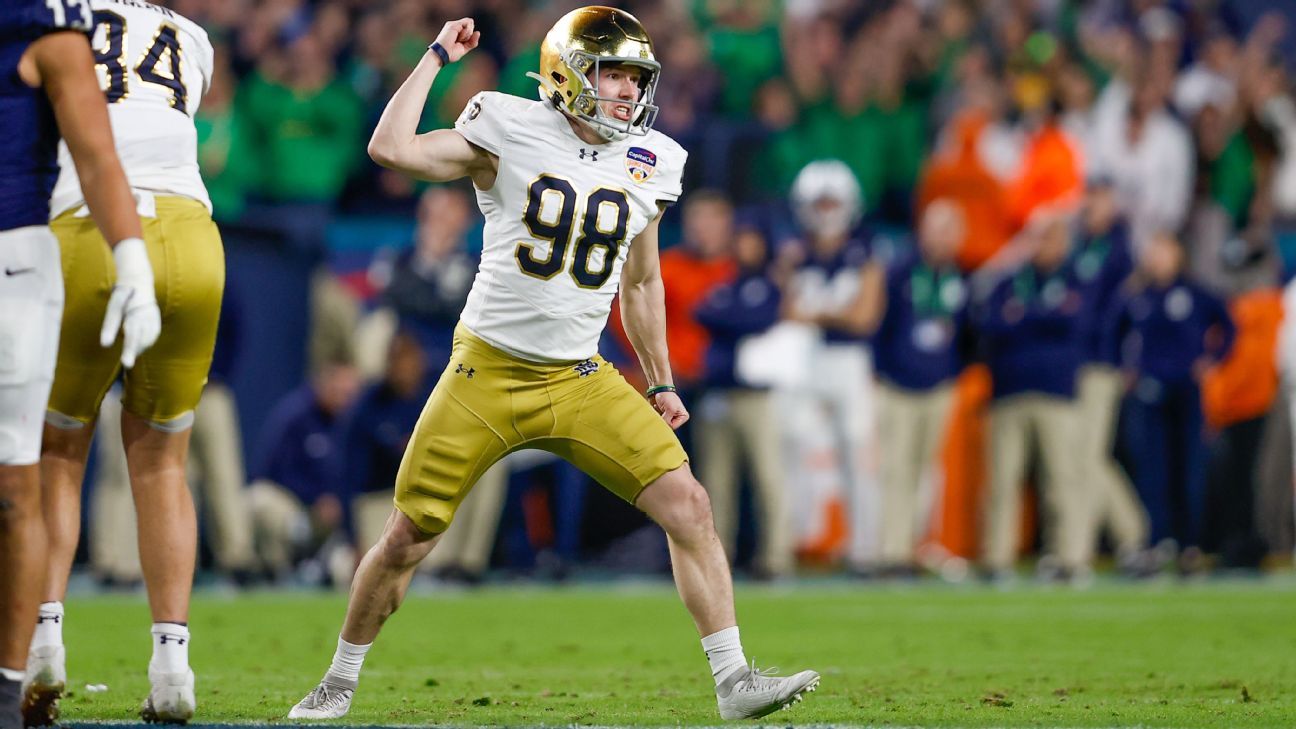
Notre Dame’s ‘Mr. January’ puts Irish in CFP final


-
Andrea Adelson, ESPN Senior Writer
MIAMI GARDENS, Fla. — There were moments this season when Mitch Jeter simply could not make a kick, as injuries to his hip and groin ruined his form and threatened to sink his confidence.
But over the past month, as he got healthy, he turned into “Mr. January.” As a result, Notre Dame is headed to its first national championship game since 2013, with an opportunity to win its first title since 1988.
The Irish say they have built their season on resilience — and it is possible nobody on the team embodies that more than Jeter. As he lined up for a 41-yard field goal attempt with the score tied at 24 and 12 seconds left on the clock against Penn State on Thursday night, all he could think was: “Let’s go make it.”
Jeter pushed the football through the uprights to give Notre Dame a 27-24 win in the College Football Playoff semifinal at the Capital One Orange Bowl. In doing so, he became the first kicker to make a go-ahead field goal in the fourth quarter of a playoff game.
“Coach [Marcus] Freeman talks a lot about delayed gratification,” Jeter said. “He’s been talking like that all the way back to Week 2, when the [loss to Northern Illinois] happened. So it’s kind of been my mindset, going through an injury, having delayed gratification now to be able to come out and give our team a chance to go win a national championship.”
In addition, Freeman is the first Black head coach to have a chance to win a college football national championship.
Jeter was not the only player who stepped up big Thursday night. Many of those clutch performances came from unexpected players. Cornerback Christian Gray came up with a huge play to set up the game-winning field goal, when he intercepted Penn State quarterback Drew Allar with 30 seconds left.
Defensive coordinator Al Golden called the play by the sophomore “amazing” because he recognized what Allar was doing and beat his receiver to the ball.
“Christian got a great break on it,” Golden said. “And generally speaking, that kid works really hard on his hands, so if he has an opportunity to catch it, he usually does.”
Added Freeman: “In that moment, Christian had to make a play and he did and was a huge reason why we won that game.”
A game that was an offensive slog for the first three quarters turned into a back-and-forth contest in the fourth, as the teams combined to score four touchdowns in less than 10 minutes.
Notre Dame running back Jeremiyah Love, playing with a knee brace and at less than 100%, got the scoring going in the final quarter with a remarkable second effort from the 2-yard line, when he jumped through one tackle, stayed on his feet and dragged a defender with him into the end zone as his legs refused to stop moving to give the Irish a 17-10 lead.
Love usually celebrates his touchdowns by making a heart shape with his hands. But he forgot in the heat of the moment.
“I don’t know what I was on that play, but I felt like some extra strength,” Love said. “I just wanted to scream and rage. I just felt like the Hulk or something. I wasn’t even thinking about throwing up the heart. It was just expressing the dominance I just asserted over them.”
Penn State answered with two touchdown drives to take a 24-17 lead with 7:55 remaining. That is when Irish sophomore wide receiver Jaden Greathouse took his turn in the spotlight. On second-and-8 from the Notre Dame 46-yard line with 4:38 to go, Riley Leonard stepped back to throw. Greathouse made a move on Cam Miller, who fell down — leaving Greathouse wide open in the middle of the field.
Leonard lofted the ball, and Greathouse caught it. He had a safety to beat, and one juke move later, Greathouse was in the end zone for a 54-yard touchdown pass to tie the score at 24.
“While I was out there, I really got a flashback to my 7-on-7 days in high school, and it was a similar play,” Greathouse said. “And I was like, ‘I just need to cut inside and I’ll be in the end zone celebrating.'”
Greathouse finished with seven catches for 105 yards and a score — the first 100-yard game of his career. He missed two days of practice earlier in the week because he was sick but said he woke up Thursday and believed, “Tonight is going to be my first 100-yard game.”
That brought things back to Jeter and his opportunity to break a tie at 24. His injury saga goes back to Week 4, when he took a hit to a hip on an errant field goal snap against Miami (Ohio). He played through it, but a few weeks later against Stanford, he injured his groin. As time went on, his bones were not in perfect alignment — and that affected his form.
Jeter missed four of his five field goal attempts in the final four games of the regular season. His father, Andrew, works as a chiropractor and offered to help get his body back into alignment. He would come to South Bend on Thursdays and then stay for several days to help Jeter get his body aligned so everything could heal properly.
“Bones were in places that they shouldn’t have been,” Jeter said. “That was my femur, my back, my hips. He was able to move those bones back into position where they’re supposed to be, which allowed the healing process to almost accelerate.”
Once the playoffs started, Jeter felt 100%. It has shown in his performance, as Jeter has gone 7-of-8 in three playoff games — including several clutch kicks in the quarterfinal win against Georgia too.
Quarterback Steve Angeli — another player who stepped up big, leading a field goal drive late in the first half with Leonard out of the game — said the team has nicknamed Jeter “Mr. January.”
“He is a confident guy, man,” Freeman said. “There is no moment too big for Mitch Jeter. I had a lot of confidence in him in that moment that he was going to do exactly what he did, and he did a great job at doing that.”


COLORADO SPRINGS, Colo. — NHL deputy commissioner Bill Daly said that if the league’s players feel the quality of the ice at the Olympics in Milan is unsafe, “then we’re not going to play.”
“It’s as simple as that,” Daly told reporters after the NHL board of governors meetings on Monday.
Daly told league owners Monday that he didn’t believe construction issues with the Olympic ice hockey rink were “insurmountable.”
The main hockey arena in Milan is scheduled to be finished Feb. 2. The women’s hockey tournament begins three days later, and the men’s tournament, with NHL players set to participate in the Olympics for the first time in over a decade, begins Feb. 11, leaving very little wiggle room.
The Olympic arenas will feature three games a day for nearly three weeks, which will challenge the resiliency of the ice. Daly categorized the updates the NHL and NHLPA received last week as positive, but said the league was upping its efforts to help see through the arena.
“We have offered and they’re utilizing our ice experts and technicians and outside providers,” Daly said. “We’re basically moving everybody there to try to help get this done in a way that’s acceptable for NHL athletes. And I’m cautiously optimistic it will be fruitful.”
The NHL will have ongoing access to the ice. That will include being on site for a test event scheduled for the main rink from Jan. 9-11.
On Monday, the IIHF acknowledged the two rinks in Milan would be about 3 feet shorter than a standard NHL rink (196.85 feet by 85.3 feet, instead of 200 feet by 85 feet) — which goes against the agreement the NHL and NHLPA signed with the IIHF in July.
Daly said the league found out about the skewed dimensions last week, and he was not sure how it happened. Some federations were made aware earlier, but Daly said nobody raised the issue to him and the league did not notice the difference in several site visits because it wasn’t anything “perceptible to anybody. It’s not like people bring tape measures there.”
But the NHL and NHLPA are willing to look past that for now — though they will insist the rink for the 2030 Olympics in France is built to NHL standards.
“The players association has canvassed the players and apparently they did not believe it to be a big issue, health and safety issue or a competitive issue,” Daly said.
The Pittsburgh Penguins and Nashville Predators played games on a similar-sized rink last month at the Global Series in Sweden; the solution was to move the lines so the missing ice was accounted for in the neutral zone rather than either offensive zone. Daly said they did not receive any feedback from players after those games.
Organizers have insisted there is no Plan B for the Olympic hockey tournament to be held elsewhere if the rink is not ready. Daly said the NHL also doesn’t have a contingency plan yet if it decides the ice is not suitable.
“I mean, it kind of is what it is,” Daly said. “Having said that, if you’re faced with that being the reality, then you have to think about what you do next. “
The NHL will go dark for a two-week period during the Games. Asked if it was possible to reconfigure the schedule if necessary, Daly said he wasn’t sure yet.
“Well, I can’t tell you exactly what we do,” he said. “What I’d say is, I think in emergency-type situations like that in the past, I think we’ve responded appropriately, came up with good solutions and I have no doubt that we’ll be able to come up with good solutions if we’re faced with that.”

-
Kristen Shilton
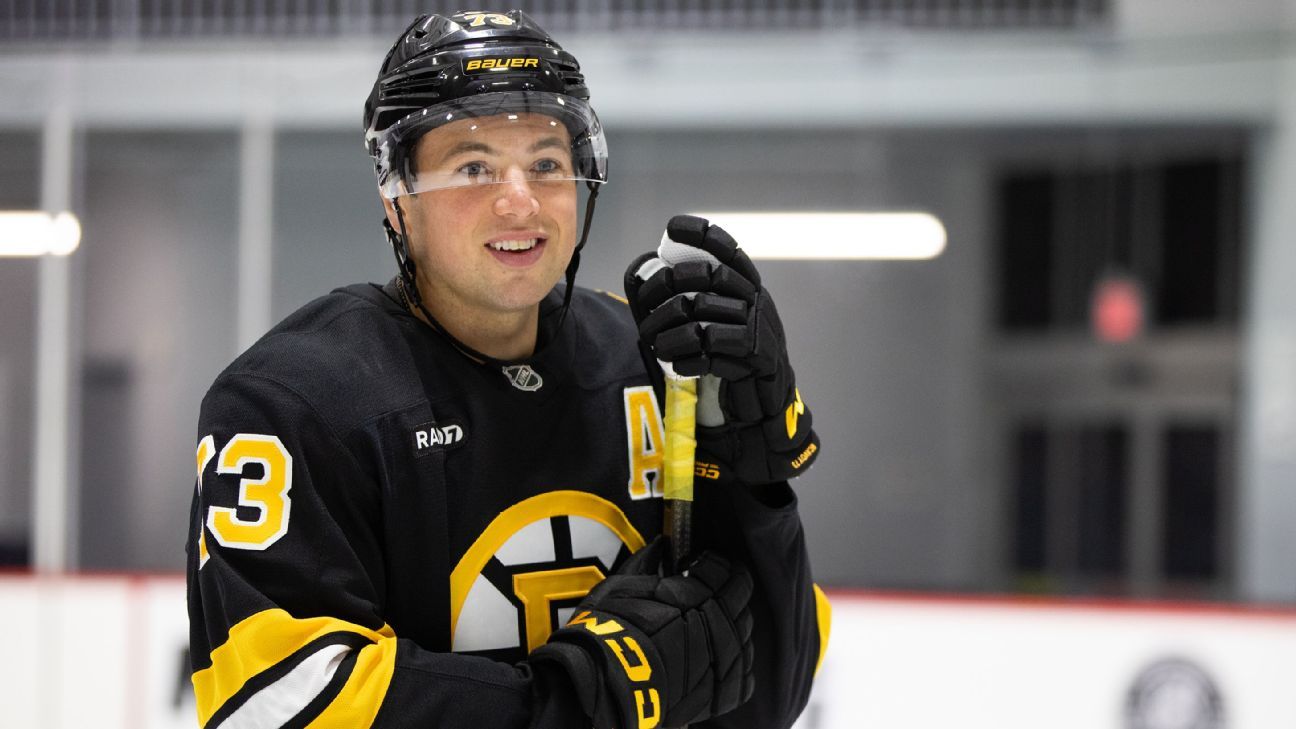
Charlie McAvoy is on the road to recovery and close to rejoining the Boston Bruins’ lineup.
Boston’s top defenseman has been sidelined since taking a slap shot to the face from Montreal Canadiens defenseman Noah Dobson on Nov. 15. McAvoy suffered what he recently described as a “linear fracture” to the left side of his face that included, he said, “some displacement, and I lost a lot of teeth on the bottom.”
The blueliner was instructed not to eat solid foods until at least six weeks after suffering the injury. He lost 20 pounds in the first week and a half afterward while relegated to a liquid diet. McAvoy said on Monday that he’s mending nicely now though and, after shedding his noncontact jersey at practice, was looking forward to getting back to work with the Bruins.
“Every day I feel better,” he said. “We’re getting it back. We’re getting the chance to do more, skate more, skate longer, and work out off the ice. All those things. We’re making strides, and I’m healing on the fly.”
McAvoy will be on Boston’s upcoming three-game road trip starting on Tuesday in St. Louis, although it’s still unclear when he’ll get the green light to suit up.
“We’ll see,” said McAvoy when asked if he would be ready to face the Blues. “Going on the trip with the expectation and hoping that some point along the way on the trip I’ll be able to get back in.”
It’s not the first time McAvoy has missed time with a significant injury — he just had shoulder surgery in February after getting hurt while representing Team USA at the 4 Nations Face-Off — but this particular ailment was something entirely new.
“It’s been one of the weirdest injuries I’ve ever had,” he said last week. “The feeling of having so much trauma in your mouth. It’s a wild feeling. But we’re doing everything we can to get back fast.”
McAvoy has been forced to consume only what could be made in a blender. He tried some creative options at first — including pulverized chicken and vegetables — but called that a “nonstarter” and carried on with classic soft foods.
“Soups have been my go-to,” said McAvoy, who has gained back about half of the weight he lost. “Early on a lot of milkshakes and ice cream.”
Considering the force of Dobson’s shot — which knocked McAvoy directly onto his back — the Bruins’ blueliner admitted he “knew right away I was in trouble” and is grateful to finally have enough energy to anchor Boston’s backend again.
McAvoy has 14 points in 19 games this season, while pacing the club in ice time with 23:46 per game. The Bruins are 4-5-0 since McAvoy went down and are currently second in the Atlantic Division.
McAvoy isn’t the only injured party Boston hopes to get back soon. David Pastrnak — the Bruins’ leading scorer — has been out since Nov. 26, but he will be on Boston’s road trip as well with sights set on a return.
-
 Sports2 years ago
Story injured on diving stop, exits Red Sox game
-
 Sports3 years ago
‘Storybook stuff’: Inside the night Bryce Harper sent the Phillies to the World Series
-
 Sports2 years ago
Game 1 of WS least-watched in recorded history
-
 Sports3 years ago
Button battles heat exhaustion in NASCAR debut
-
 Sports3 years ago
MLB Rank 2023: Ranking baseball’s top 100 players
-
Sports4 years ago
Team Europe easily wins 4th straight Laver Cup
-
 Environment3 years ago
Japan and South Korea have a lot at stake in a free and open South China Sea
-
 Environment1 year ago
Here are the best electric bikes you can buy at every price level in October 2024