
Passan: 18 innings, 11 runs, a walk-off homer — and an epic Game 3

LOS ANGELES — The game that had everything ended at 11:50 p.m. PT on Monday. For the previous 6 hours, 39 minutes, Game 3 of the World Series played out like a fantastical dreamscape of baseball, filled with tension and drama and madness. It was a game unlikely any before, never to be repeated again, and when the 18th inning ended and the Los Angeles Dodgers had beaten the Toronto Blue Jays 6-5, it was, in a way, a relief, because holding your breath for hours on end is not a sustainable way to live.
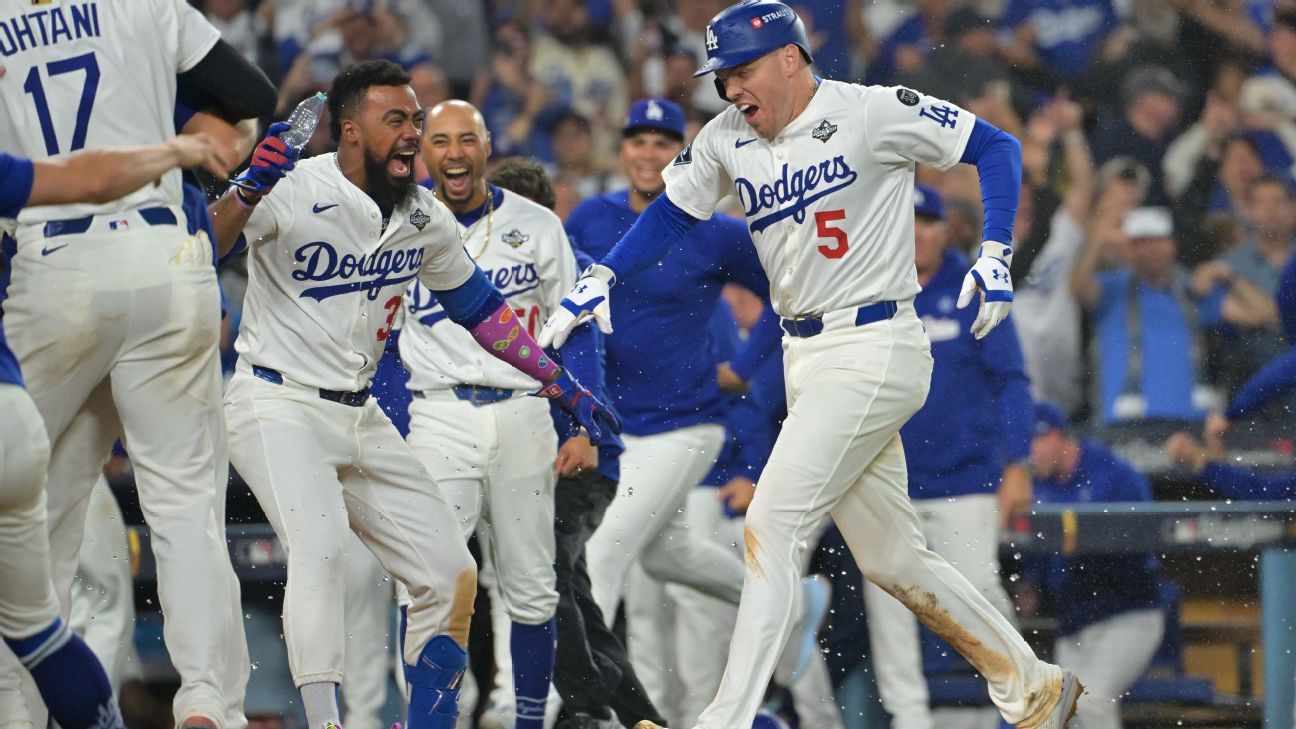
Such is the price we pay for an affair like Game 3. The Dodgers and Blue Jays competed at an exceptional level in the longest game in World Series history by innings and second-longest by time. They punched and counterpunched, emptied their benches and bullpens. They executed with wizardry and found pieces of themselves they didn’t know existed. And in the 18th inning, it was Freddie Freeman, already the hero of last year’s World Series, who deposited a center-cut sinker from Brendon Little over the center-field fence 406 feet away.
There have been 703 games played in the 121-year history of the World Series. While there are certainly competitors, this one launched itself into the upper echelon, undoubtedly elite, and left the 52,654 fans at Dodger Stadium as giddy as they were almost seven years to the day earlier, when the only other 18-inning game in World Series history ended the same way: with a Dodgers walk-off homer.
Game 3 of the World Series featured…
609 pitches (LAD: 312, TOR: 297)
37 runners left on base
25 position players used
19 pitchers used pic.twitter.com/MBHReOJ16x— ESPN Insights (@ESPNInsights) October 28, 2025
The heroes were plentiful, and in the aftermath of the lunacy, one of them stood in the Dodgers’ clubhouse, still trying to process what happened. Will Klein, the last man out of the Dodgers’ bullpen, a reliever who had topped out this year at two innings and 30 pitches, threw four innings of one-hit ball and struck out five on 72 pitches. The last of them, an 86 mph curveball, induced a swing and miss from Tyler Heineman and a scream from Klein, who understood what had been asked of him and knew he’d delivered.
Games don’t become classics without efforts like Klein’s — and he had an admirer who wanted to acknowledge that. Into the Dodgers’ clubhouse strode Sandy Koufax, his eminence of Dodgers pitching, who, at 89 years old, looked no worse for the wear at 12:48 a.m. Koufax walked up to Klein, stuck out his hand, looked him in the eyes and said: “Nice going.”
This was that kind of game, the one that forges bonds between a Hall of Famer and a man with 22.2 career major league innings who didn’t make the Dodgers’ roster in any of the previous three rounds of the postseason. The kind of game that prompted Klein to unlock his phone just to see how many messages he had, only for him to scroll … and keep scrolling … and keep scrolling to the point he just stopped. The kind of game that made Klein marvel to a friend in the clubhouse: “Seventy-two. Can you believe it?”
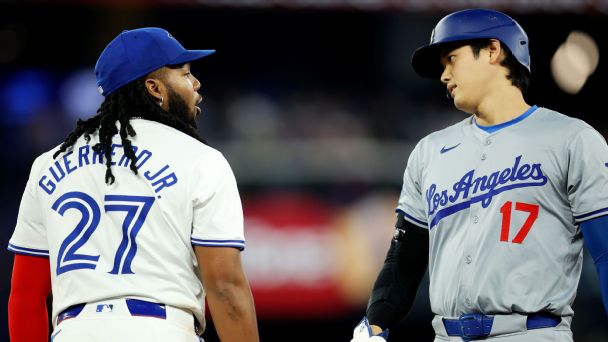
Game 3 was anarchy, a funhouse mirror of a ballgame, everything out of order. Shohei Ohtani‘s magnificence is never in question, but to see a baseball player reach nine times, something that had been done only twice in big league history — never in the postseason and not since 1942 — still registered as incredible, his magnitude lording over the game from beginning to end. He led off the game for the Dodgers with a double. He homered his next time up. He doubled again. He homered once more, his second of the game, his eighth of the postseason, to tie the game at 5 and unleash the chaos to come.
At that point, Blue Jays manager John Schneider had seen enough. In the ninth inning, Ohtani became the first hitter intentionally walked with the bases empty in the ninth inning or later of a postseason game. The next three times he came to the plate — twice with the bases empty — Schneider held up four fingers and gladly gave Ohtani a free pass. In the 17th, with a runner on first, the Blue Jays opted to pitch to him — and Brendon Little promptly deposited four balls nowhere near the strike zone. (Schneider said after the game to expect more tiptoeing around Ohtani in the days to come.)
Schneider’s decision-making earlier in the game, in which he tried to scratch across runs by substituting in a cadre of pinch runners, left the Blue Jays’ lineup compromised for most of the second half of the game. Against a Dodgers bullpen that had been a sieve for most of the postseason, Toronto managed just one run in 13⅓ innings. Los Angeles used 10 pitchers — including Clayton Kershaw, the future Hall of Famer. Kershaw came on in the 13th with the bases loaded, ground through a nine-pitch at-bat against Nathan Lukes and induced a dribbler to second base that Tommy Edman scooped with his glove to Freeman.
Memorable moments abounded over the game that featured 615 pitches, the most in a postseason game since MLB began tracking pitches in 1988. In the 14th, Will Smith lofted a fly ball to center field and dropped his bat, thinking it was a game winner. The ball died on the warning track. Teoscar Hernández, who, like Ohtani, had four hits, did the same in the 16th. It wound up in a glove, too.
By that point, Klein had arrived and set about pulling a modern-day Nathan Eovaldi, who went 97 pitches over the final six innings of the 2018 marathon. In Klein’s final inning, Yoshinobu Yamamoto — who had thrown a 105-pitch complete game two days prior — was warming up in the bullpen. Klein walked two batters. Dodgers manager Dave Roberts could have easily gone to Yamamoto. He stuck with Klein.
Klein just did it, because he had to, and that, as much as anything, is the lesson of an evening like Game 3, when a great game — which this was for the first dozen or so innings — evolves into something different altogether. Game 3 was a test. Of endurance and will — or, as it were, Will.
“You just got to either do it or you don’t,” said Dodgers reliever Justin Wrobleski, who spent time with Klein at AAA this season. “You go out there and you’re like, ‘I know what has to be done here and let’s see what I got.’ I like moments like that because it’s a test of your character. More than that, it’s a test of everything else.”
Klein passed. And Freeman, of course, is the valedictorian of such moments, one of the clutch kings of his generation. He had struggled much of the postseason, entering the game with only one RBI in the Dodgers’ previous dozen playoff games. His first two in this World Series had looked a far cry from his performance last year, when, nursing a number of injuries, he hit a walk-off grand slam in Game 1 and won series MVP. It wasn’t just the lack of production. He wasn’t hitting the ball particularly hard, either.
On the final pitch, he finally did. This is the kind of thing that happens in 18-inning games. They are uncomfortable and scary and can end with the crack of a bat. It is terrifying. It is beautiful. It is everything.
Those lucky enough to bear witness will never forget it, either. They squirmed and flinched and closed their eyes and prayed and squealed and cringed and, in the end, saw 31 hits and 37 runners left on base and 19 pitchers and one particularly majestic swing that, 10 minutes shy of Monday turning into Tuesday, ended one of the best World Series games ever — and gave the Dodgers a 2-1 advantage in this year’s series.
Klein isn’t sure how his arm will feel by the time he returns to the ballpark Tuesday for Game 4. Typically, he said, he’s a Day 2 guy, the soreness not coming until the second day after an outing. After being lavished with praise from his teammates and thanked by Sandy Koufax and written into the annals of Dodgers history, though, tomorrow and the next day wasn’t of much concern.
“I feel great right now,” he said, and with good reason. He was the winning pitcher, the stopper, the MVP of the night every bit as much as Freeman and Ohtani, and the adrenaline rush numbed whatever pain will eventually arrive. That’s for another day. This was everything — and more.

Just when you thought the 12-team College Football Playoff was the solution … it might be messier than ever.
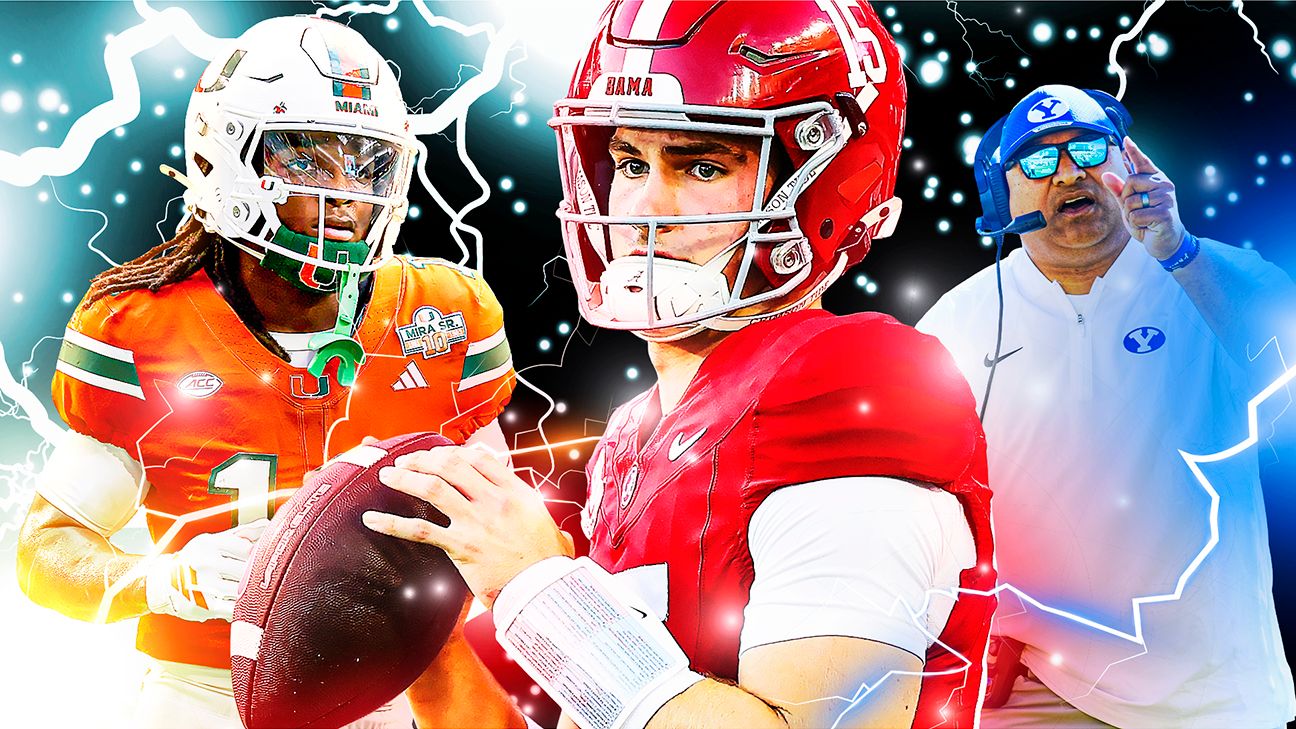
Five-loss Duke can win the ACC. Three of the four power conferences will have championship games that feature rematches (and Alabama might have to beat Georgia a second time to stay in the field). If both BYU and Texas Tech are in from the Big 12, someone currently in the top 10 is out.
There also are still plenty of questions: Will the committee do anything with Ole Miss after Lane Kiffin’s departure? Does Miami gain ground on Notre Dame? Which are the true bubble teams?
How the committee votes in Tuesday night’s fifth ranking (7 p.m. ET, ESPN) will be a strong indicator of how the 12-team field will look on Selection Day, but it’s not the final answer.
Bubble Watch accounts for what we have learned from the committee so far — and historical knowledge of what it means for teams clinging to hope. Teams with Would be in status below are looking good ahead of the committee’s fifth ranking. For each Power 4 conference, we’ve also listed Still in the mix. Teams that are Out will have to wait until next year.
The conferences below are listed in order of the number of bids they would receive, ranked from the most to least, based on this week’s top 12 projection. Check back following the selection show for an updated version that will reflect the committee’s penultimate ranking.
Jump to a conference:
ACC | Big 12 | Big Ten
SEC | Independent | Group of 5
Bracket
SEC


Would be in: Alabama, Georgia, Oklahoma, Ole Miss, Texas A&M. Right now, the Crimson Tide are the last at-large team in the field. Alabama will face Georgia in the SEC championship game, but the committee could have a difficult decision if Alabama loses and finishes as a three-loss runner-up. The Tide would have defeated Georgia during the regular season but lost to the Bulldogs in the championship game — and they’re already in a precarious position. How far Alabama drops could determine if the SEC gets four or five teams in the field. Alabama could finish as the committee’s highest-ranked three-loss team and still be excluded from the playoff to make room for a conference champion — as they were last year.
A Georgia win should lock up a first-round bye and a top-four finish for the Bulldogs, while a loss should still put them in position to host a first-round game. Georgia beat Ole Miss, so it would be surprising to see them drop below the Rebels with a loss, even though the Bulldogs would have one more defeat. With a 35-10 drubbing of Texas also on its résumé, Georgia would still have a strong enough résumé to finish as the committee’s top two-loss team.
It will be interesting to see if Lane Kiffin’s departure affects the ranking of Ole Miss. CFP protocol states the committee will consider “other relevant factors such as unavailability of key players and coaches that may have affected a team’s performance during the season or likely will affect its postseason performance.” Ole Miss won’t miss the playoff because Kiffin left for another job, but it could get dinged a spot or two if the committee surmises the team won’t be the same without him.

Still in the mix: Texas. The Longhorns will earn a promotion Tuesday night, but the win against Texas A&M is unlikely to catapult them into the playoff. Texas probably will be stuck behind Miami in part because of its loss to Florida, which Miami beat. Even if Texas Tech knocks BYU out of the top 12 with a win in the Big 12 championship game, bumping up both Miami and Texas, the Longhorns would still be excluded from the field to make room for a conference champion. If BYU and Alabama were knocked out with title game losses, that still probably wouldn’t be enough for Texas to get into the field, because even if Texas reaches No. 11 by default, it would still be excluded during the seeding process for a conference champion.
Out: Arkansas, Auburn, Florida, Kentucky, LSU, Mississippi State, Missouri, South Carolina, Tennessee, Vanderbilt
Big Ten


Would be in: Indiana, Ohio State, Oregon. Both Indiana and Ohio State are CFP locks — even if they lose in the conference title game — and the runner-up will still have a strong case for a top-four finish and a first-round bye. The loser’s only loss will be to a top-two team, but it could fall behind Georgia in the top four if the Bulldogs win the SEC, and/or Texas Tech if it wins the Big 12.
The Ducks punctuated their résumé with a respectable win at Washington and should be secure in their playoff position, probably hosting a first-round game. Oregon could get a small boost this week if Texas A&M drops behind it after losing to Texas.
Still in the mix: None.
Out: Illinois, Iowa, Maryland, Michigan, Michigan State, Minnesota, Nebraska, Northwestern, Penn State, Purdue, Rutgers, UCLA, USC, Washington, Wisconsin
Big 12

Would be in: Texas Tech. The Red Raiders will play BYU in the Big 12 title game and have a great case to be in the playoff regardless of the outcome. It’s highly unlikely the selection committee would drop the Red Raiders out of the field as a two-loss Big 12 runner-up — especially considering they would have a regular-season win against the eventual conference champion. It’s also possible Texas Tech earns a first-round bye as a top-four seed if the Red Raiders win the Big 12. The committee could move them into the top four on Tuesday night if Texas A&M falls out after its loss to Texas.

Still in the mix: BYU. If BYU doesn’t win the Big 12, it’s unlikely to earn an at-large bid as the conference runner-up because the Cougars are already on the bubble and would be eliminated during the seeding process if the playoff were today. It’s not impossible, though. If Alabama finishes as a three-loss SEC runner-up, it could at least open the door for debate. It could be as simple as No. 10 Alabama and No. 11 BYU flipping positions on Selection Day. The difference would be that BYU lost to Texas Tech twice, and Alabama would have defeated Georgia, the eventual SEC champ once — and it was on the road. If BYU wins the Big 12, it’s the ideal scenario for the conference because it would have two teams in the playoff.
Out: Arizona, Arizona State, Baylor, Cincinnati, Colorado, Houston, Iowa State, Kansas, Kansas State, Oklahoma State, TCU, UCF, Utah, West Virginia
ACC


Would be in: TBD. The ACC championship game will feature Virginia and Duke, and if five-loss Duke wins, it’s possible the ACC is excluded from the playoff. If Virginia wins, it will represent the league in the playoff, as the two-loss Cavaliers are ranked in the top 20. And no, Miami did not play Duke or Virginia during the regular season. Duke lost to Tulane, which is the top Group of 5 playoff contender and will reach the playoff if it wins the American. Duke also lost to UConn. And it has already lost to Virginia 34-17 on Nov. 15.

Still in the mix: Miami. The Hurricanes will still be the committee’s highest-ranked ACC team on Tuesday night, but they would be excluded if the playoff were today to make room for a conference champion. That means the ACC winner could knock the league’s best team out of the playoff. The committee isn’t ignoring the Miami’s head-to-head win against Notre Dame, but it also isn’t comparing the Canes only to the Irish. Miami also needs to earn an edge against Alabama and BYU — two teams the committee has deemed better than Miami to this point. If both of those teams lose their respective conference championship games, it would open the door for Miami to possibly enter the 12-team field with Notre Dame.
Out: Boston College, Cal, Clemson, Florida State, Georgia Tech, Louisville, North Carolina, NC State, Pitt, SMU, Stanford, Syracuse, Virginia Tech, Wake Forest
Independent

Would be in: Notre Dame. The Irish have done everything right since their 0-2 start, running the table and doing it with consistent dominance regardless of opponent. At No. 9, the Irish are safely in the field — if they can stay there through conference championship chaos. The concern would be if Alabama won the SEC and jumped Notre Dame, pushing the Irish to No. 10 — and if BYU and Texas Tech both made the playoff. If BYU wins the Big 12, both teams are highly likely to make the playoff, which means someone currently in the top 10 would have to be excluded. The Irish will watch and wait and need to hope those two results don’t unfold.
Group of 5

Would be in: Tulane. If the Green Wave win the American, it will represent the Group of 5 in the playoff. Tulane is currently the only Group of 5 team ranked by the committee, but if North Texas wins, it would be the most likely team to reach the CFP, given the overall strength of the conference this season.


Still in the mix: James Madison, North Texas. JMU has clinched the East Division and a spot in the Sun Belt Conference championship game. North Texas will face Tulane in the American, and if it wins, it’s more likely to represent the Group of 5 in the playoff than JMU because of its schedule strength. JMU could still be considered, though, if Duke wins the ACC, giving the Group of 5 two playoff teams in the 12-team field.
Bracket
Based on this week’s projection, the seeding would be:
First-round byes
No. 1 Ohio State (Big Ten champ)
No. 2 Indiana
No. 3 Georgia (SEC champ)
No. 4 Texas Tech (Big 12 champ)
First-round games
On campus, Dec. 19 and 20
No. 12 Tulane (American champ) at No. 5 Oregon
No. 11 Virginia (ACC champ) at No. 6 Texas A&M
No. 10 Alabama at No. 7 Ole Miss
No. 9 Notre Dame at No. 8 Oklahoma
Quarterfinal games
At the Goodyear Cotton Bowl, Capital One Orange Bowl, Rose Bowl Presented by Prudential and Allstate Sugar Bowl on Dec. 31 and Jan. 1.
No. 12 Tulane/No. 5 Oregon winner vs. No. 4 Texas Tech
No. 11 Virginia/No. 6 Texas A&M winner vs. No. 3 Georgia
No. 10 Alabama/No. 7 Ole Miss winner vs. No. 2 Indiana
No. 9 Notre Dame/No. 8 Oklahoma winner vs. No. 1 Ohio State
-
 Sports2 years ago
Story injured on diving stop, exits Red Sox game
-
 Sports3 years ago
‘Storybook stuff’: Inside the night Bryce Harper sent the Phillies to the World Series
-
 Sports2 years ago
Game 1 of WS least-watched in recorded history
-
 Sports3 years ago
Button battles heat exhaustion in NASCAR debut
-
 Sports3 years ago
MLB Rank 2023: Ranking baseball’s top 100 players
-
Sports4 years ago
Team Europe easily wins 4th straight Laver Cup
-
 Environment3 years ago
Japan and South Korea have a lot at stake in a free and open South China Sea
-
 Environment1 year ago
Here are the best electric bikes you can buy at every price level in October 2024