
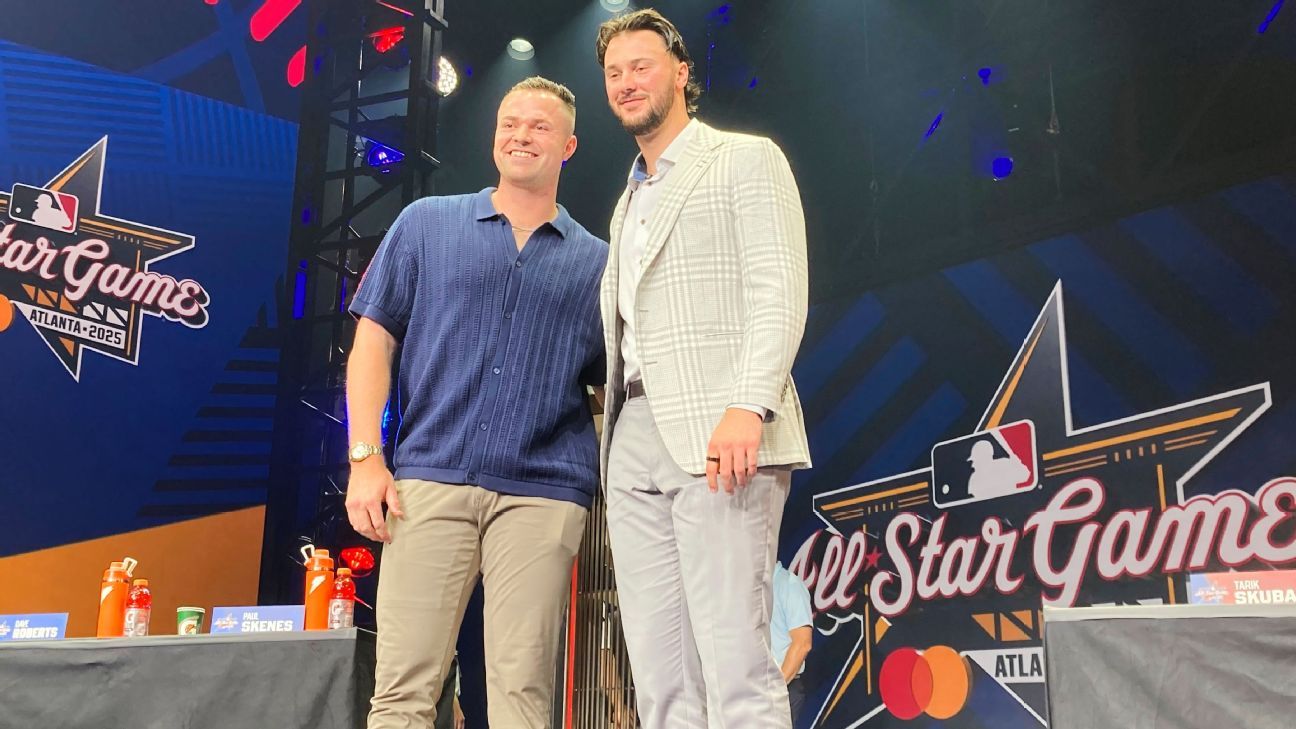
MLB Awards Week predictions, results: Will All-Star Game starters Skubal and Skenes win Cy Young Awards?


-
Bradford Doolittle
The hot stove season is already burning, but even amid the roster shuffling for the 2026 season, we have one last bit of 2025 business: handing out the major awards.
The most prestigious are the four major honors determined by BBWAA voting. These awards will have a lasting impact on baseball history books and Hall of Fame résumés.
On Monday, Athletics first baseman Nick Kurtz was unanimously selected as the American League Rookie of the Year, and Atlanta Braves rookie catcher Drake Baldwin earned the National League honor.
Milwaukee Brewers manager Pat Murphy and Cleveland Guardians manager Stephen Vogt each won their second consecutive Manager of the Year award on Tuesday.
Here is the remaining schedule (awards are announced starting at 7 ET each night on MLB Network):
Wednesday: Cy Young Awards
Thursday: MVP Awards
MLB will also hold its annual awards show in Las Vegas on Thursday, during which it will recognize its All-MLB squads, the Hank Aaron Awards for each league’s best offensive performer, the Comeback Player of the Year Awards, the Mariano Rivera/Trevor Hoffman Awards for the top relievers, and the Edgar Martinez Awards for best designated hitters. The Executive of the Year Award will also be announced.
I’ll be reacting to each night’s awards announcement throughout the week, but in the meantime, here are some opening comments and some brief reaction to the honors that have been awarded.
Below, we list the three finalists in each of the remaining categories, with what you need to know before the results are announced and my picks to take home the hardware. We’ll update each section with news and analysis as the winners are revealed.
Jump to:
MVP: AL | NL
Cy Young: AL | NL
Rookie of the Year: AL | NL
Manager of the Year: AL | NL

American League Cy Young
Finalists:
Hunter Brown, Houston Astros
Garrett Crochet, Boston Red Sox
Tarik Skubal, Detroit Tigers
My pick: Skubal
Skubal is well positioned to become the AL’s first repeat Cy Young winner since Pedro Martinez in 2000. He might just be getting started. The dominant lefty didn’t repeat as a pitching Triple Crown winner, but he posted a lower ERA (2.21 to 2.39) and struck out more batters (241 to 228) than he did while winning the Cy Young Award in 2024. For the second straight year, he led the AL in pitching bWAR, FIP and ERA+.
That’s a tough résumé for Crochet to top, but he came pretty close, leading the AL in innings (205⅓) and strikeouts (255) and beating Skubal in wins (18 to 13). Skubal was a little more consistent in terms of average game score (64.2 to 62.6). Skubal really didn’t rout Crochet in any key area, but he beat him just the same in most columns.
Brown is a worthy No. 3, but for him, it’s the same story: He hung with the big two in most areas but didn’t top them. Still, it was another season of improvement for Brown, whose ERA over the past three seasons has gone from 5.09 to 3.49 to 2.43.
Cy Young must-reads:
The extraordinary mystery of the Tigers’ Tarik Skubal
National League Cy Young
Finalists:
Cristopher Sanchez, Philadelphia Phillies
Paul Skenes, Pittsburgh Pirates
Yoshinobu Yamamoto, Los Angeles Dodgers
My pick: Sanchez
My AXE system wasn’t particularly emphatic about the No. 3 pitcher in the NL Cy Young column, so Yamamoto is as good a pick there as any. We start with him because his dominant postseason run is fresh in our minds. But that doesn’t factor in here. Maybe it should, but it doesn’t. In any event, I’d have gone with Milwaukee’s Freddy Peralta as my No. 3.
Regardless of the third finalist, during the regular season, Skenes and Sanchez gradually separated themselves from the pack, especially after Sanchez’s teammate Zack Wheeler was injured. They are the easy top two but picking between them isn’t that easy.
Sanchez has the edge in volume — 202 innings to 187⅔, in part because the Pirates eased up on Skenes toward the end. Indeed, failure to do so would have been malpractice. Despite that, Skenes struck out more batters (216 to 212), posted a better ERA (1.97 to 2.50) and led the league in ERA+, WHIP and FIP. The extra 14⅓ innings allowed Sanchez a narrow win in bWAR (8.0 to 7.7).
In the end, their runs saved against average is a virtual dead heat: 53 for Sanchez against 52 for Skenes. Thus for me it comes down to context. Sanchez put up his season for a division champ, Skenes for a cellar dweller. That is not Skenes’ fault, but we’ve got to separate these pitchers somehow. Sanchez’s season was worth 3.2% championship probability added against Skenes’ 0.5%. That’s the clincher for me.
But I think Skenes will win the vote.
Cy Young must-reads:
How young aces Skenes, Skubal dominate
American League MVP
Finalists:
Aaron Judge, New York Yankees
Cal Raleigh, Seattle Mariners
Jose Ramirez, Cleveland Guardians
My pick: Raleigh
What to know: We’re going to dive deep into the riveting race between Judge and Raleigh later this week. According to my AXE rating, which is an index that expresses the consensus of the leading bottom-line metrics, the winner is Judge (164 to 150) and it’s not particularly close.
Despite the easy statistical case for Judge, I see this as a case in which the narrative and intangible elements overwhelm the metrics. And that’s not to undersell Raleigh’s metrics, which are more than MVP-worthy. But despite another historic season from Judge, I’m going with Raleigh.
Again, we’ll get into the nitty-gritty of the numbers later, but the soft factors that swing my thinking are these: Raleigh’s 60-homer season is the stuff of science fiction when viewed through the lens of what’s expected from every-day catchers. It not only shattered the single-season mark for the position, but it broke Mickey Mantle’s record for homers by a switch-hitter. Mickey freaking Mantle. And Raleigh’s a (darn good) catcher!
Raleigh did all of this as the defensive anchor and clubhouse leader on a division champion. There aren’t many seasons when I’d pick someone as MVP over the 2025 version of Aaron Judge, but this is one of them. Sure, I’m a stat guy, so this feels like a departure from that foundation, but sometimes a narrative is just too compelling to ignore.
Finally, poor Jose Ramirez. This is Ramirez’s sixth time landing in the AL’s top five in MVP balloting, and eighth time in the top 10. But he’s not going to win. Ramirez just keeps churning out the same great season every year. It’s just that there has always been someone a little greater each season.
That being said: Kansas City’s Bobby Witt Jr. should have been the third finalist. He’ll be back.
MVP must-reads:
What it’s really like facing Aaron Judge
Can Yankees build a title-winning team around Aaron Judge?
‘It’s something that’s never been done’: Inside Cal Raleigh’s road to HR history
Why the Mariners are built to last after a crushing ALCS loss
National League MVP
Finalists:
Shohei Ohtani, Los Angeles Dodgers
Kyle Schwarber, Philadelphia Phillies
Juan Soto, New York Mets
My pick: Ohtani
What to know: Together, the three NL MVP finalists logged 63% of their starts at designated hitter. Most of the non-DH starts came from Soto, whose defensive metrics continue to suggest a future of increased DH time. Still, the days of DHs being locked out of the MVP chase are clearly over.
Ohtani was the first exclusive DH to win an MVP last year, though he’d won it before while serving as an every-day DH in addition to pitching. He logged 1.1 bWAR this season for his 47 innings on the mound, which could have proved to be a tiebreaker if he and the other finalists were close. But it’s Ohtani all the way.
As hitters, all three used up a similar number of outs as Ohtani, who had at least a 20-run advantage in runs created over both. Shockingly, it was Soto who had the best baserunning numbers, thanks to his 38-steal breakout and Ohtani deemphasizing that part of his game. But Ohtani provided easily the most defensive value with his pitching, while Soto’s defense was a negative and Schwarber was almost exclusively a DH.
Basically, everything Schwarber and Soto did, Ohtani did better — and he pitched well. Even Schwarber’s league-leading RBI count (132) is trumped by Ohtani’s decided edge in WPA, a category in which he led the league. It’s Ohtani’s award, again, and it will be No. 4 for him. Only Barry Bonds has won more.
Not for nothing, you know which position player posted the highest bWAR total? That would be a nonfinalist: Arizona’s Geraldo Perdomo (7.0 bWAR), though he did finish behind Ohtani when the latter’s pitching bWAR is added.
MVP must-reads:
2025 MLB most exciting player bracket: Ohtani, Judge, more
The improbability of Shohei Ohtani’s greatness
Schwarber, All-Star swing-off captures the beauty of baseball
Inside Juan Soto’s wild first Mets season
Juan Soto, the showman, finally showing up for Mets
American League Rookie of the Year
Winner: Nick Kurtz, Athletics (unanimous)
Final tally: Nick Kurtz 210 (30 first-place votes), Jacob Wilson 107, Roman Anthony 72, Noah Cameron 54, Colson Montgomery 23, Carlos Narvaez 21, Jack Leiter 6, Will Warren 5, Luke Keaschall 3, Braydon Fisher 2, Shane Smith 2, Cam Smith 2, Chandler Simpson 1, Luis Morales 1, Jasson Dominguez 1
Doolittle’s pick: Kurtz
Takeaway: Before the season, Kurtz’s name wasn’t near the top of the list for AL Rookie of the Year candidates. He didn’t lack hype — he was viewed by many as the Athletics’ top prospect — but his meteoric rise was unexpected.
Kurtz, the fourth pick in 2024, played just 12 minor league games and another 13 in last year’s Arizona Fall League before this season. So, it made sense that he began the season in Triple-A, where he posted a 1.000-plus OPS, which he has done every step of the way.
Kurtz debuted in the majors April 23, and 117 games later, his 1.002 rookie-season OPS ranks as the fifth best for a rookie (minimum 480 plate appearances) behind Aaron Judge, Ted Williams, Albert Pujols and Ryan Braun. But none of those greats matched Kurtz’s accomplishment against the Astros on July 25, when he hit four homers, finished with six hits and tied Shawn Green’s big league record for total bases in a game (19).
The ninth Rookie of the Year in Athletics history, Kurtz’s slash line (.290/.383/.619) at 22 is evidence that he’s the complete package at the plate and still might improve. But even if he doesn’t, and this is what he is going forward, he’s one of the best hitters in the majors.
The other two finalists — Anthony and Wilson — were both high on preseason lists for the award and validated that anticipation with fine rookie seasons. Wilson’s .311 average ranked third in the majors. He was one of seven qualifying hitters in the majors to hit at least .300. Anthony lived up to massive hype upon his arrival at Fenway Park, but he suffered an oblique injury Sept. 2, ending his chances of overtaking Kurtz for the award.
Here’s how my AXE leaderboard had it:
1. Nick Kurtz, Athletics (126 AXE, finalist)
2. Jacob Wilson, Athletics (118, finalist)
3. (tie) Roman Anthony, Red Sox (115, finalist)
Noah Cameron, Royals (115)
Colson Montgomery, White Sox (115)
6. Carlos Narvaez, Red Sox (110)
7. Shane Smith, White Sox (109)
ROY must-reads:
Passan Awards: Nick Kurtz wins ‘Individual Performance of the Year’
How a swing tweak has Red Sox rookie Roman Anthony rolling
National League Rookie of the Year
Winner: Drake Baldwin, Atlanta Braves
Final tally: Drake Baldwin 183 (21 first-place votes), Cade Horton 139 (9), Caleb Durbin 69, Isaac Collins 62, Daylen Lile 17, Agustin Ramirez 10, Chad Patrick 9, Jakob Marsee 8, Jack Dreyer 4, Matt Shaw 4, Jacob Misiorowski 2, Nolan McLean 2, Heriberto Hernandez 1
Doolittle’s pick: Baldwin
Takeaway: The voters favored Baldwin’s full-season production over Horton’s remarkable second half. It was a tough call, but Baldwin established himself as one of the game’s outstanding young catchers. Baldwin hit .274/.341/.469 over 124 games, numbers strong enough to earn him regular DH time on days he wasn’t catching. That’s key, because Atlanta still has veteran Sean Murphy under contract for three more years.
Like his AL counterpart Kurtz, Baldwin was considered his organization’s top prospect by many when the season began, but he was expected to make his big league debut late in 2025 or in 2026. Baldwin got his chance when Murphy suffered a cracked rib in spring training. The Braves had several journeyman backups in camp, but Baldwin was so impressive that he started behind the plate on Opening Day.
Baldwin is the first catcher to win NL Rookie of the Year since Buster Posey in 2010. The only other Braves catcher to win the award was Earl Williams (1971), though Williams divided his time between catching and the infield.
If Horton had a first half that matched his post-All-Star-break performance, he might have been a unanimous pick and even entered the Cy Young debate. In 12 second-half starts, Horton went 8-1 with a 1.03 ERA, allowing just 33 hits while striking out 54 over 61⅓ innings. He allowed one run or fewer in 11 of those outings. Horton’s efforts helped the Chicago Cubs, who were scrambling to make the postseason with a short-handed rotation. This shows up in his probability stats: Horton ranked 12th among all NL pitchers in win probability added and 13th in championship probability added.
Durbin was a vital cog in the Brewers’ run to a franchise-best 97 wins. He was also one of several rookies in Milwaukee who were key contributors to the Brewers’ run to the NLCS. If “Brewers rookie” was an option on the ballot, “Brewers rookie” should have won.
Here’s how my AXE leaderboard had it:
1. Drake Baldwin, Braves (115 AXE, finalist)
2. Caleb Durbin, Brewers (113, finalist)
3. Cade Horton, Cubs (112, finalist)
4. Isaac Collins, Brewers (111)
5. Chad Patrick, Brewers (110)
6. Jakob Marsee, Marlins (109)
7. Braxton Ashcraft, Pirates (108)
American League Manager of the Year
Winner: Stephen Vogt, Cleveland Guardians
Final tally: Vogt 113 (28 first-place votes), John Schneider 91 (10), Dan Wilson 50 (2), Alex Cora 7 (1), A.J. Hinch 6, Joe Espada 3
Doolittle’s pick: Schneider
Takeaway: The AL Manager of the Year race remained murky to me up to and including the day that awards finalists were announced. EARL, an algorithm that seeks to create order out of the chaotic process of rating managers, was all over the place through the season. Hinch, who was favored in many of the betting markets until he turned out to not be a finalist, was submarined by his team’s drastic midseason fall-off (though he should have received credit for side-stepping a complete collapse and earning a playoff spot).
That left last year’s winner, Vogt, whose Guardians made a stirring run to overtake the Tigers in the AL Central, as well as Wilson, skipper of the AL West champion Mariners, and Schneider, who guided the Blue Jays to the East crown. In the end, the voters were picking between the AL’s three division-winning managers.
Worst to first is always a great narrative — and perhaps the best argument in favor for Schneider after the Blue Jays rebounded from 2024’s last-place finish to win Toronto’s first division title in a decade, one that was validated with a postseason run all the way to extra innings of Game 7 of the World Series. Schneider was strong in wins versus Pythagorean-based expectation (94 wins for a win expectation of 88.5) and record in one- and two-run contests (43-30).
But Vogt beat him in both areas, and the same held true in terms of preseason expectations. Toronto beat its preseason over/under consensus by 10 wins, the fourth-best performance in the majors. Third best? Vogt, at 10.5. Vogt becomes the fourth manager to win back-to-back awards, minutes after the Murphy in the NL became the third.
Worst to first: Great story. Coming back from 15½ games back on July 8? Even better.
Here’s how my EARL leaderboard had it:
1. A.J. Hinch, Tigers (108.3 EARL)
2. John Schneider, Blue Jays (107.8, finalist)
3. Joe Espada, Astros (107.0)
4. Stephen Vogt, Guardians (105.2, finalist)
5. Dan Wilson, Mariners (103.5, finalist)
6. Matt Quatraro, Royals (101.8)
7. Mark Kotsay, Athletics (99.6)
Note: EARL is a metric that looks at how a team’s winning percentage varies from expectations generated by projections, run differential and one-run record. While attributing these measures to managerial performance is presumptive, the metric does tend to track well with the annual balloting.
Manager of the Year must-reads:
The magic chemistry of the Blue Jays clubhouse
National League Manager of the Year
Winner: Pat Murphy, Milwaukee Brewers
Final tally: Murphy 141 (27 first-place votes), Terry Francona 49 (2), Rob Thomson 32 (1), Craig Counsell 24, Clayton McCullough 22, Torey Lovullo 1, Mike Shildt 1
Doolittle’s pick: Murphy
Takeaway: The measures that feed EARL anointed Murphy pretty early in the season. Though the Brewers were a division winner in 2024, when Murphy won the award in his first full season as a big league manager, they were pegged for a .500-ish baseline entering the season. Instead, Milwaukee raced to a franchise record, a 17-win surplus against expectation that was the most in the majors. (McCullough’s Marlins were plus-15, hence his presence in the EARL leaderboard below.)
Murphy creates a fun, positive clubhouse atmosphere, keeping things light when it’s warranted, and getting heavy when it’s needed. He treats everyone the same, from the journeyman roster fill-in to franchise cornerstone Christian Yelich, not to mention everyone else in the great ecosystem of baseball that comes across his path on a daily basis. His skill set in building an upbeat culture doesn’t get enough attention — it’s an essential trait for a club that’s always iterating its roster.
One sign of a good manager is the ability to integrate rookies. Well, this season Milwaukee easily led the majors in rookie WAR, even as the Brewers chased another division crown. They played an exciting brand of offensive baseball that featured plenty of action on the basepaths and adherence to situational execution. They deployed one of the game’s top defenses. All of these things are hallmarks of a well-managed squad.
The Brewers remain perhaps baseball’s best-run franchise, a distinction that requires aptitude from the front office to the dugout, where Murphy presides. He becomes the first back-to-back NL Manager of the Year winner since Bobby Cox (2004-05), who did it with the Braves. The only other back-to-back winner was Tampa Bay’s Kevin Cash, the AL’s honoree in 2020-21. Murphy, who managed San Diego on an interim basis in 2015, is the first skipper to win in his first two full seasons.
Here’s how my EARL leaderboard had it:
1. Pat Murphy, Brewers (113.7 EARL, finalist)
2. Clayton McCullough, Marlins (106.9)
3. Oliver Marmol, Cardinals (106.1)
4. Rob Thomson, Phillies (103.9, finalist)
5. Craig Counsell, Cubs (103.4)
6. Mike Shildt, Padres (103.2)
7. Terry Francona, Reds (101.7 finalist)
Manager of the Year must-reads:
Welcome to ‘Milwaukee Community College’: How the Brewers built a $115 million juggernaut
Why Terry Francona, Bruce Bochy came back to managing in MLB
Other awards
Just a run-through of my picks, leaving aside the Comeback Player category, which is tough to attack analytically:
Executive of the Year: Matt Arnold, Milwaukee Brewers. I have a metric I use to track organizational performance. It looks at things such as the performance of acquired players, organizational records and the value produced by rookies. Arnold’s club topped the charts. Arnold won this award last year, so we’ll find out if there is an Arnold fatigue at work here. If Arnold doesn’t win, I’d lean toward Seattle’s Jerry Dipoto.
All-MLB: My All-MVP first team, courtesy of AXE:
1B: Matt Olson, Atlanta Braves
2B: Nico Hoerner, Chicago Cubs
SS: Bobby Witt Jr., Kansas City Royals
3B: Jose Ramirez, Cleveland Guardians
C: Cal Raleigh, Seattle Mariners
OF: Juan Soto, New York Mets
OF: Aaron Judge, New York Yankees
OF: Corbin Carroll, Arizona Diamondbacks
DH: Shohei Ohtani, Los Angeles Dodgers
LHP: Tarik Skubal, Detroit Tigers
RHP: Paul Skenes, Pittsburgh Pirates
RP: Aroldis Chapman, Boston Red Sox
Hank Aaron Award: Aaron Judge (AL, New York Yankees); Shohei Ohtani (NL, Los Angeles Dodgers)
Mariano Rivera Award: Aroldis Chapman, Boston Red Sox
Trevor Hoffman Award: Edwin Diaz, New York Mets
Gold Gloves: The winners have been announced and can be found here. My quibbles: I would have gone with Toronto’s Alejandro Kirk at AL catcher over Detroit’s Dillon Dingler. On the NL side, I’d have liked to find a spot for Washington’s Jacob Young, but the insistence on LF/CF/RF distinctions ruled that out. All in all, another pretty solid job in an awards category that used to be rife with absurdities.

-
Kyle Bonagura
Close
Kyle Bonagura
ESPN Staff Writer
- Covers college football.
- Joined ESPN in 2014.
- Attended Washington State University.
-
Mark Schlabach
Close
Mark Schlabach
ESPN Senior Writer
- Senior college football writer
- Author of seven books on college football
- Graduate of the University of Georgia
After a thrilling championship weekend, the games have all been played and it’s time to wait for the final College Football Playoff rankings and bowl assignments. Does Alabama make the playoff? What about Miami and Notre Dame? And what is the trickle-down effect of those decisions on bowl season?
We don’t need to wait for the official matchups.
ESPN bowl gurus Kyle Bonagura and Mark Schlabach are projecting every postseason matchup, including their breakdowns of how the playoff will play out.
Jump to a section:
Playoff picks | Quarterfinals
Semis, title game | Bowl season

College Football Playoff
First-round games (at campus sites)
All times Eastern
Friday, Dec. 19
8 p.m., ABC, ESPN
Saturday, Dec. 20
Noon, ABC, ESPN
3:30 p.m., TNT
7:30 p.m., TNT
Bonagura: No. 12 James Madison at No. 5 Oregon
Schlabach: No. 12 James Madison at No. 5 Oregon
Bonagura: No. 11 Tulane at No. 6 Ole Miss
Schlabach: No. 11 Tulane at No. 6 Ole Miss
Bonagura: No. 10 Alabama at No. 7 Texas A&M
Schlabach: No. 10 Alabama at No. 7 Texas A&M
Bonagura: No. 9 Notre Dame at No. 8 Oklahoma
Schlabach: No. 9 Notre Dame at No. 8 Oklahoma
CFP quarterfinals
Wednesday, Dec. 31
CFP Quarterfinal at the Goodyear Cotton Bowl Classic
AT&T Stadium (Arlington, Texas)
7:30 p.m., ESPN
Bonagura: No. 7 Texas A&M vs. No. 2 Ohio State
Schlabach: No. 5 Oregon vs. No. 4 Texas Tech
Thursday, Jan. 1
CFP Quarterfinal at the Capital One Orange Bowl
Hard Rock Stadium (Miami Gardens, Florida)
Noon, ESPN
Bonagura: No. 5 Oregon vs. No. 4 Texas Tech
Schlabach: No. 6 Ole Miss vs. No. 3 Ohio State
CFP Quarterfinal at the Rose Bowl Game presented by Prudential
Rose Bowl (Pasadena, California)
4 p.m., ESPN
Bonagura: No. 9 Notre Dame vs. No. 1 Indiana
Schlabach: No. 9 Notre Dame vs. No. 1 Indiana
CFP Quarterfinal at the Allstate Sugar Bowl
Caesars Superdome (New Orleans)
8 p.m., ESPN
Bonagura: No. 6 Ole Miss vs. No. 3 Georgia
Schlabach: No. 7 Texas A&M vs. No. 2 Georgia
CFP semifinals, national championship game
Thursday, Jan. 8
CFP Semifinal at the Vrbo Fiesta Bowl
State Farm Stadium (Glendale, Arizona)
7:30 p.m., ESPN
Bonagura: No. 4 Texas Tech vs. No. 1 Indiana
Schlabach: No. 3 Ohio State vs. No. 2 Georgia
Friday, Jan. 9
CFP Semifinal at the Chick-fil-A Peach Bowl
Mercedes-Benz Stadium (Atlanta)
7:30 p.m., ESPN
Bonagura: No. 3 Georgia vs. No. 2 Ohio State
Schlabach: No. 4 Texas Tech vs. No. 1 Indiana
Monday, Jan. 19
CFP National Championship Presented by AT&T
Hard Rock Stadium (Miami Gardens, Florida)
7:45 p.m., ESPN
Bonagura: No. 1 Indiana vs. No. 2 Ohio State
Schlabach: No. 1 Indiana vs. No. 3 Ohio State
Complete bowl season schedule
Matchups in bold have already been announced
Saturday, Dec. 13
Cricket Celebration Bowl
Mercedes-Benz Stadium (Atlanta)
Noon, ABC
South Carolina State vs. Prairie View A&M
Bucked Up LA Bowl
SoFi Stadium (Inglewood, California)
8 p.m., ABC
Bonagura: Washington vs. Boise State
Schlabach: Washington vs. Boise State
Tuesday, Dec. 16
IS4S Salute to Veterans Bowl
Cramton Bowl (Montgomery, Alabama)
9 p.m., ESPN
Bonagura: Miami (Ohio) vs. Texas State
Schlabach: Jacksonville State vs. Troy
Wednesday, Dec. 17
StaffDNA Cure Bowl
Camping World Stadium (Orlando, Florida)
5 p.m., ESPN
Old Dominion vs. South Florida
68 Ventures Bowl
Hancock Whitney Stadium (Mobile, Alabama)
8:30 p.m., ESPN
Louisiana vs. Delaware
Thursday, Dec. 18
Xbox Bowl
Ford Center at The Star (Frisco, Texas)
9 p.m., ESPN2
Missouri State vs. Arkansas State
Friday, Dec. 19
Myrtle Beach Bowl Presented by Engine
Brooks Stadium (Conway, South Carolina)
11 a.m., ESPN
Bonagura: Louisiana Tech vs. Georgia Southern
Schlabach: Western Michigan vs. Georgia Southern
Union Home Mortgage Gasparilla Bowl
Raymond James Stadium (Tampa, Florida)
2:30 p.m., ESPN
Bonagura: NC State vs. UConn
Schlabach: Wake Forest vs. UConn
Monday, Dec. 22
Famous Idaho Potato Bowl
Albertsons Stadium (Boise, Idaho)
2 p.m., ESPN
Bonagura: Washington State vs. Utah State
Schlabach: Ohio vs. San Diego State
Tuesday, Dec. 23
Bush’s Boca Raton Bowl
Flagler Credit Union Stadium (Boca Raton, Florida)
2 p.m., ESPN
Bonagura: Florida International vs. Central Michigan
Schlabach: Florida International vs. Miami (Ohio)
New Orleans Bowl
Caesars Superdome (New Orleans)
5:30 p.m., ESPN
Bonagura: Jacksonville State vs. Southern Miss
Schlabach: Kennesaw State vs. Southern Miss
Scooter’s Coffee Frisco Bowl
Ford Center at The Star (Frisco, Texas)
9 p.m., ESPN
Bonagura: Western Kentucky vs. San Diego State
Schlabach: Texas State vs. Louisiana Tech
Wednesday, Dec. 24
Sheraton Hawai’i Bowl
Clarence T.C. Ching Athletics Complex (Honolulu)
8 p.m., ESPN
California vs. Hawai’i
Friday, Dec. 26
GameAbove Sports Bowl
Ford Field (Detroit)
1 p.m., ESPN
Bonagura: Northwestern vs. Toledo
Schlabach: Northwestern vs. Central Michigan
Rate Bowl
Chase Field (Phoenix)
4:30 p.m., ESPN
Bonagura: Minnesota vs. Kansas State
Schlabach: Minnesota vs. Iowa State
SERVPRO First Responder Bowl
Gerald J. Ford Stadium (Dallas)
8 p.m., ESPN
Bonagura: UTSA vs. Coastal Carolina
Schlabach: UTSA vs. Utah State
Saturday, Dec. 27
Go Bowling Military Bowl
Navy-Marine Corps Memorial Stadium (Annapolis, Maryland)
11 a.m., ESPN
Bonagura: Louisville vs. North Texas
Schlabach: Louisville vs. East Carolina
Bad Boy Mowers Pinstripe Bowl
Yankee Stadium (Bronx, New York)
Noon, ABC
Bonagura: Penn State vs. Pitt
Schlabach: Penn State vs. Clemson
Wasabi Fenway Bowl
Fenway Park (Boston)
2:15 p.m., ESPN
Bonagura: Clemson vs. Army
Schlabach: NC State vs. Army
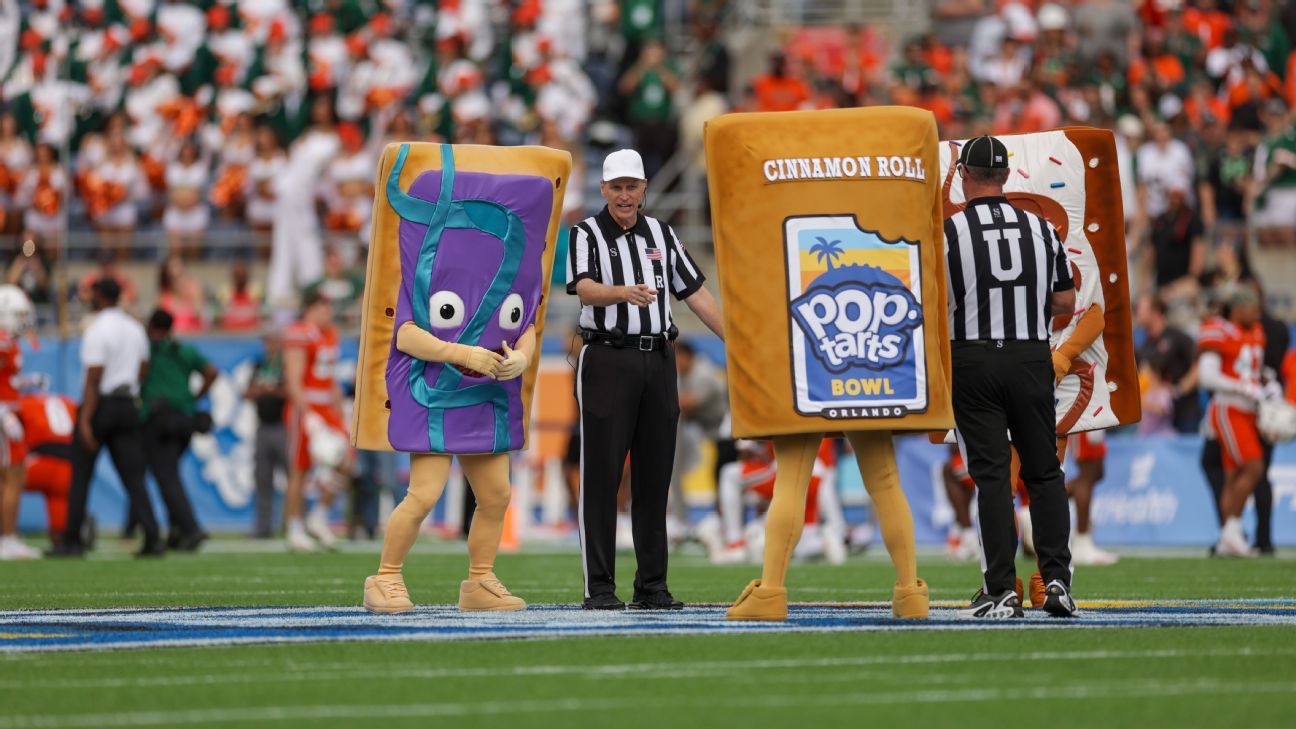
Pop-Tarts Bowl
Camping World Stadium (Orlando, Florida)
3:30 p.m., ABC
Bonagura: Virginia vs. TCU
Schlabach: Duke vs. TCU
Snoop Dogg Arizona Bowl
Arizona Stadium (Tucson, Arizona)
4:30 p.m., CW Network
Bonagura: Ohio vs. Fresno State
Schlabach: Toledo vs. Fresno State
Isleta New Mexico Bowl
University Stadium (Albuquerque, New Mexico)
5:45 p.m., ESPN
Bonagura: East Carolina vs. New Mexico
Schlabach: Washington State vs. New Mexico
TaxSlayer Gator Bowl
EverBank Stadium (Jacksonville, Florida)
7:30 p.m. ABC
Bonagura: Miami vs. Vanderbilt
Schlabach: Miami vs. Vanderbilt
Kinder’s Texas Bowl
NRG Stadium (Houston)
9:15 p.m., ESPN
Bonagura: Houston vs. Missouri
Schlabach: Houston vs. Missouri
Monday, Dec. 29
JLab Birmingham Bowl
Protective Stadium (Birmingham, Alabama)
2 p.m., ESPN
Bonagura: UNLV vs. Memphis
Schlabach: Coastal Carolina vs. Memphis
Tuesday, Dec. 30
Radiance Technologies Independence Bowl
Independence Stadium (Shreveport, Louisiana)
2 p.m., ESPN
Bonagura: Cincinnati vs. Western Michigan
Schlabach: UNLV vs. Western Kentucky
Liberty Mutual Music City Bowl
Nissan Stadium (Nashville, Tennessee)
5:30 p.m., ESPN
Bonagura: Illinois vs. LSU
Schlabach: Illinois vs. LSU
Valero Alamo Bowl
Alamodome (San Antonio)
9 p.m., ESPN
Bonagura: BYU vs. USC
Schlabach: BYU vs. USC
Wednesday, Dec. 31
ReliaQuest Bowl
Raymond James Stadium (Tampa, Florida)
Noon, ESPN
Bonagura: Iowa vs. Tennessee
Schlabach: Iowa vs. Tennessee
Tony the Tiger Sun Bowl
Sun Bowl Stadium (El Paso, Texas)
2 p.m., CBS
Bonagura: Wake Forest vs. Arizona State
Schlabach: Pitt vs. Arizona State
Cheez-It Citrus Bowl
Camping World Stadium (Orlando, Florida)
3 p.m., ABC
Bonagura: Michigan vs. Texas
Schlabach: Michigan vs. Texas
SRS Distribution Las Vegas Bowl
Allegiant Stadium (Las Vegas)
3:30 p.m., ESPN
Bonagura: Nebraska vs. Utah
Schlabach: Nebraska vs. Utah
Friday, Jan. 2
Lockheed Martin Armed Forces Bowl
Amon G. Carter Stadium (Fort Worth, Texas)
1 p.m., ESPN
Bonagura: Duke vs. Kennesaw State
Schlabach: Kansas State vs. North Texas
AutoZone Liberty Bowl
Simmons Bank Liberty Stadium (Memphis, Tennessee)
4:30 p.m., ESPN
Bonagura: Iowa State vs. Navy
Schlabach: Cincinnati vs. Navy
Duke’s Mayo Bowl
Bank of America Stadium (Charlotte, North Carolina)
8 p.m., ESPN
Bonagura: Georgia Tech vs. Troy
Schlabach: Georgia Tech vs. Virginia
Holiday Bowl
Snapdragon Stadium (San Diego)
8 p.m., Fox
Bonagura: SMU vs. Arizona
Schlabach: SMU vs. Arizona
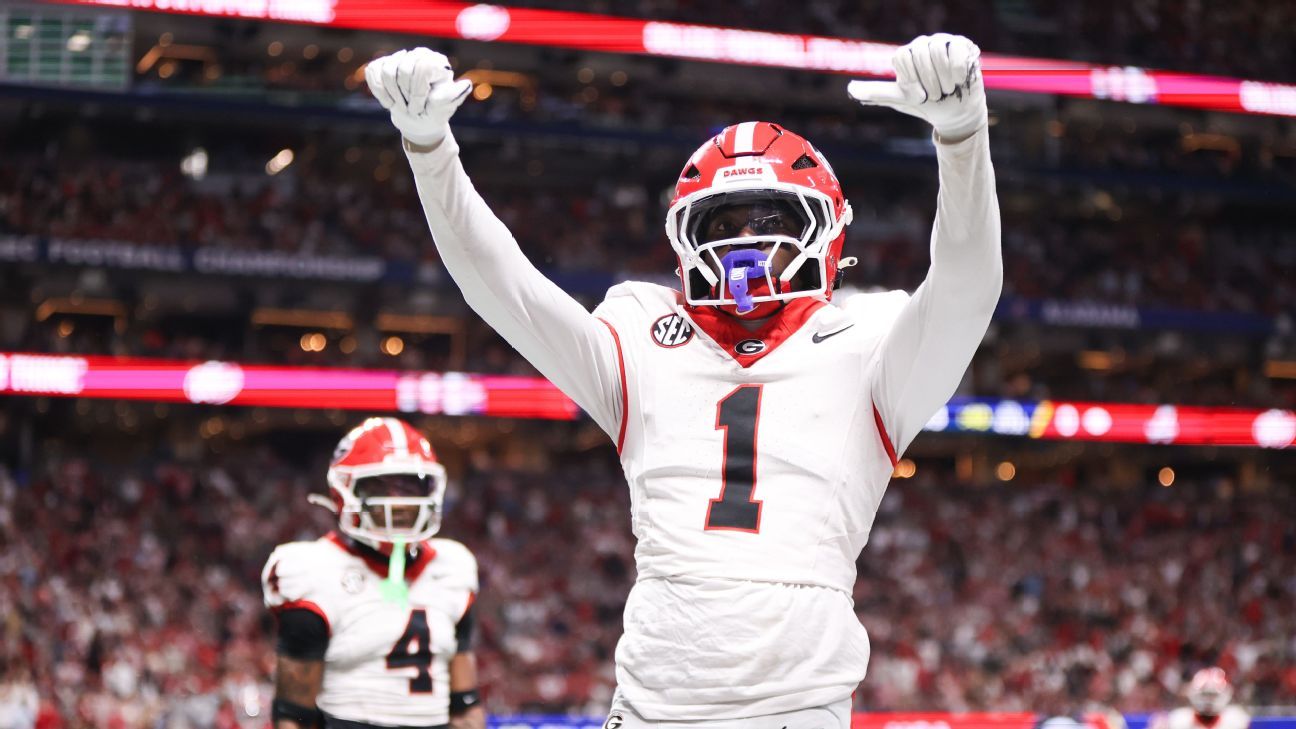
Someone is going to be upset — and it’s not just ACC champion Duke, which likely will be excluded from the playoff in favor of Sun Belt champion James Madison.
It might be the entire ACC that is fuming.
With Alabama losing to Georgia in the SEC championship game, the College Football Playoff selection committee’s biggest decision Saturday night will be how far to drop the Tide — and the result could mean the difference for Miami’s playoff hopes. The focus of the final ranking on Selection Day (Noon ET, ESPN) will be where it has been all season — on Notre Dame, Alabama and Miami.
Will the three-loss Tide earn the committee’s final at-large bid as the SEC runner-up? Or will Alabama’s poor performance against Georgia open the door for Notre Dame and Miami to finish in the top 10?
Here’s our prediction for what the committee might do in its sixth and final ranking on Selection Day.
Projecting the top 12

Why they could be here: The Big Ten champions are the only undefeated team left in the country, and they earned the best win of the season by defeating the committee’s No. 1 team, Ohio State. The Hoosiers entered Saturday ranked No. 1 in ESPN’s strength of record metric, No. 1 in total efficiency and No. 4 in game control — and that was before they beat Ohio State.
Why they could be lower: This isn’t a realistic scenario.
Need to know: Indiana won its first Big Ten title since 1967 (shared with Minnesota and Purdue) and its first outright Big Ten title since 1945.

Why they could be here: The Buckeyes have arguably the best loss of the season — to the committee’s No. 2 team — and it was a close game that went down to the wire. Ohio State still has two wins against CFP top-25 teams in Texas and Michigan, and the committee has been impressed all season with the Buckeyes’ talent and consistent dominance.
Why they could be lower: Without the win against the Hoosiers, Ohio State’s best win is a close home game against Texas — a team that Georgia hammered 35-10. Georgia and Texas Tech also have multiple wins against CFP top-25 opponents. Ohio State’s strength of schedule was ranked No. 46 entering Saturday, while Georgia was No. 25.
Need to know: Even if the committee drops Ohio State lower, it’s highly unlikely the Buckeyes fall out of the top four. They still have a strong case for a first-round bye as the Big Ten runner-up.

Why they could be here: The SEC champs avenged their regular-season loss to Alabama, and they did it in resounding fashion. The Bulldogs’ lone loss to the Tide is better than Texas Tech’s loss to Arizona, even though the committee knows the Red Raiders were without their starting quarterback in that game. Nobody has a better loss, though, than Ohio State, the Big Ten runner-up. Indiana and Ohio State entered Saturday ranked No. 1 and No. 2, respectively, in ESPN’s strength of record metric, and playing each other in the Big Ten title game will only boost that. Georgia also has a convincing victory against Texas, which should still be the committee’s No. 13 team. Wins against Tennessee, Ole Miss and Georgia Tech helped the Bulldogs to a top-five strength of record entering Saturday.
Why they could be higher: The committee might drop Ohio State to No. 3 because its strength of schedule is lower, and because of the common opponent in Texas. Georgia beat Texas 35-10, while Ohio State beat the Longhorns 14-7 in the season opener. Some committee members could believe Georgia has a stronger overall résumé.
Need to know: The Bulldogs’ 28-7 SEC title game win was Georgia’s largest margin of victory over Alabama since 1976 (won 21-0).

Why they could be here: The Red Raiders dominated BYU for a second time this season, clinching a top-four finish and a first-round bye as the Big 12 champs. The committee has been impressed by how consistently they’ve owned the margin of victory this season, ranking No. 2 in the country in points margin per game (31.5) and No. 1 in points margin (410) entering Saturday. The Red Raiders’ defense, particularly up front, has also separated Texas Tech from other one-loss contenders. The committee has considered all season that Texas Tech’s lone loss came Oct. 18 at Arizona State when Red Raiders starting quarterback Behren Morton was injured.
Why they could be higher: Texas Tech entered Saturday No. 3 in total efficiency — behind Indiana and Ohio State. Georgia was No. 11. Defensively, the Red Raiders are No. 1.
Need to know: Texas Tech entered Saturday with the worst schedule strength (59) of the top-four contenders, and the lowest strength of record (10th).

Why they could be here: With Georgia and Texas Tech winning their respective conference championship games, the No. 5 spot is likely the Ducks’ Selection Day ceiling. Oregon earned a respectable road win at Washington, a top-25 win against No. 16 USC, and the Nov. 8 victory at Iowa was ultimately against a CFP top-25 team, as the four-loss Hawkeyes came back into the ranking at No. 23 last week. Oregon has also impressed the committee with its top-five ranking in offensive and defensive efficiency. It also doesn’t hurt that the Ducks’ only loss is to the Big Ten champs, Indiana.
Why they could be higher: It’s unlikely that Ohio State drops behind Oregon. They both played the Hoosiers, and they both lost. The committee could compare their wins, but Ohio State’s victory against Texas trumps Oregon’s best win against USC.
Need to know: The No. 5 seed is one of the most desirable because Oregon gets home-field advantage and also plays the No. 12 seed, which this year will likely be James Madison, the Sun Belt champs.

Why they could be here: The selection committee rewarded Ole Miss in its last ranking for its regular-season win against rival Mississippi State, but also bumped up the Rebels because Texas A&M dropped after losing to Texas. The Rebels’ Oct. 18 loss at Georgia will keep them behind the Bulldogs, but the Oct. 25 win at Oklahoma gives Ole Miss an edge against the Sooners. The Rebels’ 45-10 victory Sept. 20 against Tulane is one of their best wins. The Green Wave won the American title and clinched a spot in the CFP.
Why they could be higher: Now that Tulane is the American champ, the committee could consider giving Ole Miss a boost above Oregon for beating the Green Wave. That’s the kind of result that could impact an idle team’s résumé.
Need to know: Even without former coach Lane Kiffin, the Rebels should still be a lock to host a first-round game.

Why they could be here: Because the Aggies didn’t play Alabama or Georgia this season, the SEC championship game didn’t impact their résumé while idle. The Aggies have only one win against a team in the CFP top 25, and that was the 41-40 victory at Notre Dame on Sept. 13. Still, the committee has a lot of respect for the Aggies’ four road wins.
Why they could be higher: It would be surprising to see Texas A&M move because Texas Tech won the Big 12 and won’t sink, and the loser of the Big Ten championship game is unlikely to drop outside of the top four.
Need to know: The Aggies should remain in position to host a first-round home game, and if they remain the No. 7 seed, they would face the No. 10 team, which is the committee’s toughest decision this week. Though the Aggies didn’t play Alabama during the regular season, it’s possible they could meet in the first round.

Why they could be here: The Sooners have earned their spot in the CFP thanks to an elite defense and their ability to continue to find ways to win — even when the offense has been average. The committee respects OU’s back-to-back road victories at Tennessee and Alabama. The Tide’s loss to Georgia doesn’t diminish the value of that win, especially because Alabama can still finish in the CFP field. The Sooners will still have the head-to-head tiebreaker, though, over Alabama. Oklahoma’s loss to Ole Miss will keep the Sooners behind the Rebels, but the committee has kept OU ahead of Texas despite the Sooners’ loss to the Longhorns because Texas has a third loss.
Why they could be higher: It’s unlikely the Sooners move up after being idle because Saturday’s results didn’t directly impact their place.
Need to know: With Alabama losing in the SEC championship game, the Sooners should still be safe as the last at-large team to host a first-round game.

Why they could be here: The Irish benefited from BYU losing to Texas Tech — preventing the Big 12 from having two teams in — and when Georgia beat Alabama soundly in the SEC title game. Arguably the biggest debate in the room all season has been between Notre Dame and Alabama, with the committee members seesawing between the two until Alabama’s Iron Bowl win tipped the scales last week for a few committee members who had been on the fence. With the loss to Georgia, though, the balance should swing back in Notre Dame’s favor, pushing Notre Dame safely into the bracket at No. 9.
Why they could be lower: If Alabama falls behind Miami, and the Canes are right next to Notre Dame, the committee could consider Miami’s head-to-head win over Notre Dame in the season opener and flip them. Even if that happened, though, both teams would still be in, and it would impact only seeding.
Need to know: Notre Dame has been in the committee’s top 10 in all five rankings this season. Last year, under the 12-team format, there were six teams that were ranked in the top 10 of every poll leading up to Selection Day; all six of them made the CFP (Oregon, Texas, Penn State, Indiana, Ohio State, Notre Dame), according to ESPN Research.

Why they could be here: Georgia beat Alabama soundly in the SEC championship game — with the selection members watching together. The group had called out Alabama’s inability to run the ball since the loss to Florida State, and it was exposed again against a relentless Georgia defense, finishing with minus-3 yards on the ground (with minus-28 of that coming from quarterback Ty Simpson). Alabama had the edge against that defense in a 24-21 win Sept. 27 in Athens. Georgia gave up 262 yards in the first half that day as Alabama scored on four of five possessions. The committee will consider Alabama’s win that day against the eventual SEC champs (along with victories against Vanderbilt, Missouri and Tennessee). Alabama’s win against Georgia is better than Miami’s victory against Notre Dame.
Why they could be lower: Alabama was outplayed Saturday and Simpson was off-target. And the Tide lost the season opener to Florida State. If the committee drops the Tide lower, it won’t be as a punishment for playing in the SEC title game — it will be because of how Alabama performed in it.
Need to know: Same as Notre Dame above, Alabama has been ranked in the selection committee’s top 10 every week.

Why they could be here: With Alabama and BYU losing, it’s possible Miami and Notre Dame get in, but for that to happen, Alabama has to drop behind Miami. The Canes are still on the outside in this projection because the committee has believed each week that Notre Dame is the better team, and they were both idle Saturday. The committee would not intentionally put Alabama between Miami and Notre Dame, so it doesn’t have to deal with the head-to-head — that’s not how the voting works — but the Tide could fall there because the committee recognized Alabama was put in a position where it had to beat the same team twice in an additional game. Miami finished the season with two losses to unranked opponents, while Alabama and Notre Dame had losses to top-10 teams.
Why they could be higher: Alabama lost to Florida State, which Miami beat. The selection committee could drop Alabama to No. 11 behind Miami because of its third loss — and poor play — in a lopsided game against Georgia. That would open the door for Miami and Notre Dame to earn the final two at-large spots, regardless of the order.
Need to know: This depends in part on whom the committee is comparing the Canes with — Alabama or Notre Dame. It has been well-documented how close Miami and Notre Dame are. But if the group is comparing Miami and Alabama side-by-side, the Tide could have the edge. Alabama entered Saturday ranked No. 8 in strength of record, while Miami was No. 14. The Canes were No. 44 in strength of schedule, while Bama was No. 11.

Why they could be here: At 11-2, BYU is lumped in the group of two-loss teams at the bottom of the top 12, so the committee will compare the Cougars against Notre Dame and Miami. BYU lost by double digits again, though, to Texas Tech, and that likely will cause the Cougars to drop behind the Canes. BYU has two CFP top-25 wins: in double overtime at current No. 18 Arizona, and 24-21 at current No. 15 Utah. Though BYU’s wins aren’t as impressive as what Texas accomplished against Texas A&M, Vanderbilt and Oklahoma, the committee could separate the two in part by their losses. The Longhorns’ defeat to Florida, along with their other losses, is holding back Texas in the committee meeting room.
Why they could be higher: BYU’s only two losses are to the Big 12 champions and a top-four team. Those two losses are better than Miami’s losses to SMU and Louisville. BYU also entered Saturday ranked No. 6 in ESPN’s strength of record metric, and it won’t be diminished by playing a top-four team. Miami was No. 14 and didn’t play. BYU also had a slight edge over Miami in strength of schedule.
Need to know: BYU will be excluded from the playoff for James Madison, which will earn the No. 12 seed as the Sun Belt champion.
Bracket
Based on the rankings above, the seeding would be:
First-round byes
No. 1 Indiana (Big Ten champ)
No. 2 Ohio State
No. 3 Georgia (SEC champ)
No. 4 Texas Tech (Big 12 champ)
First-round games
On campus, Dec. 19 and 20
No. 12 James Madison (Sun Belt champ) at No. 5 Oregon
No. 11 Tulane (American champ) at No. 6 Ole Miss
No. 10 Alabama at No. 7 Texas A&M
No. 9 Notre Dame at No. 8 Oklahoma
Quarterfinal games
At the Goodyear Cotton Bowl, Capital One Orange Bowl, Rose Bowl Presented by Prudential and Allstate Sugar Bowl on Dec. 31 and Jan. 1.
No. 12 James Madison/No. 5 Oregon winner vs. No. 4 Texas Tech
No. 11 Tulane/No. 6 Ole Miss winner vs. No. 3 Georgia
No. 10 Alabama/No. 7 Texas A&M winner vs. No. 2 Ohio State
No. 9 Notre Dame/No. 8 Oklahoma winner vs. No. 1 Indiana
-
 Sports2 years ago
Story injured on diving stop, exits Red Sox game
-
 Sports3 years ago
‘Storybook stuff’: Inside the night Bryce Harper sent the Phillies to the World Series
-
 Sports2 years ago
Game 1 of WS least-watched in recorded history
-
 Sports3 years ago
Button battles heat exhaustion in NASCAR debut
-
 Sports3 years ago
MLB Rank 2023: Ranking baseball’s top 100 players
-
Sports4 years ago
Team Europe easily wins 4th straight Laver Cup
-
 Environment3 years ago
Japan and South Korea have a lot at stake in a free and open South China Sea
-
 Environment1 year ago
Here are the best electric bikes you can buy at every price level in October 2024