
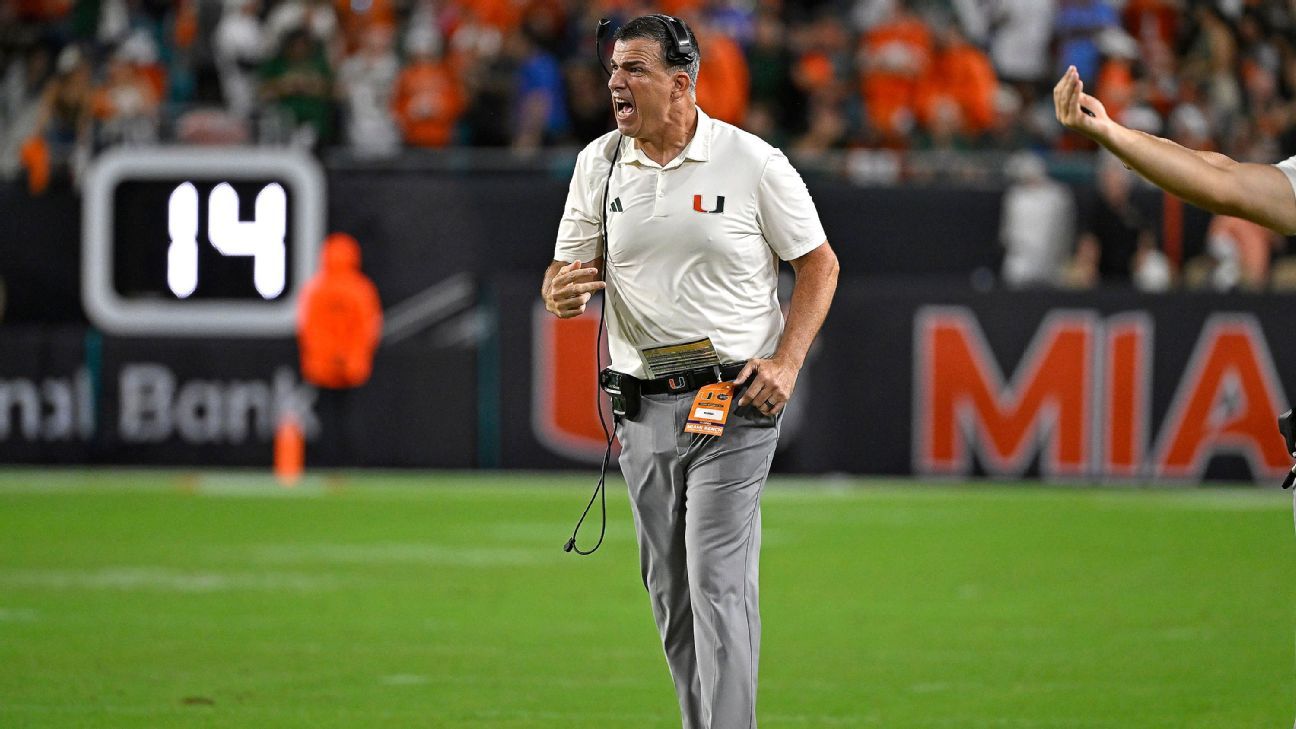
Week 12 Anger Index: Why a No. 15 ranking isn’t good enough for Miami


-
David Hale
Anger is a natural and often entirely reasonable emotion, but it can also be a little like misplacing your car keys. There’s frustration, outrage, exasperation and a string of epithets that would make Pat Narduzzi blush, and then just when the emotions have reached their apex, you realize the keys have been in your coat pocket the whole time.
So it was with last week’s Anger Index.
BYU was right to be upset that, in spite of a spotless record, it was slotted behind three one-loss teams.
The ACC was perfectly justified in its outrage, without a single team in the top 13, despite Louisville and Virginia profiling far better than two-loss teams ranked higher.
Memphis certainly had an ax to grind, relegated to the committee equivalent of an “others receiving votes” nod, when a three-loss team from across the state cracked the top 25.
So, of course, we yelled and screamed and cursed the committee, and by the end of Week 11, we imagine those same committee members were sitting in an oversized chair, stroking a cat and smugly cackling like Bond villains.
But this is a lesson worth learning — not for the outraged and aggrieved, but for the committee.
Because the committee is made up of some particularly wise college football minds, those folks can watch a team’s performance and create a trend line. They can see Virginia squeaking by in close games or compare the recruiting pedigree of BYU’s roster with teams from the SEC and make an entirely reasonable prediction that, on a long enough timeline, those teams’ flaws will become evident and the results will prove the committee right.
But it’s a little like watching the Kentucky Derby, seeing the leader fading down the stretch and a favorite charging from the back. Can we predict the outcome with some level of certainty? Sure. But you don’t call the race then and there.
The committee’s job is to survey the evidence at hand and capture that specific moment in time, not guess about the future — educated as those guesses might be.
So, yes, BYU and Louisville and Virginia and Memphis had reasons to be outraged, even if the committee’s predictions ultimately came true, just as this week’s entrants on the Anger Index are entirely justified in their frustrations, regardless of what happens from here.


In Bill Connelly’s SP+ ranking this week, Georgia is one spot ahead of Alabama. But the two teams have the same record, and the Tide hold a head-to-head advantage, so the committee — rightfully — has Alabama ranked higher.
SP+ actually has Oklahoma (ninth) ahead of Texas (14th) by a sizable margin, and the Sooners’ overall profile — with wins vs. Michigan and Tennessee — is better, too. But again, the two schools have the same record, and Texas holds a head-to-head win, so the committee ranked the Horns higher.
Or consider Louisville and Virginia. The Cardinals (26th) are a full 15 spots ahead of Virginia in SP+ and 14 spots higher in strength of record. And no matter that Virginia’s head-to-head win over the Cardinals came in overtime and required two defensive touchdowns, the committee appreciates what happened on the field, and it has the Cavaliers ranked higher.
Similarly, the committee has USC ahead of Michigan, BYU ahead of Utah and Georgia ahead of Ole Miss, partially because the metrics bear that out, but also because, in each case, the higher-ranked team has the head-to-head win.
Please explain why Miami is different.
The Hurricanes’ metrics are solid. They’re 13th in SP+, 13th in strength of record, have four wins vs. FPI top-35 teams (i.e. the top 25% of FBS) — more than anyone but Texas A&M and Alabama — and, of course, have the same record as Notre Dame and hold the head-to-head victory over the Irish.
The committee, however, has Notre Dame ranked ninth and Miami 15th.
It’s nonsensical on its face, and worse when you consider the committee also has Texas (with a worse loss than either of Miami’s), Utah (just one FPI top-35 win) and Vanderbilt (four spots behind Miami in FPI) all ranked higher, too.
Again, it’s certainly possible the Canes lose this week to NC State — a team that has already taken down Virginia and Georgia Tech — but that’s not the point. The committee isn’t supposed to guess what will happen next. It’s supposed to rank teams based on what they’ve done so far, and there is absolutely no metric that warrants Miami’s placement behind so many two-loss teams with clearly inferior résumés.

It might seem like the difference between being No. 5 and No. 6 in the committee’s rankings isn’t much, but consider this: Ohio State and Indiana will likely play in the Big Ten title game. Some combination of Texas A&M, Georgia and Alabama will play in the SEC title game. Some member of the committee’s current top four is quite likely to slip from that top perch and trade a first-round bye for a first-round home game, and someone else will get bumped up into the top tier and enjoy a week off when the playoff begins.
Texas Tech should have the inside track on that bye, but the Red Raiders don’t, because Georgia still rates ahead of them.
Why?
Texas Tech has played two top-13 teams now and beaten them by a combined score of 63-17. Georgia’s two best wins (vs. No. 7 Ole Miss and No. 23 Tennessee) came by a combined 11 points.
Texas Tech has a loss to Arizona State that looks bad on paper, but the Sun Devils actually profile well, and they won that game with a healthy Sam Leavitt. Surely that’s a better loss than Alabama’s defeat at the hands of slumping Florida State, right?
Yes, who you play matters, and in this case, Alabama (No. 4 SoR) and Georgia (No. 5) have had the tougher road. But how you play has to matter, too, and the Red Raiders have been far more dominant. Texas Tech has the second-best average in-game win probability in the country, trailing only Ohio State. Alabama’s is 17th. Georgia’s is 36th. Yes, credit to the Tide and Dawgs for winning close games. But more credit to Texas Tech for avoiding close games altogether.

As a general rule, if Lane Kiffin is pointing out a flaw in the committee’s logic, then the committee ought to take note. It’s not worth the retribution he’ll eventually deal out with a mercilessly hilarious tweet.
Lane Kiffin makes the case for Texas A&M to be #1
“Texas A&M being No. 3, what more do you want them to do to be 1?”
“They went up to Notre Dame and won.”
“What good did that do if that’s not rewarded?
“They have the highest metrics of everybody and not No. 1.” pic.twitter.com/NJ0m7qWVrw
— SEC Mike (@MichaelWBratton) November 10, 2025
And, of course, Kiffin is right. What else does Texas A&M need to do to be ranked No. 1? The Aggies have the No. 1 strength of record, a supposedly critical stat for the committee. A&M has five wins vs. FPI top-35 teams; Ohio State has four. A&M’s best win is vs. No. 9 Notre Dame. Ohio State’s is vs. No. 10 Texas. A&M has played the 15th-toughest schedule so far (per ESPN’s metrics), while Ohio State has played the 41st.
Ultimately, the difference between being the top seed and the No. 3 seed is minimal, and given that Ohio State and Indiana will likely face off in a Big Ten title game, odds are the Aggies will enter the postseason at No. 2. No harm done, really. But it’s the principle of the thing. If A&M has the best résumé, it should be No. 1, because no one wants to spend a whole offseason hearing Greg Sankey whine about the SEC getting treated unfairly.

Last week, we thought the Cougars were being underappreciated. Then they went out and lost to Texas Tech and its ferocious defense and tumbled all the way from No. 7 to No. 12 — or, from in the playoff to out of it.
But does it make sense to divvy out that much punishment for a single loss on the road to one of the best teams in the country? To drop BYU behind three two-loss teams, each of which has lost to a team far worse than the Red Raiders?
Of course it doesn’t, but that’s just the tip of the iceberg. How about this comparison?
Team A: No. 7 strength of record, No. 24 strength of schedule, two wins vs. SP+ top-40 teams by an average of four points, one loss to a top-10 team by 10 at home
Team B: No. 8 strength of record, No. 28 strength of schedule, three wins vs. SP+ top-40 teams by an average of eight points, one loss to a top-10 team by 22 on the road
You’ve probably guessed that Team B is BYU, and the No. 8 strength of record metric alone should make the committee’s ranking seem ludicrous.
But Team A? That’s Oregon, which picked up its best win of the season in Week 11 in a game it nearly lost to Iowa.
BYU and Oregon have the same record. BYU has a win over the committee’s No. 13 team, better than Oregon’s win over No. 21 Iowa (which is unranked in the AP poll, by the way). They both have understandable losses, but BYU’s was on the road.
And the committee sees BYU as four spots behind Oregon.
Make it make sense.

A quick blind résumé:
Team A: SP+ No. 12, best win vs. committee’s No. 18 team, losses to SP+ Nos. 6 and 23 by a combined 12 points, 17.8 points-per-game average margin of victory vs. FBS opponents, who are a combined 38-29 in other FBS games.
Team B: SP+ No. 14, best win vs. committee’s No. 11 team, losses to SP+ Nos. 1 and 48 by a combined 15 points, 13.1 points-per-game average margin of victory vs. FBS opponents, who are a combined 33-34 in other FBS games.
There’s not a ton of margin between the two, but you’d probably give a slight edge to Team A, right? Aside from Team B having a small advantage in its best win, Team A has the better overall résumé.
Well, Team A is the Trojans.
Team B? That’d be Texas, which the committee has seven spots higher.
As we showed with Miami’s spot, there’s certainly room for a lot of debate around the two-loss teams, but given that Notre Dame and Texas are currently on the right side of the playoff dividing line, and Miami and USC (and others) are not, it’s a debate that requires a ton of scrutiny. But somehow, USC seems like the least scrutinized of any of the two-loss teams — a team that has been largely overlooked in spite of some real success.
And it certainly feels like the committee has looked at Miami’s loss to SMU and USC’s loss to Illinois and deemed those too egregious to warrant further consideration, while completely ignoring the fact that Texas lost to a train wreck Florida Gators squad that has since fired its coach and went to overtime with both Kentucky and Mississippi State. It’s notable, too, that the committee continues to rank a three-loss Iowa, whose strength of record is No. 30, but not a three-loss Illinois, whose strength of record is No. 18. By keeping the Hawkeyes in the top 25, things look a lot better for fellow Pac-12-to-Big Ten transfer Oregon, and by keeping Illinois out, things look worse for the Trojans.
Also angry this week: James Madison Dukes (8-1, unranked), Tulane Green Wave (7-2, unranked), Arizona State Sun Devils (6-3, unranked), Illinois Fighting Illini (6-3, unranked), North Texas Mean Green (8-1, unranked), Pitt fans (who are worried Notre Dame is about to hang 100 on them).

-
Adam Rittenberg
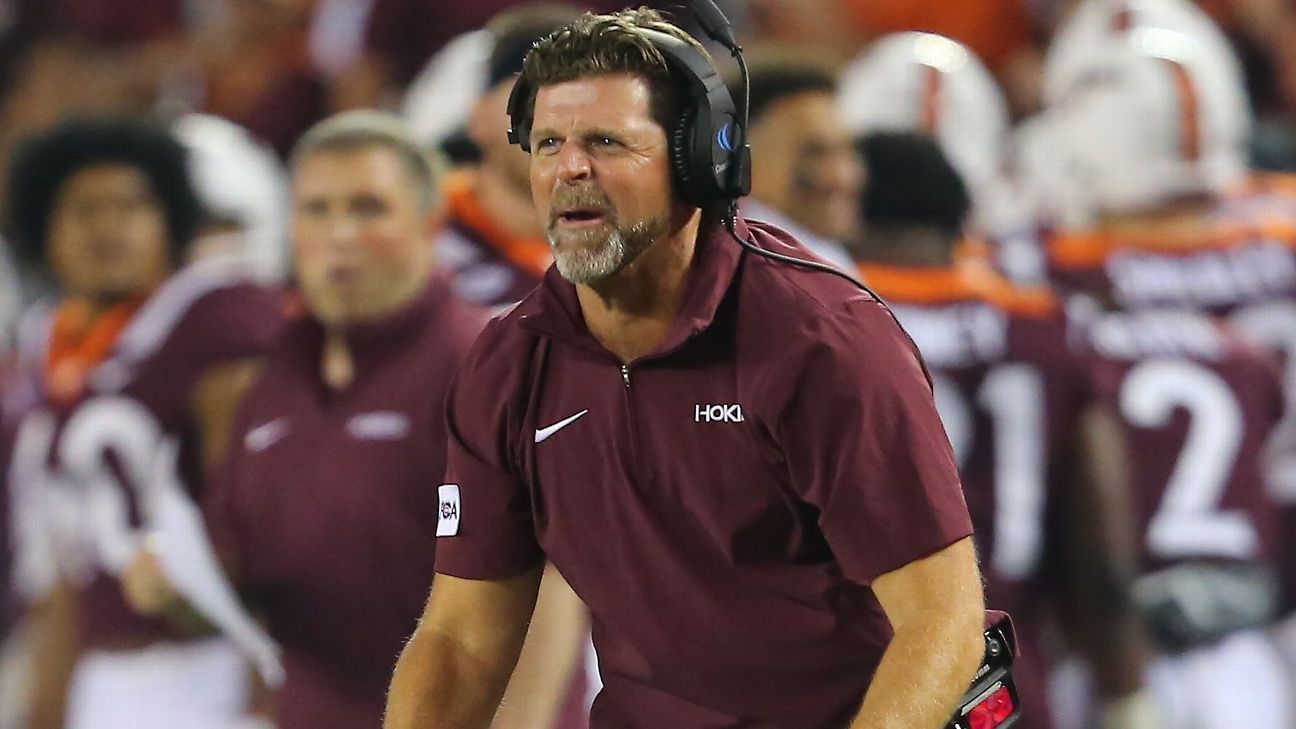
Former Virginia Tech football coach Brent Pry, fired by the school in September, is set to return as the Hokies’ defensive coordinator under James Franklin, sources confirmed to ESPN on Sunday.
A highly unusual move in major college football, Pry will rejoin the team he led from 2022 until Sept. 14, when he was fired following an 0-3 start. Pry went 16-24 as Hokies coach with bowl appearances the past two years. Virginia Tech hired Franklin, who was fired as Penn State‘s coach in October, as its new coach Nov. 17.
Before Virginia Tech, Pry served as Franklin’s defensive coordinator at Penn State. He also worked as co-defensive coordinator under Franklin at Vanderbilt from 2011 to 2013.
Franklin became emotional when discussing Pry at his introductory news conference with Virginia Tech, noting that Pry’s father, Jim, had coached Franklin in college at East Stroudsburg.
“I’ve known Brent for over 30 years,” Franklin said. “… I’ve got a ton of respect for Brent and his family. I know he poured his heart and soul into this place. I know this place is better today because of Brent and the commitment that he made.”
CBS first reported Pry as a target for Franklin’s defensive coordinator role. Pry, 55, was a graduate assistant at Virginia Tech under Frank Beamer early in his career.
Virginia Tech owed Pry about $6 million at the time of his dismissal, which is subject to offset if he obtained another coaching job.

-
 Sports2 years ago
Story injured on diving stop, exits Red Sox game
-
 Sports3 years ago
‘Storybook stuff’: Inside the night Bryce Harper sent the Phillies to the World Series
-
 Sports2 years ago
Game 1 of WS least-watched in recorded history
-
 Sports3 years ago
Button battles heat exhaustion in NASCAR debut
-
 Sports3 years ago
MLB Rank 2023: Ranking baseball’s top 100 players
-
Sports4 years ago
Team Europe easily wins 4th straight Laver Cup
-
 Environment3 years ago
Japan and South Korea have a lot at stake in a free and open South China Sea
-
 Environment1 year ago
Here are the best electric bikes you can buy at every price level in October 2024