
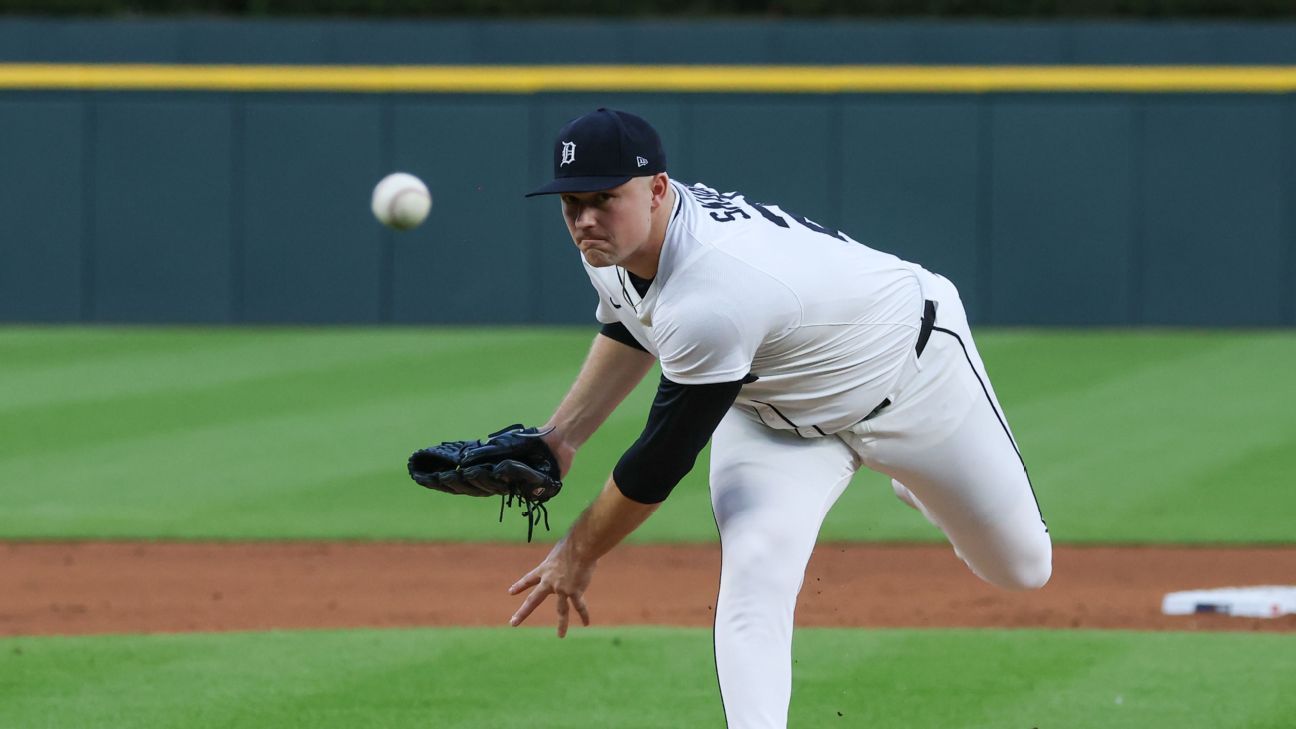
What makes Tarik Skubal and Paul Skenes the best pitchers on the planet


-
Jesse Rogers
Editor’s note: This story originally published on Aug. 19, 2025. Paul Skenes and Tarik Skubal are both finalists for the 2025 Cy Young awards to be announced on Nov. 12, 2025.
Both of MLB’s 2025 Cy Young favorites came from humble pitching beginnings. Pittsburgh Pirates ace Paul Skenes started his meteoric rise to stardom at the Air Force Academy, while Detroit Tigers lefty Tarik Skubal came of age at Seattle University. Neither place screams baseball immortality, but both pitchers could be flirting with historic achievements for the rest of their careers provided they stay healthy.
Skenes was the 2024 National League Rookie of the Year, while Skubal won the American League Cy Young Award last season — and their paths recently crossed as the 2025 All-Star Game starting pitchers in Atlanta. As they head down the stretch with the opportunity to collect more hardware this season, ESPN asked their teammates, team personnel and Skubal and Skenes themselves what makes the two best pitchers in the sport so special.
“Really advanced stuff and fill up the strike zone; they go right at guys,” Tigers starter Casey Mize said, summing up the feelings of those who have watched both aces. “So, they’re in advantageous counts a lot, applying a lot of pressure. The biggest thing to worry about is getting jumped early in counts, so they have to be good early on. But it feels like when they get strike one, the at-bat is over.”
‘He’s a guy that you can talk to when he’s starting’
The similarities between the two pitchers begin with the vibe they generate throughout the stadium when it’s their turn to pitch. There’s a different feeling in the clubhouse on a Skenes or Skubal day because of how games play out when they’re on the mound.
“You just know the other team isn’t going to do very much,” Tigers infielder Zach McKinstry said when it’s a Skubal day. “Defense is kind of boring that game.”
As a smiling teammate Spencer Torkelson added, “You can almost be blindfolded playing behind him.”
Pirates outfielder Tommy Pham has his own way of recognizing when Pittsburgh’s ace is pitching. It begins when Pham gets dressed to come to the park.
“He wears a suit to the field, so I started trying to keep up with him on ‘Skenes Day,'” Pham said. “I call out Skenes Day by wearing a suit with him so he’s not the only one.
“And we normally don’t need to score a lot of runs that day.”
Despite Skenes’ formal attire and nasty stuff, it stands out to his teammates that Skenes is still approachable when it is his day to take the mound.
“He’s a guy that you can talk to when he’s starting,” Pham stated. “I’ve played with guys, when they’re starting, you can’t talk to them, which I feel is bulls—. But he’s not like that.”
Skubal exhibits that trait, as well, according to Detroit infielder Zach McKinstry. Skubal will talk to teammates like it’s any other game.
The confidence in each pitcher’s crafts allows for a normal day, according to the players in both locker rooms.
The Tigers also get an extra jolt of energy during their pennant race as they play meaningful games down the stretch: Comerica Park comes alive when their ace takes the mound.
“Every jersey you see is a No. 29 jersey,” McKinstry said. “They love him. And he loves what he does. And we love to play behind him.”
‘We play a defensive position, but he makes it look like offense’
If there is one difference between Skubal and Skenes, it is that Skubal is in attack mode more than anyone in the league. He leads MLB in throwing his first pitch for a strike at 70% of the time. Overall, he throws strikes 55% of the time — good for third most in baseball.
Being in the zone so often is one reason Skubal is third in the majors in innings pitched this season, after finishing eighth in that category last season.
“When it gets to those later innings, you do feel like he has a chance to go the distance,” Tigers reliever Will Vest said. “It’s because he’s so efficient with his pitches.”
Skubal has pitched at least seven innings in 10 starts this season, including his signature outing: a 13-strikeout shutout against the Cleveland Guardians on May 25. That performance still resonates in the Tigers’ clubhouse three months later, especially after his last pitch registered at 103 mph.
“The aggressiveness,” Mize explained. “We play a defensive position, but he makes it look like offense. He’s going at everybody. He doesn’t care. That game illustrated that.”
Skenes, on the other hand, ranks 33rd in first-strike percentage (62.1) with a full arsenal that allows him to attack hitters differently.
“He has a larger tool box,” Pirates assistant pitching coach Brent Strom said. “It enables him to have weapons against different types of hitters. He pitches to his strengths.”
According to Baseball Savant, Skenes has thrown seven different types of pitches this season — as compared with Skubal’s five — and Skenes’ swinging-strike percentage ranks seventh. It all adds up to a pitch mix that keeps hitters baffled, even when they get pitches to hit.
“It’s full-on ‘here it is, hit it,'” Pirates catcher Joey Bart said. “He’s not scared of anyone.”
‘Everything is by the numbers, and he leaves nothing to chance’
Every player, no matter the position, has a routine to prepare for competition. But Skenes is especially unique in that regard.
One day, between starts, Pham asked to stand in the batter’s box while Skenes threw a bullpen session.
“Then the next day, I asked who’s throwing a pen because I needed to test out my contact lenses again,” Pham explained. “And Skenes says, ‘Hey, I’m throwing a pen.'”
Pham gave him a confused look, knowing Skenes had thrown the day before.
“He’s like, ‘Yeah, I throw every day, except for the day before my start,'” Pham recalled. “When I found that out, I was like, yeah, he’s different. I’ve never seen anybody do that.”
Strom noted that not every bullpen session is built the same. There’s purpose to the preparation.
“His work is very organized,” Strom said. “Very thoughtful. Everything is by the numbers, and he leaves nothing to chance. He’s very cerebral. He understands what’s necessary.”
Bart recalled Skenes’ early days with the club after getting called up in May 2024. The catcher recognized the detailed preparation of the former LSU star even then, including how Skenes readied for his very first outing against the Chicago Cubs.
“I remember the first pregame meeting last year,” Bart said. “He ran the meeting in his debut. I was like, ‘Go ahead and take it, dude. You got it.’ He has been groomed for this.”
That kind of intense and directed preparedness has gained attention and admiration around the league, and it is what Skubal identified as Skenes’ most impressive trait.
“He seems like he has his routine and preparation already figured out at a young age,” Skubal said. “It took me until I was 26 to be a good big league baseball player and figure that out. And he’s doing it at 23. That’s four years faster than me. Yeah, that’s really impressive.”
‘He just wants to show that there is something memorable about greatness’
There’s an aura of self-assuredness to Skubal that stands out as compared with even other aces, according to those around him. He has been called a “bulldog” with a “killer” mentality by his teammates: He won’t back down, no matter the circumstance.
“He comes after you,” Torkelson said. “In big situations, he trusts his best stuff. You kind of know what you’re going to get, and it’s still hard to hit.”
That confidence enables Skubal to put himself in pitcher’s counts (0-1, 0-2, 1-2, 2-2) 45.7% of the time, more than any other hurler in the game, according to ESPN Research. And until you show you can hit one of his best offers, he’ll just keep throwing it. He has 93 strikeouts on his changeup, second only to Philadelphia Phillies starter Cristopher Sanchez.
That mindset is what stands out most about Skubal to Skenes.
“He can go after hitters straight up,” Skenes said. “He gets them out quickly, which is why he pitches deep in games. He does that better than anyone else in the game. But it starts with going right at them. That takes confidence.”
Skubal has a commanding presence, according to Tigers play-by-play announcer Jason Benetti. It doesn’t hurt that his size (6-foot-3 and 240 pounds) naturally creates some intimidation when he is on the mound, but he makes himself known whenever he is in the game.
“On the day the All-Stars were announced last year, the Tigers were in Cincinnati, and he struck out [Elly] De La Cruz and there was this big primal scream — and that’s this indelible memory for me,” Benetti said of Skubal. “Because that is a guy that people hear about that there’s noise about, and he wants that.
“He ends innings and outings at 102 mph because he just wants to show that there is something memorable about greatness, is the way I would put it. He has greatness.”

-
David Hale
CHARLOTTE, N.C. — Duke defensive end Wesley Williams said he heard the refrain throughout the run-up to Saturday’s ACC championship game: A Blue Devils win would be “a doomsday scenario.”
At 7-5 and unranked, Duke arrived in Charlotte with a chance to win the conference and, in doing so, knock the ACC out of the College Football Playoff entirely, with two teams from the Group of 5 — Tulane and James Madison — potentially making it instead.
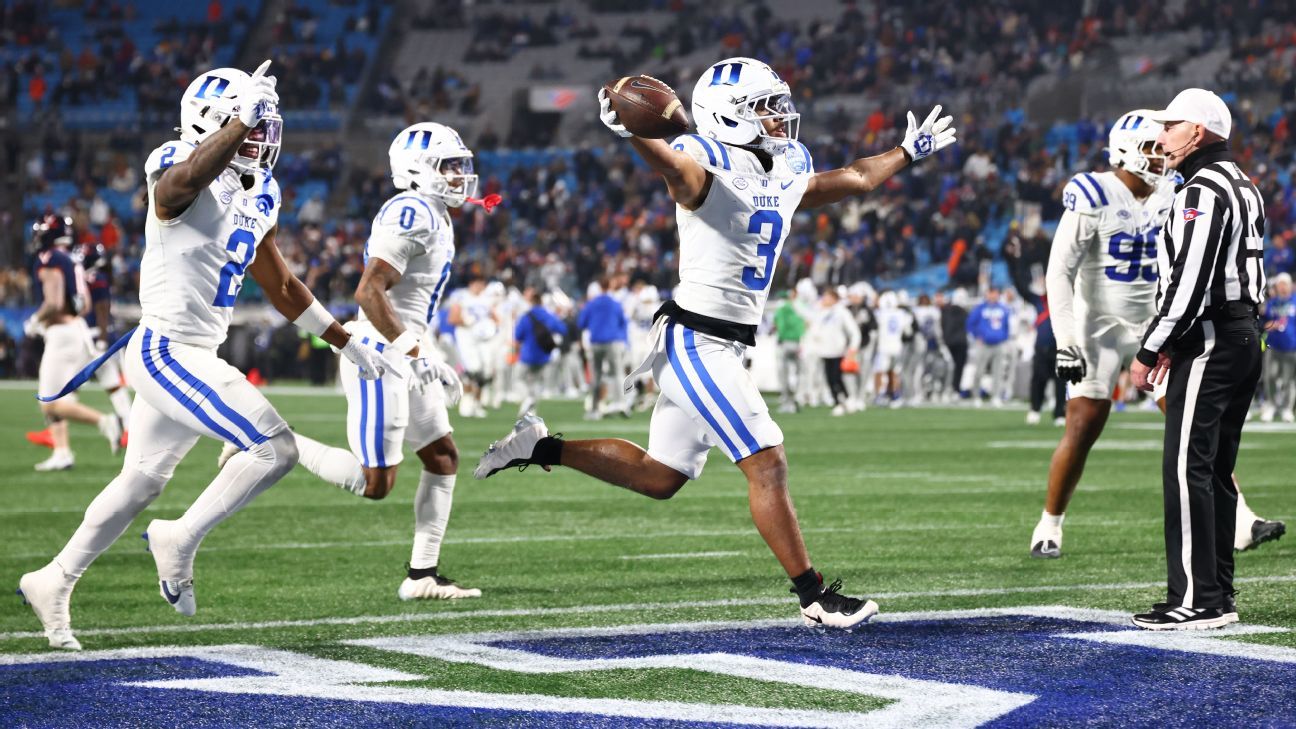
Well, doomsday has arrived, thanks to a series of fourth-down calls by Duke coach Manny Diaz, including one in overtime that resulted in the game-deciding touchdown in a 27-20 Blue Devils victory over No. 17 Virginia.
“Coach Diaz said this week, ‘If you think people hate Duke now, just wait until we win the ACC,'” Williams said.
The ACC’s fifth tiebreaker — combined win percentage of conference opponents — sent Duke to the league’s title game from among five teams tied for second place in the standings, including No. 12 Miami, a team on the fringe of an at-large CFP bid that could have benefited significantly from an extra game to wow the selection committee.
Instead, it was Duke that got the chance to avenge a Nov. 15 loss to Virginia and make its own case for playoff inclusion.
“I’m not going to take anything away from James Madison,” Diaz said. “They had a really great season. … The Sun Belt has been a really good conference in years past, but most of their top teams are having a down year. So when you start comparing strength of schedule — you can’t just look at wins and losses. It’s who you play against. That’s the whole point of playing a Power 4 schedule. There’s a reason all these coaches are all leaving for Power 4 jobs. There’s recognition that’s where the best competition is.
“The ACC champion should go to the College Football Playoff this year and every year. And we’ll be very excited to see how they rule on that tomorrow.”
James Madison coach Bob Chesney has accepted the head coaching position at UCLA, but he is expected to stay with the Dukes through any potential playoff run.
The Dukes finished the season 12-1 but lost their lone game against a Power 4 foe, Louisville, in September. James Madison beat Troy 31-14 on Friday to win the Sun Belt championship.
James Madison athletic director Matt Roan offered a counterpoint, noting that Dukes quarterback Alonza Barnett III was just coming back after a long-term injury and the Dukes still played Louisville close before losing 28-14.
“The next week, we started what is now the second-longest winning streak in the country,” Roan said. “This team is clicking since that time and separated itself as one of the five best conference champions in the country after winning the Sun Belt. JMU led the nation in wins over bowl-eligible teams with seven, matching Indiana and Ohio State. We can score points and stop points with anyone in the country. Our second halves, and fourth quarter in particular, have been untouchable. Who you play matters, but more important is how you play. Our players and our coaches have been elite all season and are deserving of this opportunity.”
James Madison was No. 25 in the most recent CFP rankings. Duke was unranked.
Diaz said after Saturday’s win, however, that the committee now has a more complete body of work to consider.
According to ESPN’s metrics, James Madison has the No. 18 strength of record but the No. 123 strength of schedule. Duke entered Saturday’s game with the No. 59 strength of record and No. 74 strength of schedule. Two of the Blue Devils’ losses were to teams outside the Power 4: playoff hopeful Tulane and 9-3 UConn.
“Having been on the selection committee, I understand it’s complicated,” Duke athletic director Nina King said. “I think we’re deserving when you look at some of these numbers like strength of schedule, number of Power 4 teams we’ve played and won. I think we’re deserving, but I fully appreciate the challenge [for the committee].”
The ACC’s doomsday scenario was in some ways more of a “Mission: Impossible.” After Duke lost to Virginia in Week 11, the Blue Devils were +1800 to win the conference and, according to ESPN’s FPI, had a 3.8% chance of winning the ACC.
Now, the conference will wait for the committee to deliver a verdict on both Duke and Miami on Sunday. The Hurricanes are 10-2 but have consistently been ranked behind several other two-loss teams, including Notre Dame, a team they beat in Week 1.
“Miami should get in,” Diaz said after Saturday’s win. “The head-to-head should matter. And so should we, because we’re the conference champion.”
ACC commissioner Jim Phillips argued the same before Saturday’s kickoff, but he declined to comment after Duke’s win over Virginia that might have left the conference with no playoff bids.
The doomsday scenario for the ACC, however, could just as easily turn into a boon with two teams in, should the committee buy into Duke’s sales pitch. Blue Devils linebacker Luke Mergott, who hauled in the championship-clinching interception in overtime, believes it will.
“We represent the ACC, and the ACC is a respected conference,” Mergott said. “I think we’ll be in, and I’m confident our name will be called.”


-
Adam Rittenberg
INDIANAPOLIS — Indiana assistant coach Ola Adams put his hands on his head in disbelief as confetti fell and the crowd roared at Lucas Oil Stadium.
But the scene unfolding before Adams on Saturday night was very believable. Since the moment coach Curt Cignetti swaggered onto campus two years earlier and outlined a success plan for the losingest program in college football, Indiana has been climbing.
On a magical night 50 miles from their home stadium, the Hoosiers reached the top, outlasting Ohio State 13-10 in a Big Ten championship game that matched the nation’s top two teams, both undefeated. Indiana beat No. 1 to become No. 1.
“We’re going to go in the playoffs as the No. 1 seed,” Cignetti said. “A lot of people probably thought that wasn’t possible.”
The milestones achieved are seemingly endless. The Hoosiers won their first Big Ten championship since 1967 and their first outright title since 1945. They beat Ohio State for the first time since 1988, ending a 32-game losing streak. And quarterback Fernando Mendoza likely clinched the school’s first Heisman Trophy with several heroic throws, rallying his team from a 10-3 deficit.
“It shows everybody: Why not? Why would you not want to come to Indiana?” linebacker Isaiah Jones said. “For any of the doubters out there, this kind of was the final nail in the coffin for any of the Indiana doubters, the Curt Cignetti doubters, the Hoosier doubters.
“This was the last thing that needed to be proved, and we did it.”
Indiana beat a top-ranked team for the first time in 17 tries, holding Ohio State scoreless for the final 40:08 and twice turning away the Buckeyes inside the 10-yard line.
“As a basketball manager, Keith Smart’s shot that won the national championship [in 1987],” Indiana athletic director Scott Dolson, who worked under coach Bob Knight for that title team, told ESPN. “This is right up there with that. This is a big moment.”
Cignetti guided the Hoosiers to a team-record 11 wins in his debut season, but when Indiana faced Ohio State, the eventual national champion, and Notre Dame, the eventual runner-up, its deficiencies were exposed in double-digit losses. Although Indiana faced a tougher regular-season schedule this fall, recorded a signature road win against Oregon and had shown clear improvement in several areas, it still entered Saturday’s game as the underdog.
But the Hoosiers (13-0) were better at the line of scrimmage, recording five sacks against an Ohio State team (12-1) that had allowed six the entire regular season. Facing Heisman Trophy contenders in quarterback Julian Sayin and wide receiver Jeremiah Smith, Indiana’s defense never yielded, making several memorable plays, including linebacker Rolijah Hardy‘s end zone pass deflection to prevent the go-ahead touchdown with 2:51 to play.
“We envisioned it,” defensive lineman Tyrique Tucker said. “We felt like we needed to handle business, especially due to last year. We felt like we had to finish some things and we had some unfinished business.”
Cignetti and his players thought that if they could keep the game close late, they would have an edge. Indiana rallied late to beat Iowa and Penn State and pulled away from Oregon with the score tied early in the fourth quarter. Ohio State, meanwhile, had not faced a second-half deficit this season until Mendoza found Elijah Sarratt for a 17-yard score with 8:02 to play in the third quarter.
“That’s what we dwell on, like, we come out and we take on a challenge,” said cornerback D’Angelo Ponds, who was matched up against Smith in man coverage throughout the game. “They haven’t been challenged all year. … We challenged them.”
Mendoza’s night began with a massive hit by Ohio State’s Caden Curry that left him writhing on the turf and forced him to miss a play. He also threw an interception that led to Ohio State’s only touchdown. But Mendoza steadied himself, even without top wideout Omar Cooper Jr., and found Charlie Becker for completions of 51 and 33 yards, the latter on third-and-6 in the final minutes.
Indiana fans gathered in the north end of the stadium chanted “Heis-Mendoza!” as Mendoza received game MVP honors.
“I don’t want to go in deep depth with the Heisman, but I remember Coach Cignetti brought me in, I think it was after UCLA, and he told me, ‘Hey, the Heisman’s a team game, it’s a team award. It’s not a player award. And if you win, then you can get nominated for it,'” Mendoza said. “Hopefully, I would love the opportunity to get the invite to New York, which would be fantastic.”
The Heisman ceremony awaits Mendoza next week, and Indiana will prepare for its first trip to the Rose Bowl since the 1967 season. But no one associated with the program will forget what happened Saturday night, just a few dozen miles from campus.
“It was just a dream come true,” Ponds said. “It actually didn’t feel real. We believed in ourselves, and we went out there and executed. It all just came together.”
-
 Sports2 years ago
Story injured on diving stop, exits Red Sox game
-
 Sports3 years ago
‘Storybook stuff’: Inside the night Bryce Harper sent the Phillies to the World Series
-
 Sports2 years ago
Game 1 of WS least-watched in recorded history
-
 Sports3 years ago
Button battles heat exhaustion in NASCAR debut
-
 Sports3 years ago
MLB Rank 2023: Ranking baseball’s top 100 players
-
Sports4 years ago
Team Europe easily wins 4th straight Laver Cup
-
 Environment3 years ago
Japan and South Korea have a lot at stake in a free and open South China Sea
-
 Environment1 year ago
Here are the best electric bikes you can buy at every price level in October 2024