Environment
Aptera (SEV) shows off assembly line for solar electric ‘car’, updates on battery and testing


Solar electric vehicle startup Aptera Motors released a new update today, giving us a first look at its validation vehicle assembly line, along with progress on battery production and efficiency testing as it moves closer to its goal of low-volume production.
The update comes just weeks after the company began trading on the Nasdaq under the ticker symbol $SEV.
The move, along with a deal to sell some shares, secured access to up to $75 million in financing for Aptera, which was struggling financially.
It enabled Aptera to get busy, and now the company has released an update about its progress over the last few weeks.
You can watch the full update video here:
On the personnel front, highlighting an expanded team across engineering, operations, and manufacturing. In the video, several new hires introduced themselves, including directors of supply chain and various engineers, signaling that the company is trying to staff up for the next phase.
But the meat of the update is on the manufacturing floor.
Aptera’s Validation Assembly Line


Steve Fambro, Aptera’s co-CEO, walked us through the facility, which he says is now “buzzing with activity”, with a few interesting time-lapse videos that showed progress.
The company has begun the buildout of its validation vehicle assembly line.
Unlike the hand-assembled prototypes we’ve seen in the past, Aptera says this new setup is designed to operate as a “normal vehicle manufacturing line” with a multi-step process. This includes receiving, inventory, kitting, and progressive installation of vehicle systems at individual stations.
At the heart of this new line is a large-scale precision assembly fixture. This is a critical piece of equipment for Aptera’s unique two-piece composite body structure.
Fambro explained the importance of this fixture:
“It’s a major step forward from the original hand-assembled approach we used on the BinC (Body in Carbon) for the first three validation vehicles. With this new fixture, we can now assemble BinCs with far greater repeatability and tighter control over final geometry.”
We also got a look at the frames, which Aptera says are robust and optimized for weight and strength.
Battery Production and ‘Gemini’ Testing

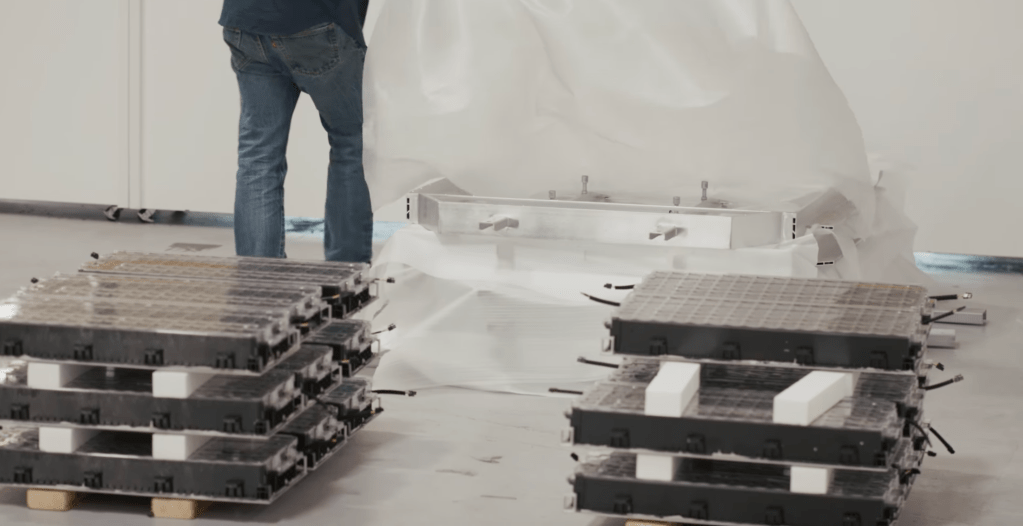
Another significant update is the battery assembly. Aptera’s battery partner, CTNS, is now on-site building battery modules.
This is the first time CTNS has assembled modules directly in Aptera’s facility. The video shows what look to be clean, precise modules ready for integration. This is a good sign for the supply chain, as the battery pack is often a major bottleneck for EV startups.
On the testing front, Aptera has been conducting internal efficiency evaluations with “Gemini,” its third production-intent vehicle.


The company claims preliminary results from combined drive cycles (high speed, stop-and-go, urban) are “encouraging.” They plan to move to more formal regulatory testing soon with the new and bigger fleet of validation vehicles.
Electrek’s Take
This is a nice progress update from Aptera. I am cautiously starting to get hope that Aptera might end up delivering a few of these vehicles.
Now, let’s be honest, there’s still a lot of work to do. The assembly line that Aptera showed today is clearly a work in progress.
$75 million might sound like a lot, but it’s nothing in the automotive manufacturing industry.
The question remains whether that capital will be enough to get them through this validation phase and into meaningful low-volume production.
As a disclosure, I have a small amount of Aptera shares from the crowdfunding days. I’ve always said I don’t see a significant chance of success, but I wish it, as I love the company’s ethos of efficiency.



FTC: We use income earning auto affiliate links. More.