
Ranking the top 25 MLB offseason trade candidates — and finding their best fits


-
Kiley McDaniel
Close
Kiley McDaniel
ESPN MLB Insider
- ESPN MLB Insider
- Kiley McDaniel covers MLB prospects, the MLB Draft and more, including trades and free agency.
- Has worked for three MLB teams.
Co-author of Author of ‘Future Value’
With baseball’s annual winter meetings set to begin next week in Orlando, Florida, and some intriguing moves already stoking the fire of this hot stove season, it’s time to rank the top players who could be included — or at least rumored to move — in trades the rest of the winter.
Baseball’s trade market is constantly evolving, and to keep you updated, we have ranked the top 25 potential trade candidates based on players’ performance — and identified the teams that could be involved in potential deals.
Though some of the players on this list are unlikely to be dealt, they’re at least being discussed in potential deals, and other names could emerge in updates to this list as the offseason plays out.
Note: Players ranked by value for their new team if traded, not likelihood of being dealt.

The buzz: Despite several executives believing Skubal will move, the Tigers have shown no sign of deviating from their position that the back-to-back American League Cy Young winner will stay in Detroit. Though he’s a free agent after 2026 and contract extension discussions have gone nowhere, Skubal is the Tigers’ centerpiece player, and Detroit intends to contend again next season.
The scouting report: After back-to-back AL Cy Young awards, Skubal is the best pitcher in the game, with Paul Skenes on his heels. Like most aces, Skubal tinkered to find an extra gear. Skubal’s changeup was the best in baseball last year by a significant margin. His usage of the pitch over the past five years went from 12% in 2021 to 15% in 2022 to 24% in 2023 to 27% in 2024 and 31% in 2025, his most-used pitch.
The velocity of his fastball (+1.8 mph) and changeup (+3.7 mph) has gone up over the past two years with the same, if not better, pitch movement. Skubal throws his slider at a cutter velocity, giving him a third plus pitch to go with durability (190-plus innings in both Cy Young years) and standout control and command. How long can Skubal, who turns 30 after the 2026 season, keep this up?
Predicted chance of getting traded: 10%
Team fits: Mets, Dodgers, Orioles, Yankees, Red Sox, Giants

The buzz: Teams believe they’ll have a better sense after the winter meetings of the Diamondbacks’ seriousness about moving the best second baseman in baseball. Marte has a very reasonable five years and $91 million (plus a sixth-year player option at $11.5 million) remaining on his contract, which means Arizona would want a whale of a return.
The scouting report: Marte is tied for the 13th-best player in baseball by WAR over the past three seasons (15.3 WAR in total). He’s 32 and is an average baserunner and defender at second base, so his value is mostly tied to his bat. That should last for a while, though, as he’s well-rounded at the plate, having better-than-average walk and strikeout rates, power numbers, contact rate and on-base percentage.
Predicted chance of getting traded: 40%
Team fits: Pirates, Giants, Phillies, Mariners, Royals, Athletics, Mets

The buzz: Though many expected a Peralta trade soon after Brandon Woodruff accepted the qualifying offer, the Brewers aren’t approaching the winter focused on dealing their top starter. If they get blown away by an offer, they won’t hesitate, but for now, the plan is to enter the year with Woodruff, Peralta, Jacob Misiorowski and Quinn Priester anchoring their rotation.
The scouting report: Peralta is going into the last season of his extension, making $8 million this year. He is drawing interest despite having just one year left on his deal because he’s a No. 2 starter and has averaged a 3.30 ERA and just under 150 innings per season since 2021, while clearing 165 innings each of the past three seasons. He relies on his fastball in an era where that isn’t en vogue, but it works due to his combination of command and a low release created by extension and a lower slot. His changeup is a plus pitch, and his breaking stuff is good enough to be effective against right-handed hitters.
Predicted chance of getting traded: 25%
Team fits: Mets, Orioles, Rangers, Giants, Astros, Diamondbacks, Padres

The buzz: Cincinnati’s cadre of excellent arms — Greene, Andrew Abbott, Nick Lodolo, Chase Burns, Brady Singer, Rhett Lowder — has opened the door for the best of the bunch to move. Don’t bet on it, though. The Reds have Greene for four more years at $60 million, and in a world where Dylan Cease is getting $210 million over seven years, frontline pitchers on inexpensive contracts are extremely valuable.
The scouting report: Greene’s heater averages 99.4 mph, which was by far the best in baseball among starters. The pitch was effective, too: the second-best fastball among starters on a per-pitch basis.
Greene has just two other pitches — a slider and splitter — that both sit in the upper-80s. He somehow started throwing his slider 2.9 mph harder in 2025 but with almost exactly the same amount of movement, so it’s now a plus pitch, too. He can work on fine-tuning his splitter locations and/or adding a fourth pitch, along with trying to exceed his career high of 150⅓ innings in a season.
Predicted chance of getting traded: 10%
Team fits: Padres, Giants, Orioles, Mets, Athletics, Diamondbacks

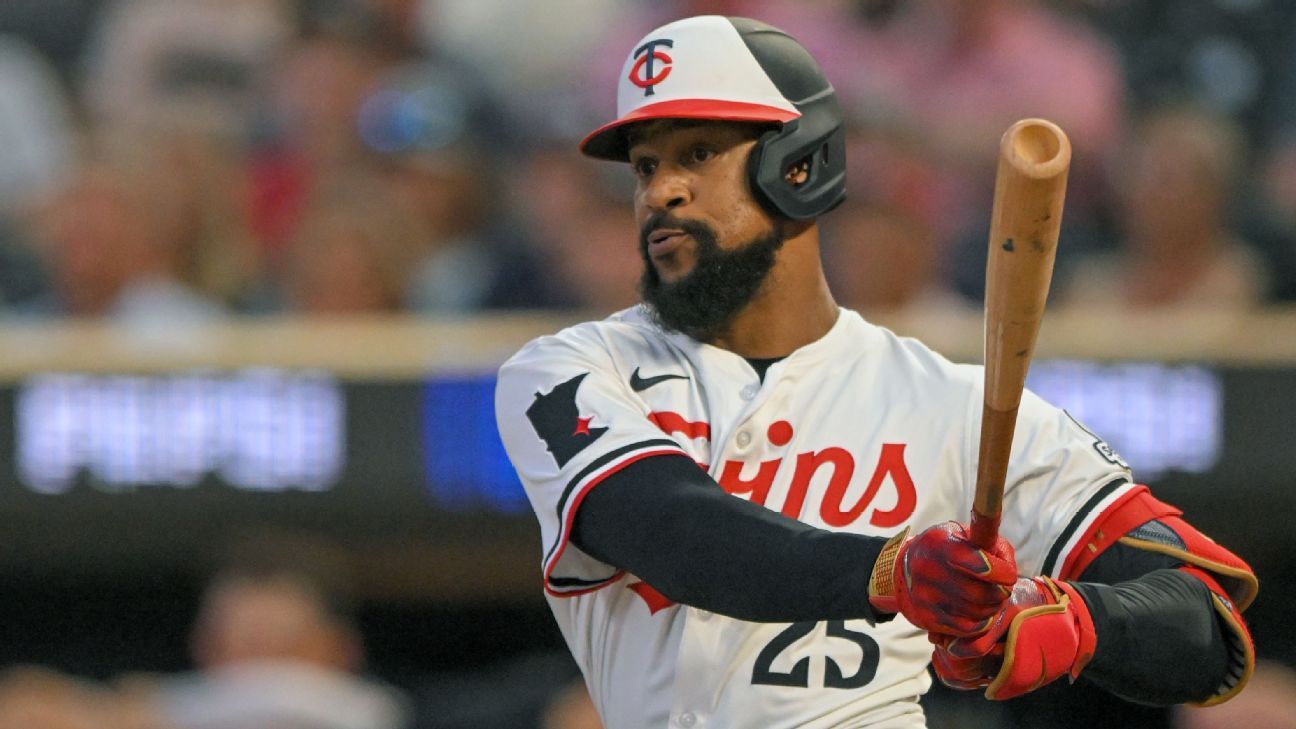
The buzz: Buxton is willing to waive his no-trade clause — and not just for Atlanta (he’s a Georgia native) — which puts the Twins in an interesting position. If the paucity of frontline free agent outfielders prompts a team to make an offer for Buxton, how seriously would Minnesota take it? And if Buxton goes, does that mean the Twins would be open to dealing some of their pitching, too? The Twins are one of the most fascinating teams this winter because of the possibilities at their disposal.
The scouting report: Buxton’s tools have been considered top of the charts since he was drafted No. 2 out of high school in 2012. He’s a top-of-the-scale runner, an above-average defender and he has a solid arm.
At the plate, he has standout bat speed that helps compensate for middling pitch selection. Buxton has the third-best isolated power in the league since 2020 (behind only Aaron Judge and Shohei Ohtani), but Buxton has roughly half the number of homers as those two in that span because of various injuries that have limited his playing time.
Last season, he had career highs in plate appearances (542) and WAR (5.0). Did Buxton figure something out about his durability at age 31 or did things fall just right? The price is right, with three years of control for just over $15 million per year.
Predicted chance of getting traded: 35%
Team fits: Braves, Mets, Tigers, Reds, Phillies, Royals
6. Joe Ryan, RHP, Minnesota Twins
The buzz: For all the rumors about Ryan at the trade deadline, the Twins never came close to finalizing a deal. If the cost remains high for free agent pitching, teams could turn to trades to fill their rotation holes, at which point Minnesota again would be a match for just about anyone. Having three of the eight best trade candidates is a good place to start a rebuild.
The scouting report: Ryan has an elite fastball, not because of his fringe-average velocity or ordinary movement, but because of his very low release height (big extension + low arm slot = flat plane and thus whiffs) and plus control. Take that key fastball/control combination and add durability (between 135 to 171 innings each of the past four seasons) along with five other solid pitches to keep hitters honest, and you have a solid No. 2 or No. 3 starter. He’s still in his 20s and has two years left of team control, so the asking price will be high.
Predicted chance of getting traded: 50%
Team fits: Red Sox, Mets, Orioles, Rangers, Giants, Astros

The buzz: The Red Sox are valuing Duran more like the seven-win player of 2024 than his 4-win version in 2025. Either way, his addition can instantaneously make a team better, and Boston can hold out for a big return because the Red Sox don’t have to deal him. At some point, though, the Red Sox will have to move Duran or Wilyer Abreu. Keeping full-time-quality players for less than full-time roles rarely works out well.
The scouting report: Duran has elite bat speed and foot speed, along with a good arm, so his physical tools can lead to a return to something like his star performance from 2024. His foot speed pays off in elite baserunning value, ranking third in baseball over the past three seasons combined at +23 runs. His true talent level seems quite close to his 2025 production, which is still one of the top 35 position players in the sport. Duran has a ton of trade value because he’s still in his 20s and has three years of control.
Predicted chance of getting traded: 50%
Team fits: Tigers, Royals, Giants, Pirates, Phillies, Mets, Reds, Diamondbacks
8. Pablo Lopez, RHP, Minnesota Twins
The buzz: With No. 2 starter potential, Lopez would slot into every big league rotation. He is signed for two more years at a reasonable $43 million. Similar to Ryan, he’s eligible for free agency after the 2027 season, and with the coming expiration of the collective bargaining agreement, teams are pricing in the potential of lost games in ’27 to any trade offer, making deals for players with two years of control particularly tricky.
The scouting report: Lopez’s fastball has long been his standout pitch, with his sweeper emerging as another weapon in the past few seasons. Forearm and shoulder issues limited Lopez to 75⅔ innings in 2025 after three seasons averaging 180-plus innings per year. Lopez has gone between a No. 2 and No. 3 starter the past five seasons, but he turns 30 in March, so it’s still a bit of a gamble to expect that to continue.
Predicted chance of getting traded: 50%
Team fits: Mets, Orioles, Giants, Astros, Padres

The buzz: Teams expect Gore to be wearing a different uniform by the end of 2026. They just aren’t sure whether a deal will happen now or at the trade deadline in July. New Washington president of baseball operations Paul Toboni has held discussions with multiple teams about Gore, but the ask is understandably high. Gore’s impending free agency after 2027 complicates things somewhat.
The scouting report: Gore was the No. 3 pick in the 2017 draft but didn’t find big league success until 2024. He has been solid the past two years, ranking 23rd in pitcher WAR in that span, but hasn’t quite made the jump to a frontline starter that some envisioned years ago.
Gore throws at least 80% fastball/slider to lefties and at least 80% fastball/curveball to righties, so developing a fourth viable pitch shape could be the key; the best pitching development clubs excel at this.
Predicted chance of getting traded: 30%
Team fits: Yankees, Orioles, Rangers, Giants, Diamondbacks

The buzz: Though it looked like Kwan would be moved before the July 31 deadline, he remained in Cleveland, and the belief among other executives is that will remain this winter. The Guardians aren’t expected to spend significant money this offseason, and their offense is paltry enough that moving Kwan — when a playoff spot in the AL Central is well within reach — doesn’t make sense.
The scouting report: Kwan is an elite defensive left fielder despite just average raw foot speed and is among the best contact hitters in the sport despite bottom-of-the-scale bat speed. Kwan has a fantastic sense of the strike zone and bat-to-ball ability, and he can make the most of his tools. Even with middling physical tools, he’s a steady 3-to-4 win player because of his incredible feel for the game. He has two years of team control left.
Predicted chance of getting traded: 25%
Team fits: Giants, Pirates, Mets, Phillies, Royals, Tigers, Astros

The buzz: The Cardinals are not eager to trade Donovan, but the market for him is percolating, and a number of teams see the 28-year-old as an option at second base, third base or left field. Because of his excellent bat-to-ball skills and gap power, Donovan can bat leadoff or occupy a middle-of-the-order role on a team with boppers. Almost nobody is off-limits as new president of baseball operations Chaim Bloom retools the Cardinals, and Donovan is the best of the available bunch.
The scouting report: Donovan has two years of control left at very affordable arbitration rates before free agency. He has plus ability to get on base, though the rest of his game is around average. He primarily plays second base, with some versatility, and hits left-handed. Donovan is a steady 3-win player with more value than most fans realize.
Predicted chance of getting traded: 75%
Team fits: Dodgers, Mariners, Yankees, Red Sox, Pirates, Giants, Royals, Guardians
12. CJ Abrams, SS, Washington Nationals
The buzz: Abrams made his first All-Star team in 2024 and followed with a nearly identical 2025. And at just 25, he’s in his prime. So why isn’t he higher on this list? His defense at shortstop is not good, and the Nationals — with a dearth of quality big league players — will not trade one to teams unwilling to pay a premium for his age, position and control.
The scouting report: Abrams has been the worst defensive shortstop over the past three seasons (-31 runs), with the next-closest player at -15 runs. But he is a solid hitter, with close to average power and on-base figures, and is also an elite baserunner, ranking sixth in baseball over the past three seasons (+18 runs) due in large part to his 109 stolen bases in that span.
If he were to excel defensively in center field while leveling up at the plate, he could still grow into a star, but those are two pretty big ifs.
Predicted chance of getting traded: 35%
Team fits: Pirates, Giants, Royals, Guardians
13. Wilyer Abreu, OF, Boston Red Sox
The buzz: It has long been expected that either Duran or Abreu would be dealt once Roman Anthony arrived, and with Boston seeking big bats on the free agent market, either outfielder could bring back some necessary pitching. Abreu is three years younger than Duran, has won back-to-back Gold Gloves in right field and comes with four years of club control, which makes the high asking price understandable.
The scouting report: Abreu is elite in right field, ranking second in runs saved behind Fernando Tatis Jr., and Abreu also has a plus-plus arm despite average foot speed. At the plate, he’s more good than great, with a power-and-patience approach that produced 22 homers last season. He’s going into his age-27 season this year, which is typically the peak age for most players.
Predicted chance of getting traded: 50%
Team fits: Tigers, Giants, Pirates, Phillies, Mets, Royals, Astros

The buzz: The former first-round pick finally broke out last year, earning an All-Star bid with a sub-3.00 ERA and the peripherals to match. Then, he suffered a shoulder injury and didn’t pitch in August or September. Any deal for Bubic is a bet on his health, and though Kansas City might have to tap into its rotation to get an outfield bat, he is perhaps the best combination of performance and affordability, questions notwithstanding.
The scouting report: Bubic added a slider in 2025 to bridge the gap between his fastball, changeup and sweeper, and it helped him look like a frontline pitcher for 20 starts, even as his fastball velo decreased a tick due to his longer outings. He’s not the same pitcher as fellow Royals lefty Cole Ragans, but a pretty similar situation (transitioning from reliever to starter with Kansas City in 2023) happened with him, and Ragans posted 4.9 WAR in his next season, en route to a fourth-place AL Cy Young finish in 2024.
Predicted chance of getting traded: 30%
Team fits: Mets, Orioles, Rangers, Giants, Diamondbacks, Padres, Angels

The buzz: On a $12 million deal (with a $10 million club option that vests at $13 million with 500 plate appearances next year), Díaz’s contract is very affordable. Whether the Rays are willing to trade him is another question. They’ve got Jonathan Aranda at first base. They’ve got enough DH at-bats to go around. And yet, there’s skepticism that they’ll move Díaz, who has spent the past seven years with the team.
The scouting report: Diaz, 34, doesn’t offer much baserunning or defensive ability, but he’s reliable at the plate. If he can get close to last year’s numbers — .300 average and 25 homers — he’ll be a huge bargain, and his option would be an easy pickup. Given his age, his bat speed could decrease soon.
Predicted chance of getting traded: 25%
Team fits: Padres, Marlins, Reds, Diamondbacks, Pirates
The buzz: Contreras always hits, and even with $41.5 million owed over the next two years (with a club option for a third), teams could use his on-base skills. He has expressed his desire to stay in St. Louis, though, and with a full no-trade clause through the end of 2026, threading the needle on the right deal could be a time suck for a team that needs to spread its bandwidth wisely.
The scouting report: Contreras moved to first base full time in 2025 and was a standout defensively, ranking third in baseball in runs saved. His plate discipline is just OK, but he always does damage at the plate, in large part due to his bat speed, which ranks eighth in baseball. He has posted 2.7 to 3.5 WAR five years in a row, and is a solid bet, especially considering he’s a 33-year-old right-handed-hitting first baseman.
Predicted chance of getting traded: 15%
Team fits: Padres, Marlins, Diamondbacks, Pirates
The buzz: A perpetual trade candidate, Lowe is in the final of two option years after a six-year extension. At $11.5 million, his contract is affordable enough that teams with holes at second base could try to wheedle the Rays into moving him. Tampa Bay loathes taking a step back, though, and considering the activity of the Rays’ AL East compatriots, only a strong offer would do the trick.
The scouting report: Lowe’s defense at second base hovered around average to slightly below for most of his career, but it regressed to -9 runs last season while his baserunning value turned negative for the first time in his career. Lowe, 31, is beginning to regress physically but still has impact in the batter’s box, leading to 31 homers and a .256 average last season.
Predicted chance of getting traded: 25%
Team fits: Pirates, Marlins, Padres, Giants, Royals, Guardians, Mariners

The buzz: The hard-throwing Cabrera exceeded 100 innings for the first time in his career in 2025 and flashed frontline starter ability. Is that enough for teams to try to acquire him? Due to Cabrera’s injury history, his ceiling and three years of control, a deal like this is tough to gauge. The Marlins understandably want premium prospects back, and teams understandably are wary of the red flags.
The scouting report: Even though he averages 97 mph with his four-seam and two-seam fastballs, the shape of Cabrera’s heater is ordinary, and the outcomes are quite bad as a result. On the bright side, his slider, curveball and changeup are all above-average-to-plus pitches, and he has solid control, so it’s a matter of playing into his strengths. Cabrera turns 28 in April and comes with three years of control at arbitration prices and big upside if he can build upon his career high of 137⅔ innings.
Predicted chance of getting traded: 40%
Team fits: Yankees, Orioles, Giants, Astros, Diamondbacks, Padres, Rays

The buzz: If Keller, 29, is moved — and the Pirates would like to deal a starter for a bat — the return might be an every-day player with a hefty salary commensurate to Keller’s than a collection of prospects. At $55.7 million for the next three seasons, Keller provides value more as an innings eater than a top-of-the-rotation pitcher.
The scouting report: Keller is reliable, ranking sixth in baseball in innings over the past three seasons (548⅔). Keller’s raw stuff is more good than great, with average velocity on his fastball and sinker, along with a standout sweeper; he’s a steady No. 3 or No. 4 starter.
Predicted chance of getting traded: 60%
Team fits: Rangers, Astros, Angels, Athletics, Mets

The buzz: As the Padres grapple with a rotation that needs three spots filled behind Nick Pivetta and Joe Musgrove, who is returning from Tommy John surgery, their financial state comes into play. They need to move money, and dealing Cronenworth is the easiest route to do so, with his appealing versatility and five years and $60 million remaining on his deal.
The scouting report: Cronenworth doesn’t have big tools or a huge upside, but is a steady player with medium tools and outstanding control of the strike zone. Being average to a touch above across the board while playing second base and hitting from the left side makes him a solid every-day player with a high floor and lots of contractual control.
Predicted chance of getting traded: 25%
Team fits: Mariners, Pirates, Marlins, Royals

The buzz: Now is finally the time, it seems, for Robert to move. The White Sox held on to him after his excellent 2023, hoping to cash in at the deadline in 2024. Then, Robert cratered and took his trade value with him. Though Chicago wouldn’t be giving him away, the combination of two bad years and a substantial salary would limit the return on any potential deal.
The scouting report: The White Sox picked up Robert’s $20 million option for 2026, and they have another $20 million club option for 2027. He still has elite tools — in the 90th or better percentile, per Baseball Savant, for sprint speed, defensive range, and bat speed — but has been inconsistent, injured and unlucky on balls in play over the past two seasons. His 4.9 WAR campaign in 2023 (.264 average, 38 homers, 20 stolen bases, plus defense) is what Chicago or any team that acquires him is banking on seeing again, rather than the combined 1.9 WAR since.
Predicted chance of getting traded: 60%
Team fits: Giants, Phillies, Mets, Reds
The buzz: Alcantara’s return from Tommy John surgery was so-so, and the market for him at the trade deadline reflected that. At $17.3 million this year (with a $21 million club option for next season), teams aren’t clamoring to give Miami the return it would need to give him up. At the same time, with a rotation of Alcantara, Cabrera, Eury Perez, Ryan Weathers, Max Meyer and Braxton Garrett — plus the best left-handed pitcher in the minor leagues, Thomas White, on the doorstep — dealing a pitcher makes sense.
The scouting report: Alcantara is 30 years old and his 2022 NL Cy Young is in the rear view. He’s back to supplying bulk, with 174⅔ innings in an up-and-down 2025 season after having elbow surgery that caused him to miss the 2024 season. Alcantara’s power sinker (averaging 97.2 mph in 2025) has been his best pitch most seasons, but he needs to find an out-pitch to regain his past form; his slider and changeup are the leading options and have shown flashes.
Predicted chance of getting traded: 30%
Team fits: Orioles, Rangers, Giants, Astros, Angels
23. Brady Singer, RHP, Cincinnati Reds
The buzz: If the Reds were to trade a starter, Singer would make much more sense than Greene or Abbott. He’s a free agent after this season, and taking a trade the Reds already won (for Jonathan India last winter) and parlaying it into even more is an ideal scenario.
The scouting report: Singer has one year of control remaining at roughly $12 million, pending arbitration. Singer has thrown between 150 and 180 innings each of the past four seasons but with below-average fastball velocity (92.2 mph, a sinker), so he can be classified as an innings eater. His slider (and sweeper) are his best pitches, delivered from a low release due to his low arm slot and big extension.
Predicted chance of getting traded: 25%
Team fits: Orioles, Rangers, Giants, Astros, Padres, Rays

The buzz: Bohm being dealt could depend on the Phillies’ other moves. If they miss out on Kyle Schwarber and pivot to Alex Bregman, Bohm is as good as gone. If they spend their money elsewhere, they still could move him and either acquire a stopgap at third or run with top prospect Aidan Miller. In a winter of change in Philadelphia, Bohm is among the likeliest of Phillies not to return.
The scouting report: Bohm has one year of control left at roughly $10 million, pending arbitration. His numbers regressed a bit in 2025, with his walk and strikeout rate, along with his power numbers and defensive metrics, all taking a step back. If he could get back to his 2023-24 levels of power (50-plus extra-base hits both seasons), Bohm could be a nice bounce-back candidate.
Predicted chance of getting traded: 50%
Team fits: Brewers, Mariners, Pirates, Angels

The buzz: The acquisition of Marcus Semien took away McNeil’s at-bats at second base, and he’s not a great defensive outfielder, which, for a team looking to shore up its fielding, is suboptimal. The expectation, then, is that McNeil will be dealt, even if New York needs to eat some of his $15.75 million deal (with a $2 million buyout on an option for 2027).
The scouting report: McNeil is a “nice to have” utility player who can play capably all over the field and hit at a league average or better rate from the left side. He’ll be 34 in April, isn’t an impact type of player and has had some injuries the past few seasons. But he’s a valuable role player on a contender or a nice upgrade for a smaller-market club looking to upgrade its offensive floor.
Predicted chance of getting traded: 80%
Team fits: Pirates, Giants, Royals
15 more who could move
Nolan Arenado, 3B, St. Louis Cardinals
Nick Castellanos, OF, Philadelphia Phillies
Triston Casas, 1B, Boston Red Sox
Jasson Dominguez, OF, New York Yankees
Kyle Freeland, LHP, Colorado Rockies
Nolan Gorman, 2B, St. Louis Cardinals
Ryan Jeffers, C, Minnesota Twins
Jake Meyers, CF, Houston Astros
Ryan Mountcastle, 1B/OF, Baltimore Orioles
JoJo Romero, LHP, St. Louis Cardinals
Kodai Senga, RHP, New York Mets
Luis Severino, RHP, Athletics
Alek Thomas, OF, Arizona Diamondbacks
Mark Vientos, 1B/3B, New York Mets
Christian Walker, 1B, Houston Astros

-
Jorge Castillo
The New York Mets and reliever Devin Williams agreed to a three-year, $51 million deal, league sources told ESPN’s Jeff Passan on Monday night, giving the club a replacement for Edwin Diaz should the All-Star closer sign elsewhere.
The contract has no opt-outs or options but includes a $6 million signing bonus spread over the three seasons.
Williams will bolster the back end of a bullpen that the Mets are determined to substantially improve this winter. The question is whether he will be used as a setup man or a closer.
Williams’ role depends on whether the Mets re-sign Diaz, who opted out of his contract last month and is considered the top free agent reliever this offseason. The addition of Williams does not erase the possibility of a reunion with Diaz, and the Mets remain interested in bringing him back, sources told Passan.
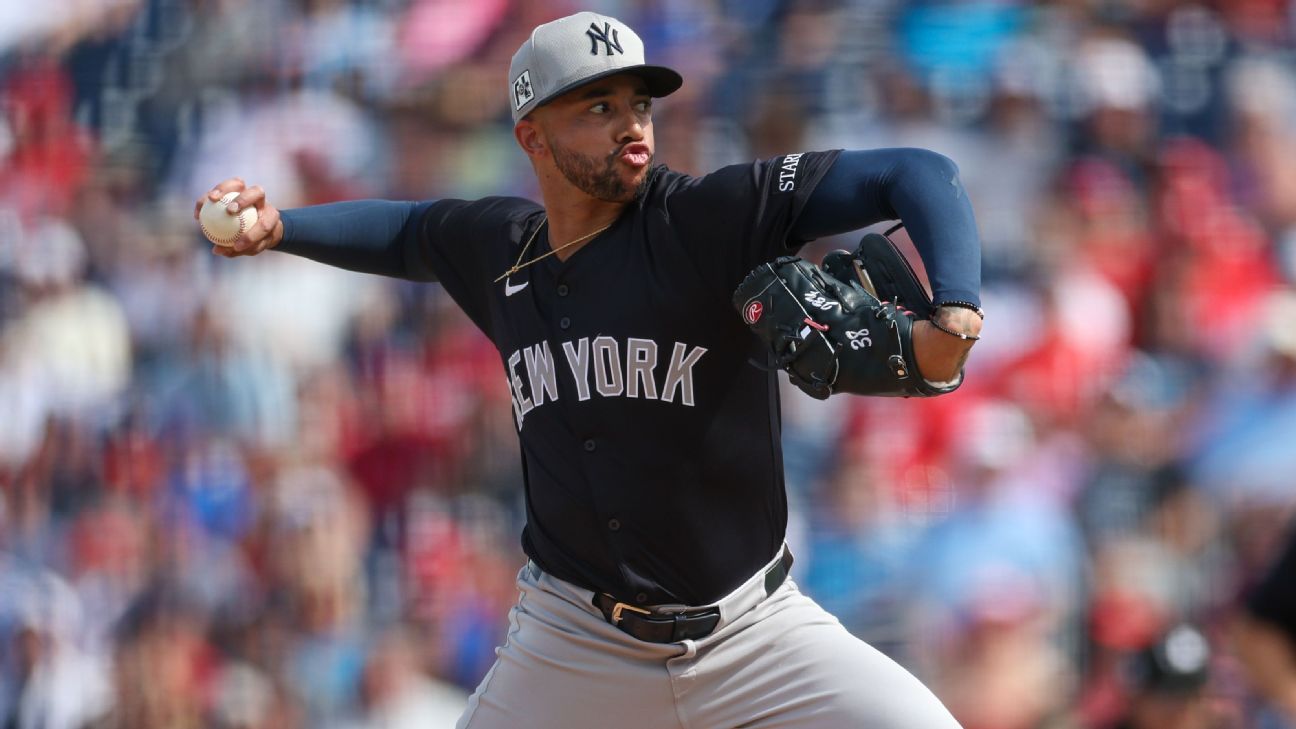
Williams, 31, hit free agency after his lone season with the New York Yankees. Acquired last December from the Milwaukee Brewers for pitcher Nestor Cortes and National League Rookie of the Year finalist Caleb Durbin, Williams struggled to a career-worst 4.79 ERA over 67 appearances for New York. But underlying metrics — including a 2.68 FIP, a .195 expected batting average against, and elite strikeout, whiff and chase rates — suggest the bloated ERA is misleading.
He saved 18 games in 22 chances for the Yankees, but despite entering the season as the designated closer, he shared the role for most of the season after his rough start to 2025. Williams recorded four scoreless outings during the Yankees’ postseason run, but David Bednar earned both of New York’s playoff saves.
Before joining the Yankees, Williams was a premier back-of-the-bullpen pitcher during his six seasons with Milwaukee, first as a setup reliever for star closer Josh Hader and then as Hader’s replacement in the role.
After winning the NL Rookie of the Year in 2020 — when he posted a 0.33 ERA over 22 outings — Williams was named to two NL All-Star teams. During the three seasons before being dealt to the Yankees, Williams went 15-7 with 65 saves and a minuscule 1.66 ERA.
Williams has had an unorthodox style as a closer. Despite a fastball velocity below the big league average, he flourished thanks to one of the game’s best changeups, an offering so distinct that it acquired a nickname — “The Airbender.”
Now, Williams will be reunited with Mets president of baseball operations David Stearns, who was in that role for the Brewers for Williams’ first four seasons in Milwaukee.
Williams’ agreement with the Mets was first reported by The Athletic.
ESPN MLB Writer Bradford Doolittle contributed to this report.


The Orioles signed closer Ryan Helsley to a two-year contract Monday, continuing the remaking of their beleaguered pitching staff with one of the most sought-after relievers on the free agent market.
Sources told ESPN’s Jeff Passan that the deal is for $28 million and includes an opt-out after the first season.
While multiple teams sought to sign Helsley as a starter, the 31-year-old right-hander chose to remain in the role that made him a two-time All-Star and will hand him the ninth inning for the Orioles while retaining the ability to reach the open market after 2026.
Helsley, whose deal is pending a physical, is the second bullpen addition of the winter for Baltimore, which reacquired right-hander Andrew Kittredge from the Cubs after dealing him to Chicago at the trade deadline. With a moribund pitching staff, the Orioles went 75-87 and finished in last place in the American League East after consecutive postseason berths.
Orioles president of baseball operations Mike Elias trawled the free agent market for a late-inning option and landed on Helsley, who over his seven-year career has a 2.96 ERA in 319⅔ innings with 377 strikeouts, 133 walks and 105 saves.
Among the lowest points were the final two months of Helsley’s 2025 season, when, following a deadline deal from St. Louis to the New York Mets, he posted a 7.20 ERA and allowed 36 baserunners in 20 innings. Coming off an All-Star showing for St. Louis in 2024, which included a National League-leading 49 saves and a 2.04 ERA, Helsley saved 21 games with a solid 3.00 ERA for the Cardinals before the deadline, when he was sent to the Mets for three prospects.
Acquired to deepen a New York bullpen anchored by closer and fellow free agent Edwin Diaz, Helsley struggled badly during his time with the Mets. He blew saves in three straight appearances in mid-August and spent most of the past month working in low-leverage situations as New York collapsed down the stretch and missed the postseason.
Baltimore saw more noise than signal in Helsley’s downturn and is banking on Helsley’s stuff — which pitch-quality metrics rate as some of the best in the game — returning him to dominance. Helsley deploys one of baseball’s hardest fastballs, which averaged 99.3 mph in 2025, according to Statcast, ranking in the 99th percentile of all pitchers.
With incumbent closer Felix Bautista expected to miss the 2026 seasons following rotator cuff and labrum surgeries in August, the Orioles entered the winter with only right-hander Yennier Cano and left-hander Keegan Akin as veteran bullpen options. Beyond Helsley and Kittredge, Baltimore could add another reliever, sources said. The Orioles’ need for pitching help isn’t limited to their bullpen, either. Following the trade of Grayson Rodriguez to the Los Angeles Angels for left fielder Taylor Ward, Baltimore continues to pursue starting-pitching options to join left-hander Trevor Rogers and right-hander Kyle Bradish at the top of their rotation, sources said.
A fifth-round pick out of Northeastern State in Oklahoma, Helsley was a full-time starter throughout the minor leagues until he joined the Cardinals’ big league roster. From 2022 to ’24, he was arguably the most valuable reliever in the NL, alongside right-hander Devin Williams, a free agent with whom the Orioles spoke as well.
ESPN’s Bradford Doolittle contributed to this report.
-
 Sports2 years ago
Story injured on diving stop, exits Red Sox game
-
 Sports3 years ago
‘Storybook stuff’: Inside the night Bryce Harper sent the Phillies to the World Series
-
 Sports2 years ago
Game 1 of WS least-watched in recorded history
-
 Sports3 years ago
Button battles heat exhaustion in NASCAR debut
-
 Sports3 years ago
MLB Rank 2023: Ranking baseball’s top 100 players
-
Sports4 years ago
Team Europe easily wins 4th straight Laver Cup
-
 Environment3 years ago
Japan and South Korea have a lot at stake in a free and open South China Sea
-
 Environment1 year ago
Here are the best electric bikes you can buy at every price level in October 2024