World
Powerful earthquake in northern Japan triggers tsunami, injuring 23


A powerful earthquake struck off northern Japan, injuring 23 people and unleashing a tsunami.
The 7.5-magnitude quake struck at about 11.15pm local time, around 80 kilometers off the coast of Aomori prefecture.
Japan’s Fire and Disaster Management Agency said 23 people were injured, including one seriously, with most hurt by falling objects.
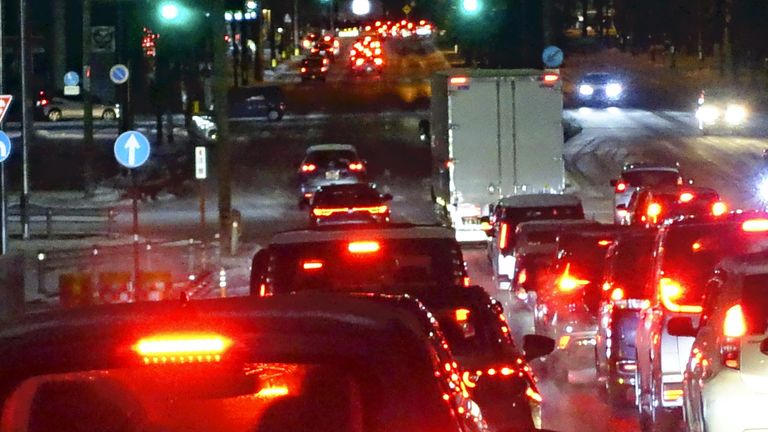
A road is congested with cars heading for higher ground in Tomakomai City December 8, 2025 after a magnitude 7.6 earthquake. Pics: AP
A tsunami of 70cm was measured just south of Aomori, in Kuji port, Iwate prefecture, while levels of up to 50cm struck elsewhere in the region, the Japan Meteorological Agency said.
“I’ve never experienced such a big shaking,” said Nobuo Yamada, who owns a convenience store in Hachinohe, Aomori, in an interview with public broadcaster NHK.
Earlier on, the meteorological agency issued an alert for potential tsunami surges of up to 3m/10ft, with 90,000 residents ordered to evacuate.
Residents were urged by chief cabinet secretary Minoru Kihara to go to higher ground or seek shelter until advisories were lifted.
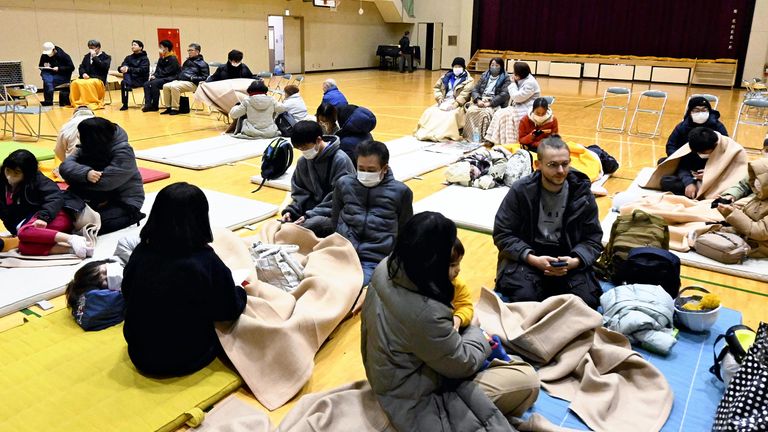
People sheltering today in Kamaishi Elementary School in Kamaishi City, Miyagi Prefecture. Pic: AP
He said about 800 homes were without electricity, and that the Shinkansen bullet trains and some local lines were suspended in parts of the region.
Some 480 residents took shelter at the Hachinohe Air Base, defence minister Shinjiro Koizumi said, with 18 defence helicopters mobilised for damage assessments.
While Satoshi Kato, vice principal of a public high school in the same town, encountered traffic jams and car accidents en-route to the school as panicked people tried to flee.
Japan has recent experience of the perils of earthquakes – one in 2011 unleashed a tsunami that killed some 20,000 people and triggered a nuclear meltdown at the Fukushima Daiichi Nuclear Power Plant.
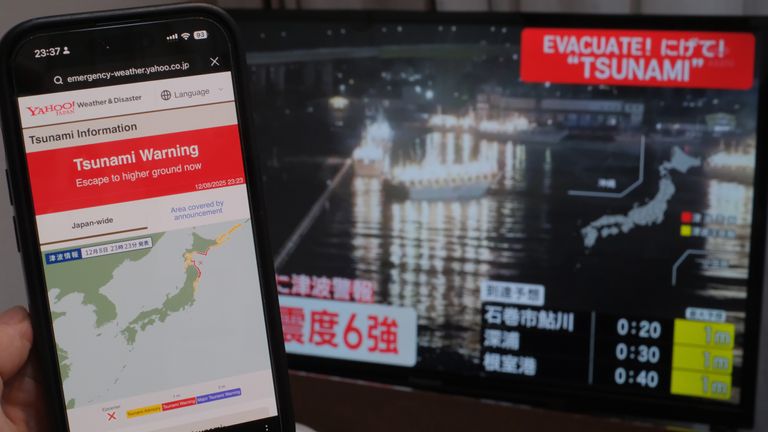
The earthquake warning off the coast of Aomori Prefecture, Japan. Pic: AP
Today’s quake caused about 450 litres of water to spill from a spent fuel cooling area at the Rokkasho fuel reprocessing plant in Aomori, the Nuclear Regulation Authority said.
But water levels remained within the normal range and there was no safety concern, the authority added.
Read more:
Tokyo overtaken as world’s biggest city
Japan sends in troops over deadly bear attacks
The Japanese government has now lifted all remaining tsunami advisories, but warned people to remain alert for another week in case of aftershocks.
Satoshi Harada, from the meteorological agency’s earthquake and volcano division, cautioned that the 2011 quake could repeat itself.
“You need to prepare, assuming that a disaster like that could happen again,” he said.