

Young people may lose benefits if they don’t engage with help from new £820m scheme, government warns

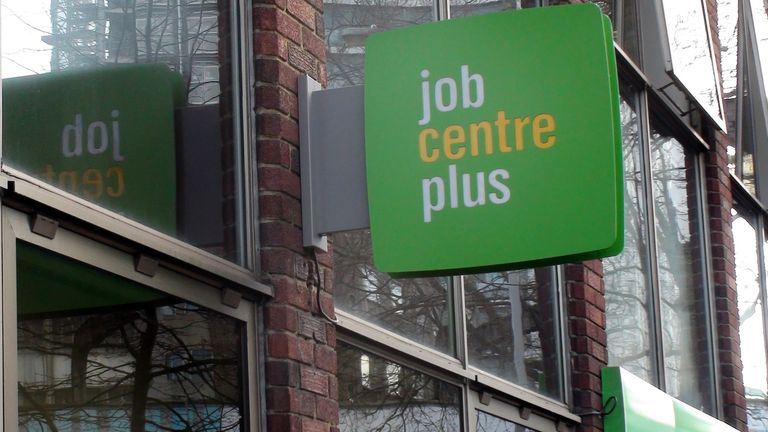
Young people could lose their right to universal credit if they refuse to engage with help from a new scheme without good reason, the government has warned.
Almost one million will gain from plans to get them off benefits and into the workforce, according to officials.
Latest updates from the Politics Hub
Pic: iStock
It comes as the number of young people not in employment, education or training (NEET) has risen by more than a quarter since the COVID pandemic, with around 940,000 16 to 24-year-olds considered as NEET as of September this year, said the Office for National Statistics.
That is an increase of 195,000 in the last two years, mainly driven by increasing sickness and disability rates.
The £820m package includes funding to create 350,000 new workplace opportunities, including training and work experience, which will be offered in industries including construction, hospitality and healthcare.
Around 900,000 people on universal credit will be given a “dedicated work support session”.
That will be followed by four weeks of “intensive support” to help them find work in one of up to six “pathways”, which are: work, work experience, apprenticeships, wider training, learning, or a workplace training programme with a guaranteed interview at the end.
However, Work and Pensions Secretary Pat McFadden has warned that young people could lose some of their benefits if they refuse to engage with the scheme without good reason.
“Doing nothing should not be an option,” he told Sky News’ Sunday Morning with Trevor Phillips.
“If someone just took that attitude, yes, they would then be subject to, you know, the obligations that are already part of the system.”
“What I want to see is young people in the habit of getting up in the morning, doing the right thing, going to work,” he added.
“That experience of that obligation, but also the sense of pride and purpose that comes with having a job.”

Some young people on benefits will be offered job opportunities in construction. Pic: iStock
Read more from Sky News:
Child poverty strategy unveiled – but not everyone’s happy
Universal credit claimants soar by over million in a year
The government says these pathways will be delivered in coordination with employers, while government-backed guaranteed jobs will be provided for up to 55,000 young people from spring 2026, but only in those areas with the highest need.
However, shadow work and pensions secretary Helen Whately, from the Conservatives, said the scheme is “an admission the government has no plan for growth, no plan to create real jobs, and no way of measuring whether any of this money delivers results”.
She told Sky News the proposals are a “classic Labour approach” for tackling youth unemployment.

Youth jobs plan ‘the wrong answer’
“What we’ve seen today announced by the government is funding the best part of £1bn on work placements, and government-created jobs for young people. That sounds all very well,” she told Sunday Morning with Trevor Phillips.
“But the fact is, and that’s the absurdity of it is, just two weeks ago, we had a budget from the chancellor, which is expected to destroy 200,000 jobs.
“So the problem we have here is a government whose policies are destroying jobs, destroying opportunities for young people, now saying they’re going to spend taxpayers’ money on creating work placements. It’s just simply the wrong answer.”
Ms Whately also said the government needs to tackle people who are unmotivated to work at all, and agreed with Mr McFadden on taking away the right to universal credit if they refuse opportunities to work.
But she said the “main reason” young people are out of work is because “they’re moving on to sickness benefits”.
Ms Whately also pointed to the government’s diminished attempt to slash benefits earlier in the year, where planned welfare cuts were significantly scaled down after opposition from their own MPs.
The funding will also expand youth hubs to help provide advice on writing CVs or seeking training, and also provide housing and mental health support.
Some £34m from the funding will be used to launch a new “Risk of NEET indicator tool”, aimed at identifying those young people who need support before they leave education and become unemployed.
Monitoring of attendance in further education will be bolstered, and automatic enrolment in further education will also be piloted for young people without a place.
Politics
Rayner’s combative, defiant performance in Commons signals to Labour MPs she’s here to make a comeback and shows them what they’ve been missing

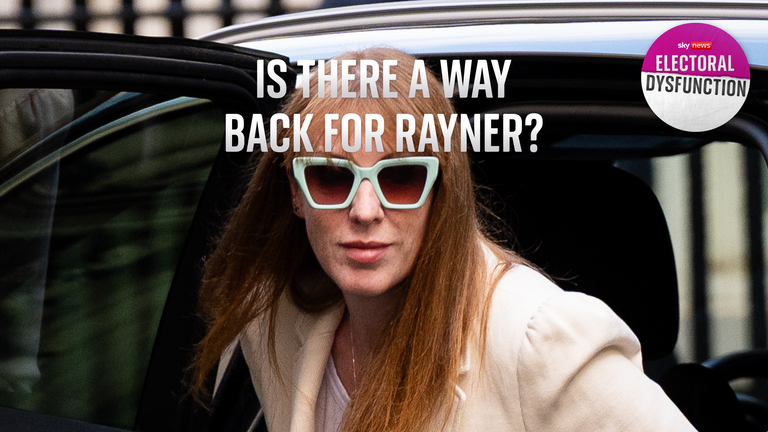
The day after Sir Keir Starmer said he wanted Angela Rayner back in the cabinet, she showed Labour MPs what they’ve been missing.
The former deputy prime minister delighted Labour backbenchers with a powerful Commons speech defending her workers’ rights legislation on Monday evening.
With the House of Lords locked in a battle of parliamentary “ping pong” with MPs, she told ministers: “Now is not the time to blink or buckle.”
Her very public intervention came amid claims that her next move has the Labour Party on tenterhooks and that she’s the favourite to succeed Sir Keir if she wants the job.
And her speech, delivered from notes and clearly meticulously prepared, appeared to send a message to Labour MPs: I’m here to make a comeback.
The government’s flagship Employment Rights Bill was championed by Ms Rayner when she was deputy PM, in the face of bitter opposition from the Conservatives.
In a bid to end the deadlock with the Lords, ministers have backed down on unfair dismissal protection from day one, proposing a compromise of six months.
Backing the compromise, brokered with the TUC, Ms Rayner said: “I know ministers had faced difficult decisions and difficult discussions with the employers and worker representatives.
“But I strongly believe that the work that has been done has been necessary, and we should be able to move forward now.”
Could Rayner come back?
Attacking the upper chamber for delaying the legislation, she said: “There is now no more time to waste.
“Vested interests worked with the Tories and the Lib Dems and, cheered on by Reform and backed by the Greens, to resist the manifesto on which we were elected.
“And now there can be no excuses. We have a mandate for a new deal for working people, and we must, and we will deliver it.
And she concluded: “It has been a battle to pass this bill, but progress is always a struggle that we fought for. Its passage will be a historic achievement for this Labour government.
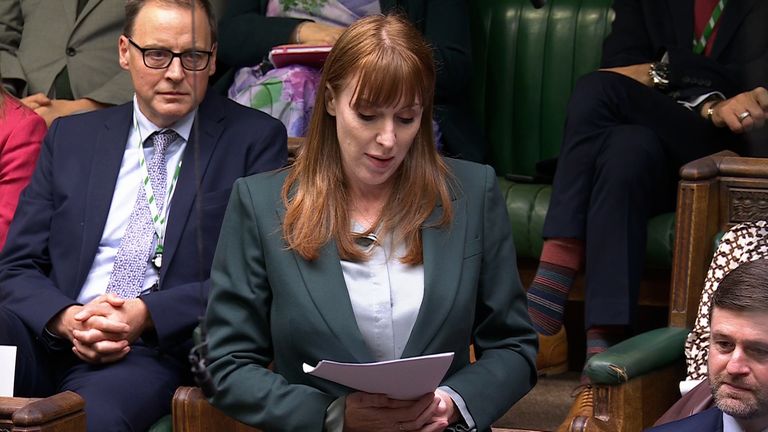
Angela Rayner’s resignation speech
“It will benefit working people now and into the future. Now is not the time to blink or buckle. Let’s not waste a minute more. It’s time to deliver.”
It was the sort of fighting talk and defiance of the government’s opponents that will have cheered up Labour MPs and boosted her hopes of a comeback and even a leadership bid.
It came as speculation over Sir Keir’s future grows more frenzied by the day, with claims that even some of his own supporters have begun the hunt for his successor.
The thinktank that ran his leadership campaign in 2020, Labour Together, is reported to be canvassing party members on candidates to replace him.

Wes Streeting and Angela Rayner.
There was even a claim last week that allies of Wes Streeting were sounding out Labour MPs about a pact with Ms Rayner and a joint ticket for the leadership.
The health secretary dismissed that claim as a “silly season story”, while a Rayner ally said: “There’s no vacancy and there’s no pact”. They added that she will not “be played like a pawn”.
Mr Streeting did, however, start speculation himself when he said in his Labour conference speech: “We want her back. We need her back.”
Fuelling more speculation, Sir Keir went further than he had previously on Sunday, when he was asked in an Observer interview if he missed her and replied; “Yes, of course I do. I was really sad that we lost her.”
And asked if she would return to the cabinet, the prime minister said: “Yes. She’s hugely talented.”
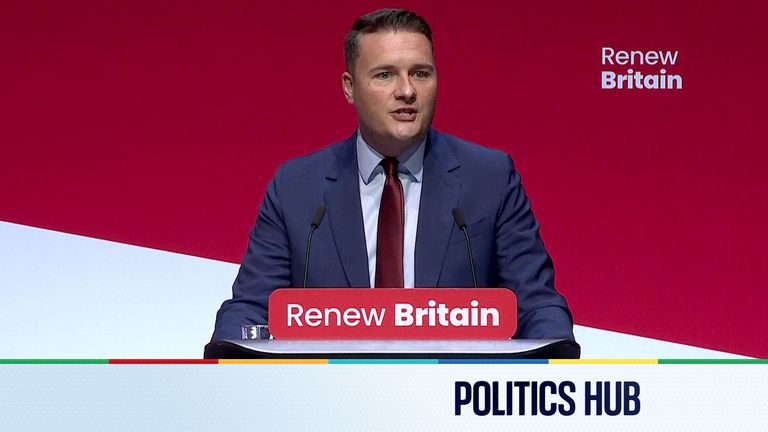
‘Angela Rayner, this achievement is yours.’
Sir Keir also described Ms Rayner, who left school at 16 without any qualifications, as “the best social mobility story this country has ever seen”.
But a swift return to the cabinet would be hugely controversial, because the PM’s ethic adviser, Sir Laurie Magner, ruled that she breached the ministerial code by underpaying stamp duty when she bought a flat.
But she has been linked to speculation about possible efforts to remove Sir Keir if – as predicted – Labour performs badly in the Scottish, Welsh and local elections next May.
Her supporters also claim she will eventually be cleared by HMRC over her stamp duty breach, clearing the way for her to come back.
And her latest speech – combative, defiant and yet loyal – will have boosted her hopes, and reminded Labour MPs what they’ve missed since she quit in September.

The Sandie Peggie case has been such a high-profile story because it gets to the heart of the debate about trans rights versus women’s rights, which has been so fraught in recent years – especially in Scotland.
While the Supreme Court ruled in April that the Equality Act referred to a person’s biological sex – with major ramifications over who can use female-protected spaces – we are still waiting for long-delayed government guidance on how this should be applied. We are told it’s due “as soon as possible”.
Government minister Dame Diana Johnson brightly told Darren McCaffrey on Sky’s Politics Hub on Monday that organisations “just need to get on with it – the law is clear”.
But with so many organisations waiting for government guidance before changing policy – that’s clearly not the case.
Tap here for the latest political news
Campaigners have criticised the Peggie tribunal for not following the Supreme Court’s lead more directly. The tribunal didn’t find that it was wrong to let Dr Upton use the female changing rooms – just that action should have been taken after Ms Peggie complained.
Her lawyers say that is hugely problematic, as it puts the onus on a woman to complain.
The political reaction has been swift. Conservative leader Kemi Badenoch has long been outspoken on this issue, and she has posted a typically punchy statement in response to the case.
“It’s ridiculous it took two years to reach a verdict that was so obvious from the start,” she wrote on X.
“This entire episode is indicative of a system wasting time and taxpayers’ money to please a small cabal of activists.”
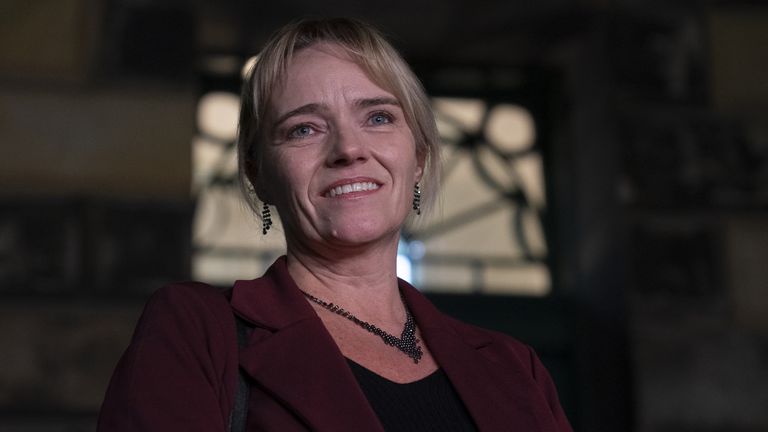
Nurse Sandie Peggie, pictured outside the Edinburgh Tribunals Service after she won a claim for harassment. Pic: PA
But it’s not just the Tories. Scottish Labour MP Joani Reid described Ms Peggie’s treatment as “a disgrace…enabled by a warped NHS culture and fostered by a Scottish government that refused to listen to women’s concerns”.
Of course, the SNP have always been hugely supportive of trans rights, attempting to pass gender recognition laws which would have made it much easier for people to self-ID. That legislation was blocked by the UK Supreme Court.
John Swinney gave a carefully worded response when asked about the issue on Monday, saying “it’s important to take time to consider the judgment” with no further comment on the questions raised by the case.
Sir Keir Starmer, too, has long been dogged by criticism over the lack of clarity in some of his answers to the question “what is a woman”, although he has sought to be more definite in recent years.
Anna Turley, the chair of the Labour Party, said on Monday that it’s more important to get the Supreme Court guidance right than to get it out quickly.
But Monday’s judgment shows the urgent importance of both.

With Do Kwon scheduled to be sentenced on Thursday after pleading guilty to two felony counts, a US federal judge is asking prosecutors and defense attorneys about the Terraform Labs co-founder’s legal troubles in his native country, South Korea, and Montenegro.
In a Monday filing in the US District Court for the Southern District of New York, Judge Paul Engelmayer asked Kwon’s lawyers and attorneys representing the US government about the charges and “maximum and minimum sentences” the Terraform co-founder could face in South Korea, where he is expected to be extradited after potentially serving prison time in the United States.
Kwon pleaded guilty to two counts of wire fraud and conspiracy to defraud in August and is scheduled to be sentenced by Engelmayer on Thursday.

In addition to the judge’s questions on Kwon potentially serving time in South Korea, he asked whether there was agreement that “none of Mr. Kwon’s time in custody in Montenegro” — where he served a four-month sentence for using falsified travel documents and fought extradition to the US for more than a year — would be credited to any potential US sentence.
Judge Engelmayer’s questions signaled concerns that, should the US grant extradition to South Korea to serve “the back half of his sentence,” the country’s authorities could release him early.
Kwon was one of the most prominent figures in the crypto and blockchain industry in 2022 before the collapse of the Terra ecosystem, which many experts agree contributed to a market crash that resulted in several companies declaring bankruptcy and significant losses to investors.
Defense attorneys requested that Kwon serve no more than five years in the US, while prosecutors are pushing for at least 12 years.
Related: There’s more to crypto crime than meets the eye: What you need to know
The sentencing recommendation from the US government said that Kwon had “caused losses that eclipsed those caused” by former FTX CEO Sam Bankman-Fried, former Celsius CEO Alex Mashinsky and OneCoin’s Karl Sebastian Greenwood combined. All three men are serving multi-year sentences in federal prison.
Will Do Kwon serve time in South Korea?
The Terraform co-founder’s lawyers said that even if Engelmayer were to sentence Kwon to time served, he would “immediately reenter pretrial detention pending his criminal charges in South Korea,” and potentially face up to 40 years in the country, where he holds citizenship.
Thursday’s sentencing hearing could mark the beginning of the end of Kwon’s chapter in the 2022 collapse of Terraform. His whereabouts amid the crypto market downturn were not publicly known until he was arrested in Montenegro and held in custody to await extradition to the US, where he was indicted in March 2023 for his role at Terraform.
South Korean authorities issued an arrest warrant for Kwon in 2022, but have not had him in custody since the collapse of the Terra ecosystem. The country’s prosecutors applied to extradite Kwon from Montenegro simultaneously with the US, while they were pursuing similar cases against individuals tied to Terraform.
Magazine: When privacy and AML laws conflict: Crypto projects’ impossible choice
-
 Sports2 years ago
Story injured on diving stop, exits Red Sox game
-
 Sports3 years ago
‘Storybook stuff’: Inside the night Bryce Harper sent the Phillies to the World Series
-
 Sports2 years ago
Game 1 of WS least-watched in recorded history
-
 Sports3 years ago
Button battles heat exhaustion in NASCAR debut
-
 Sports3 years ago
MLB Rank 2023: Ranking baseball’s top 100 players
-
Sports4 years ago
Team Europe easily wins 4th straight Laver Cup
-
 Environment3 years ago
Japan and South Korea have a lot at stake in a free and open South China Sea
-
 Environment1 year ago
Here are the best electric bikes you can buy at every price level in October 2024