UK
Royal Navy chief gives stark warning: Fund defence or risk losing Atlantic to Russia

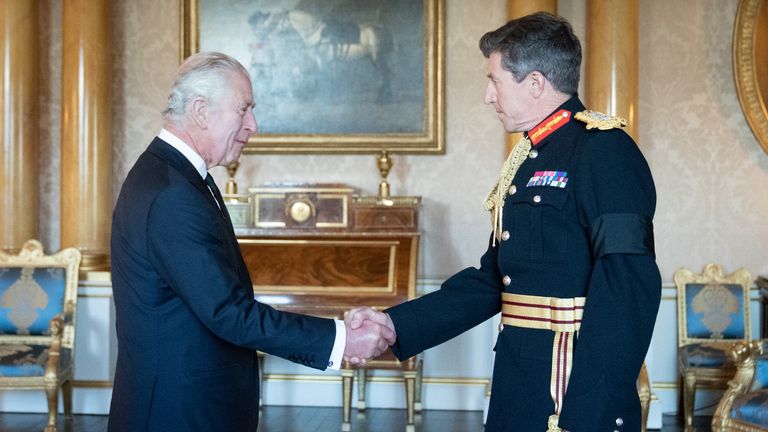

The head of the Royal Navy has warned the government to “step up” and fund defence or risk losing the UK’s superiority in the Atlantic to Russia.
Should that happen, General Sir Gwyn Jenkins said it would be the first time since the end of the Second World War that Britain’s warships and submarines were not the dominant force in their most vital sea lanes alongside their allies.
“We are holding on, but not by much,” he told a conference in London on Monday.
“There is no room for complacency. Our would-be opponents are investing billions. We have to step up, or we will lose that advantage.”
King Charles III greets General Sir Gwyn Jenkins, now First Sea Lord and Chief of the Naval Staff, back in 2022. Photo: PA
As a senior, serving military officer speaking publicly, he did not make any direct criticism of the speed of plans by Sir Keir Starmer’s government to increase defence spending.
But Sky News has reported that he and his fellow chiefs held a “very difficult meeting” last month over how to fund plans to rebuild the armed forces amid fears of further cuts.
Defence sources said there was growing concern at the very top of the armed forces about a gap between the promises being made by the prime minister to fix the UK’s hollowed-out defences and the reality of the size of the defence budget, which is currently not seen as growing fast enough.
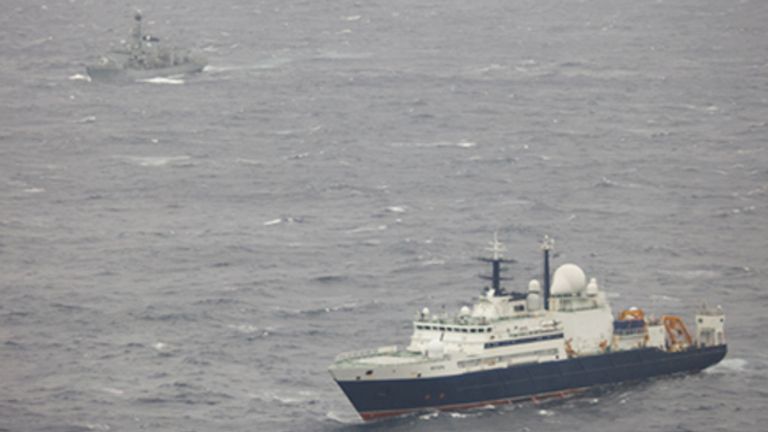
The Russian spy ship Yantar.
Pic: MOD/PA
That means either billions of additional pounds must be found more quickly, or ambitions to modernise and transform the armed forces might need to be curbed, despite warnings of mounting threats from Russia and China, and pressure from Donald Trump on allies to spend more on their own defences.
A Sky News and Tortoise podcast series called The Wargame tracks the hollowing out of the UK’s military since the end of the Cold War and the risk that has created.
👉Search for The Wargame on your podcast app👈
General Jenkins, the first Royal Marine to serve as First Sea Lord, used a speech at the Sea Power Conference to say that Russia is still investing billions in its naval capabilities – in particular the Northern Fleet that operates in the Atlantic – even as it wages war against Ukraine.
There has been a 30% increase in Russian incursions in the North Atlantic in the past two years, he said.
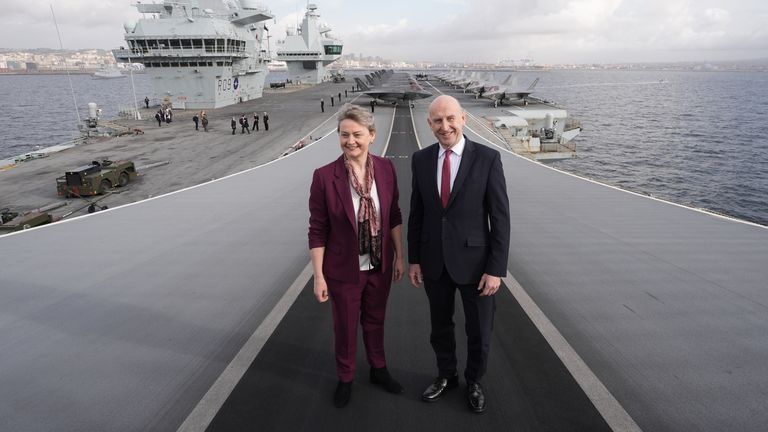
Defence Secretary John Healey and Foreign Secretary Yvette Cooper during a visit to Royal Navy carrier HMS Prince of Wales in Naples, Italy. Pic: PA
That included the Yantar spy ship, which last month was spotted off the coast of Scotland and even shone a laser at the pilots of a Royal Air Force reconnaissance plane that was tracking the vessel.
Yet General Jenkins said what Russia is doing beneath the surface of the waves, where the UK and its allies store vital communications cables as well as critical oil and gas pipelines, was even more concerning.
Read more:
UK unveils undersea tech to defend against Russia
Britain warns Russia’s spy ship – but is it a hollow threat?
“I can also tell you today that the advantage that we have enjoyed in the Atlantic since the end of the Second World War is at risk,” he said.
It is a particularly tough time for the navy, which has more ships and submarines alongside and unable to operate than at sea or at least ready to sail.
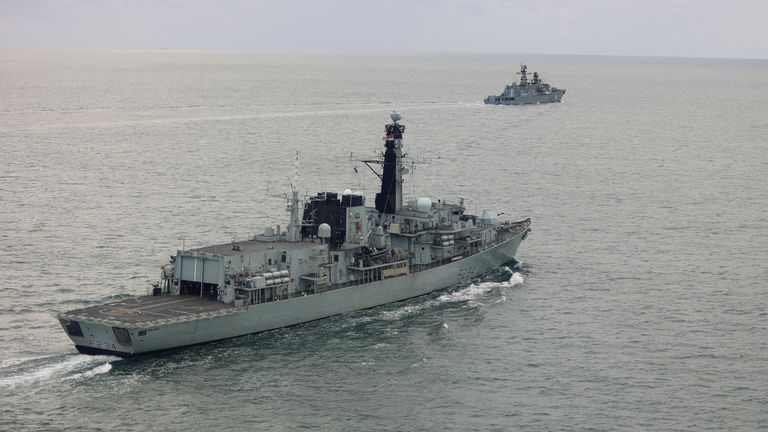
HMS Iron Duke shadowing the Russian Frigate Neustrashimy through UK waters in September. Pic: PA
The service is also suffering from a shortage of sailors and in particular submariners, which again is impacting the availability of the fleet.
The crisis follows decades of funding cuts since the end of the Cold War, compounded by a litany of botched procurement programmes that has all too often seen vessels coming into service years late, at an inflated price and in too few numbers.
Despite the sombre tone, the First Sea Lord set out how he wants to transform his service and make it ready to fight a war – though not until 2029, a timeline that could be too slow if some predictions about the threat posed by Russia to NATO are correct.
His vision – working with industry and other allies – is about developing a blend of manned ships and submarines as well as unmanned ones – a “hybrid navy”.
He is also stripping back what he called the navy’s own bureaucracies to enable the service to move much faster – crucially at the pace of the threat and the pace of rapid and growing technological change.
“We will face headwinds, we will face rough seas, but together, we can solve these problems if we have the appetite, if we have the determination, and if we have the mindset.”