
Passan: 18 innings, 11 runs, a walk-off homer — and an epic Game 3

LOS ANGELES — The game that had everything ended at 11:50 p.m. PT on Monday. For the previous 6 hours, 39 minutes, Game 3 of the World Series played out like a fantastical dreamscape of baseball, filled with tension and drama and madness. It was a game unlikely any before, never to be repeated again, and when the 18th inning ended and the Los Angeles Dodgers had beaten the Toronto Blue Jays 6-5, it was, in a way, a relief, because holding your breath for hours on end is not a sustainable way to live.
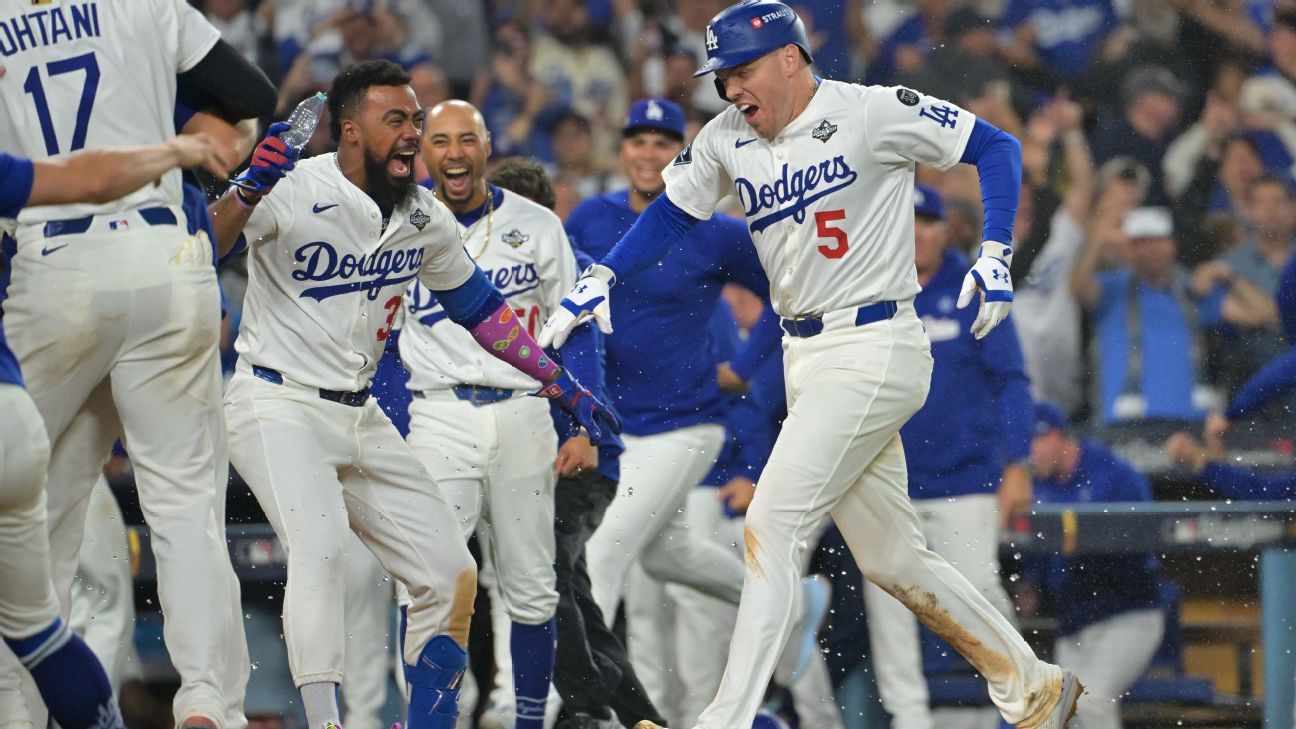
Such is the price we pay for an affair like Game 3. The Dodgers and Blue Jays competed at an exceptional level in the longest game in World Series history by innings and second-longest by time. They punched and counterpunched, emptied their benches and bullpens. They executed with wizardry and found pieces of themselves they didn’t know existed. And in the 18th inning, it was Freddie Freeman, already the hero of last year’s World Series, who deposited a center-cut sinker from Brendon Little over the center-field fence 406 feet away.
There have been 703 games played in the 121-year history of the World Series. While there are certainly competitors, this one launched itself into the upper echelon, undoubtedly elite, and left the 52,654 fans at Dodger Stadium as giddy as they were almost seven years to the day earlier, when the only other 18-inning game in World Series history ended the same way: with a Dodgers walk-off homer.
Game 3 of the World Series featured…
609 pitches (LAD: 312, TOR: 297)
37 runners left on base
25 position players used
19 pitchers used pic.twitter.com/MBHReOJ16x— ESPN Insights (@ESPNInsights) October 28, 2025
The heroes were plentiful, and in the aftermath of the lunacy, one of them stood in the Dodgers’ clubhouse, still trying to process what happened. Will Klein, the last man out of the Dodgers’ bullpen, a reliever who had topped out this year at two innings and 30 pitches, threw four innings of one-hit ball and struck out five on 72 pitches. The last of them, an 86 mph curveball, induced a swing and miss from Tyler Heineman and a scream from Klein, who understood what had been asked of him and knew he’d delivered.
Games don’t become classics without efforts like Klein’s — and he had an admirer who wanted to acknowledge that. Into the Dodgers’ clubhouse strode Sandy Koufax, his eminence of Dodgers pitching, who, at 89 years old, looked no worse for the wear at 12:48 a.m. Koufax walked up to Klein, stuck out his hand, looked him in the eyes and said: “Nice going.”
This was that kind of game, the one that forges bonds between a Hall of Famer and a man with 22.2 career major league innings who didn’t make the Dodgers’ roster in any of the previous three rounds of the postseason. The kind of game that prompted Klein to unlock his phone just to see how many messages he had, only for him to scroll … and keep scrolling … and keep scrolling to the point he just stopped. The kind of game that made Klein marvel to a friend in the clubhouse: “Seventy-two. Can you believe it?”
Game 3 was anarchy, a funhouse mirror of a ballgame, everything out of order. Shohei Ohtani‘s magnificence is never in question, but to see a baseball player reach nine times, something that had been done only twice in big league history — never in the postseason and not since 1942 — still registered as incredible, his magnitude lording over the game from beginning to end. He led off the game for the Dodgers with a double. He homered his next time up. He doubled again. He homered once more, his second of the game, his eighth of the postseason, to tie the game at 5 and unleash the chaos to come.
At that point, Blue Jays manager John Schneider had seen enough. In the ninth inning, Ohtani became the first hitter intentionally walked with the bases empty in the ninth inning or later of a postseason game. The next three times he came to the plate — twice with the bases empty — Schneider held up four fingers and gladly gave Ohtani a free pass. In the 17th, with a runner on first, the Blue Jays opted to pitch to him — and Brendon Little promptly deposited four balls nowhere near the strike zone. (Schneider said after the game to expect more tiptoeing around Ohtani in the days to come.)
Schneider’s decision-making earlier in the game, in which he tried to scratch across runs by substituting in a cadre of pinch runners, left the Blue Jays’ lineup compromised for most of the second half of the game. Against a Dodgers bullpen that had been a sieve for most of the postseason, Toronto managed just one run in 13⅓ innings. Los Angeles used 10 pitchers — including Clayton Kershaw, the future Hall of Famer. Kershaw came on in the 13th with the bases loaded, ground through a nine-pitch at-bat against Nathan Lukes and induced a dribbler to second base that Tommy Edman scooped with his glove to Freeman.
Memorable moments abounded over the game that featured 615 pitches, the most in a postseason game since MLB began tracking pitches in 1988. In the 14th, Will Smith lofted a fly ball to center field and dropped his bat, thinking it was a game winner. The ball died on the warning track. Teoscar Hernández, who, like Ohtani, had four hits, did the same in the 16th. It wound up in a glove, too.
By that point, Klein had arrived and set about pulling a modern-day Nathan Eovaldi, who went 97 pitches over the final six innings of the 2018 marathon. In Klein’s final inning, Yoshinobu Yamamoto — who had thrown a 105-pitch complete game two days prior — was warming up in the bullpen. Klein walked two batters. Dodgers manager Dave Roberts could have easily gone to Yamamoto. He stuck with Klein.
Klein just did it, because he had to, and that, as much as anything, is the lesson of an evening like Game 3, when a great game — which this was for the first dozen or so innings — evolves into something different altogether. Game 3 was a test. Of endurance and will — or, as it were, Will.
“You just got to either do it or you don’t,” said Dodgers reliever Justin Wrobleski, who spent time with Klein at AAA this season. “You go out there and you’re like, ‘I know what has to be done here and let’s see what I got.’ I like moments like that because it’s a test of your character. More than that, it’s a test of everything else.”
Klein passed. And Freeman, of course, is the valedictorian of such moments, one of the clutch kings of his generation. He had struggled much of the postseason, entering the game with only one RBI in the Dodgers’ previous dozen playoff games. His first two in this World Series had looked a far cry from his performance last year, when, nursing a number of injuries, he hit a walk-off grand slam in Game 1 and won series MVP. It wasn’t just the lack of production. He wasn’t hitting the ball particularly hard, either.
On the final pitch, he finally did. This is the kind of thing that happens in 18-inning games. They are uncomfortable and scary and can end with the crack of a bat. It is terrifying. It is beautiful. It is everything.
Those lucky enough to bear witness will never forget it, either. They squirmed and flinched and closed their eyes and prayed and squealed and cringed and, in the end, saw 31 hits and 37 runners left on base and 19 pitchers and one particularly majestic swing that, 10 minutes shy of Monday turning into Tuesday, ended one of the best World Series games ever — and gave the Dodgers a 2-1 advantage in this year’s series.
Klein isn’t sure how his arm will feel by the time he returns to the ballpark Tuesday for Game 4. Typically, he said, he’s a Day 2 guy, the soreness not coming until the second day after an outing. After being lavished with praise from his teammates and thanked by Sandy Koufax and written into the annals of Dodgers history, though, tomorrow and the next day wasn’t of much concern.
“I feel great right now,” he said, and with good reason. He was the winning pitcher, the stopper, the MVP of the night every bit as much as Freeman and Ohtani, and the adrenaline rush numbed whatever pain will eventually arrive. That’s for another day. This was everything — and more.

-
Greg Wyshynski
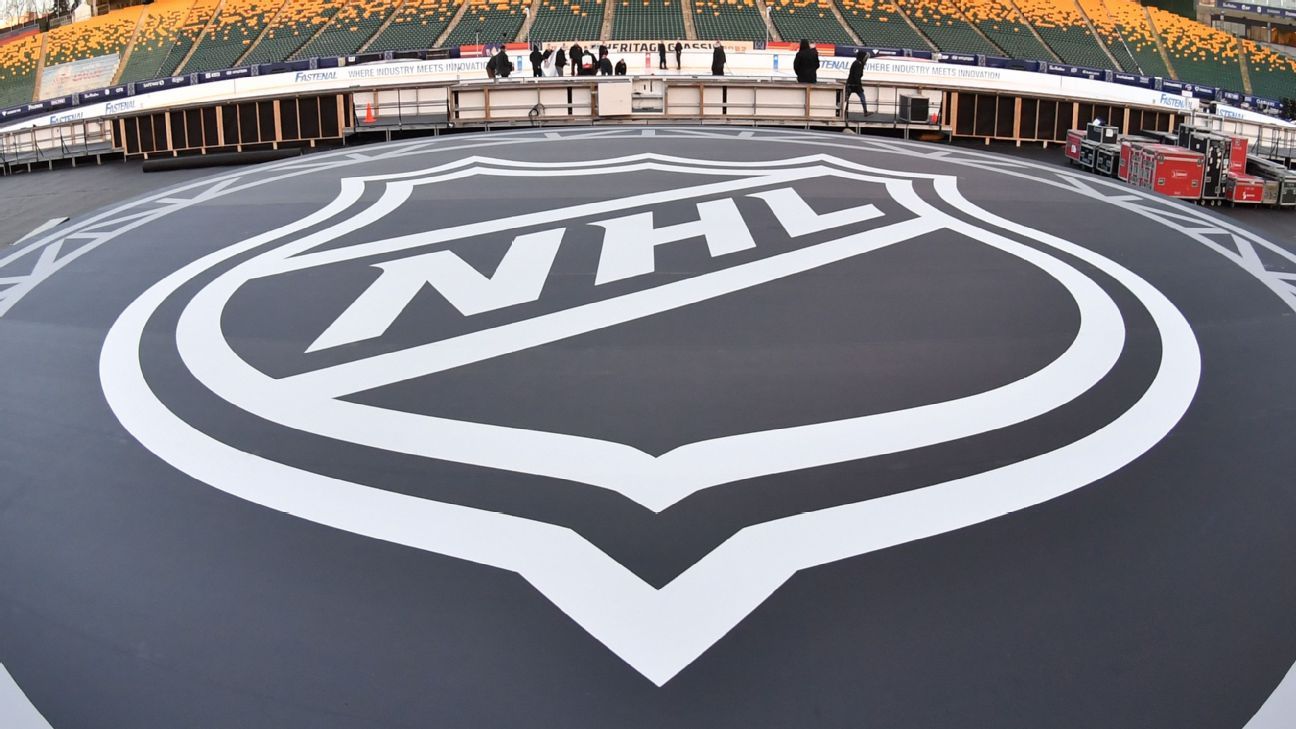
Deputy commissioner Bill Daly said the NHL is warning teams against taking warmups without helmets, a growing trend this season that violates NHL rules.
Daly told ESPN that the league is sending out a memo to remind teams that helmets are mandatory in warmups for “all players who entered the NHL beginning with the 2019-2020 season or later,” per Rule 9.6.
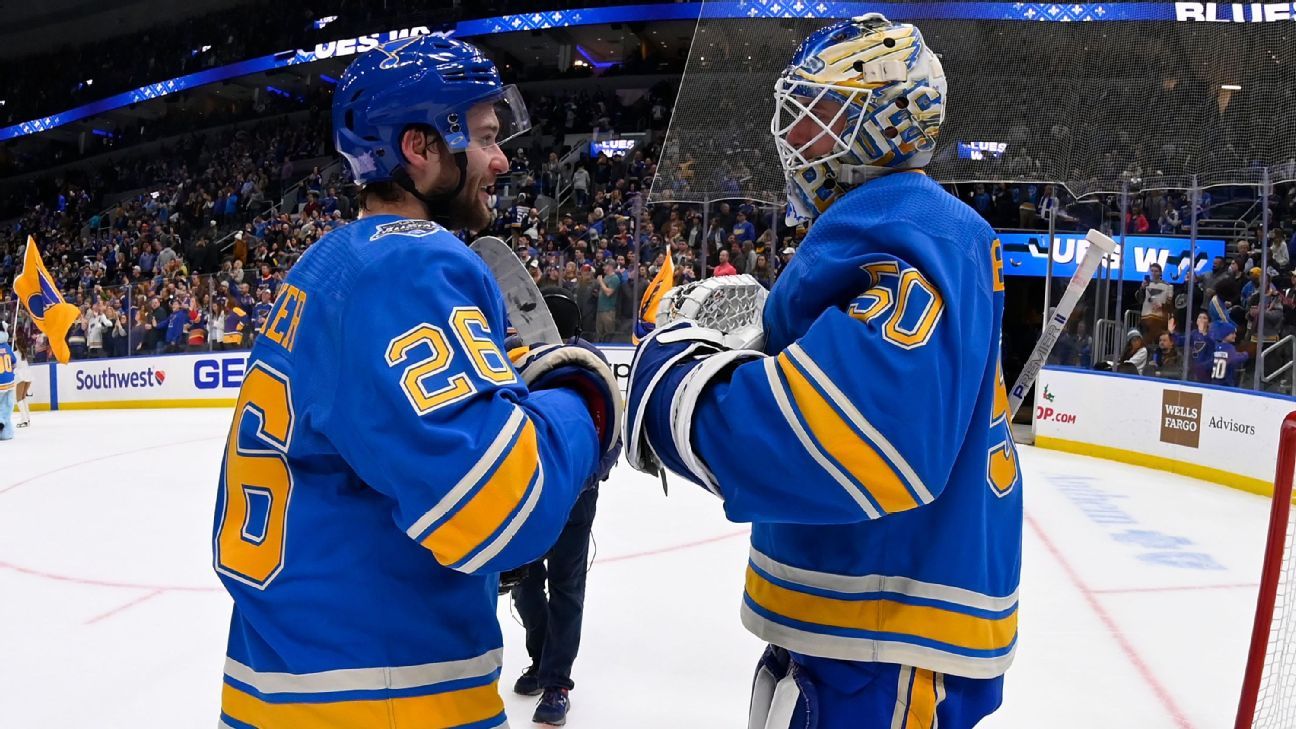
The Ottawa Senators skated out for warmups without helmets in a game at the Vegas Golden Knights last Wednesday, having lost in their past six trips to T-Mobile Arena. Forward Shane Pinto told TSN that the players decided at a team dinner to change their Vegas luck by doffing their helmets. “It was pretty cool to do,” he said.
The Senators won the game 4-3 in a shootout.
The San Jose Sharks also went without helmets in warmups in Vegas, having lost five straight road games to the Knights. Alas, their luck didn’t change, losing 4-3 to their division rival. Forward Will Smith said there was no particular motivation for it.
“It was a team decision. It was Saturday night in Vegas, so I think all the guys were pretty easy to [do] it,” he said.
On Tuesday night, the New Jersey Devils skated out wearing hats instead of helmets, in honor of defenseman Brenden Dillon‘s 1,000th NHL game.
Rule 9.6 reads:
“It is mandatory for all players who entered the NHL beginning with the 2019-2020 season or later to wear their helmet during pre-game warm-up. To be clear, all players who entered the League prior to the 2019-2020 season and who are currently playing are exempt from this mandate.”
The NHL amended its rules in 2022 to mandate helmet usage in warmups out of player safety concerns, in particular with rookies who took the ice without helmets before their debut games as part of a longstanding NHL tradition. Much like the league’s visor rule, some veteran players were “grandfathered” in and exempt.
-
 Sports2 years ago
Story injured on diving stop, exits Red Sox game
-
 Sports3 years ago
‘Storybook stuff’: Inside the night Bryce Harper sent the Phillies to the World Series
-
 Sports2 years ago
Game 1 of WS least-watched in recorded history
-
 Sports3 years ago
Button battles heat exhaustion in NASCAR debut
-
 Sports3 years ago
MLB Rank 2023: Ranking baseball’s top 100 players
-
Sports4 years ago
Team Europe easily wins 4th straight Laver Cup
-
 Environment3 years ago
Japan and South Korea have a lot at stake in a free and open South China Sea
-
 Environment1 year ago
Here are the best electric bikes you can buy at every price level in October 2024