
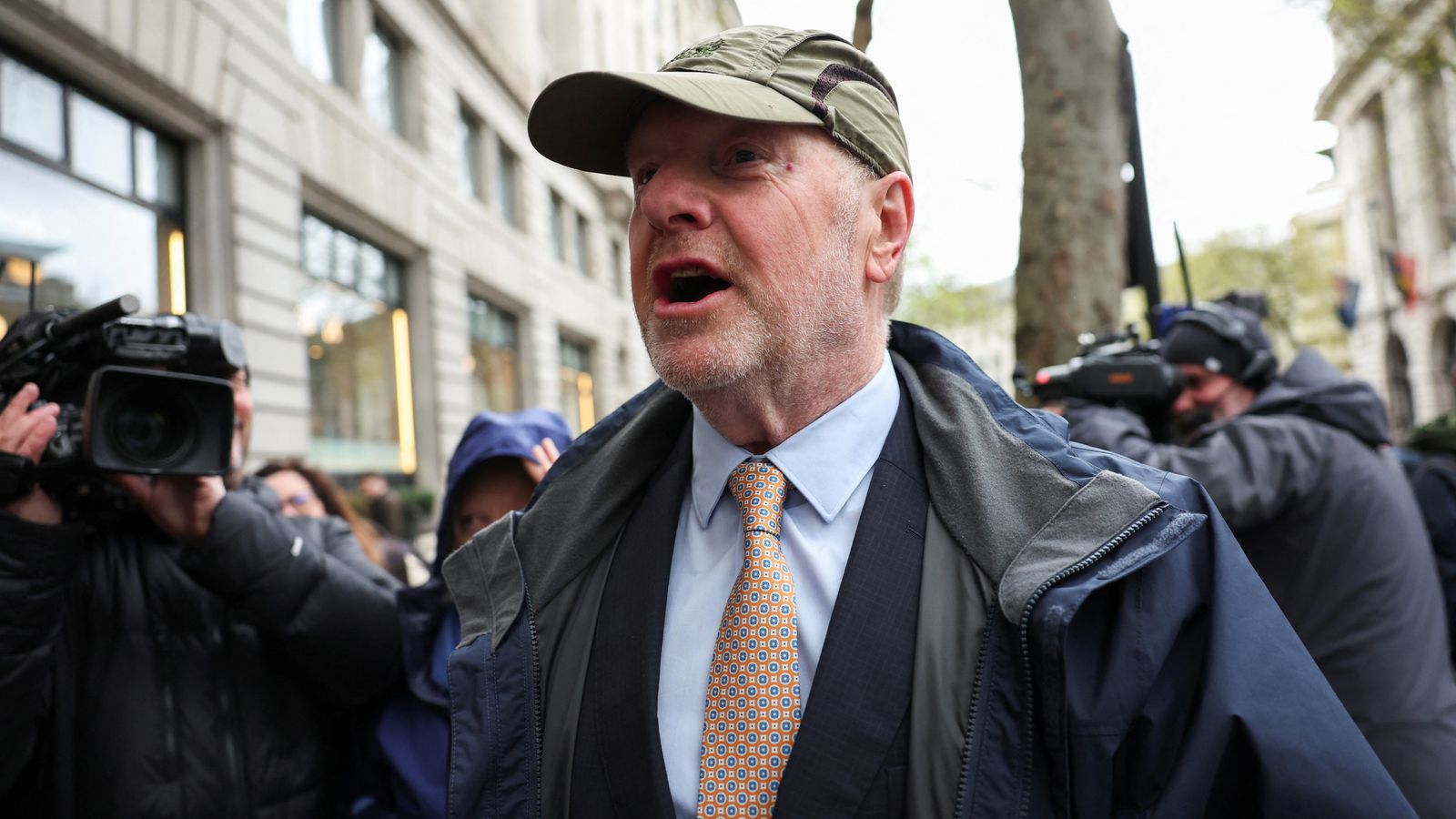
New compensation scheme for Post Office victims is ‘half-baked’, Sir Alan Bates warns

Sir Alan Bates has told Sky News that the government’s new Capture Redress Scheme is “half-baked”.
The Post Office scandal campaigner, who may also be a victim of Capture, accused officials of not learning lessons from previous compensation failures.
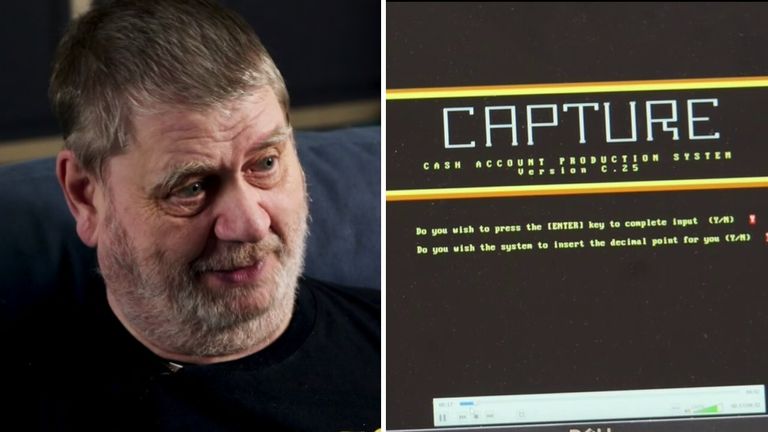
Capture was a piece of faulty computer software used in about 2,500 branches between 1992 and 1999 before the infamous Horizon scandal.
Many sub-postmasters made up potentially false accounting shortfalls from their own pocket, with dozens, at least, convicted of stealing.
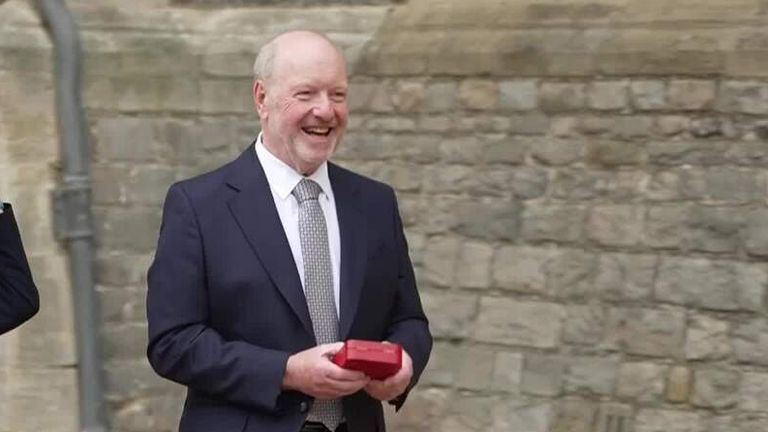
Sir Alan Bates reaches settlement with govt
Sir Alan welcomed the launch of the first ever Capture Redress Scheme last week “in general”.
However, he added: “It does seem to have gone off half-baked with almost none of the lessons that should have been learnt from the failures of the other Postmaster Schemes having been applied when compiling it.”
Sir Alan Bates, who has settled his redress claim with the government in connection with Horizon, also confirmed he may have been a victim of Capture.
He said: “I have documentation which shows that a PC running Capture was part of the inventory when we purchased our sub-post office and I know it was used until it was replaced by the infamous Horizon system toward the end of 2000.”
Despite this, Sir Alan said that – with the information he has about the scheme and making a claim – “it does seem I may not be able submit one”.
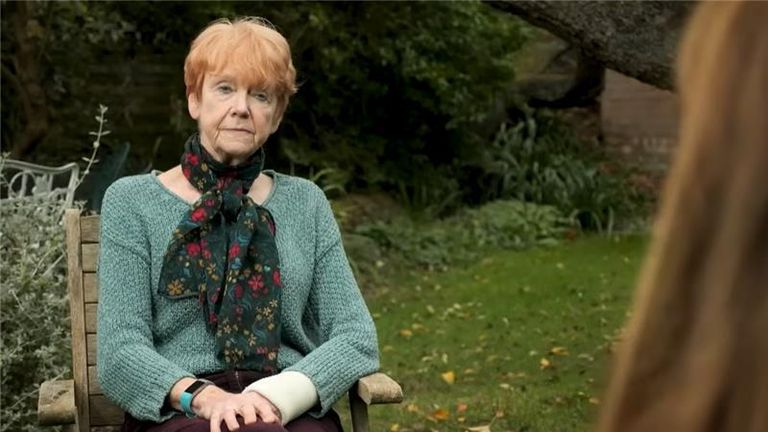
Will Post Office victims be cleared?
Under the current rules, it appears claimants must submit a fully itemised claim before the Department for Business and Trade (DBT) will decide if they qualify – a process Sir Alan described as “mad”.
“We could spend a year compiling a claim only for the DBT to say we weren’t eligible in the first place.”
He called for a two-stage process: first to confirm eligibility, then to allow victims to build their case with legal support – a model he says would save time, money and avoid unnecessary legal costs.
The revelation that Sir Alan may have been a Capture victim – and didn’t realise until later on – raises fresh concerns about how many others remain unaware.
In a statement to Sky News, a government spokesperson said: “After over two decades of fighting for justice, victims will finally receive redress for being impacted by the Capture software and we pay tribute to all of those who have worked to expose this scandal.
“All eligible applicants will receive an interim payment of £10,000. In exceptional circumstances, the independent panel can award above £300,000, which is not a cap.
“We have been in contact with Sir Alan’s legal representative and stand ready to provide further information to help all claimants.”
‘This waiting is just unbearable’
It comes as documents seen by Sky News suggest that the Post Office knew about faults in Capture computer software before it was rolled out in 1992.
Notes from a meeting of “the Capture steering group” held in February – months before the system was introduced to branches – described files as being “corrupted”.
It highlighted that: “If the power was switched off when a file was open it would be corrupted. In this situation data should be checked and reinput.”

‘All we want is her name cleared’
Another fault mentioned in the meeting notes was if “part of the system was closed early, to produce client summaries any additional transactions might not be captured for that day”.
“If a high error rate was detected the software would need to be reworked.”
A document called “Capture Troubleshooting Guide” from April 1993 – over a year after the steering group noted faults – again described “corrupt data” such as incorrect transaction values.
It concluded that the “cause” of this was “switching off the computer or a power cut (even if only for a few seconds) whilst in the Capture programme”.
It also put forward instructions to remedy the fault.
Rupert Lloyd-Thomas, campaigner for Capture victims, said: “The Post Office knew … in 1992, long before the launch, that Capture could be zapped by a power cut.
“They did nothing about it.”
Read more UK news:
How a cup of coffee led Sky News to sex offender on the run
NHS trust and ward manager to be sentenced over patient’s death
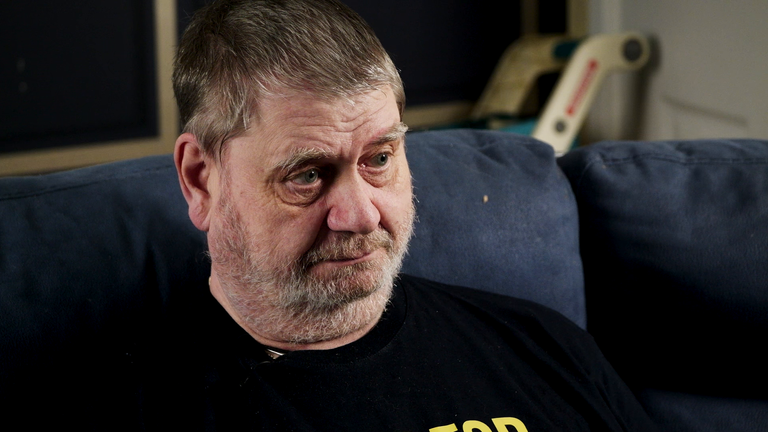
Steve Marston
Steve Marston, who was convicted of stealing from his Post Office branch in 1998 after using Capture, said the information “didn’t come as any surprise”.
“They’ve known since the very beginning it should never have been released,” he added.
A Post Office spokesperson said: “We have been very concerned about the reported problems relating to the use of the Capture software and are sincerely sorry for past failings that have caused suffering to postmasters.
“In September 2024, Kroll published an independent report which examined the Capture software that was used in some Post Office branches in the 1990s and we fully co-operated with Kroll throughout their investigation.
“We are determined that past wrongs are put right and are continuing to support the government’s work in this area.
“Post Office has very limited records relating to this system and we encourage anyone who has Capture related material to share it with Post Office and the Criminal Cases Review Commission.”

Did the chancellor mislead the public, and her own cabinet, before the budget?
It’s a good question, and we’ll come to it in a second, but let’s begin with an even bigger one: is the prime minister continuing to mislead the public over the budget?
The details are a bit complex but ultimately this all comes back to a rather simple question: why did the government raise taxes in last week’s budget? To judge from the prime minister’s responses at a news conference just this morning, you might have judged that the answer is: “because we had to”.
“There was an OBR productivity review,” he explained to one journalist. “The result of that was there was £16bn less than we might otherwise have had. That’s a difficult starting point for any budget.”
Politics latest: OBR boss resigns over budget leak
Beth Rigby asks Keir Starmer if he misled the public
Time and time again throughout the news conference, he repeated the same point: the Office for Budget Responsibility had revised its forecasts for the UK economy and the upshot of that was that the government had a £16bn hole in its accounts. Keep that figure in your head for a bit, because it’s not without significance.
But for the time being, let’s take a step back and recall that budgets are mostly about the difference between two numbers: revenues and expenditure; tax and spending. This government has set itself a fiscal rule – that it needs, within a few years, to ensure that, after netting out investment, the tax bar needs to be higher than the spending bar.
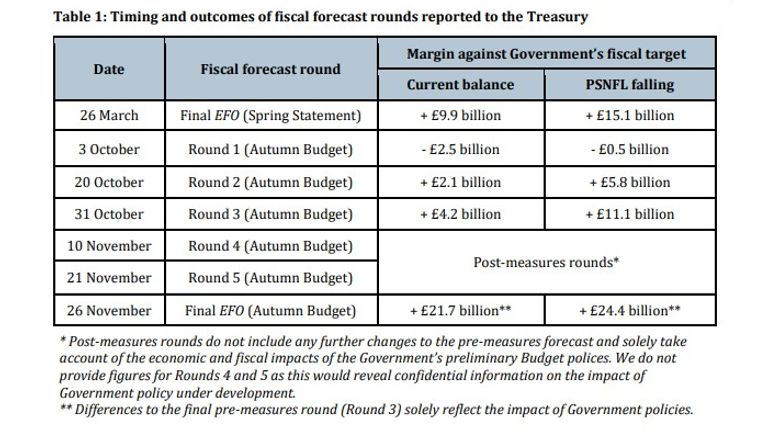
At the time of the last budget, taxes were indeed higher than current spending, once the economic cycle is taken account of or, to put it in economists’ language, there was a surplus in the cyclically adjusted current budget. The chancellor had met her fiscal rule, by £9.9bn.
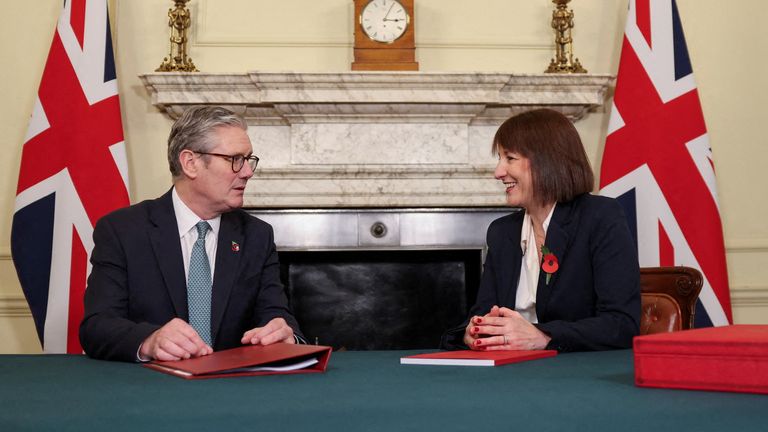
Pic: Reuters
This, it’s worth saying, is not a very large margin by which to meet your fiscal rule. A typical budget can see revisions and changes that would swamp that in one fell swoop. And part of the explanation for why there has been so much speculation about tax rises over the summer is that the chancellor left herself so little “headroom” against the rule. And since everyone could see debt interest costs were going up, it seemed quite plausible that the government would have to raise taxes.
Then, over the summer, the OBR, whose job it is to make the official government forecasts, and to mark its fiscal homework, told the government it was also doing something else: reviewing the state of Britain’s productivity. This set alarm bells ringing in Downing Street – and understandably. The weaker productivity growth is, the less income we’re all earning, and the less income we’re earning, the less tax revenues there are going into the exchequer.
The early signs were that the productivity review would knock tens of billions of pounds off the chancellor’s “headroom” – that it could, in one fell swoop, wipe off that £9.9bn and send it into the red.
Read more:
Main budget announcements – at a glance
Enter your salary to see how the budget affects you
That is why stories began to brew through the summer that the chancellor was considering raising taxes. The Treasury was preparing itself for some grisly news. But here’s the interesting thing: when the bad news (that productivity review) did eventually arrive, it was far less grisly than expected.
True: the one-off productivity “hit” to the public finances was £16bn. But – and this is crucial – that was offset by a lot of other, much better news (at least from the exchequer’s perspective). Higher wage inflation meant higher expected tax revenues, not to mention a host of other impacts. All told, when everything was totted up, the hit to the public finances wasn’t £16bn but somewhere between £5bn and £6bn.
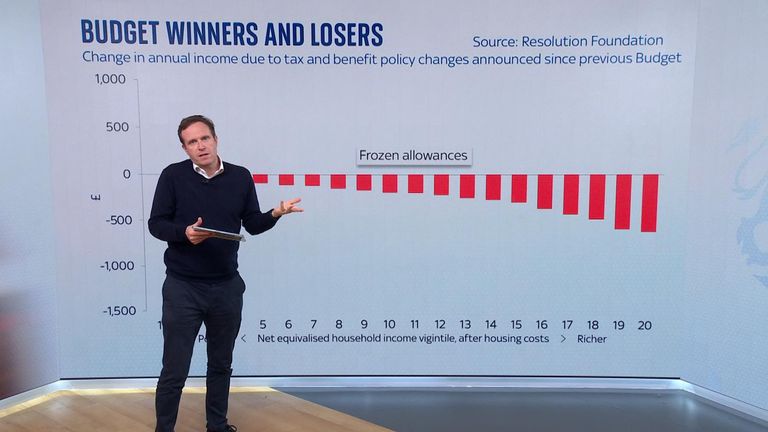
Budget winners and losers
Why is that number significant? Because it’s short of the chancellor’s existing £9.9bn headroom. Or, to put it another way, the OBR’s forecasting exercise was not enough to force her to raise taxes.
The decision to raise taxes, in other words, came down to something else. It came down to the fact that the government U-turned on a number of its welfare reforms over the summer. It came down to the fact that they wanted to axe the two-child benefits cap. And, on top of this, it came down to the fact that they wanted to raise their “headroom” against the fiscal rules from £9.9bn to over £20bn.
These are all perfectly logical reasons to raise tax – though some will disagree on their wisdom. But here’s the key thing: they are the chancellor and prime minister’s decisions. They are not knee-jerk responses to someone else’s bad news.
Yet when the prime minister explained his budget decisions, he focused mostly on that OBR report. In fact, worse, he selectively quoted the £16bn number from the productivity review without acknowledging that it was only one part of the story. That seems pretty misleading to me.

Sir Keir Starmer has denied he and the chancellor misled the public and the cabinet over the state of the UK’s public finances ahead of the budget.
The prime minister told Sky News’ political editor Beth Rigby “there was no misleading”, following claims he and Rachel Reeves deliberately said public finances were in a dire state, when they were not.
Politics latest: Reeves says Cabinet briefed on morning of budget
He said a productivity review by the Office for Budget Responsibility (OBR), which provides fiscal forecasts to the government, meant there would be £16bn less available so the government had to take that into account.
“To suggest that a government that is saying that’s not a good starting point is misleading is wrong, in my view,” Sir Keir said.
Cabinet ministers have said they felt misled by the chancellor and prime minister, who warned public finances were in a worse state than they thought, so they would have to raise taxes, including income tax, which they had promised not to in the manifesto.
At last Wednesday’s budget, Ms Reeves unveiled a record-breaking £26bn in tax rises.
The OBR published the forecasts it provided to the chancellor in the two months before the budget, which showed there was a £4.2bn headroom on 31 October – ahead of that warning about possible income tax rises on 4 November.
The OBR’s timings and outcomes of the fiscal forecasts reported to the Treasury
Sir Keir added: “There was a point at which we did think we would have to breach the manifesto in order to achieve what we wanted to achieve.
“Late on, it became possible to do it without the manifesto breach. And that’s why we came to the decisions that we did.”
Sir Keir said a productivity review had not taken place in 15 years and questioned why it was not done at the end of the last government, as he blamed the Conservatives for the OBR downgrading medium-term productivity growth by 0.3 percentage points to 1% at the end of the five-year forecast.
Read more:
Senior cabinet minister defends Reeves
‘Of course I didn’t lie about budget forecasts, says chancellor
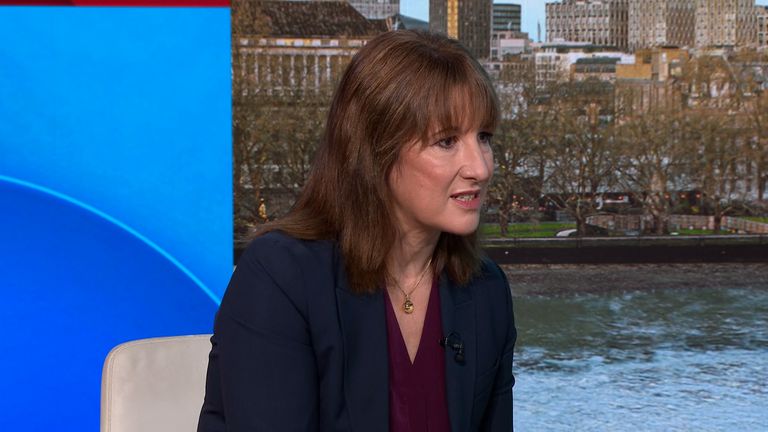
Reeves: I didn’t lie about ‘tax hikes’
The prime minister added: “I wanted to more than double the headroom, and to bear down on the cost of living, because I know that for families and communities across the country, that is the single most important issue, I wanted to achieve all those things.
“Starting that exercise with £16 billion less than we might otherwise have had. Of course, there are other figures in this, but there’s no pretending that that’s a good starting point for a government.”
On Sunday, when asked by Sky’s Trevor Phillips if she lied, Ms Reeves said: “Of course I didn’t.”
She also said the OBR’s downgrade of productivity meant the forecast for tax receipts was £16bn lower than expected, so she needed to increase taxes to create fiscal headroom.

-
 Sports2 years ago
Story injured on diving stop, exits Red Sox game
-
 Sports3 years ago
‘Storybook stuff’: Inside the night Bryce Harper sent the Phillies to the World Series
-
 Sports2 years ago
Game 1 of WS least-watched in recorded history
-
 Sports3 years ago
Button battles heat exhaustion in NASCAR debut
-
 Sports3 years ago
MLB Rank 2023: Ranking baseball’s top 100 players
-
Sports4 years ago
Team Europe easily wins 4th straight Laver Cup
-
 Environment3 years ago
Japan and South Korea have a lot at stake in a free and open South China Sea
-
 Environment1 year ago
Here are the best electric bikes you can buy at every price level in October 2024