
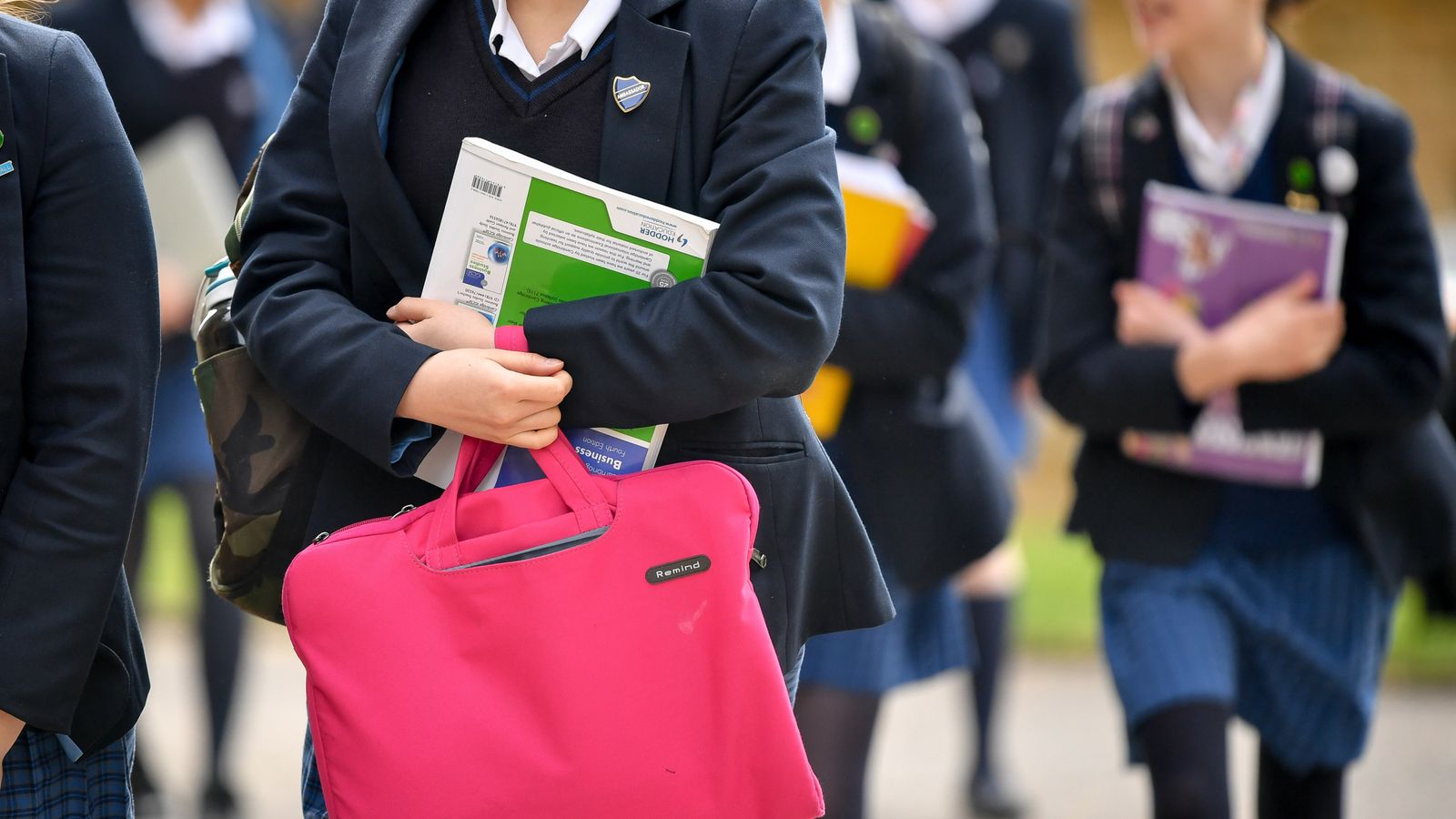
AI to tackle truancy by setting school attendance targets


All schools will be set individual targets for attendance, powered by AI, in a bid to tackle the growing classroom absence crisis.
The move comes after persistent absence figures (those missing 10% or more of classes) soared to 22.3% in 2021/22.
That number has been steadily decreasing since, but the number of pupils missing more than half their classes is still increasing and remains significantly above pre-pandemic levels.
One in three schools is failing to improve attendance, the Department for Education (DfE) said.
But headteacher unions have criticised the new targets, announced by the government, as the “wrong way to go”, and said they will create “another burden” for schools, without actually solving the issue it is supposed to address”.
How will targets be set?
The minimum improvement target a school is given will be based on attendance levels achieved by schools with similar circumstances – including deprivation, location, and needs of pupils.
Schools will receive their targets as soon as possible and will be expected to meet them by the end of the year.
Targets will not be published and watchdog Ofsted will not be able to access them.
But schools will be able to see others with similar circumstances who have successfully improved attendance as part of the AI reports, and will be able to contact them for advice.
Read more from Sky News:
Ofsted launches new school report card system
Nearly half of youngsters missing due to mental health
Paul Whiteman, general secretary of school leaders’ union NAHT, said schools are already working to improve attendance and “yet more targets” won’t help.
He instead called for investment in community services providing help for families.
Pepe Di’Iasio, general secretary of the Association of School and College Leaders, urged the government to “understand the realities in schools rather than issuing yet more diktats dreamt up in Whitehall”.
He added: “Schools already move heaven and earth to ensure that all their pupils attend regularly, but many of the factors that contribute to absence are beyond their direct control.
“Setting them individual targets doesn’t resolve those issues, but it does pile yet more pressure on school leaders and staff who are already under great strain.”
Do you have a question about this story or want to know more about this topic from an expert? Try our Ask Us Anything feature – which puts your questions to our correspondents and presenters. Submit your question here.
New Ofsted report system explained
The DfE has also announced 36 new hubs which will provide other schools with support on attendance and behaviour, and resources to help them keep children engaged when they transition from primary to secondary.
Education Secretary Bridget Phillipson said she wants every school to play its part in getting attendance back to and beyond pre-pandemic levels.
“By working jointly with schools to set individual targets, we’re tackling variation head-on. Our best schools already have a brilliant approach to attendance, and now we’re driving that focus everywhere so that all children are supported to attend school and learn,” she said.
The head of the Royal Navy has warned the government to “step up” and fund defence or risk losing the UK’s superiority in the Atlantic to Russia.
Should that happen, General Sir Gwyn Jenkins said it would be the first time since the end of the Second World War that Britain’s warships and submarines were not the dominant force in their most vital sea lanes alongside their allies.
“We are holding on, but not by much,” he told a conference in London on Monday.
“There is no room for complacency. Our would-be opponents are investing billions. We have to step up, or we will lose that advantage.”
As a senior, serving military officer speaking publicly, he did not make any direct criticism of the speed of plans by Sir Keir Starmer’s government to increase defence spending.
But Sky News has reported that he and his fellow chiefs held a “very difficult meeting” last month over how to fund plans to rebuild the armed forces amid fears of further cuts.
Budget: what about defence spending?
Defence sources said there was growing concern at the very top of the armed forces about a gap between the promises being made by the prime minister to fix the UK’s hollowed-out defences and the reality of the size of the defence budget, which is currently not seen as growing fast enough.
That means either billions of additional pounds must be found more quickly, or ambitions to modernise and transform the armed forces might need to be curbed, despite warnings of mounting threats from Russia and China, and pressure from Donald Trump on allies to spend more on their own defences.
A Sky News and Tortoise podcast series called The Wargame tracks the hollowing out of the UK’s military since the end of the Cold War and the risk that has created.
👉Search for The Wargame on your podcast app👈
General Jenkins, the first Royal Marine to serve as First Sea Lord, used a speech at the Sea Power Conference to say that Russia is still investing billions in its naval capabilities – in particular the Northern Fleet that operates in the Atlantic – even as it wages war against Ukraine.
There has been a 30% increase in Russian incursions in the North Atlantic in the past two years, he said.
That included the Yantar spy ship, which last month was spotted off the coast of Scotland and even shone a laser at the pilots of a Royal Air Force reconnaissance plane that was tracking the vessel.
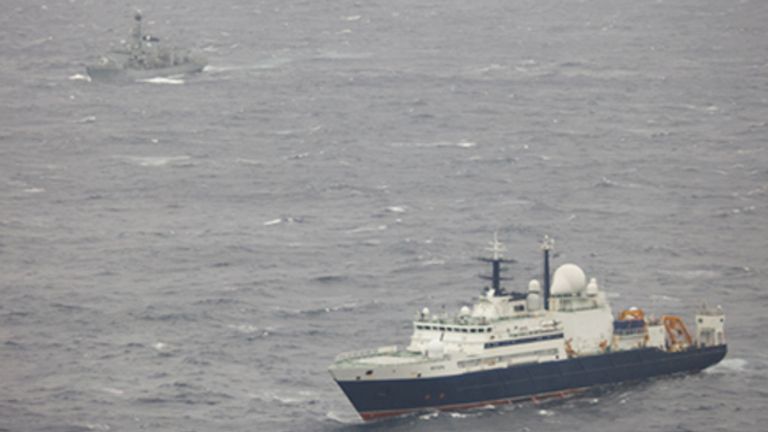
The Russian spy ship Yantar. Pic: MOD/PA
Yet General Jenkins said what Russia is doing beneath the surface of the waves, where the UK and its allies store vital communications cables as well as critical oil and gas pipelines, was even more concerning.
“I can also tell you today that the advantage that we have enjoyed in the Atlantic since the end of the Second World War is at risk,” he said.
Read more:
UK unveils undersea tech
Does Britain’s threat to Russia ring hollow?
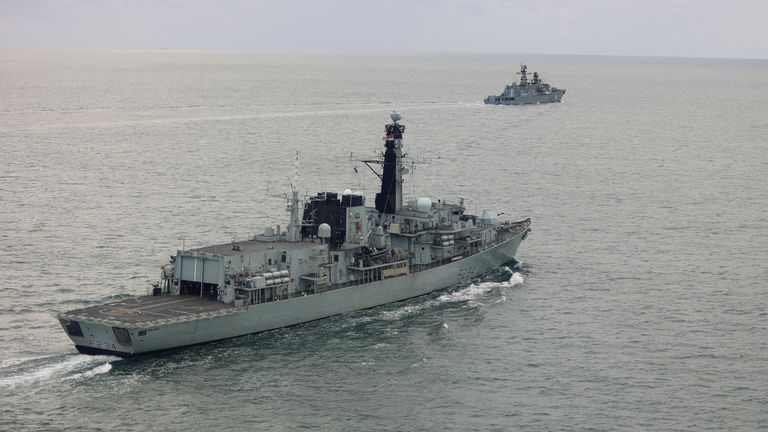
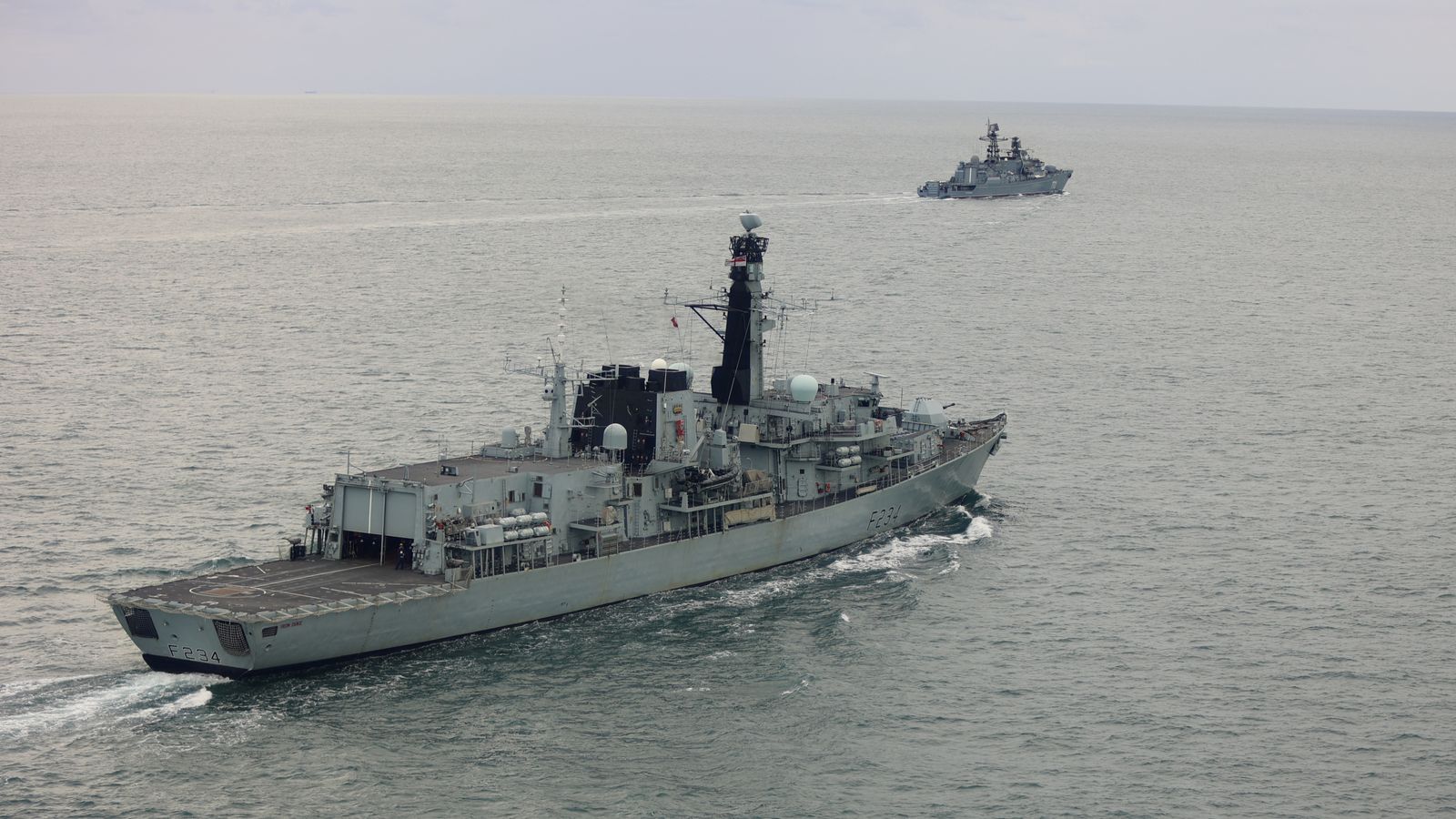
HMS Iron Duke shadowing the Russian Frigate Neustrashimy through UK waters in September. Pic: PA
Navy facing huge challenges
It is a particularly tough time for the navy, which has more ships and submarines alongside and unable to operate than at sea or at least ready to sail.
The service is also suffering from a shortage of sailors and in particular submariners, which again is impacting the availability of the fleet.
The crisis follows decades of funding cuts since the end of the Cold War, compounded by a litany of botched procurement programmes that has all too often seen vessels coming into service years late, at an inflated price and in too few numbers.
Vision of ‘hybrid navy’
Despite the sombre tone, the First Sea Lord set out how he wants to transform his service and make it ready to fight a war – though not until 2029, a timeline that could be too slow if some predictions about the threat posed by Russia to NATO are correct.
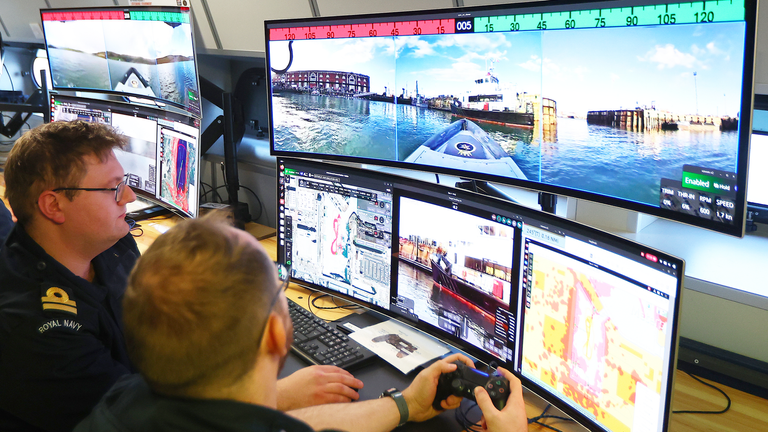
New UK military technology unveiled
His vision – working with industry and other allies – is about developing a blend of manned ships and submarines as well as unmanned ones – a “hybrid navy”.
He is also stripping back what he called the navy’s own bureaucracies to enable the service to move much faster – crucially at the pace of the threat and the pace of rapid and growing technological change.
“We will face headwinds, we will face rough seas, but together, we can solve these problems if we have the appetite, if we have the determination, and if we have the mindset.”

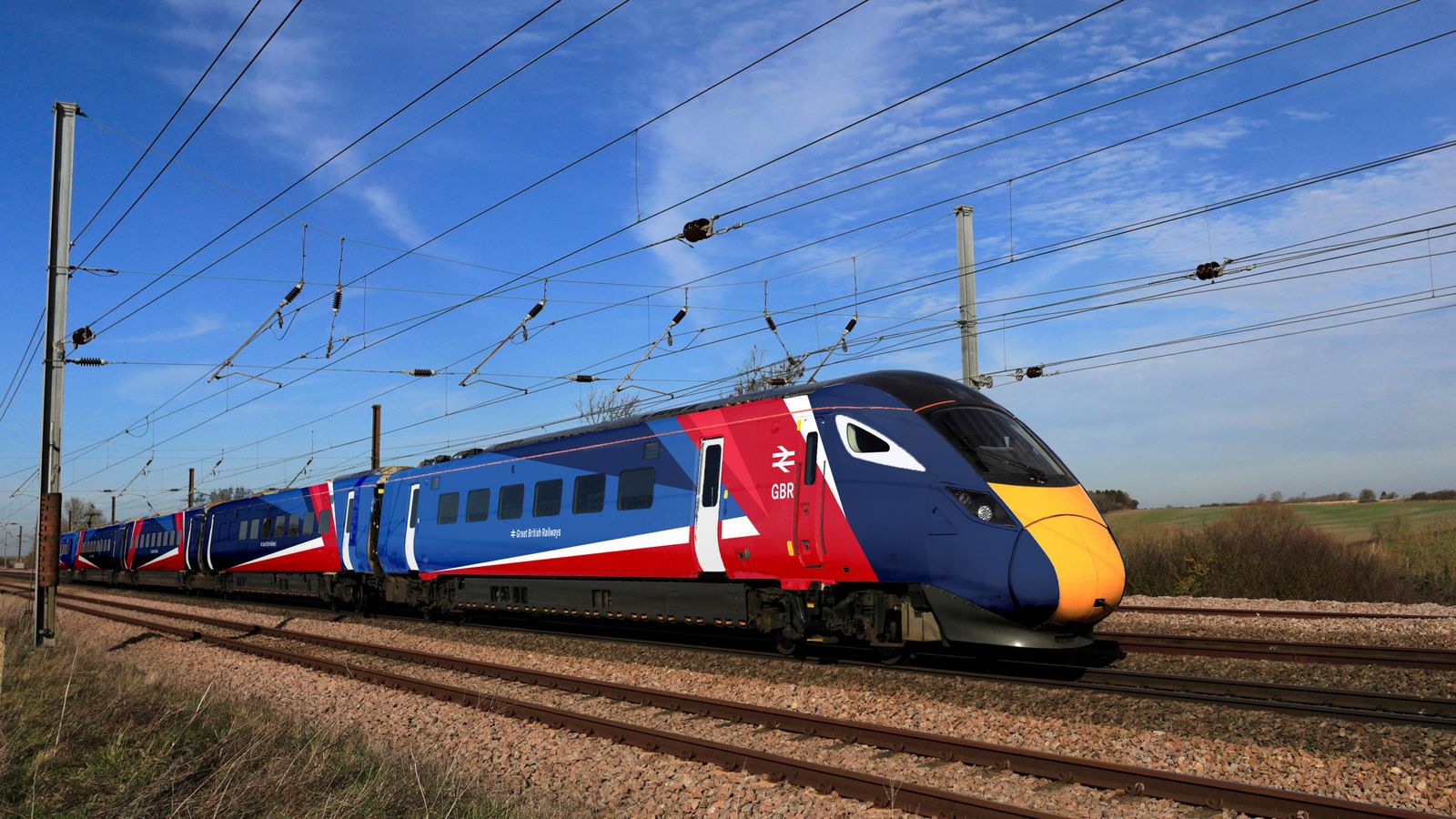
A “striking” new design for UK trains has been revealed by the transport secretary – but you may well think it looks familiar.
Train services already in public ownership will begin to adopt a Union flag-inspired design from this spring, Heidi Alexander has confirmed.
It’s part of the government’s efforts to nationalise most passenger rail services in the UK and run them under the new Great British Railways (GBR) brand – with its logo to be unveiled later today.
Ms Alexander will be speaking more about GBR – which is due to be formally established in 2027 – on Mornings With Ridge And Frost from around 7.10am.
The new Great British Railways logo has drawn on the original logo of British Rail from 1965.
Pic: Dovetail Games.
Haven’t I seen this somewhere before?
The branding features the familiar double arrow symbol used by British Rail when the country’s trains were last state-owned.
A spokesperson for the Department for Transport (DfT) said the “iconic” symbol has been incorporated into the new GBR logo to reflect “Britain’s proud railway heritage”.
Ms Alexander has insisted it “isn’t just a paint job”, saying: “It represents a new railway, casting off the frustrations of the past and focused entirely on delivering a proper public service for passengers.”
Special one-day public exhibition launched
People in the capital will be able to see the new train livery for themselves today, with a special one-day exhibit being held at London Bridge station, where a GBR-branded Hornby model train will be on display.
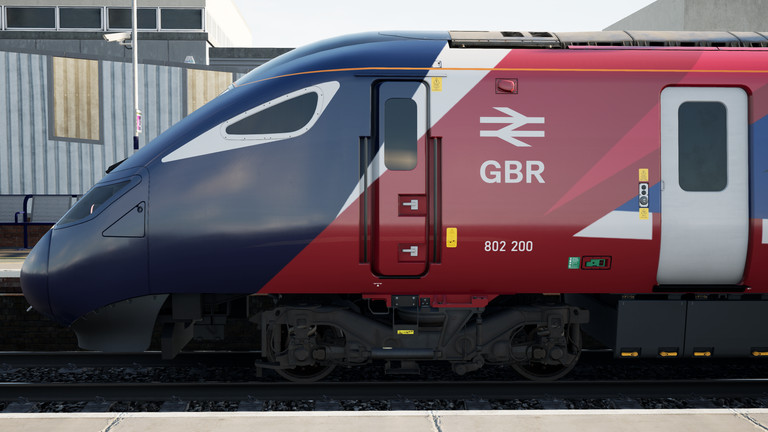
The government has also partnered with a gaming company to create mock-ups of the new design, and those at the station will be able to see a digital demonstration of the new artwork in Train Sim World 6.
The new designs will also be beamed on to digital display boards over the coming days at Manchester Piccadilly, Birmingham New Street, Glasgow Central, and Leeds City.
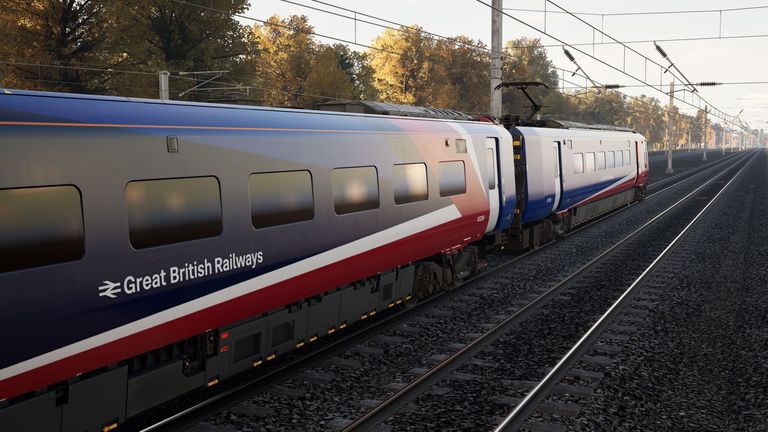
People in the capital will be able to see a mock-up of a train in the new livery in a Train Sim World 6 game.
Pic: Dovetail Games.
It comes as MPs prepare to debate the government’s Railways Bill in the Commons.
The government has taken control of seven major operators so far, but has pledged to return all passenger services to public ownership as contracts with existing operators expire or are broken through a failure to deliver.
Read more:
What is Labour’s rail nationalisation plan?
Rail fares frozen for first time in 30 years
What will nationalisation actually involve?
The government has said its Railways Bill will bring 17 different organisations together and will also lead to greater accountability, better services and an easier way to buy tickets.
Among the measures is the creation of a GBR app, where passengers will be able to check train times and buy tickets without booking fees, while those with disabilities will be able to also request assistance.

A new ‘one-stop shop’ app will be launched as part of the scheme.
Pic: Department for Transport
The draft law would also beef up accountability by creating a strengthened Passenger Watchdog, while GBR would operate both services and maintain the railways themselves.
Ministers have pointed to improvements to existing services since they have been nationalised, such as South Western Railway boosting capacity by almost 10% by quadrupling its number of Arterio trains in service.
A new East Coast Main Line timetable will also come into effect this month, which the government says will lead to 10,000 extra LNER services every year, or roughly 60,000 extra seats a week.
-
 Sports2 years ago
Story injured on diving stop, exits Red Sox game
-
 Sports3 years ago
‘Storybook stuff’: Inside the night Bryce Harper sent the Phillies to the World Series
-
 Sports2 years ago
Game 1 of WS least-watched in recorded history
-
 Sports3 years ago
Button battles heat exhaustion in NASCAR debut
-
 Sports3 years ago
MLB Rank 2023: Ranking baseball’s top 100 players
-
Sports4 years ago
Team Europe easily wins 4th straight Laver Cup
-
 Environment3 years ago
Japan and South Korea have a lot at stake in a free and open South China Sea
-
 Environment1 year ago
Here are the best electric bikes you can buy at every price level in October 2024