
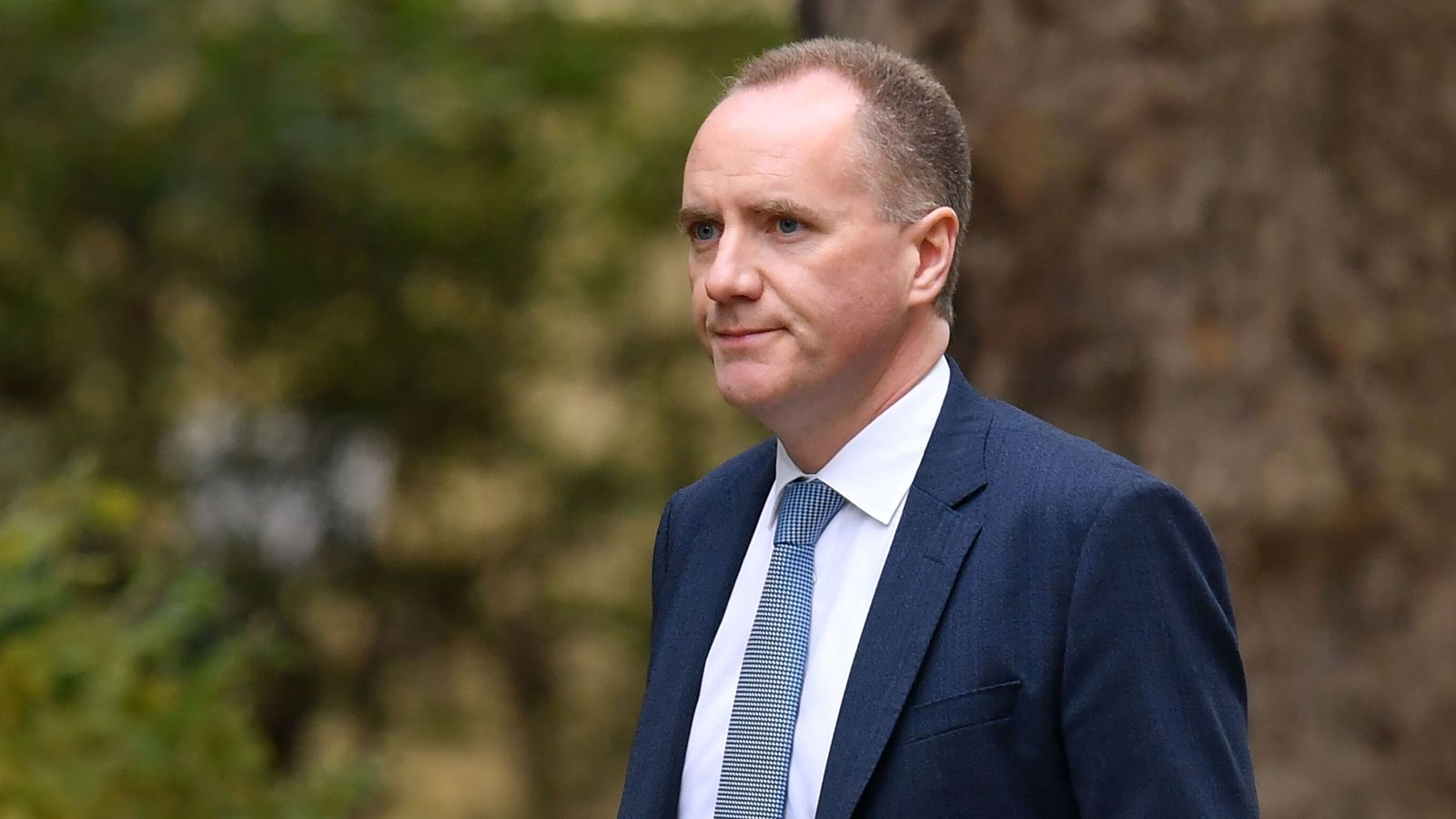
OBR chief Richard Hughes resigns after budget leak investigation

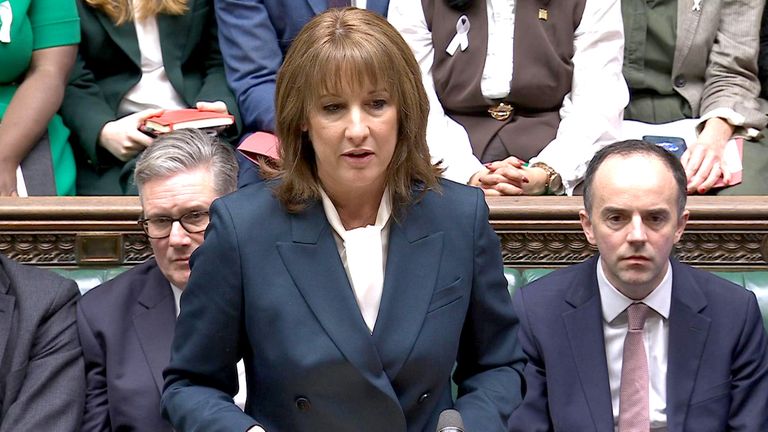
The chairman of the Office for Budget Responsibility (OBR) has resigned after an investigation into the leak of last week’s budget criticised the watchdog’s leadership.
Richard Hughes stepped down following the publication of a report into the early release of Rachel Reeves’s fiscal event.
The OBR’s official forecast, which revealed the contents of the record-breaking tax rise budget, was accessed at 11.35am last Wednesday, about an hour before the chancellor stood up to deliver it.
Latest updates from the Politics Hub
Rachel Reeves said she only found out about the leak when she was in the House of Commons
In a letter to Ms Reeves and the chairwoman of the Commons Treasury Committee Dame Meg Hillier, Mr Hughes said he was quitting to allow the OBR to “quickly move on from this regrettable incident”.
He said he took “full responsibility” for “the shortcomings identified in the report”.
Mr Hughes said: “By implementing the recommendations in this report, I am certain the OBR can quickly regain and restore the confidence and esteem that it has earned through 15 years of rigorous, independent economic analysis.”
An investigation ordered by the independent fiscal forecaster soon after the budget called the leak “the worst failure in the 15-year history of the OBR” and strongly criticised the watchdog’s processes for protecting sensitive information.
The probe found there was “nothing to suggest” the premature access was the result of “hostile cyber activity by foreign actors or cyber criminals, or of connivance by anyone working for the OBR”.
“Nor was it simply a matter of pressing the publication button on a locally managed website too early,” the report stated.
It concluded that “configuration errors” led to “a failure to ensure the protections which hide documents from public view immediately before publication were in place”.
“The ultimate responsibility for the circumstances in which this vulnerability occurred and was then exposed rests, over the years, with the leadership of the OBR,” the investigation said.

Did Rachel Reeves mislead the nation with her budget?
Kemi Badenoch claimed that Ms Reeves was trying to use Mr Hughes as a “human shield”.
The Conservative leader said on social media: “More serious questions for the chancellor as she tries to make Richard Hughes her human shield.
“Her actions have turned this into a full blown political crisis for the government. If [Prime Minister] Keir Starmer had a backbone, he would have sacked Reeves long ago.”
Mr Hughes had been under pressure to explain the leak, which he immediately apologised for, and ordered the investigation.
It is also led by Professor David Miles and Tom Josephs, with Baroness Sarah Hogg and Dame Susan Rice as non-executive members.
There are 52 permanent staff, who are civil servants, with six of those working on the strategy, operations and communications team.
The report acknowledged the leak “changed the pattern of budget day to the chancellor’s disadvantage”.
Read more:
The budget’s key points
‘Of course I didn’t’ lie about budget forecasts – Reeves
It revealed the OBR’s spring statement 2025 was also accessed ahead of time, but said the likely explanation “is benign”.
And it said last week’s budget forecast document had multiple attempts to access it before it was inadvertently made accessible online.
The investigation partly blamed the Treasury and the Cabinet Office, as the OBR’s IT services were moved on to the Treasury’s shared systems in 2023 to “align more closely with Treasury security arrangements”, particularly around the sharing of sensitive budget information between the OBR and Treasury.
It said the Treasury should pay “greater attention” when setting the OBR’s budget, currently £6.4m, to the need for adequate support.
The investigation said there was pressure on the small team involved to ensure the full economic and fiscal outlook was published when the chancellor sat down after giving her budget, so a pre-publication “facility” was used.
But this commonly used device created a “potential vulnerability if not configured properly” and had not received the same amount of attention by the OBR as it had placed on security of communications with the Treasury “during the long period of run-up to the budget”.
Starmer says he did not mislead the public
An outside web developer, who has helped the OBR team since it came into existence 15 years ago, assists the internal team and manages content and uploads at times of pressure, including the release of the budget forecast.
The report said the risks of this approach have increased over the years as technologies have developed and online threats have risen.
“With hindsight, it is clear that over the years this arrangement should have been regularly reexamined and assessed by the management of the OBR,” the report said.
It recommended the process for publishing forecasts should “immediately” be removed from the OBR’s locally managed website, which is a WordPress website, and published as part of a government website.

The Japanese government is reportedly backing plans to introduce a significant reduction in the nation’s maximum tax rate on crypto profits, with a flat rate of 20% across the board.
Japan’s financial regulator, the Financial Services Agency (FSA), first floated the proposed tax changes in mid-November, outlining plans to introduce a bill in early 2026, and now the government and ruling coalition — the political parties in control of Japan’s parliament, the National Diet — are on board.
According to a report from Japanese news outlet Nikkei Asia on Sunday, the new rules aim to align crypto taxation rules with those of other financial products, such as equities and investment funds.
Under the current laws, taxation on crypto trading is included as part of income taxes for individuals and businesses, falling under the category of “miscellaneous income.” The rate ranges from 5% on the lower end of the spectrum to 45% on the high end, with high-income earners potentially on the hook for an additional 10% inhabitant tax.
Meanwhile, assets such as equities and investment trusts are taxed separately, with a flat 20% tax on profits, regardless of the amount.
The tax changes could be a boon for the domestic cryptocurrency market, as the higher tax rates may have deterred potential investors.

According to the Nikkei report, the potential changes to crypto taxation in Japan will be introduced as part of a “solid investor-protection framework” proposed in the FSA’s bill, which aims to amend the Financial Instruments and Exchange Act.
The FSA will submit the bill during the regular Diet session in 2026, as it pushes for greater oversight of crypto trading, including a ban on dealing with non-public information and stricter investment disclosures.
Japan finally set for crypto tax change after long fight
The Japan Blockchain Association (JBA), the nation’s major crypto-focused non-governmental lobbying group, has been calling for these changes for almost three years.
Related: Bitcoin falls to $84K: Is Japan’s bond market the culprit, or is more at play?
In July 2023, the JBA published a letter to the government on its website, outlining key tax reform requests to support the industry. The letter called for a 20% tax rate that aligns with other investment vehicles.
“This letter requests a review of tax on crypto assets, which is the biggest hurdle for companies operating Web3 businesses in Japan and a disincentive for the public to actively own and use crypto assets,” the letter reads.
While it is unclear if the JBA had a direct influence on the FSA’s thinking, the financial watchdog did start warming up to the idea and pushing for reform in September 2024.
Magazine: Koreans ‘pump’ alts after Upbit hack, China BTC mining surge: Asia Express
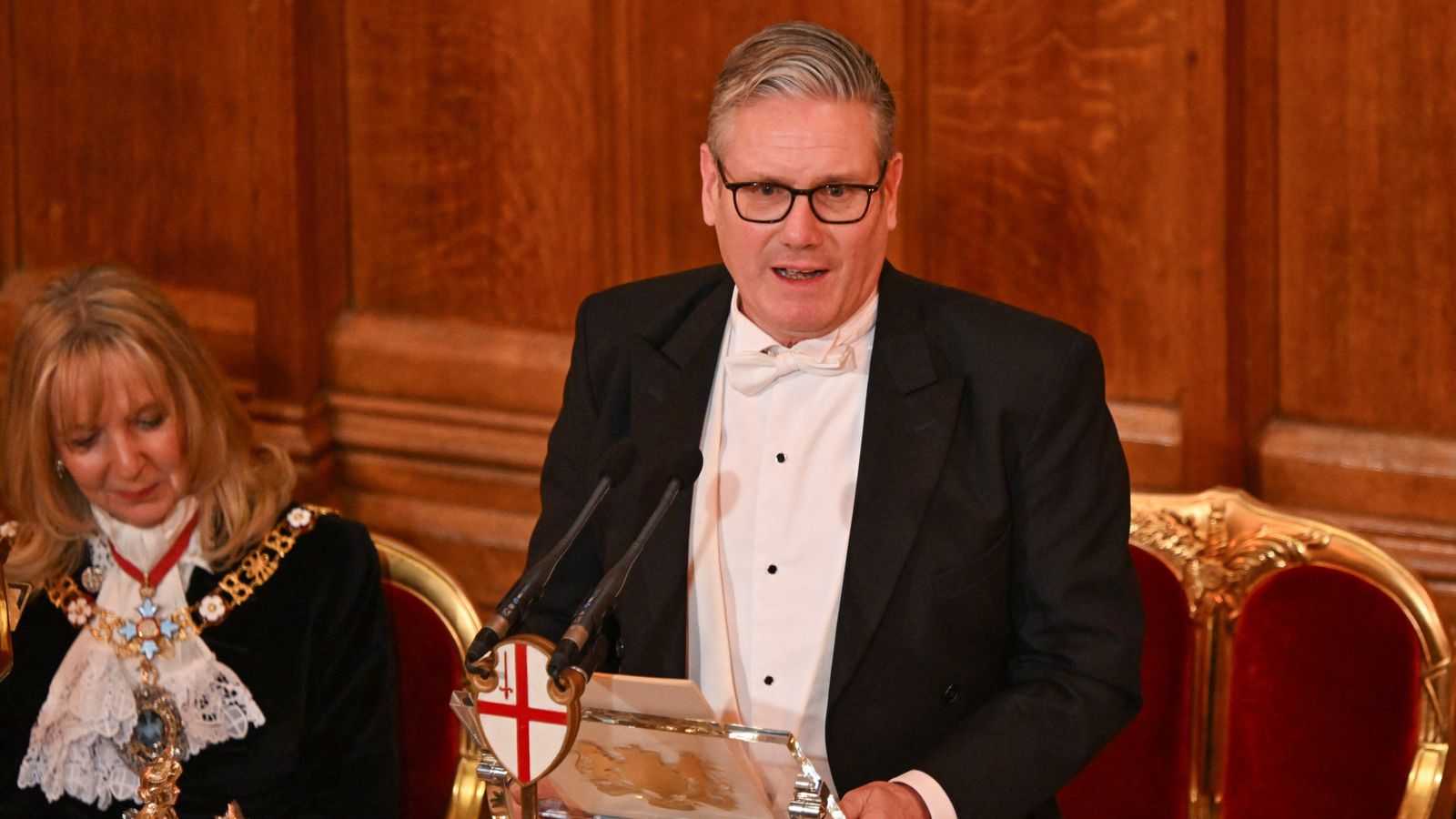
Sir Keir Starmer has warned China poses “real national security threats to the United Kingdom”.
But the prime minister also described China as a “nation of immense scale, ambition and ingenuity” and a “defining force in technology, trade and global governance”.
“The UK needs a China policy that recognises this reality,” he added in a speech at the Guildhall in London.
“Instead, for years we have blown hot and cold.
“So our response will not be driven by fear, nor softened by illusion. It will be grounded in strength, clarity and sober realism.”
Prime Minister Keir Starmer giving his speech. Pic: Reuters
Describing the absence of engagement with China – the world’s second-biggest economy – as “staggering” and “a dereliction of duty”, Sir Keir said: “This is not a question of balancing economic and security considerations. We don’t trade off security in one area, for a bit more economic access somewhere else.
“Protecting our security is non-negotiable – our first duty. But by taking tough steps to keep us secure, we enable ourselves to cooperate in other areas.”
Sir Keir’s remarks come after MPs and parliamentarians were warned last month of new attempts to spy on them by China.
And they follow the collapse of a prosecution of two people suspected of spying on behalf of China.
That case led to controversy over how the government under Labour responded to the Crown Prosecution Service’s requests for evidence.
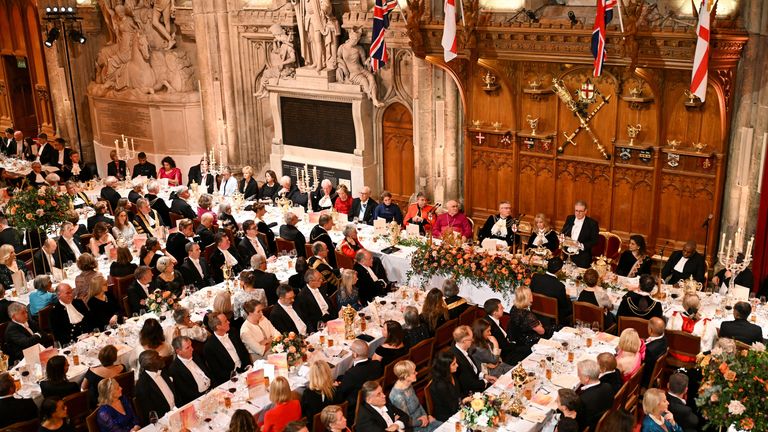
Speech at the annual Lady Mayor’s Banquet. Pic: Reuters
At the time, Sir Keir sought to blame the previous Conservative government for the issues, which centred on whether China could be designated an “enemy” under First World War-era legislation.
Meanwhile, Sky News understands the prime minister is set to approve plans for a controversial Chinese “super embassy” in central London.
Read more:
MI5 spying warning aims to send signal to China
‘Many options’ on table for Venezuela
A final decision on the planning application for the former Royal Mint site near the Tower of London is due on 10 December, after numerous previous delays.
Sir Keir is also understood to be preparing for a likely visit to China in the new year.
Since he was elected last year, Sir Keir has been active on the world stage, trumpeting deals with the US, India and the EU and leading the “coalition of the willing” in support of Ukraine.
PM preparing for likely China visit
But he has also faced criticism from his opponents, who accuse him of spending too much time out of the UK attending international summits rather than focusing on domestic issues.
Sir Keir offered a defence of his approach, describing it as “the biggest shift in British foreign policy since Brexit” and “a decisive move to face outward again”.
While saying he would “always respect” the Brexit vote as a “fair, democratic expression”, he said the way the UK’s departure from the EU had been “sold and delivered” was “simply wrong”.
He said: “Wild promises were made to the British people and not fulfilled. We are still dealing with the consequences today.”
In his speech on Monday, the prime minister accused opposition politicians of offering a “corrosive, inward-looking attitude” on international affairs.
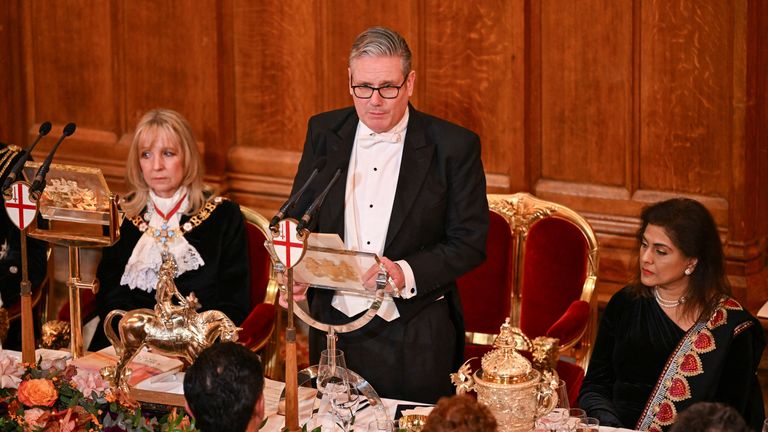
Sir Keir Starmer. Pic: Reuters
Taking aim at those who advocate leaving the European Convention on Human Rights or NATO, he said they offered “grievance rather than hope” and “a declinist vision of a lesser Britain”.
Sir Keir said: “Moreover, it is a fatal misreading of the moment, ducking the fundamental challenge posed by a chaotic world – a world which is more dangerous and unstable than at any point for a generation, where international events reach directly into our lives, whether we like it or not.”
He added: “In these times, we deliver for Britain by looking outward with renewed purpose and pride, not by shrinking back. In these times, internationalism is patriotism.”
Responding to the prime minister’s speech, shadow foreign secretary Dame Priti Patel said: “From China’s continued flouting of economic rules to transnational repression of Hong Kongers in Britain, Starmer’s ‘reset’ with Beijing is a naive one-way street, which puts Britain at risk while Beijing gets everything it wants.
“Starmer continues to kowtow to China and is captivated by half-baked promises of trade.
“Coming just days after the latest Chinese plot to interfere in our democracy was exposed, his love letter to the Chinese Communist Party is a desperate ploy to generate economic growth following his budget of lies and is completely ill-judged.
“While China poses a clear threat to Britain, China continues to back Iran and Russia, and plots to undermine our institutions. Keir Starmer has become Beijing’s useful idiot in Britain.”

Did the chancellor mislead the public, and her own cabinet, before the budget?
It’s a good question, and we’ll come to it in a second, but let’s begin with an even bigger one: is the prime minister continuing to mislead the public over the budget?
The details are a bit complex but ultimately this all comes back to a rather simple question: why did the government raise taxes in last week’s budget? To judge from the prime minister’s responses at a news conference just this morning, you might have judged that the answer is: “because we had to”.
“There was an OBR productivity review,” he explained to one journalist. “The result of that was there was £16bn less than we might otherwise have had. That’s a difficult starting point for any budget.”
Politics latest: OBR boss resigns over budget leak
Beth Rigby asks Keir Starmer if he misled the public
Time and time again throughout the news conference, he repeated the same point: the Office for Budget Responsibility had revised its forecasts for the UK economy and the upshot of that was that the government had a £16bn hole in its accounts. Keep that figure in your head for a bit, because it’s not without significance.
But for the time being, let’s take a step back and recall that budgets are mostly about the difference between two numbers: revenues and expenditure; tax and spending. This government has set itself a fiscal rule – that it needs, within a few years, to ensure that, after netting out investment, the tax bar needs to be higher than the spending bar.
At the time of the last budget, taxes were indeed higher than current spending, once the economic cycle is taken account of or, to put it in economists’ language, there was a surplus in the cyclically adjusted current budget. The chancellor had met her fiscal rule, by £9.9bn.
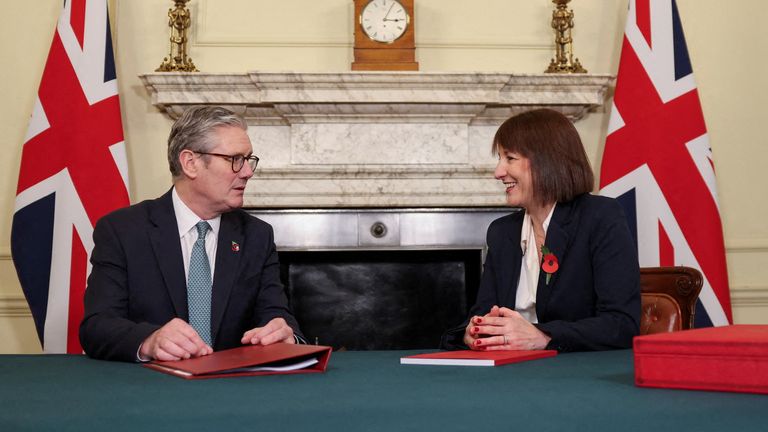
Pic: Reuters
This, it’s worth saying, is not a very large margin by which to meet your fiscal rule. A typical budget can see revisions and changes that would swamp that in one fell swoop. And part of the explanation for why there has been so much speculation about tax rises over the summer is that the chancellor left herself so little “headroom” against the rule. And since everyone could see debt interest costs were going up, it seemed quite plausible that the government would have to raise taxes.
Then, over the summer, the OBR, whose job it is to make the official government forecasts, and to mark its fiscal homework, told the government it was also doing something else: reviewing the state of Britain’s productivity. This set alarm bells ringing in Downing Street – and understandably. The weaker productivity growth is, the less income we’re all earning, and the less income we’re earning, the less tax revenues there are going into the exchequer.
The early signs were that the productivity review would knock tens of billions of pounds off the chancellor’s “headroom” – that it could, in one fell swoop, wipe off that £9.9bn and send it into the red.
Read more:
Main budget announcements – at a glance
Enter your salary to see how the budget affects you
That is why stories began to brew through the summer that the chancellor was considering raising taxes. The Treasury was preparing itself for some grisly news. But here’s the interesting thing: when the bad news (that productivity review) did eventually arrive, it was far less grisly than expected.
True: the one-off productivity “hit” to the public finances was £16bn. But – and this is crucial – that was offset by a lot of other, much better news (at least from the exchequer’s perspective). Higher wage inflation meant higher expected tax revenues, not to mention a host of other impacts. All told, when everything was totted up, the hit to the public finances wasn’t £16bn but somewhere between £5bn and £6bn.
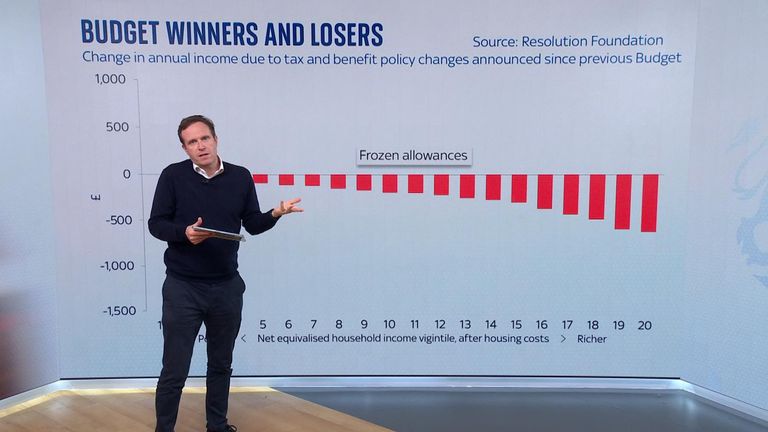
Budget winners and losers
Why is that number significant? Because it’s short of the chancellor’s existing £9.9bn headroom. Or, to put it another way, the OBR’s forecasting exercise was not enough to force her to raise taxes.
The decision to raise taxes, in other words, came down to something else. It came down to the fact that the government U-turned on a number of its welfare reforms over the summer. It came down to the fact that they wanted to axe the two-child benefits cap. And, on top of this, it came down to the fact that they wanted to raise their “headroom” against the fiscal rules from £9.9bn to over £20bn.
These are all perfectly logical reasons to raise tax – though some will disagree on their wisdom. But here’s the key thing: they are the chancellor and prime minister’s decisions. They are not knee-jerk responses to someone else’s bad news.
Yet when the prime minister explained his budget decisions, he focused mostly on that OBR report. In fact, worse, he selectively quoted the £16bn number from the productivity review without acknowledging that it was only one part of the story. That seems pretty misleading to me.
-
 Sports2 years ago
Story injured on diving stop, exits Red Sox game
-
 Sports3 years ago
‘Storybook stuff’: Inside the night Bryce Harper sent the Phillies to the World Series
-
 Sports2 years ago
Game 1 of WS least-watched in recorded history
-
 Sports3 years ago
Button battles heat exhaustion in NASCAR debut
-
 Sports3 years ago
MLB Rank 2023: Ranking baseball’s top 100 players
-
Sports4 years ago
Team Europe easily wins 4th straight Laver Cup
-
 Environment3 years ago
Japan and South Korea have a lot at stake in a free and open South China Sea
-
 Environment1 year ago
Here are the best electric bikes you can buy at every price level in October 2024