Environment
Honda wants to move deliveries off the road and into bike lanes with this quad

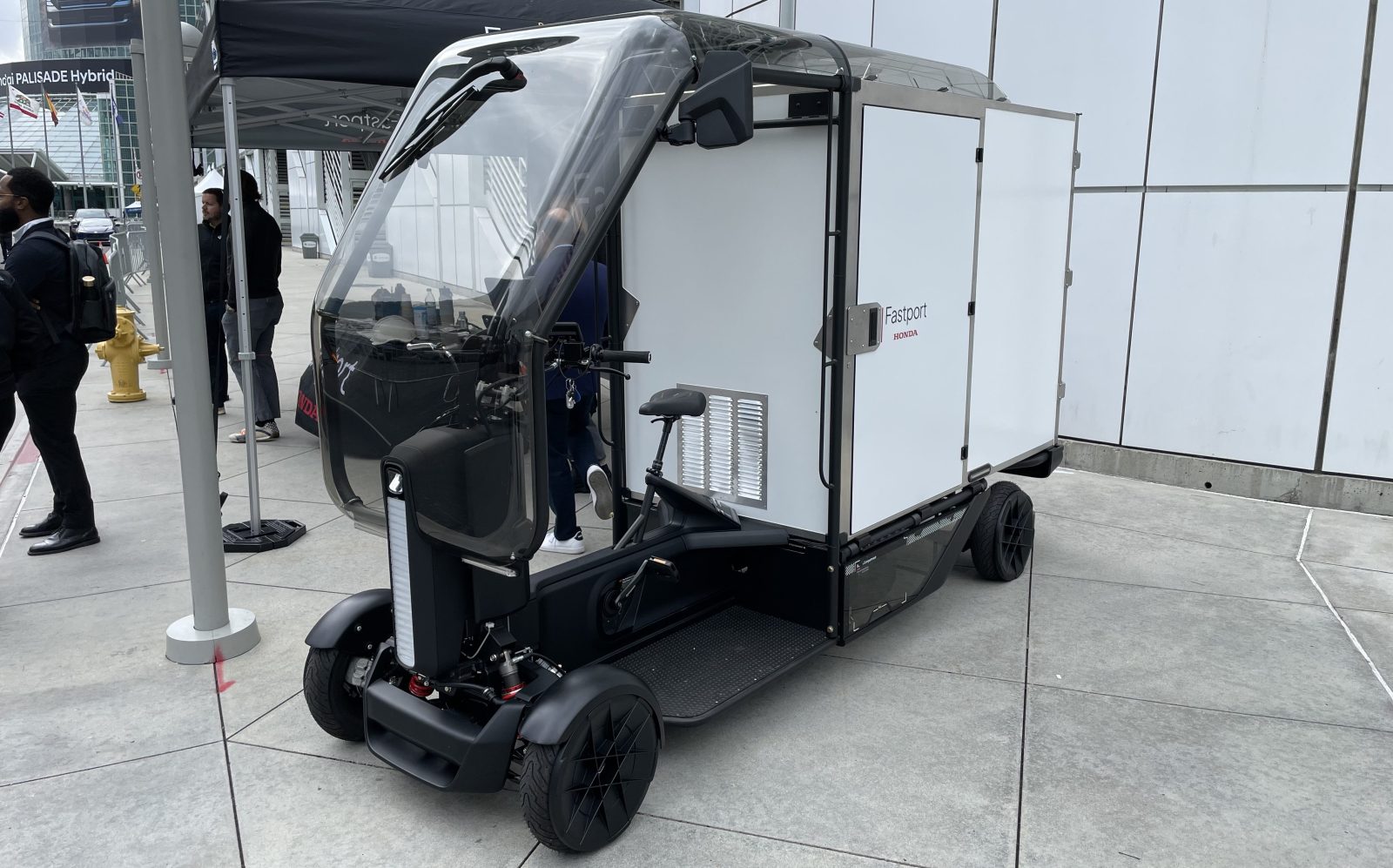

Honda is moving forward with its Fastport delivery quadcycle, and we got a chance to see it up close and take it for a quick spin.
We told you about Honda’s 4-wheeled delivery vehicle back in June, and we were excited about the idea of right-sizing delivery vehicles in urban centers that are often clogged with car traffic.
To catch you up, it’s a four-wheeled electric cargo vehicle that Honda has been working on for short-range, intra-city deliveries. It has 650lb capacity and a 12mph top speed, with 23 miles of range.
That’s not a huge range number, but we’re talking about cities here – Manhattan is 13×2 miles, San Francisco is 7×7 miles, for example. Also, the 2 x 1.3kWh batteries are 22lbs each and easily swappable if you need a little more juice.
The main concept here is that the vehicle is small, built to fit within the width of a bike lane, and to be treated as one in vehicle regulations. This means you can get cargo around in a smaller package than big delivery trucks, causing less traffic, congestion, road wear, and pollution.
Its presence in the bike lane is the reason for some of those limitations above – EU regulations mean the motor can only go up to 250W continuous draw, which also leads to a 12mph top speed for a vehicle that could be laden with ~1,700lbs of bike, cargo and rider (there is also a “small” version which is narrower and shorter, with 320lb capacity, for smaller roads).
But all that is nice on paper, what’s it like in person?
We got a little tour of the bike up close, and then a very brief ride and chance to do a couple three-point turns. And they did have to be three-point turns – this bike is quite long and unwieldy. A smaller turning circle would be nice.
Honda calls the drive system “pedal-by-wire,” and describes it as unique, and it certainly felt as such. The pedaling experience feels fully disconnected from the motor – you do spin the pedals, but the bike seems to do its own thing entirely. This felt strange to me as a person who is used to a torque sensor e-bike, where I’m still pushing even if the bike is helping me.
You might ask why there’s no throttle if the pedals just send a signal to the motor – this is to comply with regulations, making this technically a “pedal assist” vehicle, even though the bike is doing everything.
This is nice for accessibility, as you won’t need to be an athlete to drag 650lbs of cargo around behind you, but it also means the motor and batteries will be doing all of the work and you’ll be limited to a total of 250W of power (whereas if you combined that with the legs of a cyclist, you could add another hundred watts or two of human pedal power).
One question I had is how 2.6kWh worth of batteries could run a 12mph, 250W draw motor for only 23 miles – some napkin math suggests that the range should be much higher than that. But it turns out that the motor has much higher peak draw, as when we were accelerating, it would pull well over 2kW according to the display. And given the batteries are easily swappable, this isn’t much of a limitation.

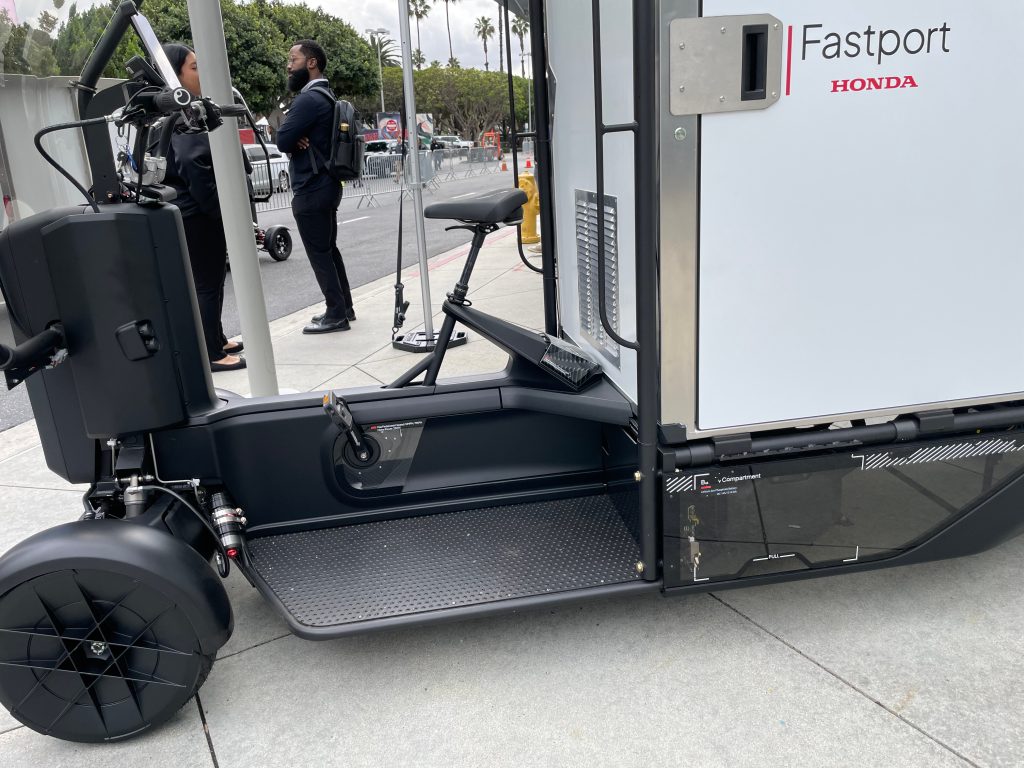
The display and handlebars are much more normal-looking than those seen in early renders. Rather than a large iPad-like display in the center, there’s a smaller one with a rear-view camera (helpful, but not well-calibrated – it makes you seem closer to objects than you actually are), and a side display with the sort of details you’d see in most bike computers, like speed and motor power. The displays are usable with polarized glasses, which is nice, since I’ve encountered quite a few bike displays which aren’t.
The shroud covering the rider’s “compartment” blocks UV light and helps to insulate from rain and wind. The final version will extend further down, adding more wind protection for legs and feet – but when it’s hot out, there’s a ventilation fan as well. Honda told us some things about the bike are still being tweaked from the version we saw… but first deliveries are supposed to start imminently, so we imagine the final version will look quite a lot like what we saw.
The cargo area on the bike is quite basic, just a big box. Shelving or other attachments could be added, depending on the specific implementation (food delivery, flowers, or whatever else). The box can be opened from the side or rear, with a horizontal sliding door on the side, and a vertical sliding door on the rear. It’s available in two sizes, depending on how big your bike lanes and delivery needs are.
But in addition to that basic cargo area, the vehicle has telematics built in, which are very valuable to fleets who want to know where their items are and how deliveries are going at any given time. And will help enable Honda to offer these quads as a “fleet as a service,” where businesses can get access to delivery vehicles, and Honda will even handle battery swaps.
Electrek’s Take
I love the idea of moving deliveries to smaller vehicles, especially since giant trucks can be such a problem in city centers.
But it’s particularly interesting looking at this vehicle versus the type of small delivery trucks that exist in other countries and that we don’t get much of here in the US.
For example, Japanese kei trucks can have a cargo capacity of 700-1000lbs, GVWR of ~2,500lbs, and a maximum length of 134 inches. Compare that to a cargo capacity of 320-650lbs (for small and large versions, respectively), GVWR of 1,433-1,765lbs and length of 134-148 inches for the Honda delivery quad.
So the kei truck has quite a bit more cargo capacity for a similar footprint, but then it makes pollution and requires more road infrastructure than the quad would. And of course… we simply don’t have them in the US.
So, whether comparing them to a gigantic delivery vehicle or even the smaller trucks available in Japan or some parts of Europe, this offers a distinct new option for getting goods around in a city – and one which requires less of the car and truck infrastructure that has taken over our public spaces.
That said… I think a higher speed would be preferable so as not to get in the way of cyclists, or in the case that the vehicle decides to take a real lane and can then keep up with traffic. It will be interesting to see how this and other cargo bikes turn out, whether they gain traction and what sort of challenges they might help cities avoid… or present on their own.
The 30% federal solar tax credit is ending this year. If you’ve ever considered going solar, now’s the time to act. To make sure you find a trusted, reliable solar installer near you that offers competitive pricing, check out EnergySage, a free service that makes it easy for you to go solar. It has hundreds of pre-vetted solar installers competing for your business, ensuring you get high-quality solutions and save 20-30% compared to going it alone. Plus, it’s free to use, and you won’t get sales calls until you select an installer and share your phone number with them.
Your personalized solar quotes are easy to compare online and you’ll get access to unbiased Energy Advisors to help you every step of the way. Get started here.




FTC: We use income earning auto affiliate links. More.