
Calls for Theresa May’s former aide to resign from BBC for ‘trying to block senior appointment’

Labour has called for Theresa May’s former communications director to be sacked from the BBC board over claims he tried to block someone from a senior job on political grounds.
Sir Robbie Gibb, who became non-executive director at the Corporation in May, tried to stop Jess Brammar, former HuffPost UK editor and Newsnight journalist, from becoming BBC executive news editor, according to the Financial Times.
Sir Robbie, a former senior BBC journalist, texted Fran Unsworth, BBC director for news and current affairs, saying the broadcaster “cannot make this appointment” because the government’s “fragile trust in the BBC will be shattered” if it did, the newspaper reported.
Deputy Labour leader Angela Rayner has written to BBC director general Tim Davie demanding Sir Robbie be removed from his position.
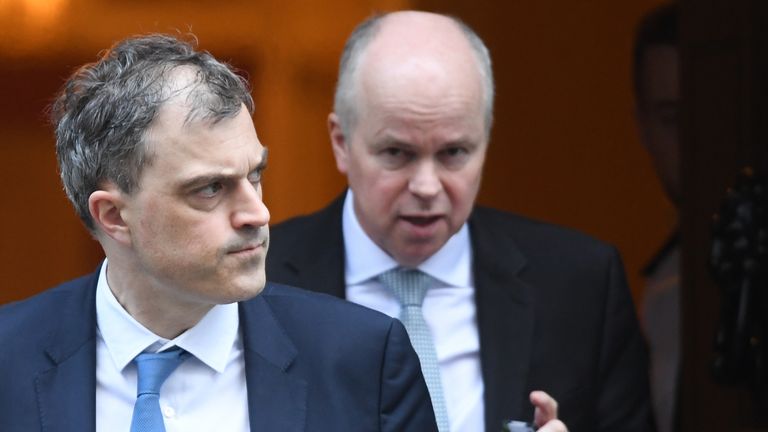
Sir Robbie Gibb (right) is pictured with former chief whip Julian Smith
“If Robbie Gibb won’t resign then the chair of the BBC must sack him,” she wrote on Twitter.
Jo Stevens, shadow digital, culture, media and sport secretary, added: “These allegations raise very serious questions about Conservative cronyism at the heart of the BBC.
“If Robbie Gibb is in post to further Tory interests rather than the public interest, then he is in the wrong job.”
Ms Brammar had applied for a newly-created post that oversees BBC output on its UK and global news channels, according to the FT.
She used to work as deputy editor of BBC Newsnight and ran the HuffPost UK website until the company was bought by Buzzfeed, which made editorial staff redundant.
Sir Robbie now works as senior communications adviser at Kekst CNC and is director of the Jewish Chronicle, but served as Theresa May’s director of communications from 2017 to 2019.
The row comes at a time when Mr Davie has attempted to address concerns about the BBC’s impartiality.
The broadcaster said in a statement: “The BBC doesn’t comment on ongoing recruitment processes, which are the responsibility of the executive, but for the record, no recruitment process has been blocked.
“People should wait for the outcome which will be announced in due course.
“And as a general principle, board members are able to discuss issues with other board members or senior executives. These principles were adhered to.”


The International Monetary Fund’s mission chief for El Salvador issued a statement confirming that government authorities were proceeding with negotiations for the sale of the country’s Chivo Bitcoin wallet.
In a Monday statement, the IMF said El Salvador’s government was continuing to discuss its Bitcoin (BTC) project with the fund’s officials, and “negotiations for the sale of the government e-wallet Chivo are well advanced.” The announcement signaled that the government may be preparing to sell some or all of its crypto holdings in the Chivo wallet.
The statement followed a May deal with El Salvador in which the IMF would pay $120 million as part of a 2024 loan agreement for $1.4 billion. As part of the deal, the government would stop acquiring Bitcoin.
It’s unclear whether El Salvador is abiding by the terms of the deal. Though the IMF reported in July that the country’s government had not purchased any BTC since December 2024, El Salvador’s Bitcoin Office continues to announce crypto buys, including 1,090 Bitcoin worth about $100 million in November.
Related: CFTC changes guard as Selig takes reins, Pham departs
According to the terms of the IMF-El Salvador deal made public, the government would make public sector engagement of BTC-related economic activity “confined,” the private sector’s acceptance of Bitcoin would be voluntary, and it would wind down involvement in the Chivo wallet. Cointelegraph reached out to the IMF for comment but had not received a response at the time of publication.
El Salvador recognized Bitcoin as legal tender in 2021 and began acquiring the cryptocurrency as part of a strategy largely pushed by President Nayib Bukele. According to data provided by the country’s Bitcoin Office, the government held 7,509 Bitcoin as of Monday, worth about $659 million at the time of publication.
‘It’s not stopping,’ says Bukele on Bitcoin buys
Despite the reported deal between the IMF and El Salvador, Bukele said in March that the government would continue its Bitcoin investment strategy, purchasing at least one BTC daily. It’s unclear how the president’s statement could affect the IMF agreement.
Magazine: When privacy and AML laws conflict: Crypto projects’ impossible choice

-
 Sports2 years ago
Story injured on diving stop, exits Red Sox game
-
 Sports3 years ago
‘Storybook stuff’: Inside the night Bryce Harper sent the Phillies to the World Series
-
 Sports2 years ago
Game 1 of WS least-watched in recorded history
-
 Sports3 years ago
Button battles heat exhaustion in NASCAR debut
-
 Sports3 years ago
MLB Rank 2023: Ranking baseball’s top 100 players
-
Sports4 years ago
Team Europe easily wins 4th straight Laver Cup
-
 Environment3 years ago
Japan and South Korea have a lot at stake in a free and open South China Sea
-
 Environment1 year ago
Here are the best electric bikes you can buy at every price level in October 2024