
Emergency workers won’t need to be jabbed to have self-isolation exemption as testing expanded

Boris Johnson is facing growing pressure to allow fully vaccinated people who have been identified as close contacts of coronavirus cases to be exempt from isolation.
London Mayor Sadiq Khan has joined business leaders in calling for more workers to be allowed to skip quarantine if they are alerted by the NHS COVID-19 app to prevent a staffing crisis during the so-called “pingdemic”.
In a letter to the prime minister, the mayor and industry bodies including UKHospitality, the London Chamber of Commerce and Industry and London’s branch of the Federation of Small Businesses, said there is “an urgent need to outline a more considered approach” on the rules regarding self-isolation.
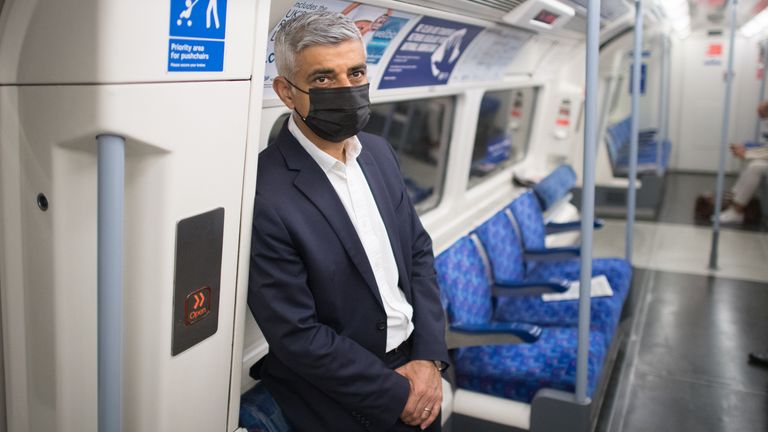
Mayor of London Sadiq Khan has urged the PM to outline ‘a more considered approach’ to self-isolation
They warned that the app is exacerbating staff shortages for pubs, bars and restaurants.
The government has announced that a phased approach to testing will soon see some “critical workers” being exempt from quarantine as long as they use daily lateral flow tests and the results are negative.
But the mayor and business leaders said daily PCR tests should be used instead.
“The summer months are crucial for many businesses’ recovery and their ability to recover must not be put in jeopardy,” they noted.
“We are therefore calling on you to ensure that the necessary testing is in place to enable people who have been double vaccinated for longer than two weeks and pinged by the NHS COVID app, to immediately return to work, following a negative PCR test, rather than having to self-isolate.”
The PM is also facing calls from senior members of his own backbenches for a change to the system.
Conservative MP and chairman of the health and social care select committee Jeremy Hunt warned the government that it faces “losing social consent” for the self-isolation scheme if nothing is done.
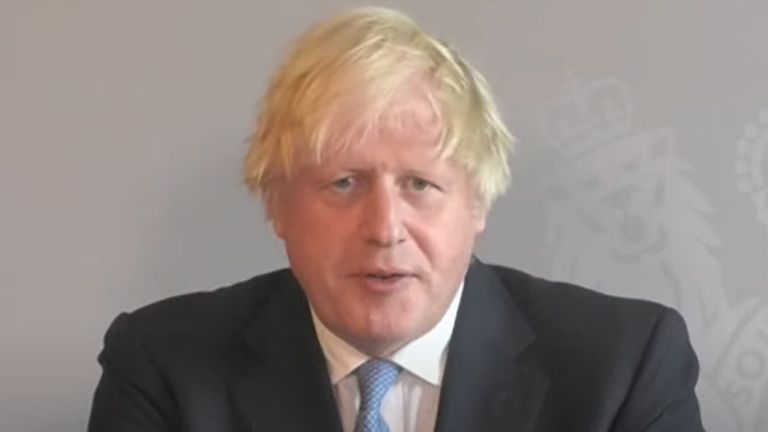
Boris Johnson is isolating in Chequers after being alerted as a close contact of Sajid Javid who tested positive for the virus
And fellow Conservative Greg Clark, a former business secretary who now chairs the Commons science and technology committee, suggested that an exemption from self-isolation for all those fully-vaccinated should be brought in immediately.
It comes as pub and restaurant bosses warned of a “summer of venue closures” unless hospitality workers are exempt from quarantine rules as cases continue to increase.
More than 600,000 people were alerted by the app in the week to 14 July.
And the latest information from the Office for National Statistics showed around one in 75 people in England currently have the virus.
Business Secretary Kwasi Kwarteng admitted the government is “very concerned” about the numbers of people being pinged by the NHS app.
From 16 August, all of those double vaccinated will be exempt from self-isolation if identified as a close contact, the government has said.
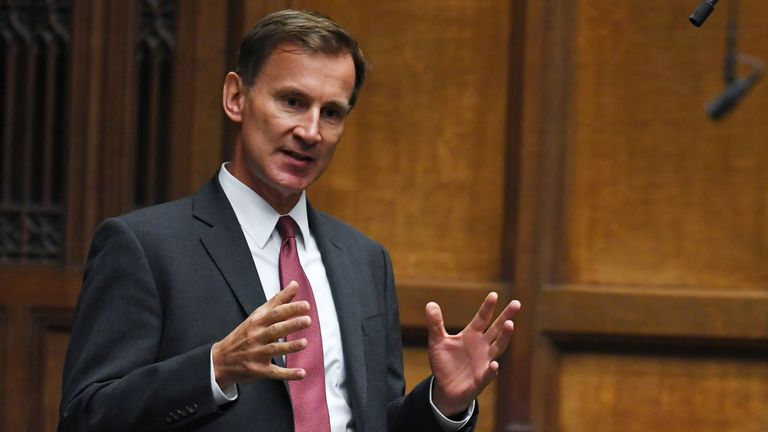
Jeremy Hunt says the government faces ‘losing social consent’ over the isolation system if it fails to act
Environment Secretary George Eustice told Sky News this date “at the moment is not coming forward”.
The PM himself is currently isolating at Chequers, having been identified as a close contact of newly-appointed Health Secretary Sajid Javid who tested positive for coronavirus.
Chancellor Rishi Sunak was identified as another of Mr Javid’s contacts – and Labour leader Sir Keir Starmer was also forced into isolation on Wednesday after one of his children tested positive for the virus.
On Thursday evening, the government published a list of 16 sectors where double-jabbed workers will be eligible to avoid isolation if they undergo daily lateral flow testing and their results are negative.
These included energy, civil nuclear, digital infrastructure, food production and supply, waste, water, veterinary medicines, essential chemicals, essential transport, medicines, medical devices, clinical consumable supplies, emergency services, border control, essential defence outputs, and local government.
Around 10,000 workers in the food sector are also expected to be included in the scheme.
And on Friday, the Department for Environment, Food and Rural Affairs expanded on this further, outlining the positions the exemptions would apply to “subject to all other mitigation options being exhausted”.
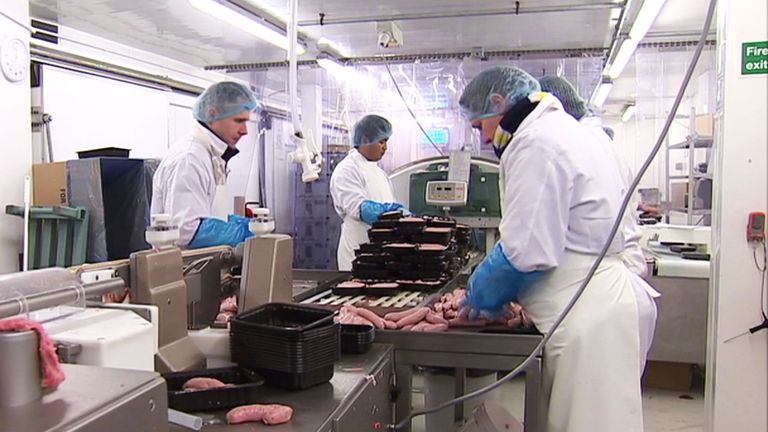
Around 10,000 food sector workers are among those who could be exempt from isolation
The roles include manufacturing maintenance engineers, specialist reach truck drivers, official vets, environmental health officers, landfill operators, water engineers, laboratory staff essential to the batch release of medicines, and environment agency staff operating critical flood defence assets.
Those who work in the roles above will be able to leave their COVID-19 isolation to travel to work and do their jobs after a negative daily test but must remain at home otherwise and go straight into quarantine if they receive a positive result.
It will only apply to workers who are fully vaccinated – and 14 days after their second coronavirus jab.

The US Federal Deposit Insurance Corporation will propose a framework for implementing US stablecoin laws later this month, according to its acting chair, Travis Hill.
“The FDIC has begun work to promulgate rules to implement the GENIUS Act; we expect to issue a proposed rule to establish our application framework later this month,” Hill said in prepared testimony to be delivered on Tuesday to the House Financial Services Committee.
He added the agency will also have a “proposed rule to implement the GENIUS Act’s prudential requirements for FDIC-supervised payment stablecoin issuers early next year.”
President Donald Trump signed the GENIUS Act in July, which created oversight and licensing regimes for multiple regulators, with the FDIC to police the stablecoin-issuing subsidiaries of the institutions it oversees.
The FDIC insures deposits in thousands of banks in the event that they fail, and under the GENIUS Act, it will also be tasked with making “capital requirements, liquidity standards, and reserve asset diversification standards” for stablecoin issuers, said Hill.

Federal agencies, such as the FDIC, publish their proposed rules for public feedback, and they then review and respond to the input, if necessary, before publishing a final version of the rules, a process that can take several months.
Related: Republicans urge action on market structure bill over debanking claims
The Treasury, which will also regulate some stablecoin issuers, including non-banks, began its implementation of the GENIUS Act in August and finished a second period of public comment on its implementation proposal last month.
FDIC is working on tokenized deposit guidelines
Hill said in his remarks that the FDIC has also considered recommendations published in July by the President’s Working Group on Digital Asset Markets.
“The report recommends clarifying or expanding permissible activities in which banks may engage, including the tokenization of assets and liabilities,” Hill said.
“We are also currently developing guidance to provide additional clarity with respect to the regulatory status of tokenized deposits,” he added.
Fed helping regulators with stablecoin rules
The Federal Reserve’s vice supervision chair, Michelle Bowman, will also testify on Tuesday that the central bank is “currently working with the other banking regulators to develop capital, liquidity, and diversification regulations for stablecoin issuers as required by the GENIUS Act.”
Bowman added, according to her prepared remarks, that “we also need to provide clarity in treatment on digital assets to ensure that the banking system is well placed to support digital asset activities.”
“This includes clarity on the permissibility of activities, but also a willingness to provide regulatory feedback on proposed new use cases,” she said.
The House Finance Committee’s hearing on Tuesday will also see remarks from the heads of the Office of the Comptroller of the Currency and the National Credit Union Administration, which will both have a role in implementing stablecoin rules.
Magazine: Bitcoin vs stablecoins showdown looms as GENIUS Act nears

The Japanese government is reportedly backing plans to introduce a significant reduction in the nation’s maximum tax rate on crypto profits, with a flat rate of 20% across the board.
Japan’s financial regulator, the Financial Services Agency (FSA), first floated the proposed tax changes in mid-November, outlining plans to introduce a bill in early 2026, and now the government and ruling coalition — the political parties in control of Japan’s parliament, the National Diet — are on board.
According to a report from Japanese news outlet Nikkei Asia on Sunday, the new rules aim to align crypto taxation rules with those of other financial products, such as equities and investment funds.
Under the current laws, taxation on crypto trading is included as part of income taxes for individuals and businesses, falling under the category of “miscellaneous income.” The rate ranges from 5% on the lower end of the spectrum to 45% on the high end, with high-income earners potentially on the hook for an additional 10% inhabitant tax.
Meanwhile, assets such as equities and investment trusts are taxed separately, with a flat 20% tax on profits, regardless of the amount.
The tax changes could be a boon for the domestic cryptocurrency market, as the higher tax rates may have deterred potential investors.

According to the Nikkei report, the potential changes to crypto taxation in Japan will be introduced as part of a “solid investor-protection framework” proposed in the FSA’s bill, which aims to amend the Financial Instruments and Exchange Act.
The FSA will submit the bill during the regular Diet session in 2026, as it pushes for greater oversight of crypto trading, including a ban on dealing with non-public information and stricter investment disclosures.
Japan finally set for crypto tax change after long fight
The Japan Blockchain Association (JBA), the nation’s major crypto-focused non-governmental lobbying group, has been calling for these changes for almost three years.
Related: Bitcoin falls to $84K: Is Japan’s bond market the culprit, or is more at play?
In July 2023, the JBA published a letter to the government on its website, outlining key tax reform requests to support the industry. The letter called for a 20% tax rate that aligns with other investment vehicles.
“This letter requests a review of tax on crypto assets, which is the biggest hurdle for companies operating Web3 businesses in Japan and a disincentive for the public to actively own and use crypto assets,” the letter reads.
While it is unclear if the JBA had a direct influence on the FSA’s thinking, the financial watchdog did start warming up to the idea and pushing for reform in September 2024.
Magazine: Koreans ‘pump’ alts after Upbit hack, China BTC mining surge: Asia Express


Sir Keir Starmer has warned China poses “real national security threats to the United Kingdom”.
But the prime minister also described China as a “nation of immense scale, ambition and ingenuity” and a “defining force in technology, trade and global governance”.
“The UK needs a China policy that recognises this reality,” he added in a speech at the Guildhall in London.
“Instead, for years we have blown hot and cold.
“So our response will not be driven by fear, nor softened by illusion. It will be grounded in strength, clarity and sober realism.”
Prime Minister Keir Starmer giving his speech. Pic: Reuters
Describing the absence of engagement with China – the world’s second-biggest economy – as “staggering” and “a dereliction of duty”, Sir Keir said: “This is not a question of balancing economic and security considerations. We don’t trade off security in one area, for a bit more economic access somewhere else.
“Protecting our security is non-negotiable – our first duty. But by taking tough steps to keep us secure, we enable ourselves to cooperate in other areas.”
Sir Keir’s remarks come after MPs and parliamentarians were warned last month of new attempts to spy on them by China.
And they follow the collapse of a prosecution of two people suspected of spying on behalf of China.
That case led to controversy over how the government under Labour responded to the Crown Prosecution Service’s requests for evidence.
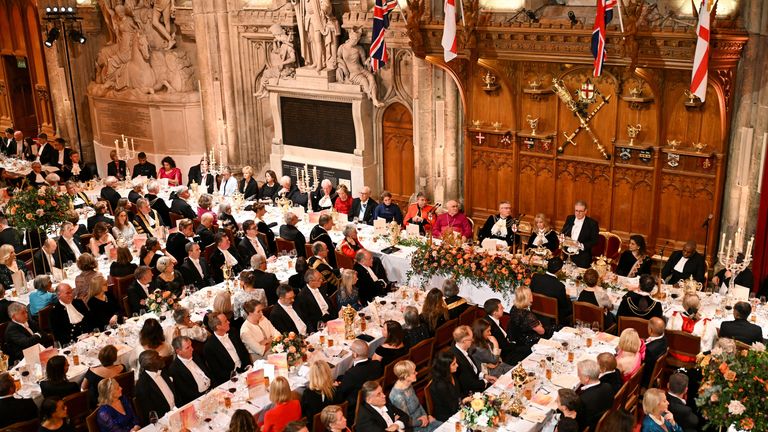
Speech at the annual Lady Mayor’s Banquet. Pic: Reuters
At the time, Sir Keir sought to blame the previous Conservative government for the issues, which centred on whether China could be designated an “enemy” under First World War-era legislation.
Meanwhile, Sky News understands the prime minister is set to approve plans for a controversial Chinese “super embassy” in central London.
Read more:
MI5 spying warning aims to send signal to China
‘Many options’ on table for Venezuela
A final decision on the planning application for the former Royal Mint site near the Tower of London is due on 10 December, after numerous previous delays.
Sir Keir is also understood to be preparing for a likely visit to China in the new year.
Since he was elected last year, Sir Keir has been active on the world stage, trumpeting deals with the US, India and the EU and leading the “coalition of the willing” in support of Ukraine.
PM preparing for likely China visit
But he has also faced criticism from his opponents, who accuse him of spending too much time out of the UK attending international summits rather than focusing on domestic issues.
Sir Keir offered a defence of his approach, describing it as “the biggest shift in British foreign policy since Brexit” and “a decisive move to face outward again”.
While saying he would “always respect” the Brexit vote as a “fair, democratic expression”, he said the way the UK’s departure from the EU had been “sold and delivered” was “simply wrong”.
He said: “Wild promises were made to the British people and not fulfilled. We are still dealing with the consequences today.”
In his speech on Monday, the prime minister accused opposition politicians of offering a “corrosive, inward-looking attitude” on international affairs.

Sir Keir Starmer. Pic: Reuters
Taking aim at those who advocate leaving the European Convention on Human Rights or NATO, he said they offered “grievance rather than hope” and “a declinist vision of a lesser Britain”.
Sir Keir said: “Moreover, it is a fatal misreading of the moment, ducking the fundamental challenge posed by a chaotic world – a world which is more dangerous and unstable than at any point for a generation, where international events reach directly into our lives, whether we like it or not.”
He added: “In these times, we deliver for Britain by looking outward with renewed purpose and pride, not by shrinking back. In these times, internationalism is patriotism.”
Responding to the prime minister’s speech, shadow foreign secretary Dame Priti Patel said: “From China’s continued flouting of economic rules to transnational repression of Hong Kongers in Britain, Starmer’s ‘reset’ with Beijing is a naive one-way street, which puts Britain at risk while Beijing gets everything it wants.
“Starmer continues to kowtow to China and is captivated by half-baked promises of trade.
“Coming just days after the latest Chinese plot to interfere in our democracy was exposed, his love letter to the Chinese Communist Party is a desperate ploy to generate economic growth following his budget of lies and is completely ill-judged.
“While China poses a clear threat to Britain, China continues to back Iran and Russia, and plots to undermine our institutions. Keir Starmer has become Beijing’s useful idiot in Britain.”
-
 Sports2 years ago
Story injured on diving stop, exits Red Sox game
-
 Sports3 years ago
‘Storybook stuff’: Inside the night Bryce Harper sent the Phillies to the World Series
-
 Sports2 years ago
Game 1 of WS least-watched in recorded history
-
 Sports3 years ago
Button battles heat exhaustion in NASCAR debut
-
 Sports3 years ago
MLB Rank 2023: Ranking baseball’s top 100 players
-
Sports4 years ago
Team Europe easily wins 4th straight Laver Cup
-
 Environment3 years ago
Japan and South Korea have a lot at stake in a free and open South China Sea
-
 Environment1 year ago
Here are the best electric bikes you can buy at every price level in October 2024