
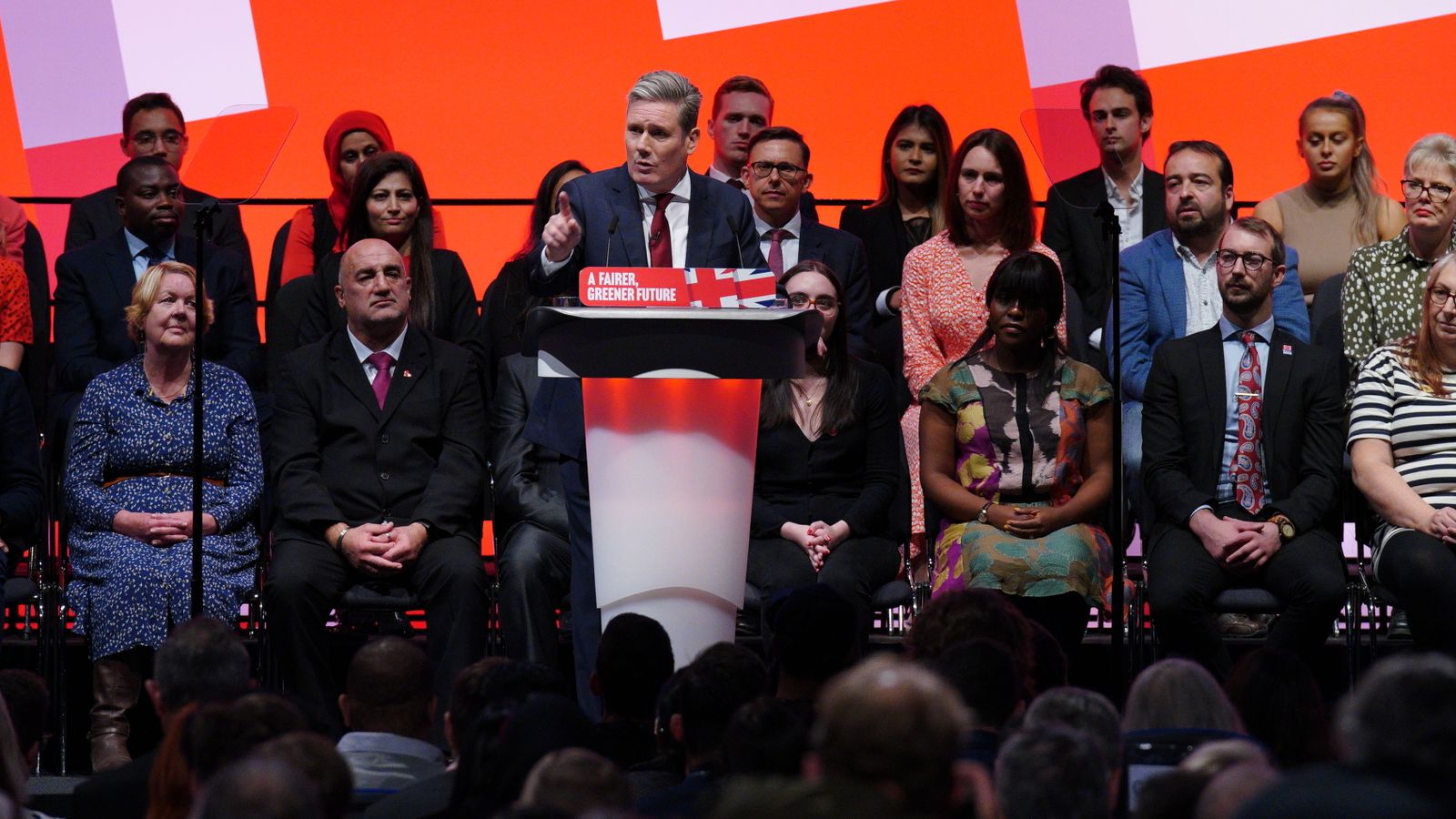
Keir Starmer used his party conference speech to sharpen his message and go heavy on patriotism in a pitch to ‘hero voters’

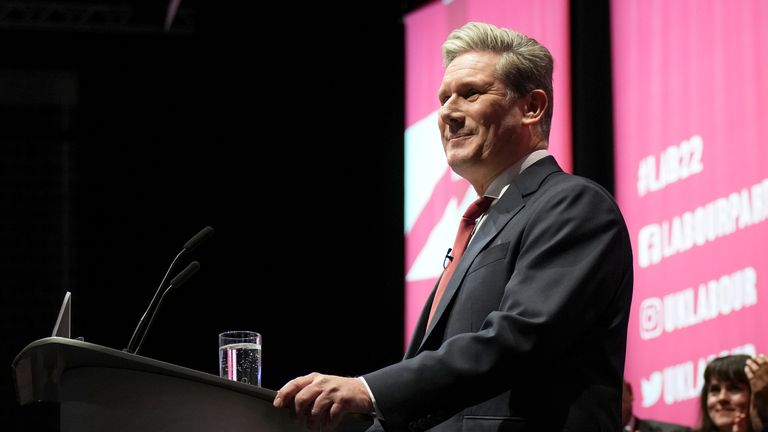
As an exercise in party management, this has been the most successful conference for Labour since Tony Blair’s last in 2006.
There was buyer’s remorse the moment Gordon Brown took over in 2007; the conferences of the Ed Miliband years left deeper scars than evident in public; and that was nothing compared to the civil war of the Corbyn era.
Last year, Keir Starmer’s first proper conference was consumed by clashes with his left flank and Corbyn groupies.
This year, his own party – with a very different membership turning up in Liverpool – decided to give Keir Starmer pretty much a clear run.
Politics Hub: Live updates from Labour conference
That’s meant the question all week has been whether today’s speech connects with the public, makes an argument for a better Britain that voters can believe and is memorable enough to impact on a noisy political scene.
To do this, Keir Starmer has changed speechwriters. Gone were the authors of last year’s windy treatise that overstayed its welcome.
In its place is Alan Lockey, who worked for Tony Blair’s policy chief Matthew Taylor at the Royal Society of Arts. The change was noticeable: the speech more muscular, more tightly constructed and with sharper phrasing than anything previously seen from this leader.
Starmer lashed out at energy initiatives in the UK being owned by foreign companies before making the announcement.
The three themes listeners were bludgeoned with all the way through the hour were patriotism, solidarity and integrity.
Praise for the “remarkable sovereign”; invoking how the “Late Queen would turn our collar up and face the storm”; talk of “British power to the British people”; arguing the Tories are responsible for “redistribution from the poor to the rich” – a highly targeted speech.
This is because there is a clear political strategy behind this approach.
Under the guidance of pollster and strategist Deborah Mattinson, Labour is prioritising winning back a slice of the electorate they call “hero voters” – one-time Labour supporters who backed Brexit and then voted Tory in 2019 but who they think are up for grabs at the next election.
An overt drive by Starmer to stress his patriotism, sense of solidarity and integrity is only one part of Team Starmer’s drive to win back “hero voters”. The other was to hammer the differences between himself and Labour’s Corbyn era.
Read More:
Labour surge to biggest poll lead over Tories since 2001
‘The cavalry is coming’: Labour shadow minister says party ‘ready to govern’
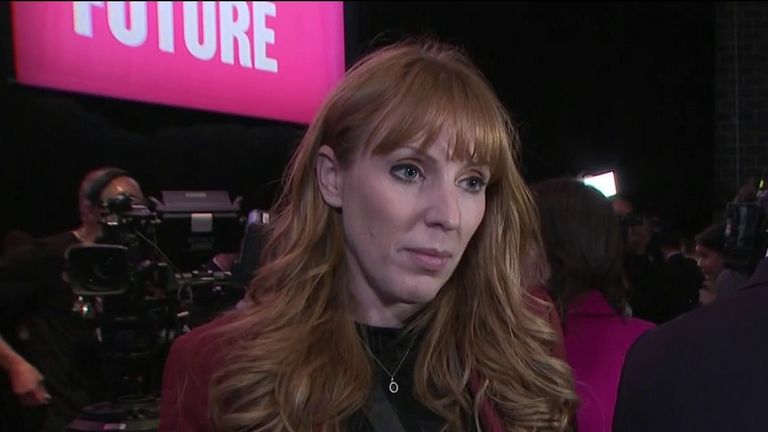
Labour deputy leader Angela Rayner says Labour has what it takes to win the next general election and is the ‘party of the people’
The former regime may have played a comparatively tiny role in this year’s conference compared to 2021, yet still Starmer decided the public needs to be reminded.
Again, the repudiation of antisemitism. Again, another standing ovation. A different membership in Liverpool this year, and Starmer attempting to use that to his advantage. The Tories the enemy of the speech, but the Corbyn era an almost equal opponent.
One big announcement at the heart of the speech – the creation of a British state-owned energy company to rival France’s EDF, known as Great British Energy – got a standing ovation.
As he acknowledged, its birth will be tricky, its role in the market yet to be fleshed out – it is more political signal than fully fleshed out change. Whether this idea will stay uppermost in voters’ minds is yet to be seen.
But the other striking thing about the speech was the way he wanted to signal confidence.
By addressing Brexit head-on – which for a long time has unnerved party strategists – attacking the government for failing to “grasp the nettle” and promising to deliver “control” in a way the Tories have failed. This would not have been possible 18 months ago.
A good party conference speech provides verbal weapons for their troops to deploy on doorsteps in the months ahead. Starmer provided his team with options – pretty much for the first time. Let’s see if his flock use them.
World
Is this what the beginning of a war looks like? How the US threat around Venezuela is shaping up
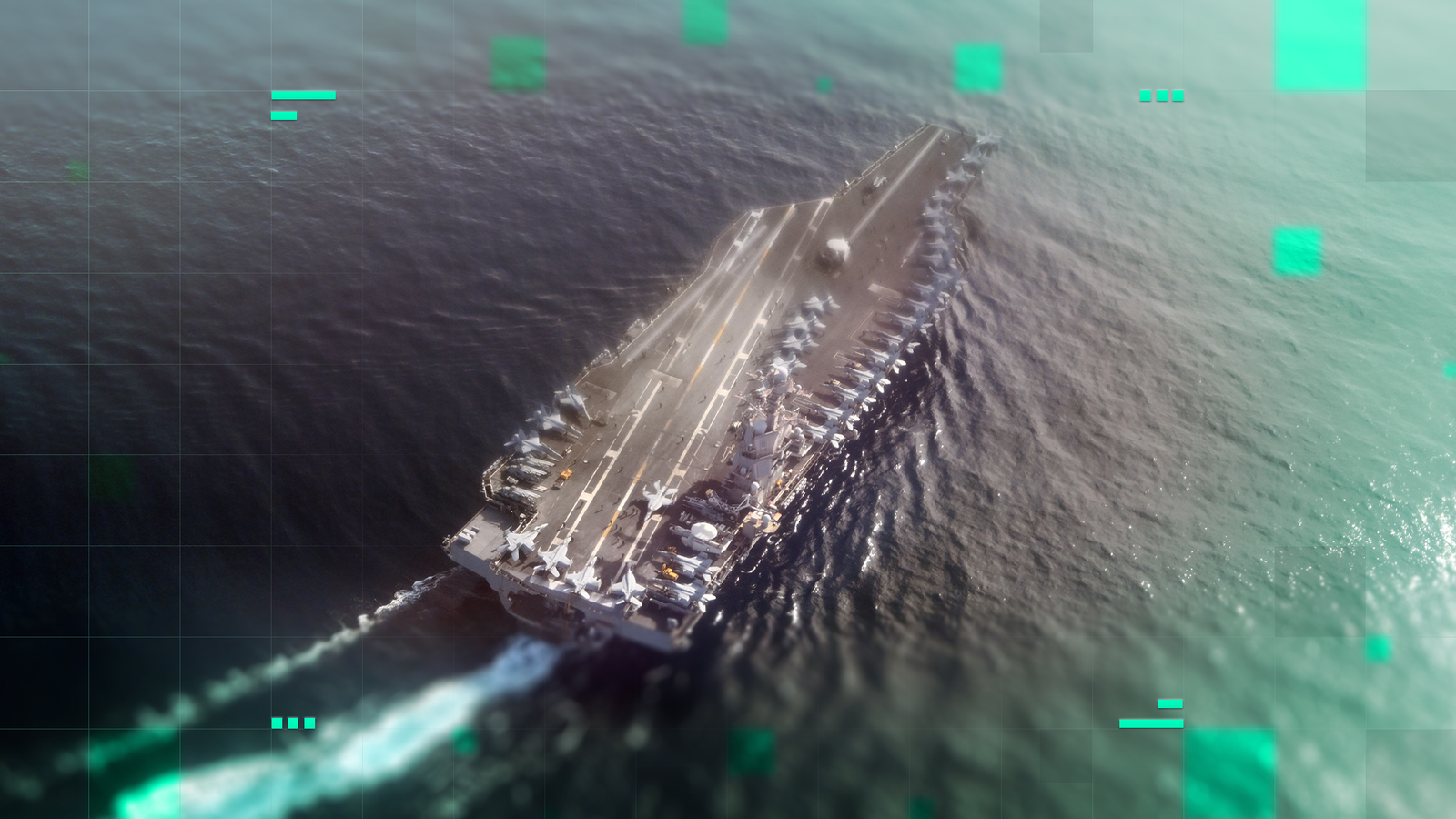
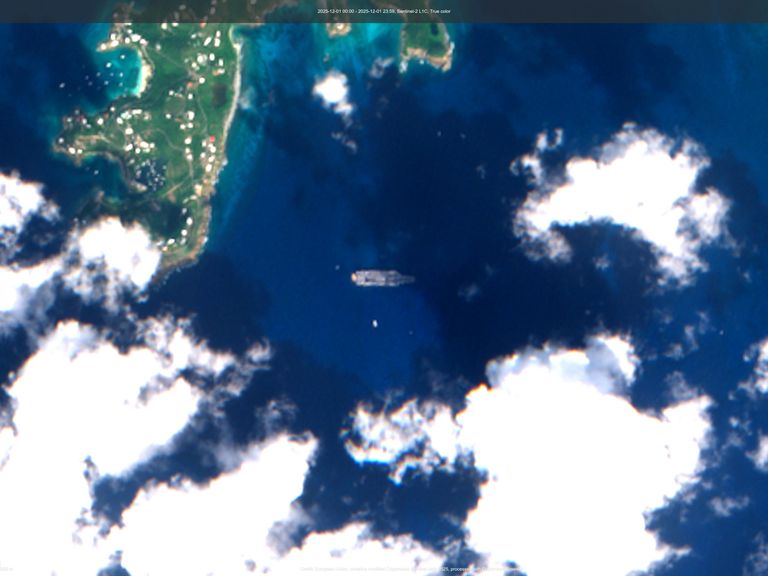
Is this what the beginning of a war looks like?
In the deep blue waters of the Caribbean, visible from space, an unremarkable grey smudge.
The USS Gerald R Ford seen off the US Virgin Islands on 1 December. Credit: Copernicus
But this is the USS Gerald R Ford: the largest, most deadly aircraft carrier in the world. And it is only part of an armada, apparently set on Venezuela.
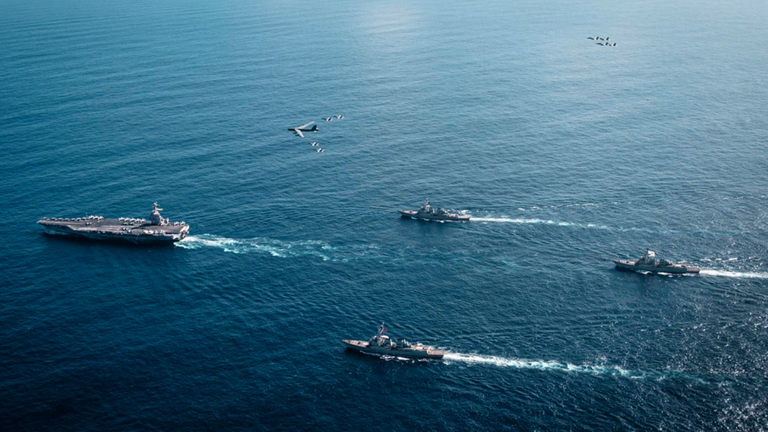
The Gerald R Ford, USS Winston S Churchill, USS Mahan and USS Bainbridge in the Atlantic on 13 November. Source: US Department of Defense
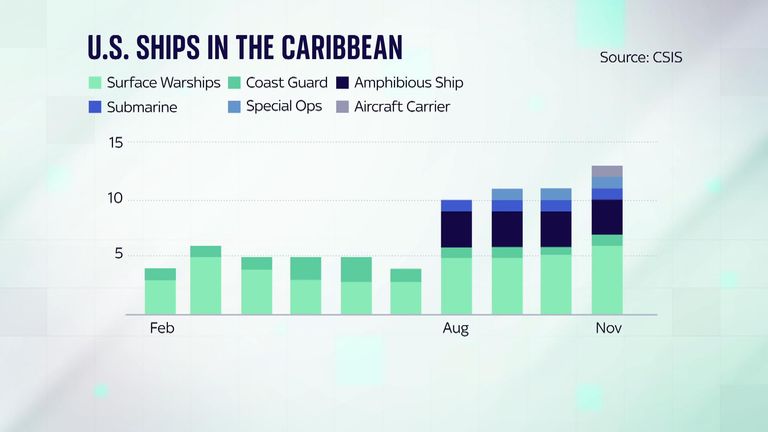
From being able to count on one hand the number of warships and boats in the Caribbean, since August we can see the build-up of the number, and variety of ships under US command.
And that’s only at sea – air power has also been deployed, with bombers flying over the Caribbean, and even along the Venezuelan coast, as recently as this week.
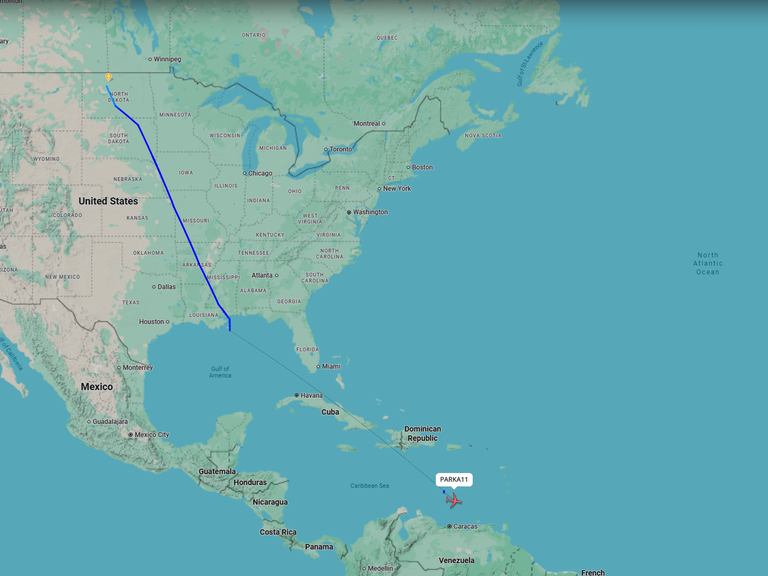
A Boeing B-52H Stratofortress near Venezuelan coast from Minot Air Force Base, North Dakota, on 3 December. Credit: FlightRadar24
Venezuela’s President Nicolas Maduro told crowds his country has endured 22 weeks of aggression from the US and Donald Trump.
Things could be about to get worse.
So let’s rewind those 22 weeks to understand how we got here…
‘Drug boat’ strike
On 2 September, the White House posted on X that it had conducted a strike against so-called “narcoterrorists” shipping fentanyl to the US, without providing direct evidence of the alleged crime.
Sky’s Data & Forensics unit has verified that in the past four months since strikes began, 23 boats have been targeted in 22 strikes, killing 87 people.
Read more: The US-Venezuela crisis explained
The latest was on 4 December, after which US Southern Command announced it had conducted another strike on an alleged drug smuggling boat in the eastern Pacific.
It was the first such strike since 15 November and since the defence secretary, sometimes referred to as secretary of war, Pete Hegseth, came under scrutiny for an alleged “second strike” in an earlier attack.
The US says it carried out the action because of drugs – and there has been some evidence to support its assertion.
The Dominican Republic said it had recovered the contents of one boat hit by a strike – a huge haul of cocaine.
Legal issues
Whatever the cargo, though, there are serious, disputed legal issues.
Firstly, it is contested whether by designating the people on the boats as narcoterrorists, it makes them lawful military targets – or whether the strikes are in fact extra judicial murders of civilians at sea.
And more specifically… well, let’s go back to that very first video, of the very first strike.
What this footage doesn’t show is what came afterwards – an alleged “second strike” that targeted people in the water posing no apparent threat.
That has created a crisis for Hegseth.
Speaking at a cabinet meeting last week, the defence secretary said he did not see that there were survivors in the water when the second strike was ordered and launched in early September, saying that “the thing was on fire”.
And the 4 December strike shows this strategy isn’t over.
The strikes are just part of the story, as warships and planes have headed toward the region in huge numbers.
Drugs or oil?
Some have said this isn’t about drugs at all, but oil.
Venezuela has lots – the world’s largest proven reserves.
Speaking to the faithful on Fox News, Republican congresswoman – and Trump supporter – Maria Salazar said access to Venezuela would be a “field day” for American oil companies.
And Maduro himself has taken up that theme. A few days later, he wrote this letter to OPEC – which represents major oil producing nations – to “address the growing and illegal threats made by the government of the United States against Venezuela”.
That’s how Maduro has framed this – a plan by the US “to seize Venezuela’s vast oil reserves… through lethal military force”.
Lethal military force – an understatement when you think of the armada lying in wait.
And it may be called upon soon. Trump on Tuesday said he’s preparing to take these strikes from international waters on to Venezuelan territory.
Maduro has complained of 22 weeks of “aggression”. There may be many more to come.
Additional reporting by Sophia Massam, junior digital investigations journalist.
The Data X Forensics team is a multi-skilled unit dedicated to providing transparent journalism from Sky News. We gather, analyse and visualise data to tell data-driven stories. We combine traditional reporting skills with advanced analysis of satellite images, social media and other open source information. Through multimedia storytelling we aim to better explain the world while also showing how our journalism is done.
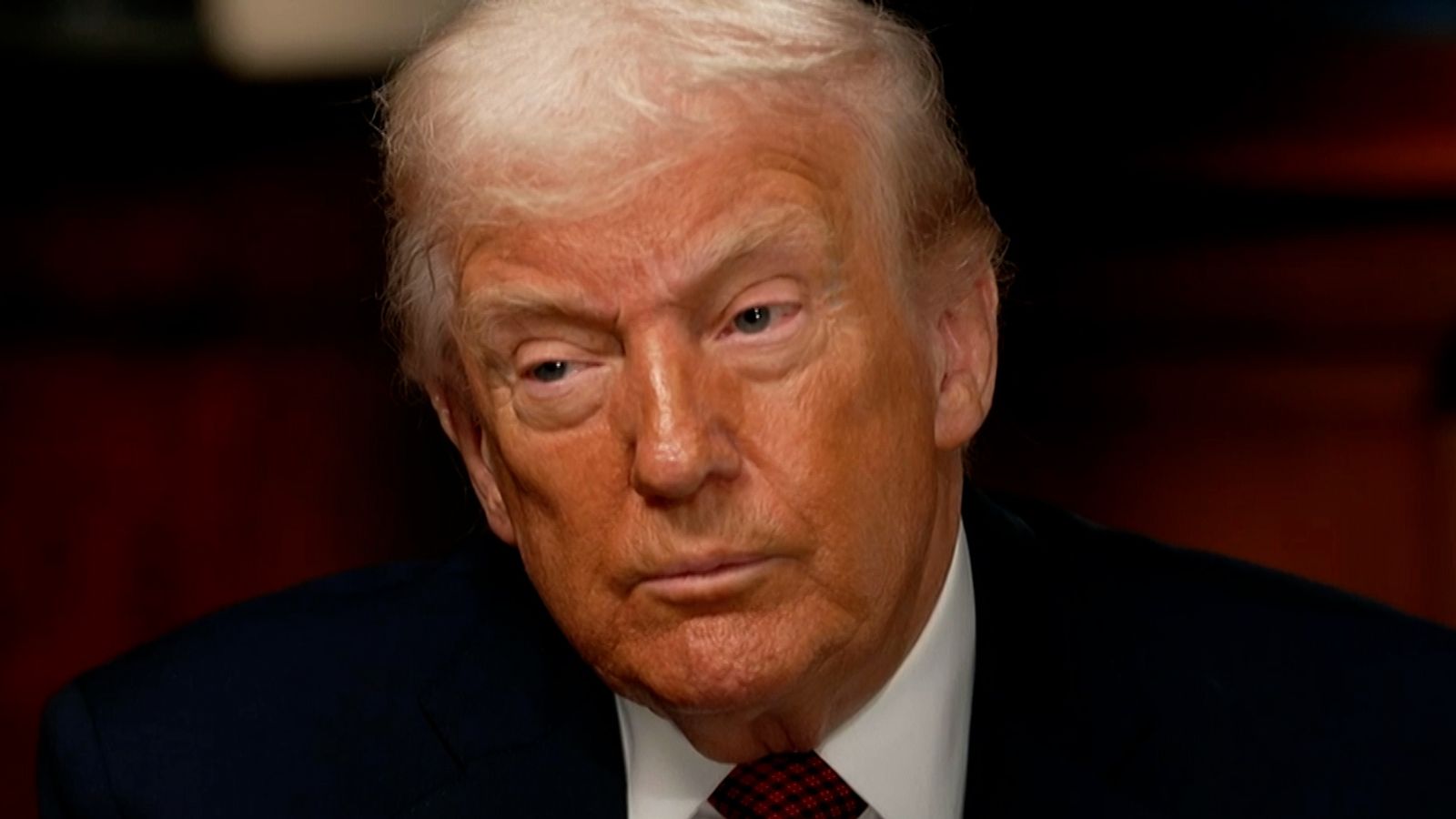
Donald Trump’s bruising assessment of Europe as “weak” and “decaying” is a bitter blow to nations already reeling from the release of his national security strategy.
At the end of the 45-minute interview with Politico, EU leaders might be forgiven for thinking, with friends like these, who needs enemies?
“Europe doesn’t know what to do,” Trump said, “They want to be politically correct, and it makes them weak.”
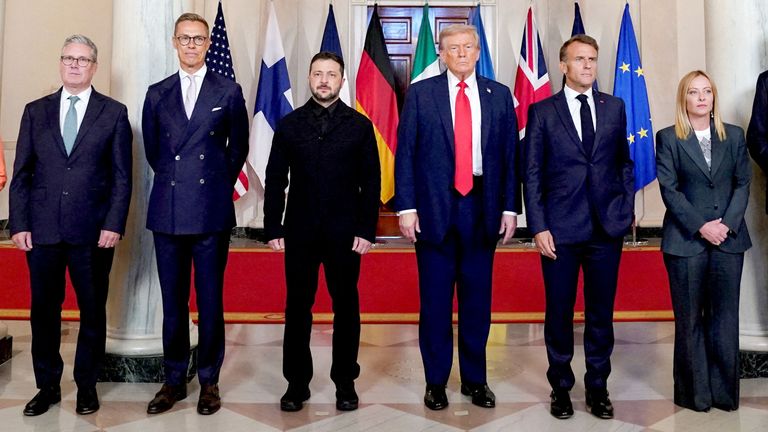
Trump meets leaders from Ukraine, Germany, France, the UK, Italy, and Finland, as well as the EU and NATO, in August Pic: Reuters
On the contrary, I would imagine some choice words were being uttered in European capitals as they waded through the string of insults.
What has Trump said?
First up, the US president criticised European leaders for failing to end the war between Russia and Ukraine.
“They talk but they don’t produce. And the war just keeps going on and on,” he said.
The fact that the Russians have shown no real commitment to stopping the invasion they started is not mentioned.
Instead, the blame is laid squarely at the feet of Ukraine and its allies in Europe.
“I think if I weren’t president, we would have had World War III,” Trump suggested, while concluding that Moscow is in the stronger position.
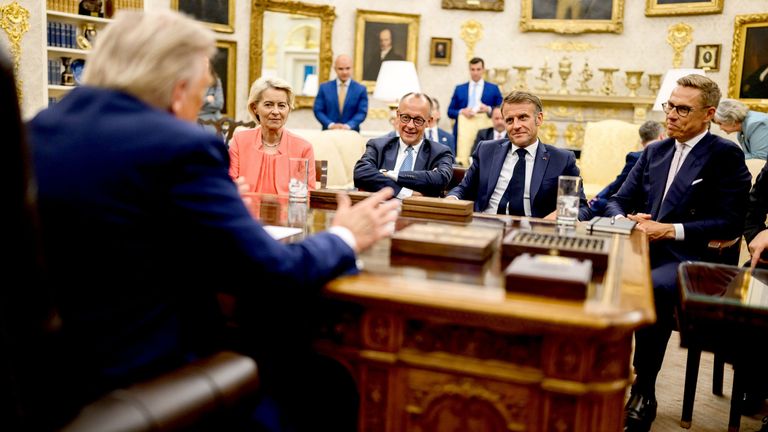
Trump meeting European leaders in the Oval Office in August. Pic: @RapidResponse47
Does he have a point?
Critics claim that the White House has emboldened the Kremlin and brought Putin in from the cold with a summit and photo opportunities.
Trump highlights the fact that his return to office forced many European NATO members to increase defence spending drastically.
On this, he is correct – the growing insecurity around how long America can be relied on has brought security into sharp focus.
But the release of the new US national security strategy has only added to the feelings of unease.
German Chancellor Friedrich Merz on Tuesday claimed some of its contents were unacceptable from a European point of view.
“I see no need for America to want to save democracy in Europe. If it was necessary to save it, we would manage it on our own,” he told a news conference in Rhineland-Palatinate, the German state where Trump’s paternal grandfather was born.
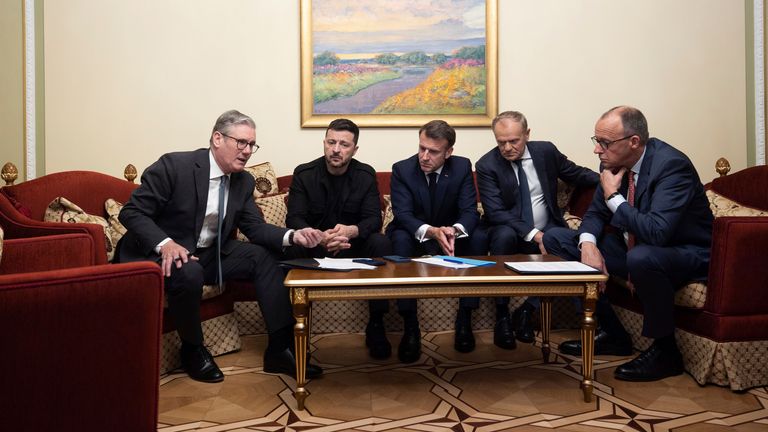
Meeting between, left to right, Keir Starmer of the UK, Volodymyr Zelenskyy of Ukraine, Emmanuel Macron of France, Donald Tusk of Poland, and Friedrich Merz of Germany. Pic: AP
The leader of the EU’s biggest power also said the new US strategy was not a surprise and largely chimed with the vice president’s speech at the Munich Security Conference in February.
For this reason, Merz reiterated that Europe and Germany must become more independent of America for their security policies.
However, he noted, “I say in my discussions with the Americans, ‘America first’ is fine, but America alone cannot be in your interests.”
For his part, while Trump said he liked most of Europe’s current leaders, he warned they were “destroying” their countries with their migration policies.
He said: “Europe is a different place, and if it keeps going the way it’s going, Europe will not be…in my opinion, many of those countries will not be viable countries any longer. Their immigration policy is a disaster”.
He added: “Most European nations… they’re decaying.”
Read more:
Analysis: Putin preparing for more war, not less
White House: Europe ‘unrecognisable in 20 years or less’
Again, the comments echoed his security strategy, which warned immigration risked “civilisation erasure” in Europe.
There’s no doubt immigration is a major concern for many of the continent’s leaders and voters.
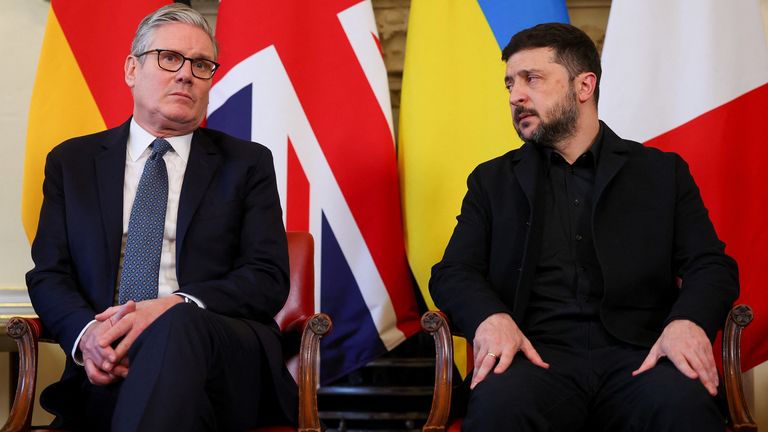
Zelenskyy meets European leaders
However, irregular crossings into the EU fell 22% in the first 10 months of 2025 according to Frontex, a fact which seems to have passed the president and his team by.
“Within a few decades at the latest, certain Nato members will become majority non-European”, his security document warned.
It also suggested “cultivating resistance” in Europe “to restore former greatness” leading to speculation about how America might intervene in European politics.
Trump appeared to add further clarification on Tuesday, saying while he did not “want to run Europe”, he would consider “endorsing” his preferred candidates in future elections.
👉 Tap to follow Trump100 wherever you get your podcasts👈
This comment will also ruffle feathers on the continent where the European Council President has already warned Trump’s administration against interfering in Europe’s affairs.
“Allies do not threaten to interfere in the domestic political choices of their allies,” Antonio Costa said on Monday.
“The US cannot replace Europe in what its vision is of free expression… Europe must be sovereign.”
So, what will happen now, and how will Europe’s leaders respond?
If you are hoping for a showdown, you will likely be disappointed.
Like him or loathe him, Europe’s leaders need Trump.
They need the might of America and want to try to secure continued support for Ukraine.
While the next few days will be filled with politely scripted statements or rejections of the president’s comments, most of his allies know on this occasion they are probably best to grin and bear it.
World
‘Cheap ceasefire’ between Ukraine and Russia would create ‘expensive peace’ for Europe, Norway’s foreign minister warns
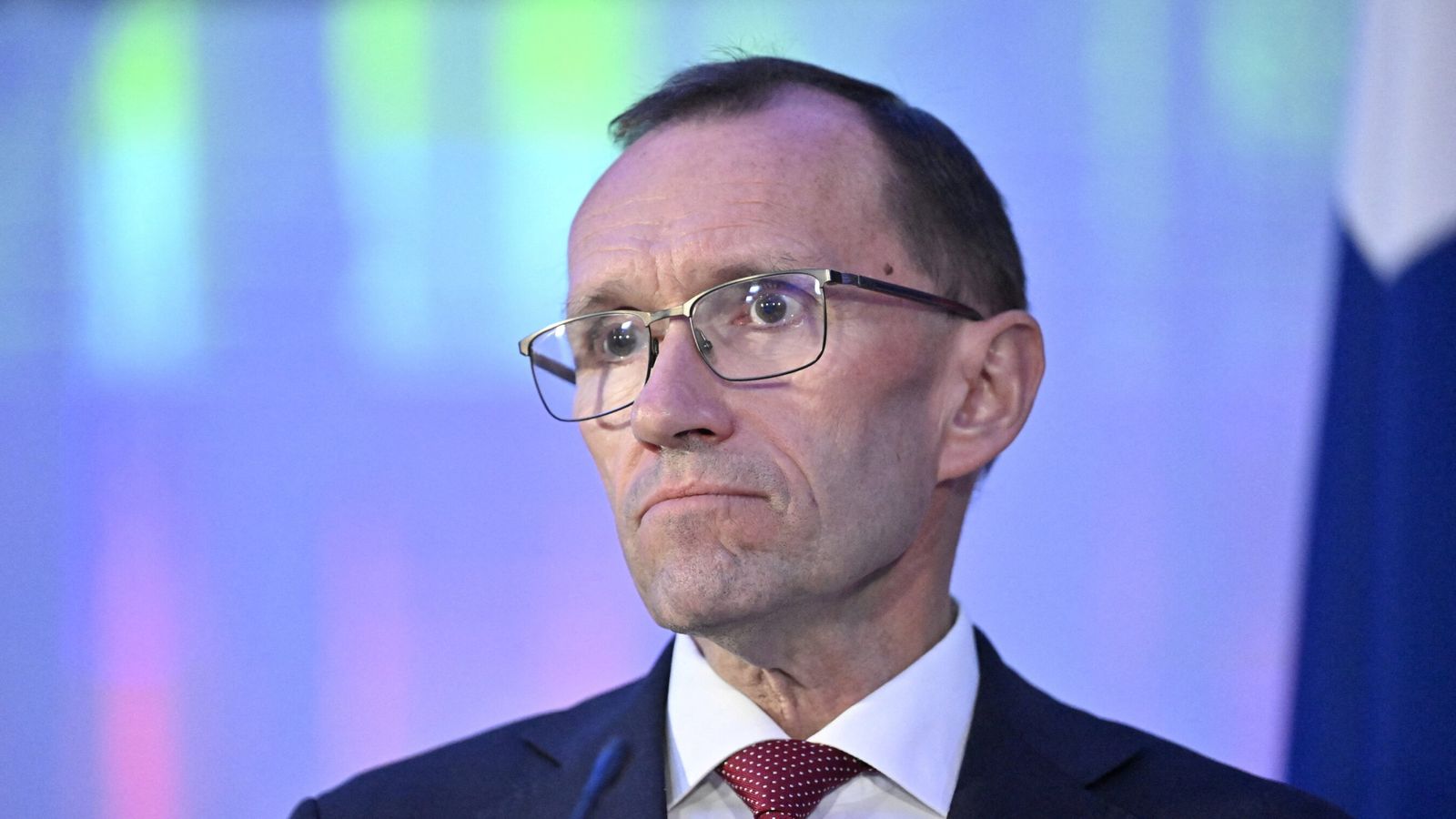
A “cheap ceasefire” between Ukraine and Russia – with Kyiv forced to surrender land – would create an “expensive peace” for the whole of Europe, Norway’s foreign minister has warned.
Espen Barth Eide explained this could mean security challenges for generations, with the continent’s whole future “on the line”.
It was why Ukraine, its European allies and the US should seek to agree a common position when trying to secure a settlement with Vladimir Putin, the top Norwegian diplomat told Sky News in an interview during a visit to London on Tuesday.
Ukraine war latest: Trump says Putin has upper hand in peace talks
“I very much hope that we will have peace in Ukraine and nobody wants that more than the Ukrainians themselves,” Mr Eide said.
“But I am worried that we might push this to what in quotation marks is a ‘cheap ceasefire’, which will lead to a very expensive peace.”
Explaining what he meant, Mr Eide said a post-war era follows every conflict – big or small.
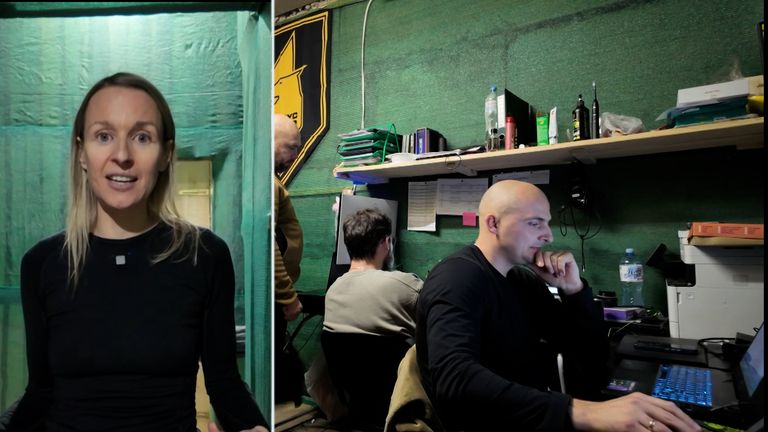
Inside Ukraine’s underground military HQ
How that plays out typically depends upon the conditions under which the fighting stopped.
“If you are not careful, you will lock in certain things that it will be hard to overcome,” he said.
“So if we leave with deep uncertainties, or if we allow a kind of a new Yalta, a new Iron Curtain, to descend on Europe as we come to peace in Ukraine, that’s problematic for the whole of Europe. So our future is very much on the line here.”
He said this mattered most for Ukrainians – but the outcome of the war will also affect the future of his country, the UK and the rest of the continent.
“This has to be taken more seriously… It’s a conflict in Europe, it has global consequences, but it’s fundamentally a war in our continent and the way it’s solved matters to our coming generations,” the Norwegian foreign minister said.
Russia ‘will know very well how to exploit vagueness’
Asked what he meant by a cheap ceasefire, he said: “If Ukraine is forced to give up territory that it currently militarily holds, I think that would be very problematic.
“If restrictions are imposed on future sovereignty. If there’s vagueness on what was actually agreed that can be exploited. I think our Russian neighbours will know very well how to exploit that vagueness in order to keep a small flame burning to annoy us in the future.”
Progress being made on peace talks
Referring to the latest round of peace talks, initiated by Donald Trump, Mr Eide signalled that progress was being made from an initial 28-point peace plan proposed a couple of weeks ago by the United States that favoured Moscow over Kyiv.
That document included a requirement for the Ukrainian side to give up territory it still holds in eastern Ukraine to Russia and Mr Eide described it as “problematic in many aspects”.
But he said: “I think we’ve now had a good conversation between Ukraine, leading European countries and the US on how to adapt and develop that into something which might be a good platform for Ukraine and its allies to go to Russia with.
“We still don’t know the Russian response, but what I do know is the more we are in agreement as the West, the better Ukraine will stand.”
-
 Sports2 years ago
Story injured on diving stop, exits Red Sox game
-
 Sports3 years ago
‘Storybook stuff’: Inside the night Bryce Harper sent the Phillies to the World Series
-
 Sports2 years ago
Game 1 of WS least-watched in recorded history
-
 Sports3 years ago
Button battles heat exhaustion in NASCAR debut
-
 Sports3 years ago
MLB Rank 2023: Ranking baseball’s top 100 players
-
Sports4 years ago
Team Europe easily wins 4th straight Laver Cup
-
 Environment3 years ago
Japan and South Korea have a lot at stake in a free and open South China Sea
-
 Environment1 year ago
Here are the best electric bikes you can buy at every price level in October 2024