
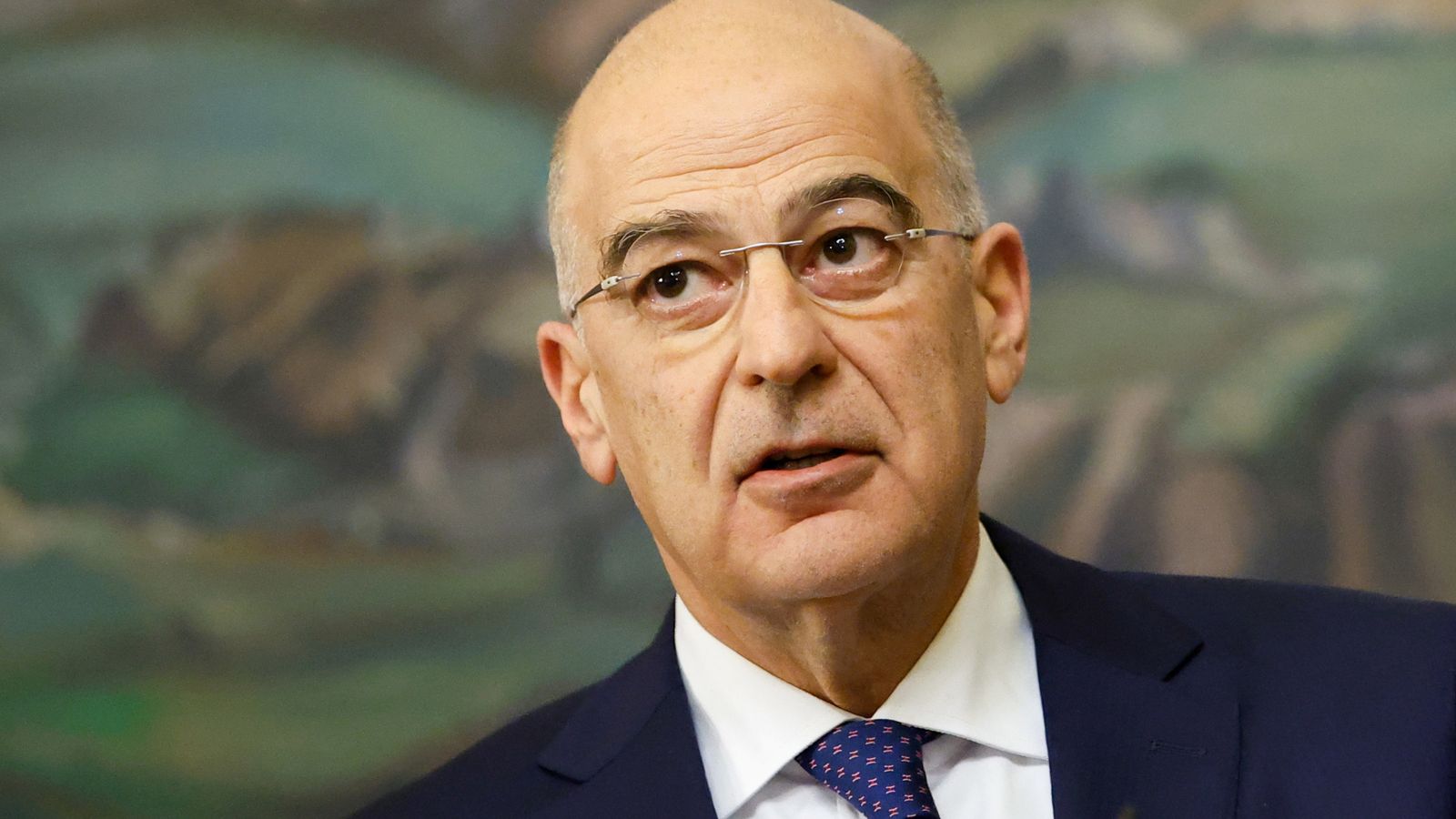
Greece ‘open’ to talks with Turkey if Ankara ‘stops provocations’, says Greek foreign minister

Greece’s foreign minister says his country is open to talks with Turkey but only if Ankara stops its provocations.
Nikos Dendias told the Proto Thema newspaper: “It is up to Turkey to choose if it will come to such a dialogue or not, but the basic ingredient must be a de-escalation.”
The two historical foes have a long list of grievances, including maritime boundaries, flying rights, the delineation of their continental shelves and the divided island of Cyprus.
But in recent months, their relationship has become more strained.
Greek Prime Minister Kyriakos Mitsotakis reportedly used a visit to the US in May to lobby against Ankara’s efforts to buy fighter jets from Washington, claiming Turkey was violating Greek airspace.
Turkey has accused Greece of arming Aegean islands that are meant to be demilitarised, under international law, and it has also been alarmed by Greece’s growing defence co-operation with the US and France.
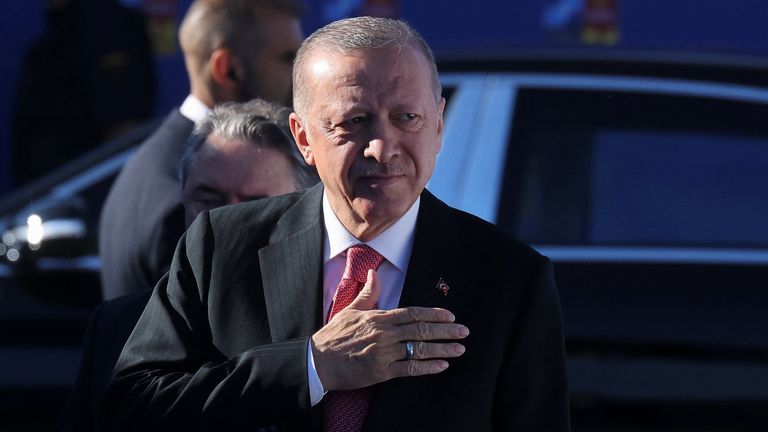
In September, Turkish President Recep Tayyip Erdogan warned Greece that “we could come suddenly one night”, adding: “We will not fail to defend our country’s rights and interests against Greece by using all the means at our disposal, when necessary”.
The European Commission said last month that the Turkish threats were “unacceptable”, calling on Ankara to “seriously work on de-escalating tension”.
Turkish President Recep Tayyip Erdogan
‘Aggressive revisionist agenda’
Also in September, Mr Mitsotakis told the UN General Assembly that Turkey was “building a comprehensive narrative of false claims in the Aegean” and pursuing an “ever more aggressive revisionist agenda”.
He added: “What is particularly alarming is the growing intensity of the threats.”
On Sunday, Mr Dendias said Turkey had sharply increased its overflights and violations of Greek airspace and that its behaviour was serving a “revisionist narrative”.
“The one responsible for a de-escalation is the one causing the escalation – which is Turkey,” he added.
Mr Dendias said Turkish claims that Greece cannot be an equal participator diplomatically, politically and militarily were “an insulting approach”.
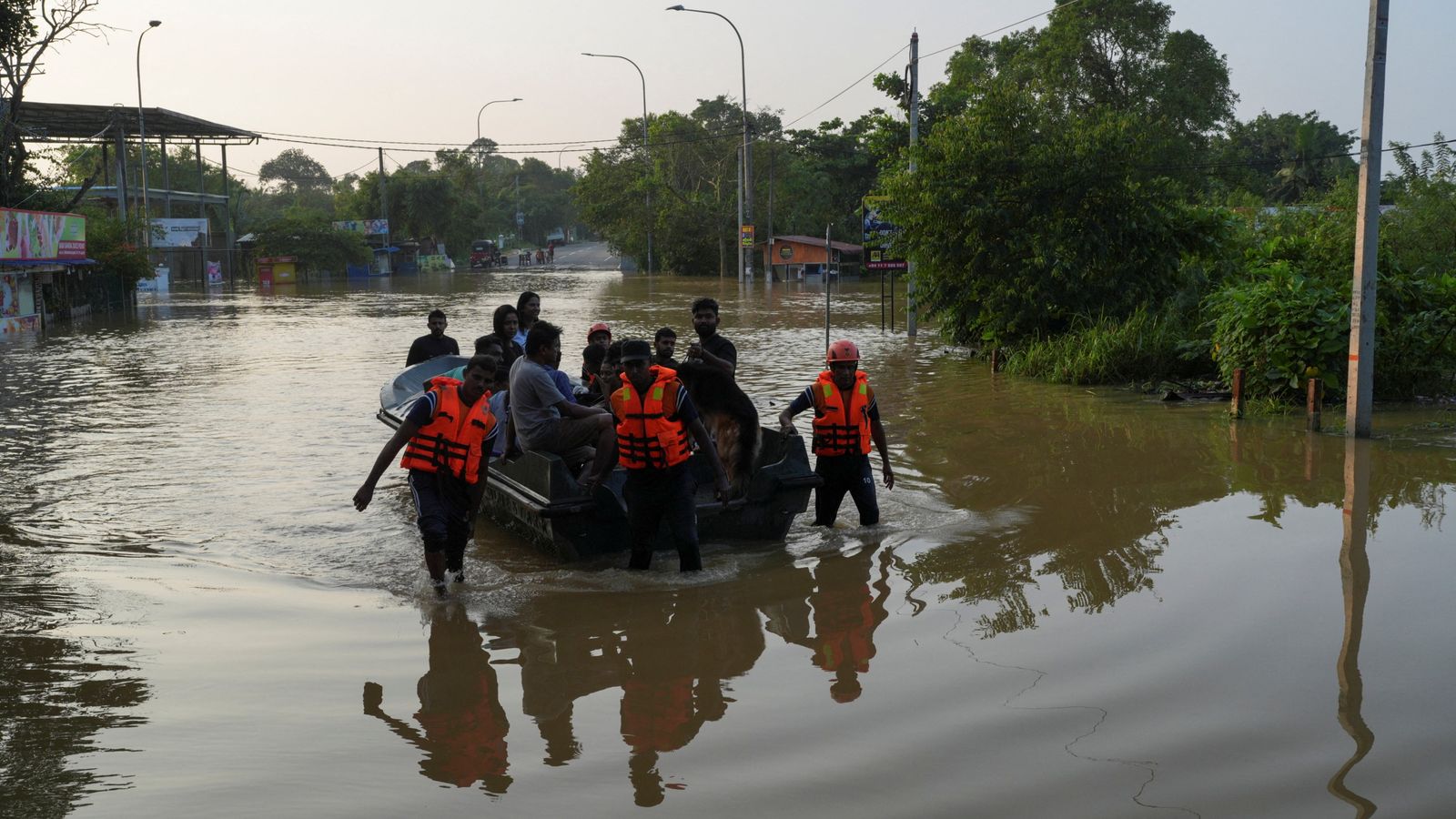
Rescue and recovery and efforts are under way in parts of South and Southeast Asia where the number of those killed in devastating floods continues to rise.
The extreme weather last week has killed at least 366 people in Sri Lanka, 604 in Indonesia, and 176 in Thailand, according to authorities.
Rescuers are searching for 464 missing people in Indonesia, and a further 367 in Sri Lanka, after a cyclone and other storms triggered flooding and landslides in the region.
In a post on X, the King and Queen Camilla said they were “deeply saddened” to hear about devastating storms and added their “heartfelt condolences” to the families of those who have died.
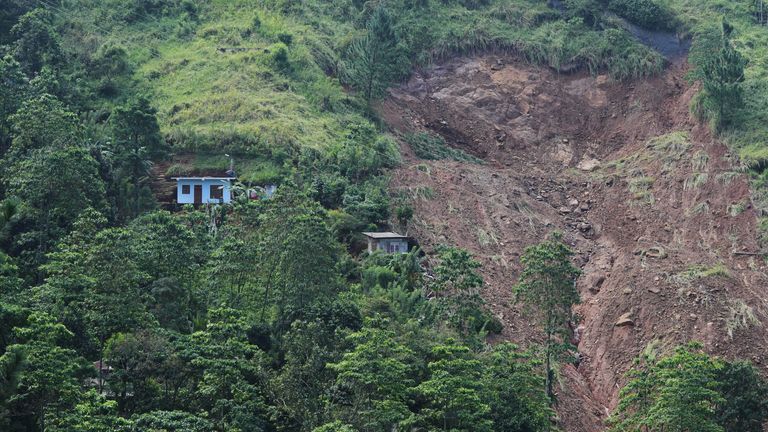
Landslides in Sarasavigama village near Kandy, Sri Lanka. Pic: AP
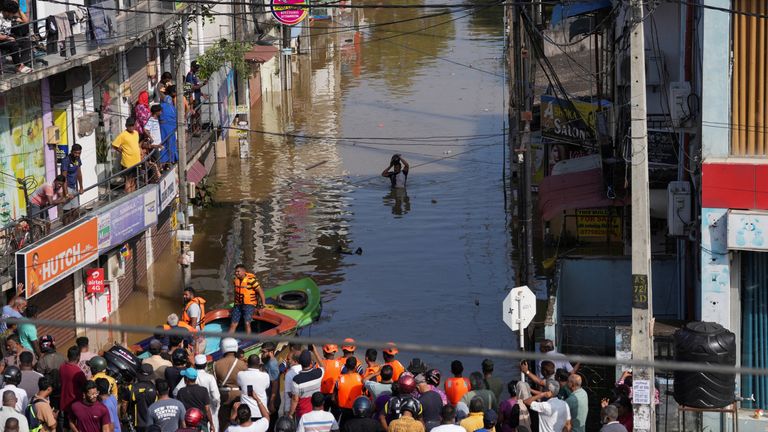
A man wades through the flooded street, following heavy rainfall in Wellampitiya, Sri Lanka. Pic: Reuters
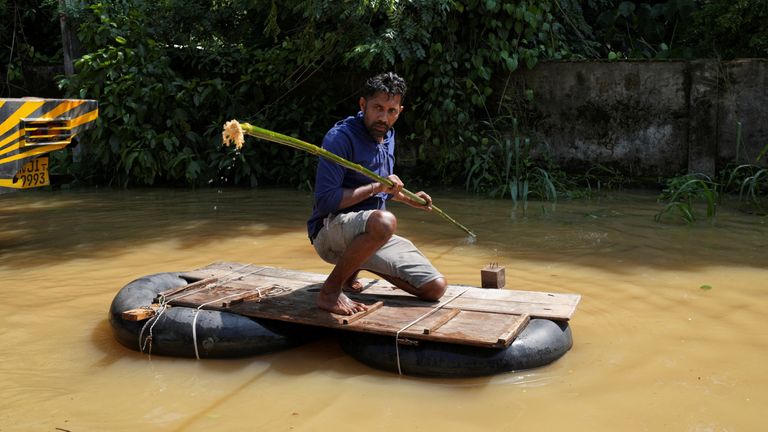
A man uses a makeshift raft at a flooded area, following Cyclone Ditwah in Kelaniya, Sri Lanka. Pic: Reuters
Hundreds of thousands in shelters in Sri Lanka
Sri Lankan authorities said about 218,000 people were in temporary shelters after downpours that triggered landslides, primarily in the tea-growing central hill country.
People were seen salvaging belongings from flooded homes along the banks of the Kelani River, near the capital Colombo on Monday.
Meanwhile, train and flight services have resumed after being disrupted last week, but schools stayed closed, officials said.
Cyclone Ditwah was the “largest and most challenging” natural disaster in Sri Lanka’s history, President Anura Kumara Dissanayake said.
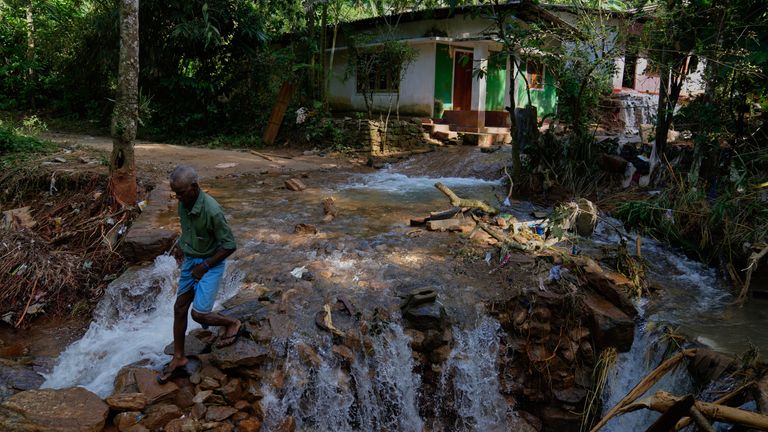
A landslide survivor crosses a section of a damaged road in Sarasavigama village near Kandy, Sri Lanka. Pic: AP
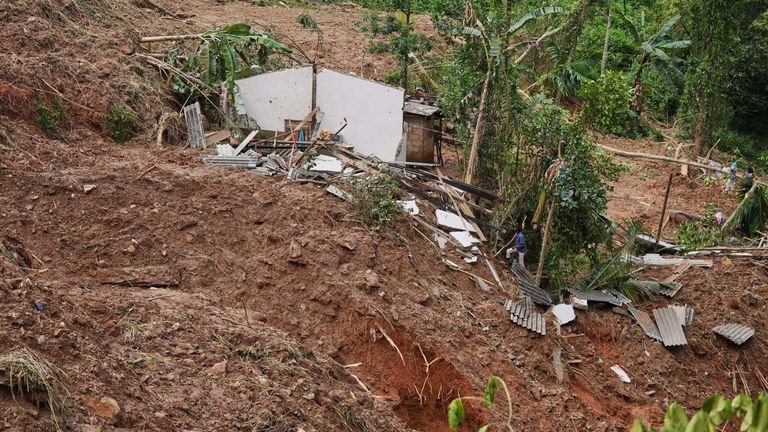
Landslide survivors salvage belongings at the site of a landslide in Sarasavigama village near Kandy, Sri Lanka. Pic: AP
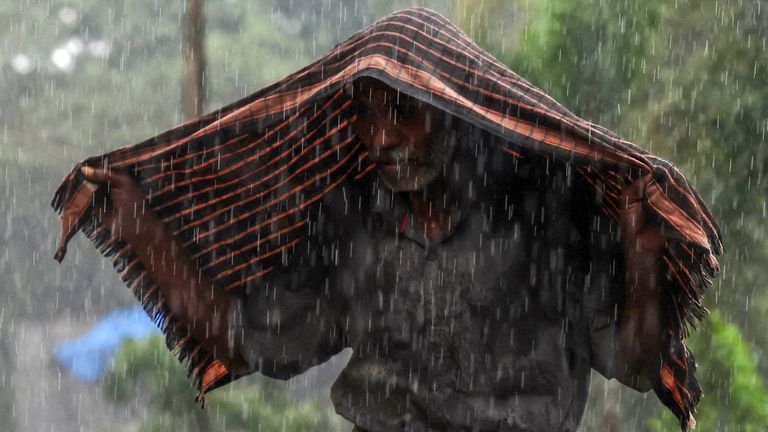
A man uses his scarf to protect himself from the rain in the aftermath of Cyclone Ditwah, in Chennai, India. Pic: Reuters
The cyclone also brought heavy rain to India’s southern state of Tamil Nadu over the weekend, with authorities saying three people were killed in rain-related incidents.
The storm, which as of 5pm UK time on Monday was about 50km (30 miles) off the coast of the state capital Chennai, has weakened into a “deep depression” and is expected to weaken further in the next few hours, weather officials said.
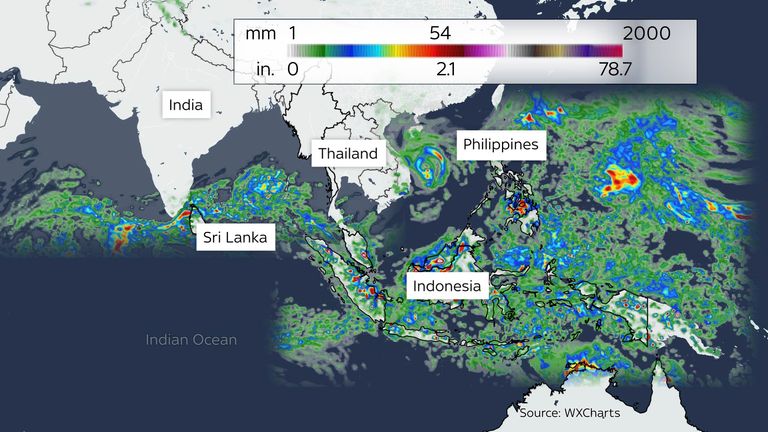
Amount of rainfall expected in South and Southeast Asia in the next 48 hours
Over a million affected in Indonesia
More than 28,000 homes have been damaged in Indonesia, with 1.4 million people affected according to the country’s disaster management centre.
The country’s president, Prabowo Subianto, called it a catastrophe and pledged to rebuild infrastructure as he visited the three affected provinces on Monday, where nearly 300,000 people have been displaced by the flooding.
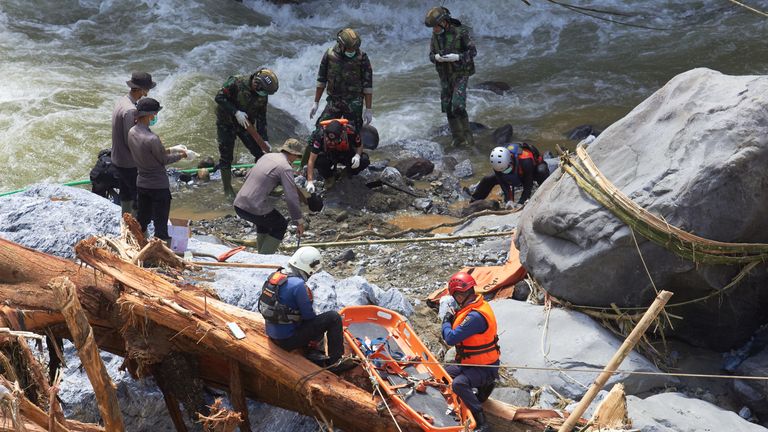
Rescuers search for flood victims in Tanah Datar, West Sumatra, Indonesia. Pic: AP
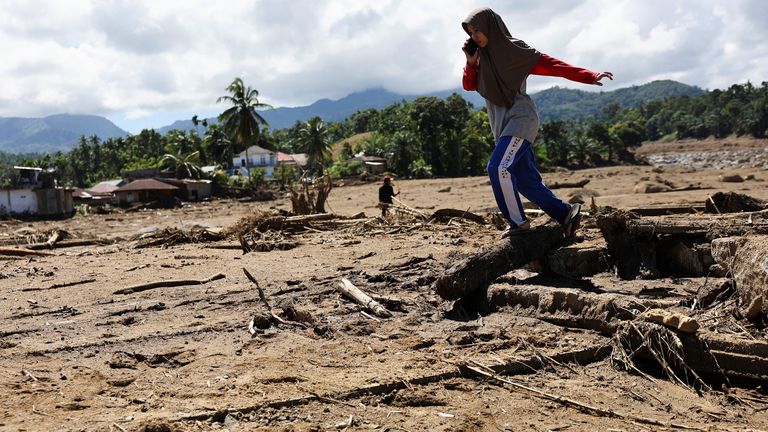
A flooded field in Indonesia’s West Sumatra province. Pic: Reuters
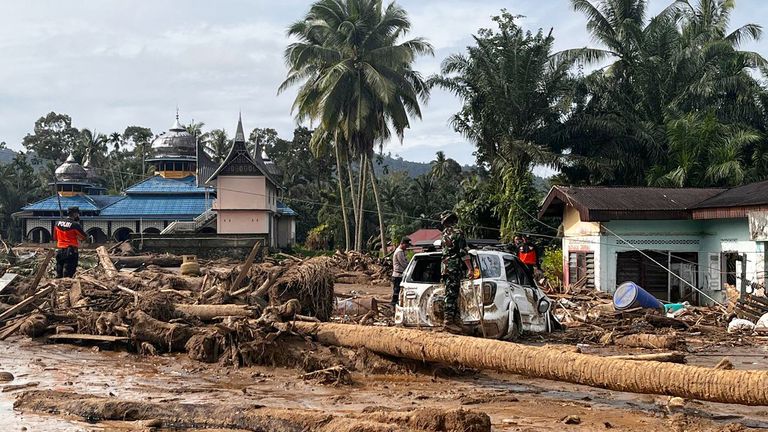
Rescuers search for victims at a village affected by flash flooding, in Agam, West Sumatra, Indonesia. Pic: AP
‘Nothing remains’
“The water just rose up into the house and we were afraid, so we fled. Then we came back on Friday, and the house was gone, destroyed,” said Afrianti, 41, who only goes by one name and lives in West Sumatra’s Padang city.
She and her family of nine have made their own tent shelter beside the single wall that remains of their home.
“My home and business are gone, the shop is gone. Nothing remains. I can only live near this one remaining wall,” she said.
Highest one-day rainfall in Thai city for 300 years
In Thailand, flooding in eight southern provinces affected about three million people and led to a major mobilisation of its military to evacuate critical patients from hospitals and reach people stuck in floodwaters for days.
In the worst-affected city of Hat Yai, a southern trading hub, 335mm (13 inches) of rain fell on 21 November, its highest single-day tally in 300 years, followed by days of unrelenting downpours.
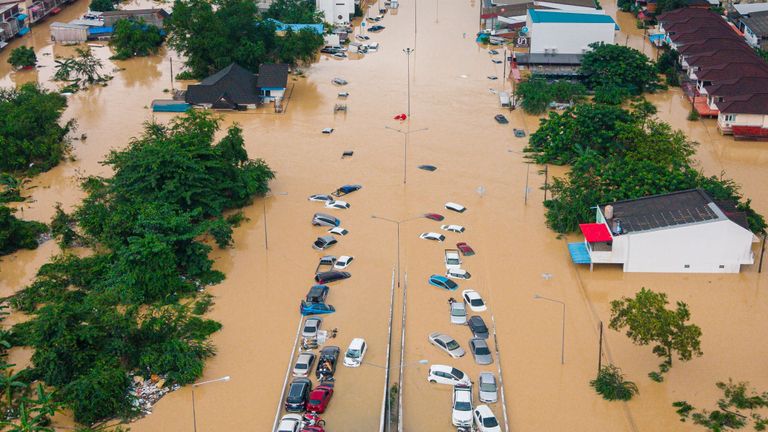
At least 82 people have died and more than three million people have been impacted by floods in 12 southern Thai provinces.
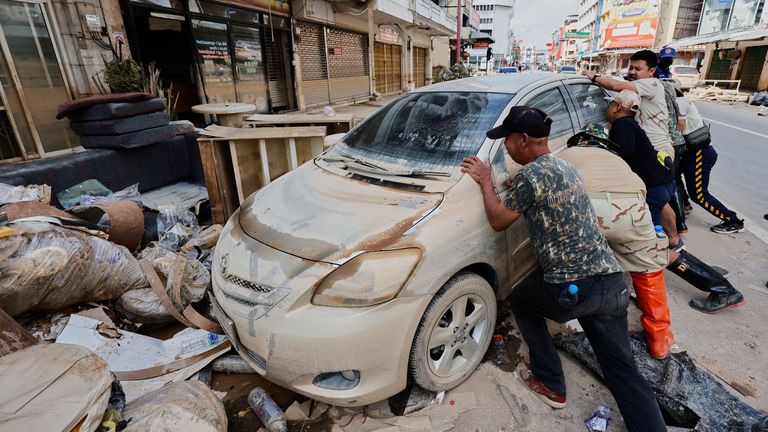
People move a car damaged by floods in Songkhla province, southern Thailand. Pic: AP
King offers ‘heartfelt condolences’
King Charles and Queen Camilla responded to the crisis in a statement posted on X and praised the work of emergency responders: “We wish to express our heartfelt condolences to the families of those who have so tragically lost their lives.
“Our thoughts and prayers are with the many whose homes have been destroyed and to all who are awaiting news of loved ones missing.
“These disasters remind us of the increasingly urgent need to restore the balance and harmony of Nature.”
Thailand’s Prime Minister Anutin Charnivirakul expects residents to be able to return home within seven days, a government spokesperson said on Monday.
Read more from Sky News:
Zelenskyy to make first official visit to Ireland
Dignitas founder dies by assisted suicide
The first batch of compensation payments is set to be distributed on Monday, starting with 239m baht (£5.6m) for 26,000 people, the spokesperson added.
In Malaysia there have been at least three deaths and authorities are still on alert for a second and third wave of flooding as 11,600 remain in evacuation centres.


The founder of Dignitas, the Switzerland-based assisted suicide clinic, has died aged 92, according to the organisation.
Ludwig Minelli, lawyer and former journalist, died on 29 November shortly before his 93rd birthday.
Mr Minelli lived a life “for freedom of choice, self-determination, and human rights”, said Dignitas in a tribute.
He founded the organisation in 1998 with “a group of like-minded people”.
“At that time, he and his fellow compatriots would never have thought that this association was about to become an internationally active organisation,” said the tribute.
‘He died like he lived, with dignity’
It described Mr Minelli’s belief that trying to “talk someone out of suicide is not a suitable prevention method”.
“Rather, the approach should be taking a person in a seemingly hopeless situation seriously, meeting them at eye level, and showing them all possible options to alleviate their suffering.”
Those options should include “the possibility of ending their own life with professional support, safely and in a self-determined way in a setting that he or she personally deems dignified”, it said, adding that a very small number of people who approach Dignitas end up choosing assisted suicide.
“It is up to the individual to decide which option to choose,” said the tribute.
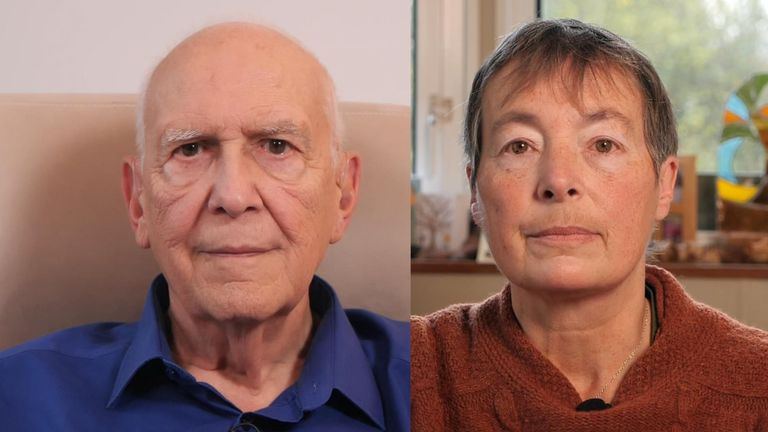
For and against assisted dying
The Dignitas team said Mr Minelli had “planned succession for a seamless transition” and the organisation would continue its “professional and combative” work.
Read more:
What does assisted dying look like?
Assisted dying poses ‘substantial task’ for NHS
Although Switzerland has allowed assisted dying since 1942 – provided the motive is not “selfish” – Dignitas became well-known as it allows non-Swiss people to use its clinics.
Despite assisted suicide still being illegal in the UK, people from Great Britain make up the second largest group of Dignitas members, according to the group’s statistics.
Last year, 37 people travelled from Great Britain to die at a Swiss Dignitas clinic.
Those who accompany their loved ones to the clinics can be charged with assisted suicide, although earlier this year, police said a widow who accompanied her husband wouldn’t face charges.
“Whilst [the CPS] concluded the evidential test had been met regarding assisted suicide, it was decided not to be in the public interest to prosecute,” said North Yorkshire Police in a statement at the time.
Anyone feeling emotionally distressed or suicidal can call Samaritans for help on 116 123 or email jo@samaritans.org in the UK. In the US, call the Samaritans branch in your area or 1 (800) 273-TALK.
-
 Sports2 years ago
Story injured on diving stop, exits Red Sox game
-
 Sports3 years ago
‘Storybook stuff’: Inside the night Bryce Harper sent the Phillies to the World Series
-
 Sports2 years ago
Game 1 of WS least-watched in recorded history
-
 Sports3 years ago
Button battles heat exhaustion in NASCAR debut
-
 Sports3 years ago
MLB Rank 2023: Ranking baseball’s top 100 players
-
Sports4 years ago
Team Europe easily wins 4th straight Laver Cup
-
 Environment3 years ago
Japan and South Korea have a lot at stake in a free and open South China Sea
-
 Environment1 year ago
Here are the best electric bikes you can buy at every price level in October 2024