
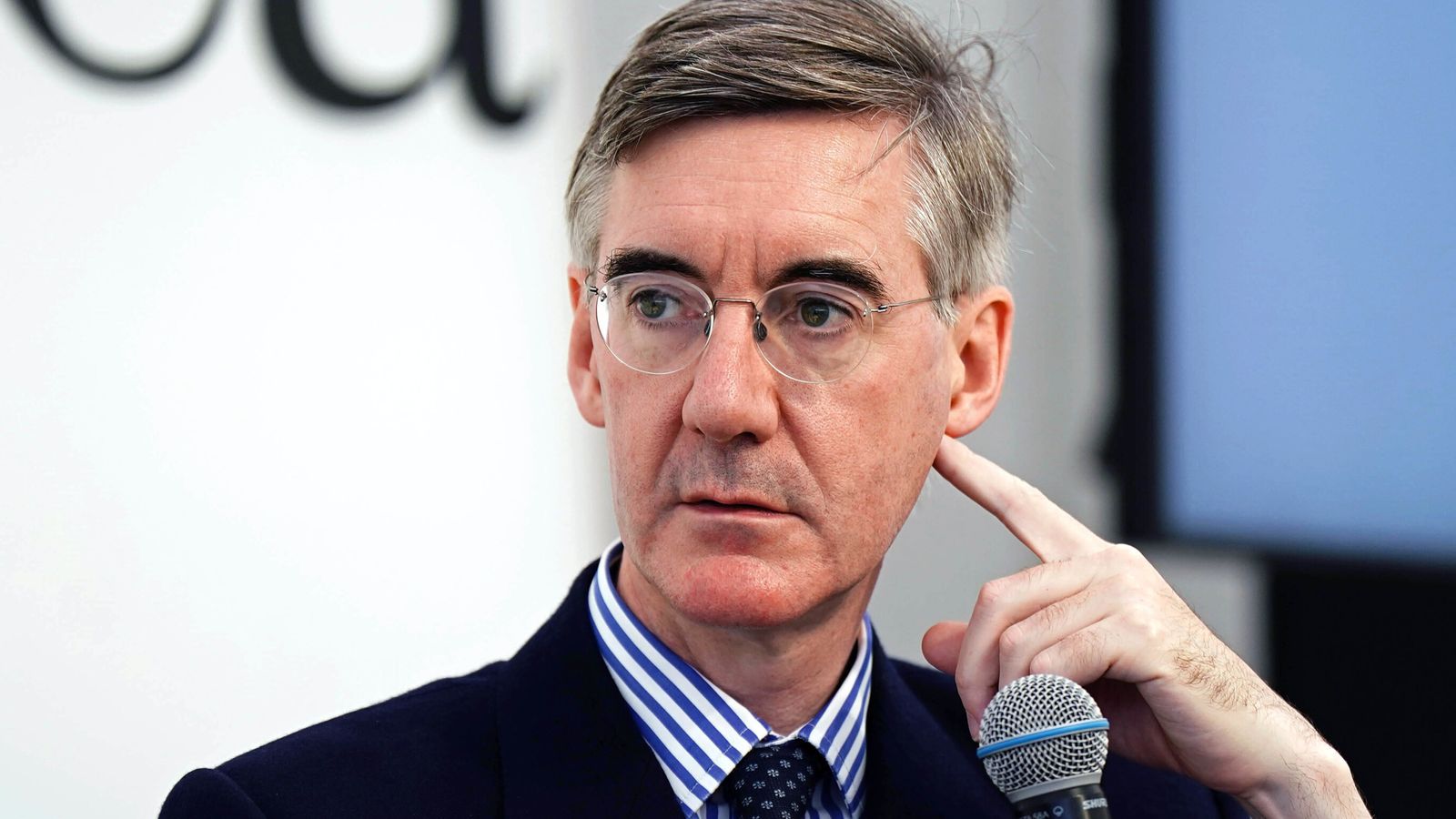
Jacob Rees-Mogg says he has ‘confidence’ in Bank of England governor Andrew Bailey but disputes pension funds ‘at risk’

Jacob Rees-Mogg has declared his confidence in the governor of the Bank of England, but disputed that pension funds are at “systemic” risk.
Speaking to Sky News, the business secretary said “of course” he has confidence in Andrew Bailey, describing him as “respected”.
He questioned, however, whether there was a “systemic problem” with pensions after the Bank of England expanded its market intervention to help pension funds for the second time in two days on Tuesday by buying up index-linked gilts.
Bank confirms market support to end – politics latest
The Bank had warned of a “material risk to UK financial stability” with “fire sales” of assets if it did not act.
The business secretary said that on the whole, pension funds “aren’t at risk”, but added: “Some pension funds have taken some high risk investments.”
He told Sky News that the “rightly independent” Bank intervened to protect these “risky investments”.
The Bank confirmed yesterday that its emergency support operation to protect pension funds would end this week.
Mr Rees-Mogg repeatedly refused to be drawn on whether the Bank was right to signal an end to its market intervention.
“I’m not going to criticise the Bank of England or the governor,” he said. “It is not for me to speculate on what the Bank of England is doing.”
He also insisted to Kay Burley that parts of the economy were in a “good state” as he admitted that after the economic turmoil of recent weeks his own mortgage payments have gone up.
“Mortgage rates have gone up for everyone who has a mortgage, and I have a mortgage,” he said.
“Any floating rate mortgages have gone up.”
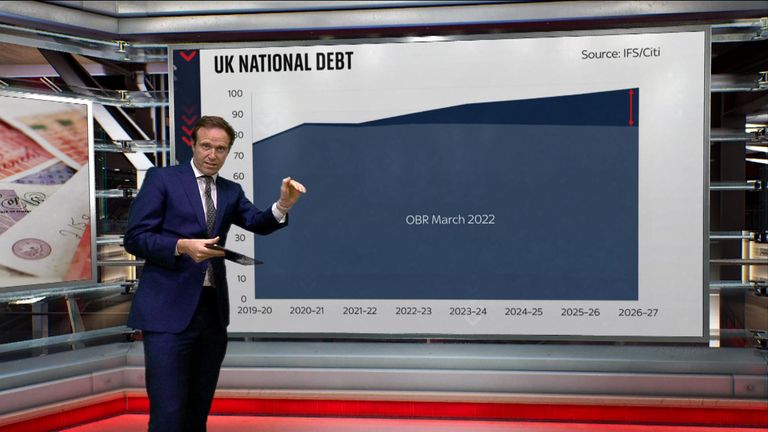
Kwarteng’s options for national debt
‘Be careful about forecasts’
Earlier this morning, new Office for National Statistics figures indicated that the economy shrank by 0.3% between July and August, a fall from downwardly revised growth of 0.1% the previous month.
Mr Rees-Mogg urged caution in interpreting them.
“The previous quarter’s figure showed a contraction [and] was then revised to show economic growth. So, be very careful about how you interpret figures immediately after they’re released,” he told Sky News.
“It’s a small amount of a very large economy, but these figures are notorious for being revised afterwards.”
The business secretary also refused to indicate his own view on whether benefits should rise in line with inflation, an issue that has split the Conservative Party.
“We haven’t yet had the inflation figure on which benefits will be set. So, that is something that will be decided once the figure is available,” he said.
“Most predictions, most economic forecasts, turn out to be inaccurate rather than spot on. So, one has got to be careful about forecasts.”
Are we set for another era of austerity?
‘Routine decision-making’
Mr Rees-Mogg said the decision on benefits would be made once inflation figures come out.
“There is a process for making this decision,” he said.
“The statutory instrument has to be laid in November to put through the increase. That will be done in the normal way. This is completely routine governmental decision-making.”
In the Commons on Tuesday Julian Smith, a former cabinet minister, warned Kwasi Kwarteng, the chancellor, that the government must not balance tax cuts “on the back of the poorest people in our country”.
The government has already been forced to abandon plans to scrap the top 45p rate of tax in the face of a threatened revolt.
Click to subscribe to the Sophy Ridge on Sunday podcast
Liz Truss, the prime minister, will face MPs in the Commons on Wednesday for the first time since Mr Kwarteng’s £43bn tax-cutting mini-budget caused economic turmoil.
On Tuesday, the International Monetary Fund warned that Mr Kwarteng’s package of unfunded tax cuts was making it harder for the Bank to get soaring inflation rates under control.
The Institute for Fiscal Studies has warned the chancellor he will have to find £60bn in public spending cuts if he persists with his tax plans.
OpenAI has signed its first major licensing deal to bring well-known characters to life on its Sora video generation tool.
The company said the agreement with Walt Disney was part of a push to ensure the rights of creators in the generative artificial intelligence (AI) space amid growing concerns over copyright, fakes and misinformation.
It forms part of a $1bn Disney investment in OpenAI, that will see the entertainment firm roll out ChatGPT to its staff and grow its AI capabilities.
Money latest: Urgent warning over tumble dryers
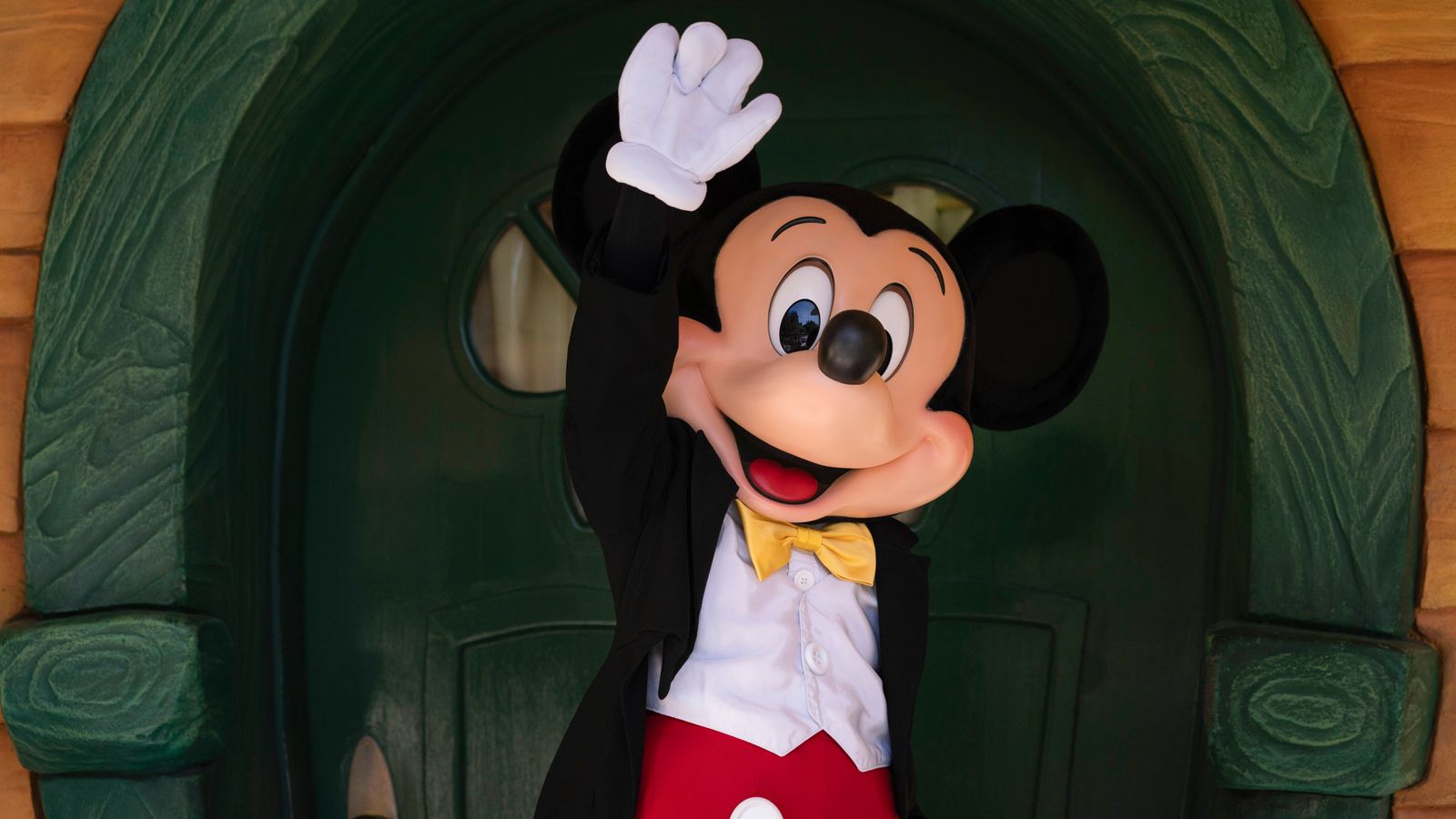
The initial three-year licensing deal will allow Sora users to generate and share videos based on more than 200 Disney, Marvel, Pixar and Star Wars characters.
These include Mickey Mouse, Cinderella and Luke Skywalker.
Sora allows people to quickly create realistic clips based merely on text prompts.
Why authors may be right to fear AI
Disney and OpenAI said they were committed to responsible use of AI amid the backlash from critics who have pointed to widespread misuse of generative AI in the social media space – a practice known as AI slop.
Some have depicted fake messages from celebrities and even used the dead.
OpenAI CEO Sam Altman said: “This agreement shows how AI companies and creative leaders can work together responsibly to promote innovation that benefits society, respect the importance of creativity, and help works reach vast new audiences.
His counterpart at Disney, Bob Iger, added that the partnership would “extend the reach of our storytelling through generative AI, while respecting and protecting creators and their works”.
As part of the deal, some user-generated Sora videos will be made available on the Disney+ streaming service.
Dan Coatsworth, head of markets at AJ Bell, said of the tie-up: “It’s a win-win situation for Disney and OpenAI. Disney gets to deploy its beloved brands in the world of AI while keeping control of the intellectual property.
“Fans can use Disney characters to make videos and take social media content to another level. That could drive significant traffic to OpenAI’s Sora social media platform, turning a relatively unknown entity into a household name in a flash.
“As part owner of the business, Disney will be able to use the equity stake in OpenAI to ensure its characters are used in a controlled environment.
“It’s a significant step forward for the concept of fan fiction”, he concluded.
-
 Sports2 years ago
Story injured on diving stop, exits Red Sox game
-
 Sports3 years ago
‘Storybook stuff’: Inside the night Bryce Harper sent the Phillies to the World Series
-
 Sports2 years ago
Game 1 of WS least-watched in recorded history
-
 Sports3 years ago
Button battles heat exhaustion in NASCAR debut
-
 Sports3 years ago
MLB Rank 2023: Ranking baseball’s top 100 players
-
Sports4 years ago
Team Europe easily wins 4th straight Laver Cup
-
 Environment3 years ago
Japan and South Korea have a lot at stake in a free and open South China Sea
-
 Environment1 year ago
Here are the best electric bikes you can buy at every price level in October 2024