
NFL Sunday Ticket still up for grabs as Apple pushes for flexibility with game rights

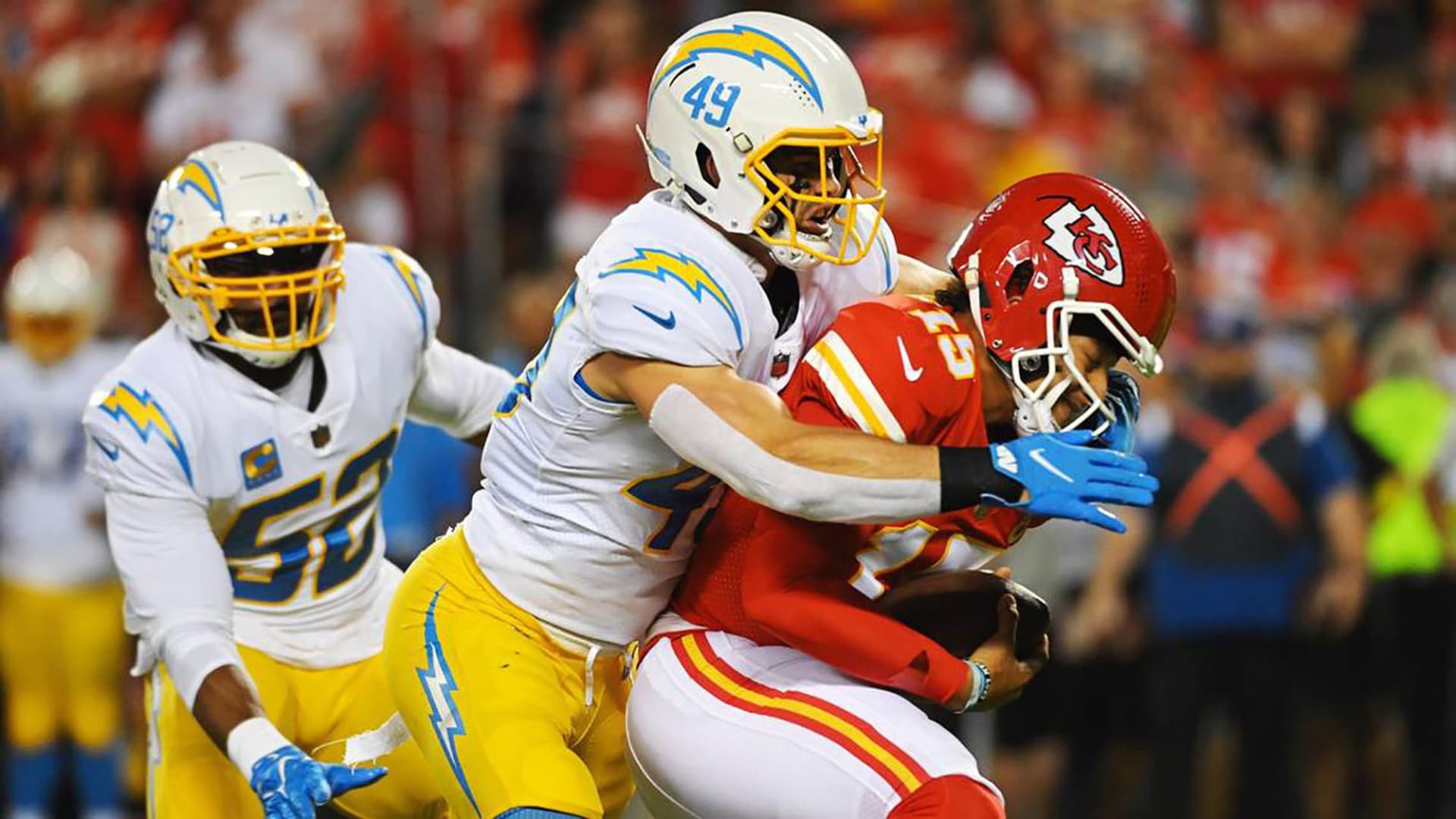
Kansas City Chiefs quarterback Patrick Mahomes (15) is sacked by Los Angeles Chargers linebacker Drue Tranquill (49) in the first quarter at Arrowhead Stadium on Thursday, Sept. 15, 2022, in Kansas City, Missouri.
Tammy Ljungblad | Tribune News Service | Getty Images
The National Football League season is heading into Week 6, and it’s still unclear which company will become the new owner of Sunday Ticket rights — the only remaining exclusive broadcast package that hasn’t been renewed until 2030.
Apple has been among the favorites to land the package, in part because the league already has broadcast deals in place with rival bidders, including Disney and Amazon. A partnership with Apple would allow the NFL to build a relationship with the deepest-pocketed company in the world.
But existing restrictions around Sunday Ticket have slowed negotiations between Apple and the NFL in recent months, according to people familiar with the matter. Talks between the league and potential buyers of Sunday Ticket are continuing, the people said.
Spokespeople for Apple and the NFL declined to comment.
The NFL and Apple, two of the most powerful corporate entities in the world, are used to getting what they want.
Apple isn’t interested in simply acting as a conduit for broadcasting games, according to Eddy Cue, Apple’s senior vice president of services. Cue oversees Apple’s media and sports partnerships and its streaming service, Apple TV+. Apple is looking for partnerships with sports leagues in which it can offer consumers more than standard rights agreements — such as having free rein to offer games globally or in local markets. Apple has that type of deal with Major League Soccer, a 10-year partnership that begins in 2023.
“We weren’t interested in buying sports rights,” Cue said this week at a Paley Center for Media panel in New York. “There’s all kinds of capabilities that we’re going to be able to do together because we have everything together. And so if I have a great idea, I don’t have to think about, OK, well, my contract or the deal of interest will allow this.”
The iPhone maker is MLS’s exclusive broadcast partner, though some linear networks may buy simulcast rights to the soccer league’s games. The pact allows Apple to stream every game of every season for the next 10 years globally. It plans to build MLS steaming capabilities into its apps, such as Apple News.
While a “great idea” by Cue could potentially manifest into a practical solution quickly with MLS, the same may not be feasible with the NFL, which has been in business with Fox, Paramount Global, Comcast‘s NBCUniversal and Disney for decades. The league also sold its “Thursday Night Football” package to Amazon.
The NFL last year renewed broadcast TV agreements with both Fox and CBS until 2030. Those deals guarantee exclusivity of local games. Fox and CBS have devised entire corporate strategies around that exclusivity, including buying local TV stations that line up with NFL markets where they own rights. For example, Fox owns local stations in locations including Atlanta, Chicago, Philadelphia, Phoenix, San Francisco, and Washington, D.C. — all places with NFC teams, because Fox owns the NFC Sunday package.
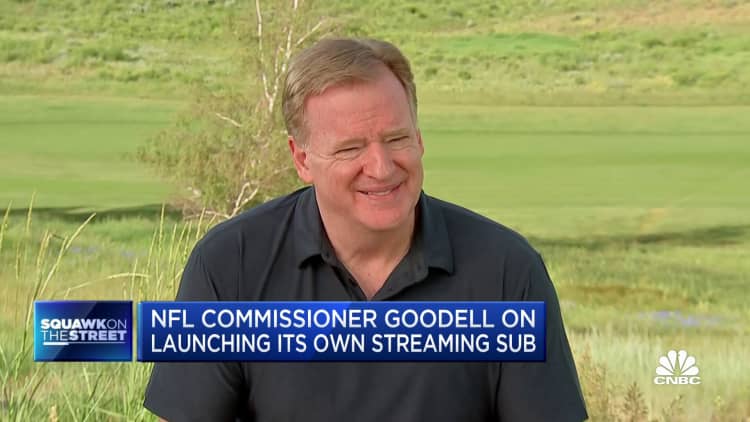
Sunday Ticket is also a U.S.-only product. It remains unclear what the NFL is willing to give Apple to enhance a deal beyond what it’s sold to DirecTV for the past 28 years. Still, NFL Commissioner Roger Goodell told CNBC in July part of the benefit of selling to a streamer is to “innovate beyond where we are today.”
Goodell said he plans to choose a new Sunday Ticket home by fall of this year. On that timeline, a winning bidder should be announced in the next 10 weeks. The NFL wants a buyer for Sunday Ticket to pay between $2 billion and $3 billion annually, CNBC has previously reported. That’s a significant increase from the $1.5 billion DirecTV has been paying since 2015. The league is also looking for a company to purchase a minority stake in NFL Media, which includes linear cable networks RedZone and NFL Network, as well as NFL.com. The NFL has been packing the minority stake with Sunday Ticket, though it could decide to sell each separately, Goodell said.
Beyond its MLS partnership, Apple has been laying breadcrumbs that it wants to take a significant plunge into live sports. Apple struck a deal with Major League Baseball to carry exclusive Friday night games this season. And last month, the NFL announced Apple Music as the new partner for the Super Bowl halftime show.
The longer the NFL waits to reach a deal, the less time a new owner of the rights will have to market the product for next season. DirecTV executives have been waiting for nearly two years for a new partner to be announced and have been surprised with how long it’s taken to find one, according to people familiar with the matter. DirecTV has routinely lost money on Sunday Ticket and isn’t participating in this round of bidding, CNBC reported in June.
The satellite provider would be interested in maintaining its commercial agreement to carry games in bars and restaurants or act as a pass-through for the Sunday Ticket winner, where existing DirecTV customers could continue to get the package through its pay-TV service, CNBC reported in June.
Disclosure: Comcast’s NBCUniversal is the parent company of CNBC.
WATCH: Tech analyst Gene Munster on Apple, tech world


Firefly’s CEO Jason Kim reacts during the company’s IPO at the Nasdaq MarketSite in New York City, U.S., August 7, 2025.
Jeenah Moon | Reuters
Last week’s liftoff also coincided with President Donald Trump‘s “space superiority” executive order, signed on Friday, that aims to create a permanent U.S. base on the moon.
Investors have also gained more clarity on the future of NASA following a whirlwind drama since Trump won the election.
Last week, the Senate confirmed Jared Isaacman as NASA administrator more than a year after he was first nominated to the position.
Trump withdrew the nomination from the Elon Musk ally earlier this year amid a public fallout, but renominated Isaacman in November.
Transportation Secretary Sean Duffy was tapped to temporarily run the space agency in the interim.


Google parent Alphabet on Monday announced it will acquire Intersect, a data center and energy infrastructure company, for $4.75 billion in cash in addition to the assumption of debt.
Alphabet said Intersect’s operations will remain independent, but that the acquisition will help bring more data center and generation capacity online faster.
In recent years, Google has been embroiled in a fierce competition with artificial intelligence rivals, namely OpenAI, which kick-started the generative AI boom with the launch of its ChatGPT chatbot in 2022. OpenAI has made more than $1.4 trillion of infrastructure commitments to build out the data centers it needs to meet growing demand for its technology.
With its acquisition of Intersect, Google is looking to keep up.
“Intersect will help us expand capacity, operate more nimbly in building new power generation in lockstep with new data center load, and reimagine energy solutions to drive US innovation and leadership,” Sundar Pichai, CEO of Google and Alphabet, said in a statement.
Google already had a minority stake in Intersect from a funding round that was announced last December. In a release at the time, Intersect said its strategic partnership with Google and TPG Rise Climate aimed to develop gigawatts of data center capacity across the U.S., including a $20 billion investment in renewable power infrastructure by the end of the decade.
Alphabet said Monday that Intersect will work closely with Google’s technical infrastructure team, including on the companies’ co-located power site and data center in Haskell County, Texas. Google previously announced a $40 billion investment in Texas through 2027, which includes new data center campuses in the state’s Haskell and Armstrong counties.
Intersect’s operating and in-development assets in California and its existing operating assets in Texas are not part of the acquisition, Alphabet said. Intersect’s existing investors including TPG Rise Climate, Climate Adaptive Infrastructure and Greenbelt Capital Partners will support those assets, and they will continue to operate as an independent company.
Alphabet’s acquisition of Intersect is expected to close in the first half of 2026, but it is still subject to customary closing conditions.
WATCH: Here’s what’s happening to electricity bills in states with the most data centers

-
 Sports2 years ago
Story injured on diving stop, exits Red Sox game
-
 Sports3 years ago
‘Storybook stuff’: Inside the night Bryce Harper sent the Phillies to the World Series
-
 Sports2 years ago
Game 1 of WS least-watched in recorded history
-
 Sports3 years ago
Button battles heat exhaustion in NASCAR debut
-
 Sports3 years ago
MLB Rank 2023: Ranking baseball’s top 100 players
-
Sports4 years ago
Team Europe easily wins 4th straight Laver Cup
-
 Environment3 years ago
Japan and South Korea have a lot at stake in a free and open South China Sea
-
 Environment1 year ago
Here are the best electric bikes you can buy at every price level in October 2024