
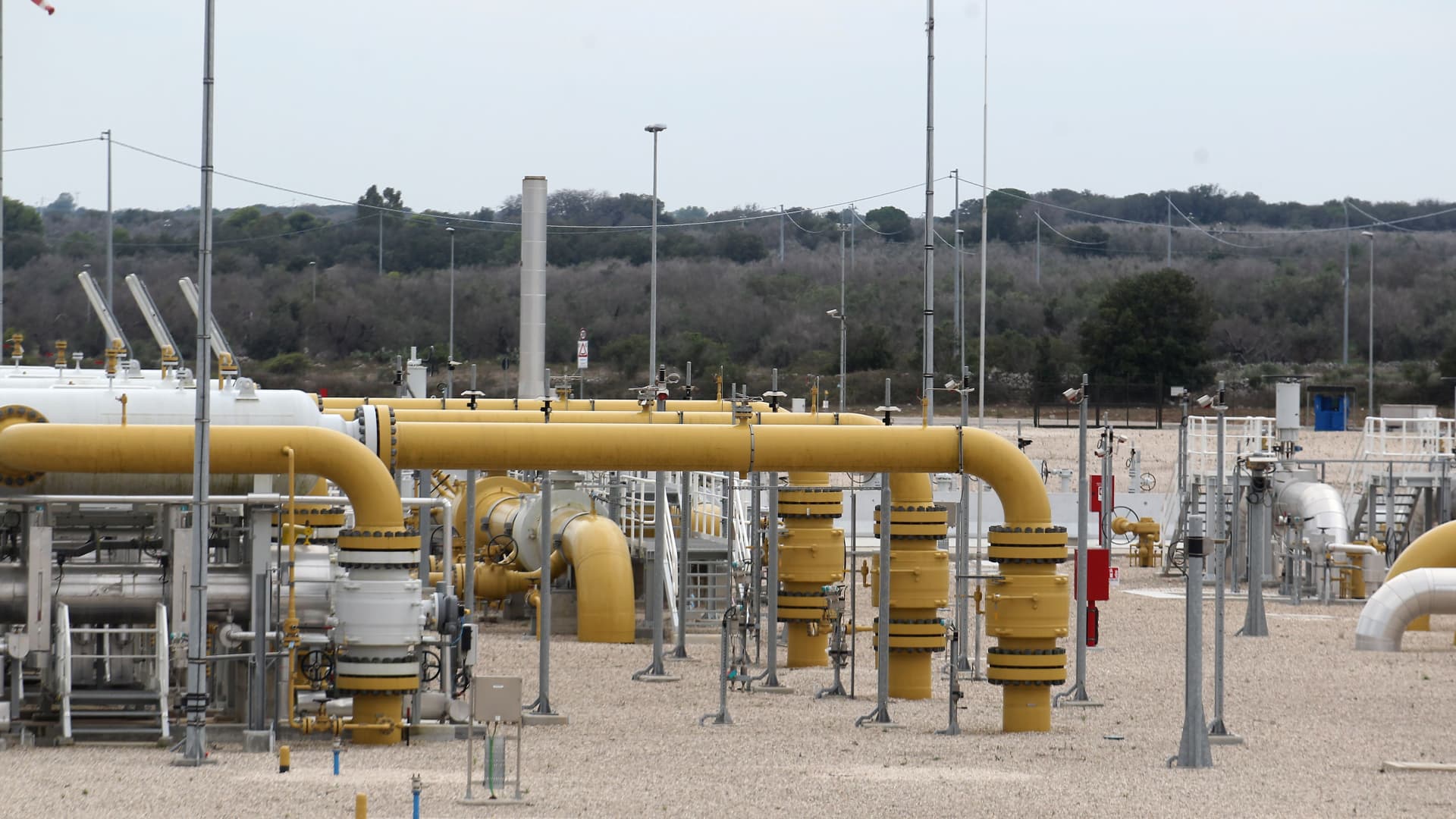
The EU wants to limit spiking gas prices after ‘excessive’ moves this summer


Rush Township supervisors in Centre County, Pennsylvania, voted this week to greenlight a key permit for the Black Moshannon Solar project – a large solar development that would turn toxic former mineland into a major source of clean power.
If built, the Pennsylvania solar project would generate 265 megawatts of electricity – enough to power about 200,000 homes annually – on nearly 2,000 acres of toxic mineland. Developers deliberately chose the site, as the project is designed to reclaim land left behind by mining and fold environmental cleanup into the solar buildout.
According to project plans, the site would be restored with pollinators and pollinator-friendly ground cover planted beneath the solar panels. Developers have also committed to ongoing water quality and soil testing during construction and operations, along with soil improvements such as applying lime to help neutralize mining-related contamination and support vegetation growth.
Beyond the environmental cleanup, the project is expected to deliver a financial boost to the region. Black Moshannon Solar is projected to generate more than $5 million in tax revenue for the Phillipsburg-Osceola Area School District, along with more than $700,000 in direct tax payments to Centre County.
Environmental and energy advocates praised the township’s decision. David Masur, executive director of PennEnvironment, called the vote a model for other communities across the state. “We are hopeful that other local government officials across Pennsylvania will follow Rush Township’s lead and implement similar, much-needed solar projects all across the Keystone State.”
Jim Gregory, executive director of the Conservative Energy Network-Pennsylvania, also applauded the approval. “In 40 years, their forward-thinking decisions will be recognized as catalysts for environmental protection, public health improvements, and economic prosperity.”
Read more: Trump admin OKs $1B loan for Three Mile Island nuclear reboot

If you’re looking to replace your old HVAC equipment, it’s always a good idea to get quotes from a few installers. To make sure you’re finding a trusted, reliable HVAC installer near you that offers competitive pricing on heat pumps, check out EnergySage. EnergySage is a free service that makes it easy for you to get a heat pump. They have pre-vetted heat pump installers competing for your business, ensuring you get high quality solutions. Plus, it’s free to use!
Your personalized heat pump quotes are easy to compare online and you’ll get access to unbiased Energy Advisors to help you every step of the way. Get started here. – *ad


FTC: We use income earning auto affiliate links. More.
![Genesis GV90 leaks as breathtaking ultra-luxe SUV with coach doors [Video]](https://i0.wp.com/electrek.co/wp-content/uploads/sites/3/2025/11/Genesis-GV90-leak-coach-doors.jpeg?resize=1200,628&quality=82&strip=all&ssl=1)
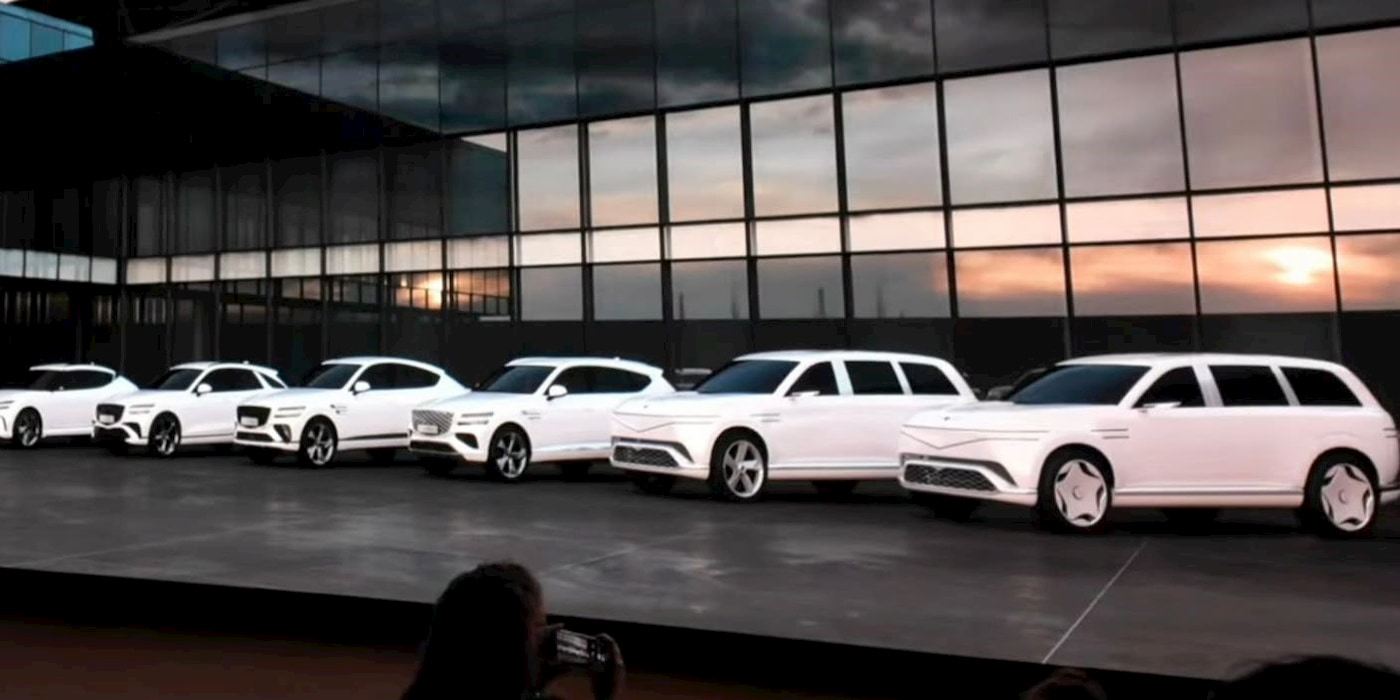
Genesis is gearing up to launch the stunning new flagship SUV. Ahead of its official debut, the GV90 leaked during an internal presentation, revealing our first look at the ultra-luxe electric SUV.
Genesis GV90 leak reveals coach doors and more
The GV90 is arriving as the largest, most luxurious Genesis SUV to date. Based on the Neolun Concept, the new flagship SUV will sit above the GV80 as Genesis expands into new segments.
As Genesis calls it, the “ultra-luxe, state-of-the-art SUV” stole the spotlight at the New York Auto Show last March.
It wasn’t the stunning, reductive design inspired by Korea’s moon-shaped porcelain jars or the premium Royal Indigo and Purple silk materials that caught most people’s attention at the event, but the B-pillarless coach doors.
The SUV was showcased with Rolls-Royce-like coach doors, offering a new level of luxury for Genesis. Although we’ve seen the GV90 spotted out in public testing a few times now with coach doors, we wondered if they would make it to the production model.

After the full-size SUV reportedly leaked during an internal presentation, it looks like we’ve found our answer. The Genesis GV90 leak reveals two versions: a standard model and a coach-door model.
The leaked images from our friends at ShortsCar offer our first look at the production version in full. Earlier this month, a GV90 prototype was spotted out in public with the coach doors wide open, providing a sneak peek of the interior.
From what was shown, the cabin will feature a similar layout to the concept, with high-end purple and indigo materials. The GV90 was also caught with an all-black interior, which is expected to be the standard version.
A new video from the folks over at HealerTV offers a closer look at the breathtaking interior ahead of its official debut.
The GV90 appears to retain the gear selector located near the top of the steering wheel from the Neolun concept.
Another report, from TheKoreanCarBlog, confirms the new gear selector after the first interior spy shots surfaced.
From what we’ve seen so far, the GV90 is shaping up to be a near replica of the ultra-luxe Neolun concept. Genesis has yet to announce a launch date for the GV90, but it is expected to make an official debut by the end of the year with sales starting in mid-2026.
Prices and final specs, like driving range, will be revealed closer to launch, but the Genesis GV90 is rumoured to be the first vehicle to ride on Hyundai’s new eM platform.
Hyundai said the new platform will deliver a 50% improvement in range compared to its current E-GMP-based EVs, such as the IONIQ 5. It’s also expected to offer Level 3 autonomous driving as well as other advanced driver assistance system (ADAS) features.
FTC: We use income earning auto affiliate links. More.

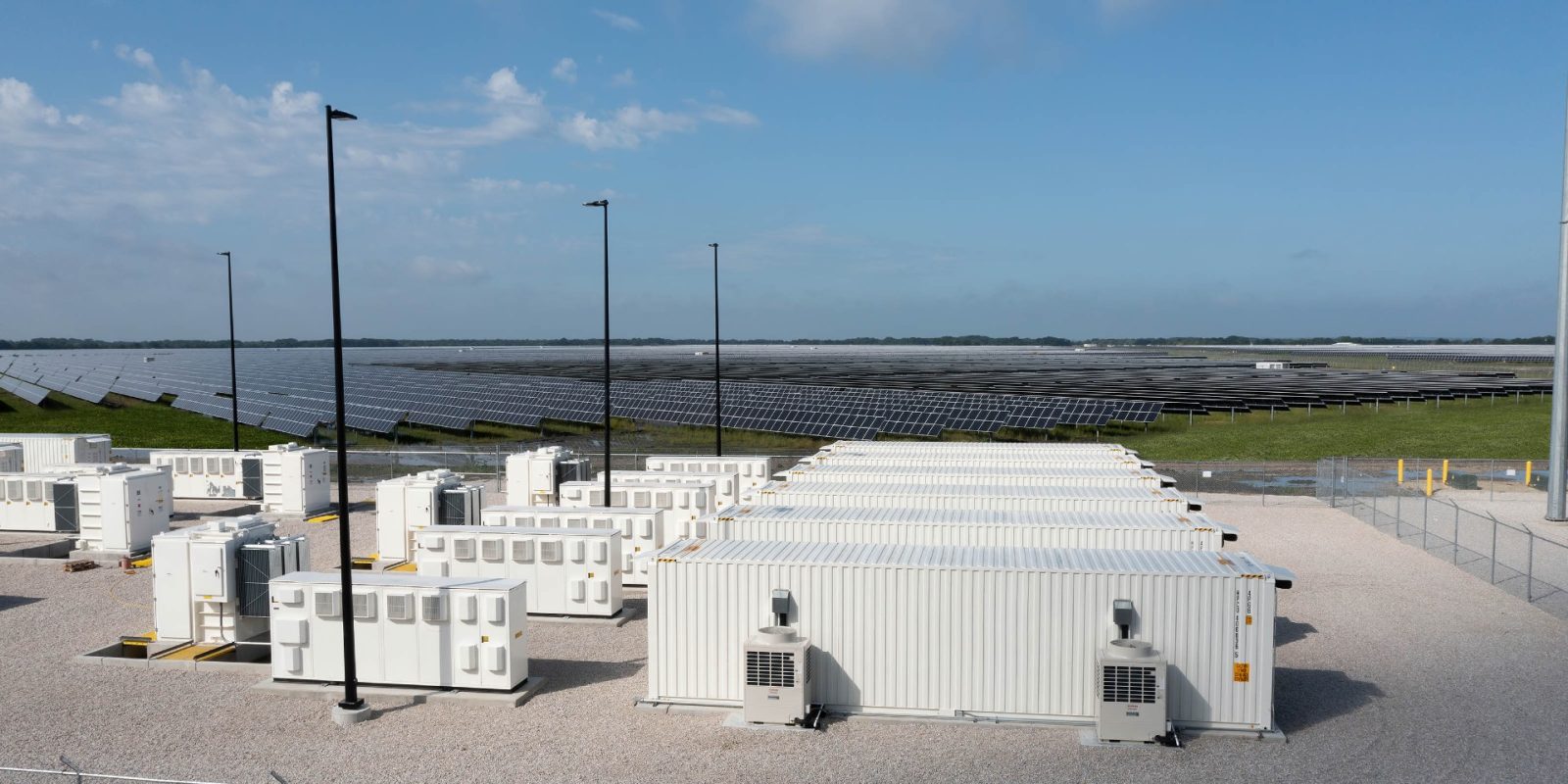
Turning cheap daytime solar into electricity you can actually use at night just got a lot cheaper. A new analysis from energy think tank Ember shows that utility-scale battery storage costs have fallen to $65 per megawatt-hour (MWh) as of October 2025 in markets outside China and the US. At that level, pairing solar with batteries to deliver power when it’s needed is now economically viable.
Battery storage costs have fallen dramatically over the past two years, and the decline continues. Following a steep decline in 2024, Ember’s analysis indicates that prices continued to fall sharply again in 2025.
The findings are based on real-world data from recent battery and solar-plus-storage auctions in Italy, Saudi Arabia, and India, as well as interviews with active developers across global markets.
According to Ember, the cost of a whole, grid-connected utility-scale battery storage system for long-duration projects (four hours or more) is now about $125 per kilowatt-hour (kWh) as of October 2025. That figure applies to projects outside China and the US. Core battery equipment delivered from China costs around $75/kWh, while installation and grid connection typically add another $50/kWh.
Those lower upfront costs have pushed down the levelized cost of storage (LCOS) to just $65/MWh. Ember’s calculation reflects real-world assumptions around financing costs, system lifetime, efficiency, and battery degradation.
Cheaper hardware isn’t the only reason storage costs are falling. Longer battery lifetimes, higher efficiencies, and lower financing costs, helped by clearer revenue models such as auctions, have all contributed to the sharp drop in LCOS. Ember has published a live calculator alongside the report, allowing users to estimate LCOS using their own assumptions.
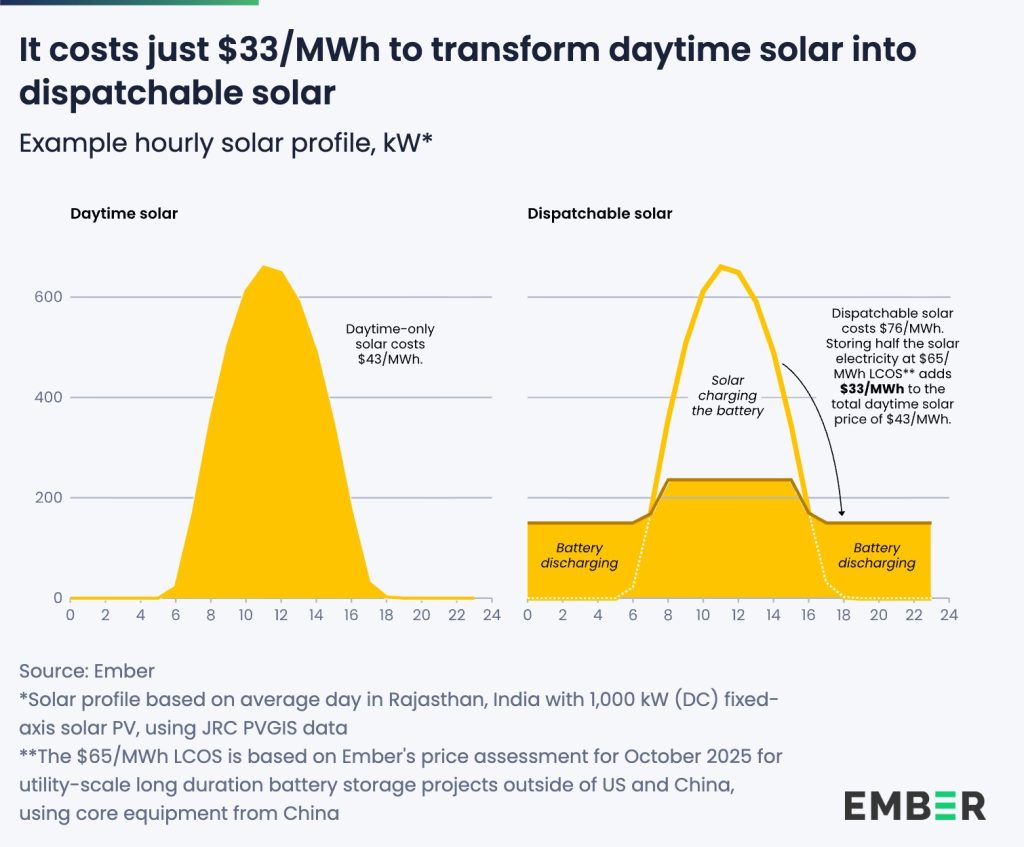
Why this matters comes down to how solar is actually used. Most solar power is generated during the day, so only a portion needs to be stored to make it dispatchable. Ember estimates that if half of daytime solar generation is shifted to nighttime, the $65/MWh storage cost adds about $33/MWh to the cost of solar electricity.
With the global average price of solar at $43/MWh in 2024, adding storage would bring the total cost to about $76/MWh, delivering power in a way that better matches real demand.
As Ember global electricity analyst Kostantsa Rangelova put it, after a 40% drop in battery equipment costs in 2024, the industry is now on track for another major fall in 2025. The economics of battery storage, she said, are “unrecognizable,” and the industry is still adjusting to this new reality.
“Solar is no longer just cheap daytime electricity; now it’s anytime dispatchable electricity. This is a game-changer for countries with fast-growing demand and strong solar resources,” Rangelova added.
Together, solar and battery storage are increasingly emerging as a scalable, secure, and affordable foundation for future power systems.
Read more: EIA: Solar + storage soar as fossil fuels stall through September 2025

If you’re looking to replace your old HVAC equipment, it’s always a good idea to get quotes from a few installers. To make sure you’re finding a trusted, reliable HVAC installer near you that offers competitive pricing on heat pumps, check out EnergySage. EnergySage is a free service that makes it easy for you to get a heat pump. They have pre-vetted heat pump installers competing for your business, ensuring you get high quality solutions. Plus, it’s free to use!
Your personalized heat pump quotes are easy to compare online and you’ll get access to unbiased Energy Advisors to help you every step of the way. Get started here. – *ad
FTC: We use income earning auto affiliate links. More.
-
 Sports2 years ago
Story injured on diving stop, exits Red Sox game
-
 Sports3 years ago
‘Storybook stuff’: Inside the night Bryce Harper sent the Phillies to the World Series
-
 Sports2 years ago
Game 1 of WS least-watched in recorded history
-
 Sports3 years ago
Button battles heat exhaustion in NASCAR debut
-
 Sports3 years ago
MLB Rank 2023: Ranking baseball’s top 100 players
-
Sports4 years ago
Team Europe easily wins 4th straight Laver Cup
-
 Environment3 years ago
Japan and South Korea have a lot at stake in a free and open South China Sea
-
 Environment1 year ago
Here are the best electric bikes you can buy at every price level in October 2024