
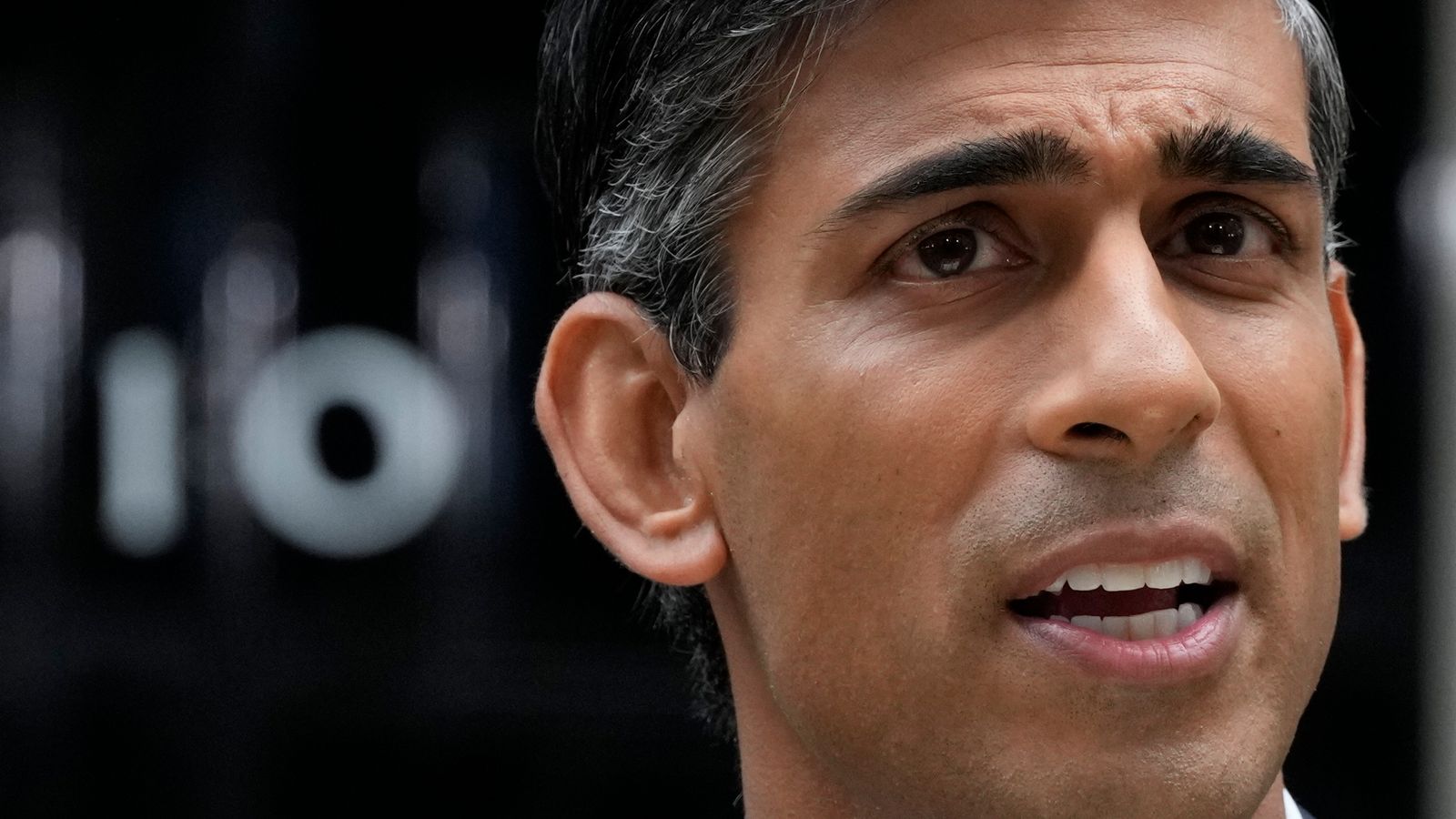
Rishi Sunak says he was chosen to ‘fix’ Truss’s mistakes in first speech as prime minister


Rishi Sunak has made his first speech as prime minister, saying he was chosen to take over to “fix” the mistakes made by Liz Truss.
Speaking outside Number 10, the former chancellor praised his predecessor’s “restlessness” and her “noble aim” to improve economic growth in the UK.
But, he added: “Some mistakes were made, not born of ill will or bad intensions – quite the opposite in fact – but mistakes none the less.”
New PM – latest updates from Downing Street
After walking up Downing Street with no supporters present, and with a serious face, Mr Sunak reiterated his comments from yesterday, saying the country was “facing a profound economic crisis” and there were “difficult decisions” to come.
But he pledged to approach the problems with “compassion” and “to place economic stability and confidence at the heart of this government’s agenda”.
The new PM added: “The government I lead will not leave the next generation, your children and grandchildren, with a debt to settle that we were too weak to pay ourselves.”
Mr Sunak made his political comeback on Monday, being appointed as the new Conservative Party leader unopposed after former prime minister Boris Johnson decided not to run and Commons leader Penny Mordaunt dropped out at the last minute.
Winning the leadership also meant he won the keys to Number 10, making him the UK’s first British Asian and Hindu prime minister, and earlier today he was asked by the King at Buckingham Palace to form a government before officially taking power.
The newest and youngest PM in modern times will now begin appointing his top team, with all eyes on which cabinet ministers will be in and out.
Mr Sunak replaces Ms Truss, who had seen him off during the summer-long leadership contest to take over from Mr Johnson, but became the UK’s shortest ruling prime minister after the disaster of her tax slashing mini-budget.
Earlier, after holding a cabinet meeting for the final time, Ms Truss had an audience with the King to formally offer her resignation.
In her final speech as PM, she wished Mr Sunak “every success” adding: “I know brighter days lie ahead.”
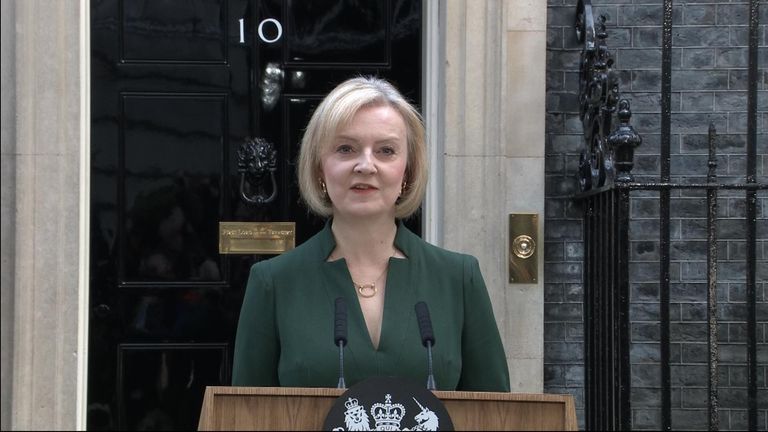
Truss: ‘I believe in Britain’
In a speech that lasted just under six minutes, Mr Sunak praised another of his predecessors, Mr Johnson, for “his warmth and generosity of spirit”.
But he said the manifesto the Tory Party was elected on in 2019 was “not the sole property of any one individual” and he would “deliver on its promise”.
The PM pointed to pledges on the NHS, education, controlling immigration and protecting the environment, as well as giving his commitment to Ukraine, saying it was a “terrible war that must be seen successfully to its conclusions”.
However, one of his main messages was that his government would have “integrity, professionalism and accountability” as he attempted to win back the trust of the public after recent weeks.
“Trust is earned,” he said. “And I will earn yours.”
Read more:
Who is Rishi Sunak? The UK’s first British Asian prime minister
Six questions Rishi Sunak must answer in appointing his cabinet
Mr Sunak said he was “not daunted” by the task, adding: “When the opportunity to serve comes along, you cannot question the moment, only your willingness.
“So I stand here before you ready to lead our country into the future, to put your needs above politics, to reach out and build a government that represents the very best traditions of my party.
“Together we can achieve incredible things. We will create a future worthy of the sacrifices so many have made
and fill tomorrow, and everyday thereafter with hope.”
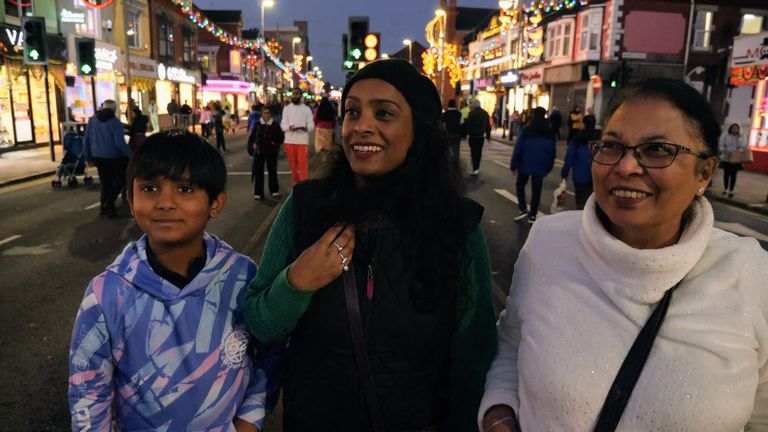
How did Sunak’s win go down on Diwali?
In his first remarks since announcing he would not seek a return to Number 10, Mr Johnson congratulated the new incumbent, calling it an “historic day”.
He tweeted: “This is the moment for every Conservative to give our new PM their full and wholehearted support.”
High profile Tories joined him in sending praise on social media, with Suella Braverman, Priti Patel and Sajid Javid among the first to celebrate the appointment.
Labour leader Sir Keir Starmer also congratulated Mr Sunak on “making history as the first British Asian PM”.
But he said the Tories had “crashed the economy, with low wages, high prices and a cost of living crisis”, and he reiterated his call for an immediate general election, adding: “The public needs a fresh start and a say on Britain’s future.”
Liberal Democrat leader Sir Ed Davey echoed the sentiment, tweeting: “Rishi Sunak’s words will do nothing to reassure struggling people worried sick about the winter ahead.
“He says he wants to win the public’s trust, but refuses to trust the public with a general election.”
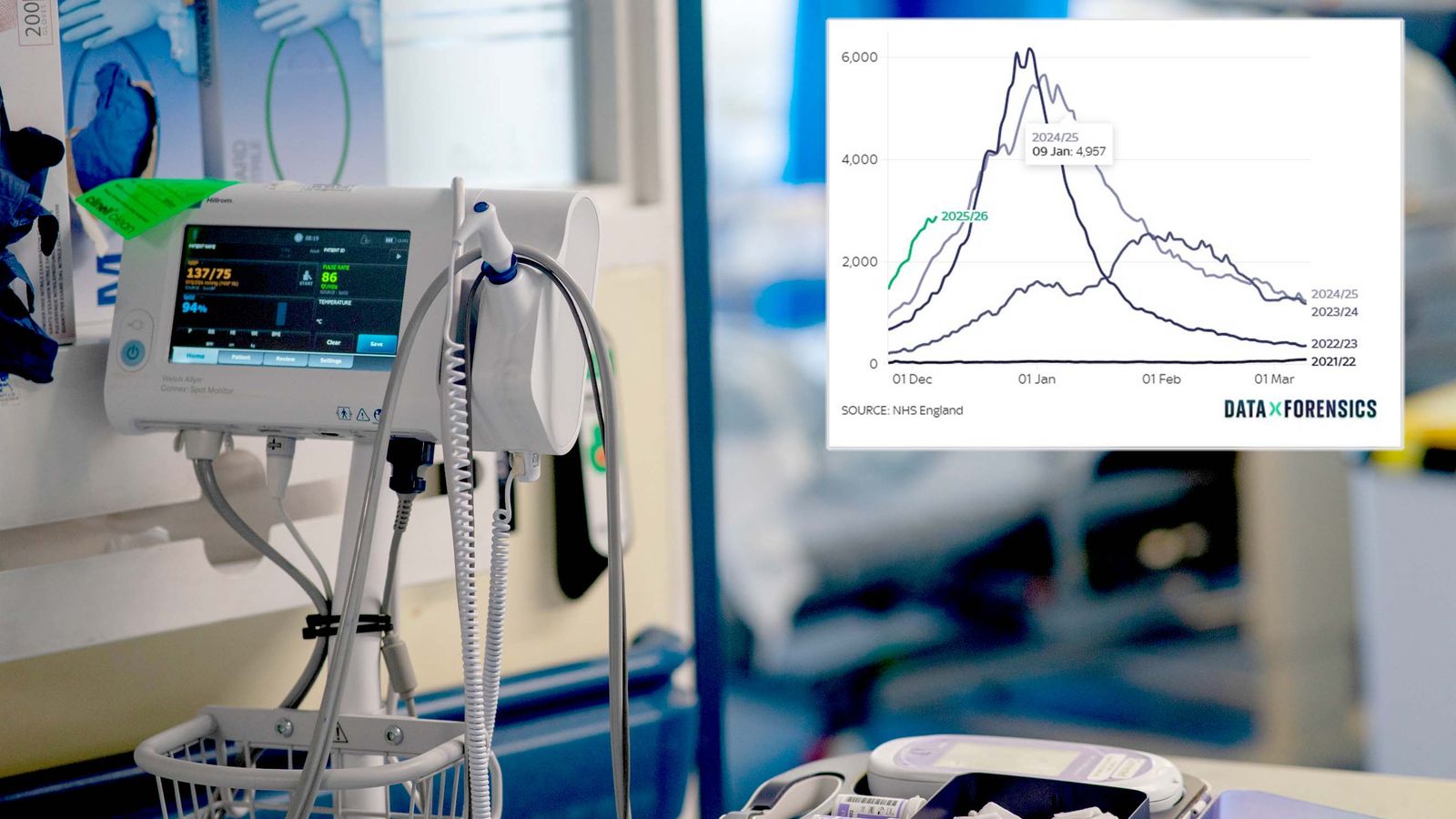
NHS England has warned the health service is facing a “worst case scenario” December with a surge of “super flu”.
The warning comes as new figures revealed the number of people in hospital with flu have increased by more than half in just one week.
Catch up as it happened: NHS warns of ‘worst-case scenario’ as ‘super flu’ surges
Latest figures show:
• An average of 2,660 patients were in hospital per day with flu last week
• This is the highest ever for this time of year and up 55% on last week
• At this point last year the number stood at 1,861 patients, while in 2023 it was just 402
Health service bosses are warning the number of flu patients in hospital has already increased sharply since the week covered by this data – with no peak in sight.
Read more: Why is flu season worse this year?
Virus outbreaks coincide with doctors’ strikes
Weekly flu numbers in England peaked at 5,408 patients last winter and reached 5,441 over the winter of 2022/23, the highest level since the pandemic.
Alongside rocketing flu, the number of norovirus patients in hospital has also risen by 35%.
The NHS is now warning winter viruses are starting to “engulf hospitals”.
Demand for A&Es and ambulance services is also soaring.
New monthly figures show A&E attendances were a record for November at 2.35 million – more than 30,000 higher than November 2024.
In addition, there were 48,814 more ambulance incidents (802,525) compared with last year (753,711).
Some hospitals across the country have asked staff, patients and visitors to wear face masks to cut the spread of flu, while others have gone in and out of critical incident status due to the high number of people attending A&E.
The record-breaking demand on the NHS coincides with a resident doctors’ strike from 17 to 22 December over pay and jobs – sparking fears of major disruption for patients in the run up to Christmas.
People are being advised to attend any planned appointments scheduled during the strikes unless they have been contacted to reschedule.
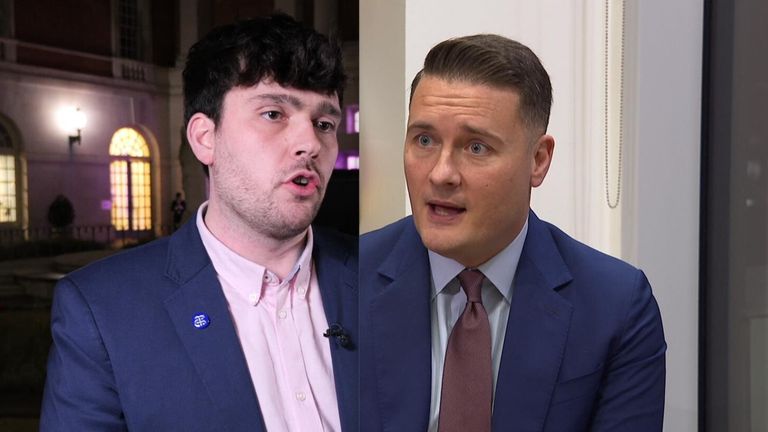
Will doctors accept late deal to avoid strikes?
Flu vaccinations on the up… who can get one?
The NHS is urging anyone eligible to get their flu vaccination to help prevent them getting seriously ill.
Latest figures show more than 17.4 million people have been vaccinated so far this year, more than 381,000 higher than last year.
You can get it if you:
• Are 65 or over in England, Scotland, Wales and Northern Ireland
• Are pregnant
• Live in a care home
• Are the main carer for an older or disabled person, or receive carer’s allowance
• Live with someone who has a weakened immune system
• Are a frontline health and social care worker
• Are of school age
• Have certain medical conditions (the NHS has a full list)
Wes Streeting, the health secretary, warned of a “tidal wave of flu tearing through our hospitals”.
“We are working with the NHS to make sure it is able to cope with this as best as possible,” he said.
Warning ‘extremely challenging few weeks ahead’
Professor Meghana Pandit, NHS national medical director, warned the health service faces “an extremely challenging few weeks ahead” with “staff being pushed to the limit”.
She said: “With record demand for A&E and ambulances and an impending resident doctors’ strike, this unprecedented wave of super flu is leaving the NHS facing a worst-case scenario for this time of year – with staff being pushed to the limit to keep providing the best possible care for patients.
“The numbers of patients in hospital with flu is extremely high for this time of year. Even worse, it continues to rise and the peak is not in sight yet, so the NHS faces an extremely challenging few weeks ahead.”
She added: “We have prepared earlier for winter than ever before, and stress-tested services to ensure people have a range of ways to get the help they need and avoid needing to go to A&E.
“For non-life-threatening care, people should call NHS 111 or use 111 online, which can direct you to the most appropriate place, and use A&E and 999 for life threatening conditions and serious injuries.”
Read more from Sky News:
US accused of ‘piracy’
Flights diverted in Moscow
Mr Streeting has offered the British Medical Association (BMA) a last-minute deal in the hope doctors will call off the walkout, which starts next Wednesday.
The doctors’ union has agreed to put the offer to members over the coming day, and is expected to announced a decision on Monday, just two days before the planned strike.
The offer includes a fast expansion of specialist training posts as well as covering out-of-pocket expenses such as exam fees, but does not include extra pay.
The spread of subclade K, the super flu, is picking up – and it’s not looking good for the NHS.
An average of just under 2,700 hospital beds a day in England were occupied by patients with flu last week.
There are fears that could jump to somewhere between 5,000 and 8,000 by the end of this week.
That’s on top of COVID and RSV.
And with the possibility of a five-day strike by resident (junior) doctors next week, it’s a perfect storm for hospitals.
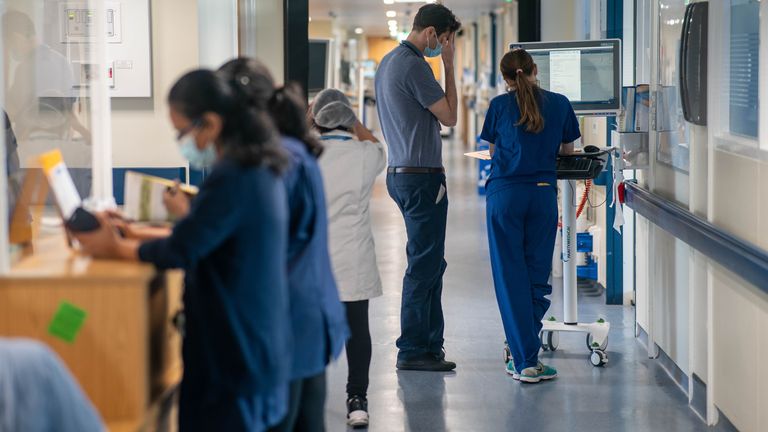
An NHS hospital ward at Ealing Hospital in London. Pic: PA
Christmas flu
Children are the super-spreaders of flu. It races around classrooms and some schools have temporarily shut because of the impact.
The Christmas holidays aren’t far off. They are likely to put the brakes on children passing around the virus.
But it’s also a time of year when families mix with elderly relatives, who are more likely to be hit hard by the infection – perhaps even needing hospital care.
So while the holidays may temporarily slow the overall rise in infections, the impact on hospitals could get much worse.
File pic: PA
Subclade K
Flu is spreading so rapidly at the moment because immunity to subclade K from previous infections and vaccinations is low.
The virus – a variant of the H3N2 flu strain – suddenly acquired seven new mutations in late summer.
Every 100 people infected with seasonal flu would typically pass the virus on to 120 others.
With subclade K, it’s 140.
And that’s why cases are rising so quickly on the charts.
At the moment, 18 in every 100,000 patients in England are consulting their GP with flu-like symptoms. That’s still well short of the peak of around 50 in every 100,000 in 2017/18, the worst flu outbreak in recent years.

File pic: PA
The grim reality of flu
Flu is a really unpleasant disease, nothing like a cold. I’ve had it twice in my life and it physically hurt to get out of bed. It’s grim.
Most people get over it with a few days’ rest and paracetamol to take the edge off the fever.
But vulnerable people can become seriously ill. In the outbreak of 2017/18, around 22,000 died.
Read more:
Nurses ‘deeply concerned about what lies ahead’
NHS braced for ‘toughest winter’ after record-breaking month
That’s why the NHS is urging people in certain groups – the over 65s, those with underlying health conditions, pregnant women, carers and children – to get the jab.
The vaccine isn’t a great match for subclade K, but still reduces the chance of hospital admission by 30-40% in adults.
It’s impossible to say when the spread will peak, but the latest figures suggest the outbreak is far from over.

-
 Sports2 years ago
Story injured on diving stop, exits Red Sox game
-
 Sports3 years ago
‘Storybook stuff’: Inside the night Bryce Harper sent the Phillies to the World Series
-
 Sports2 years ago
Game 1 of WS least-watched in recorded history
-
 Sports3 years ago
Button battles heat exhaustion in NASCAR debut
-
 Sports3 years ago
MLB Rank 2023: Ranking baseball’s top 100 players
-
Sports4 years ago
Team Europe easily wins 4th straight Laver Cup
-
 Environment3 years ago
Japan and South Korea have a lot at stake in a free and open South China Sea
-
 Environment1 year ago
Here are the best electric bikes you can buy at every price level in October 2024