
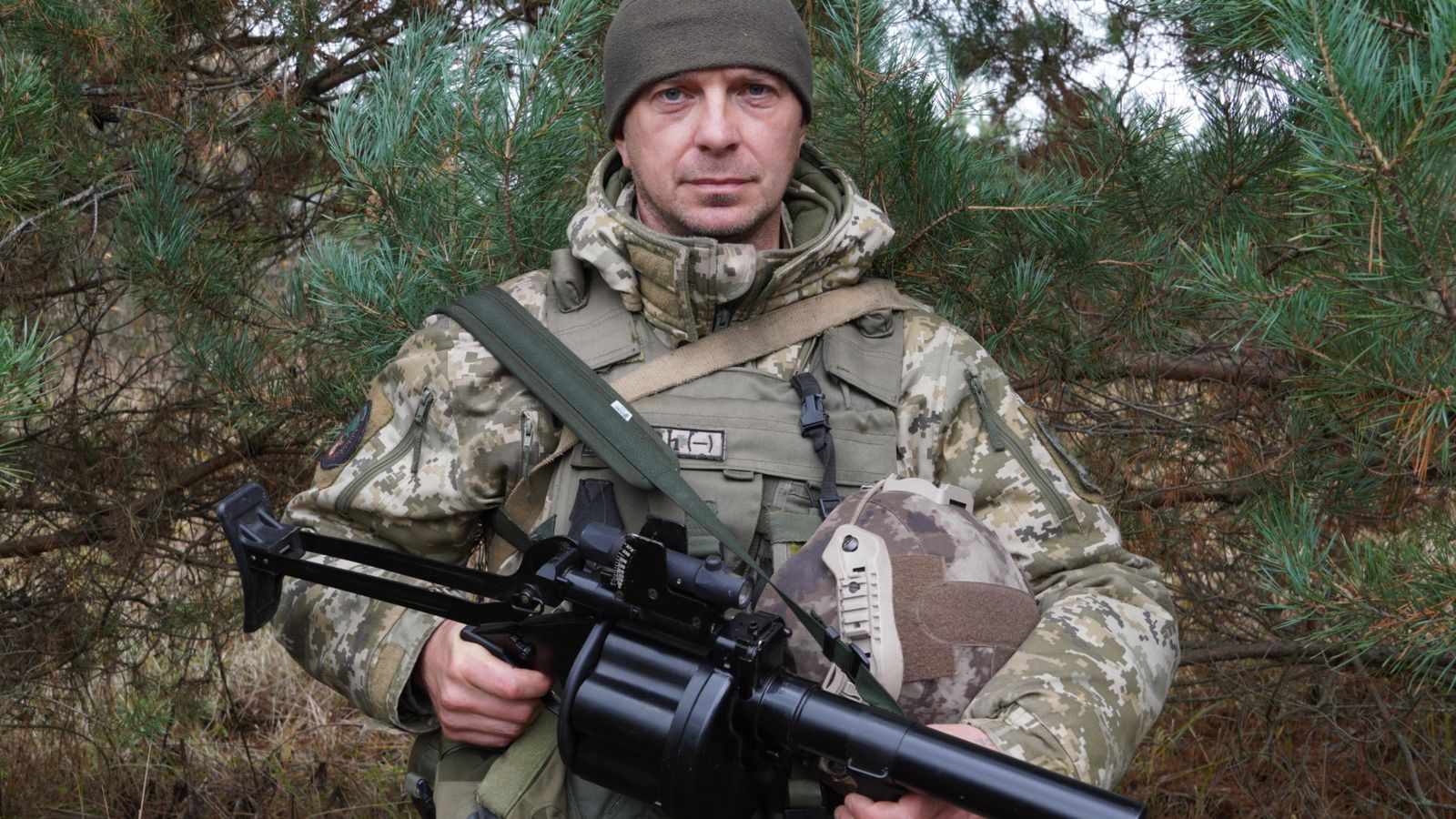
Ukraine war: ‘There is only us and them – enemies’ – Ukrainians dug in trenches on Belarus and Russia frontline

They tell us to run, and so we run. Through the scrub, the mud and the undergrowth until we stop under the shelter of trees. Out of breath, out of sight and, for now, out of danger.
This is a place of mud, weapons and nervous energy. We are in the area where the borders of Ukraine, Belarus and Russia converge. What was once a novelty on a map is now a tangible military pinch point and Russia’s next assault on Ukraine might well come through this terrain.
We are with the Ukrainian Border Force, who monitor and guard the frontier. A year ago, these people worried about customs checks on the hundreds of lorries that came through every day, en route between Turkey and Russia. It was, says a smiling, broad-shouldered man guard called Barack, “good work – interesting, not too hard”.
Now, there are no lorries and the guards have become the first line of defence. If Russian troops do pour through this border once more – and there is a growing feeling that they will – then these men and women will be the ones to greet them; to try to repel the Russian army. And so, the border guards have adapted to a new and vastly more perilous world.
“I don’t want to do this,” one of them says to me. “But I do it because I love my land and my country. If I need to fight, I will do this without thinking. It’s just work.”
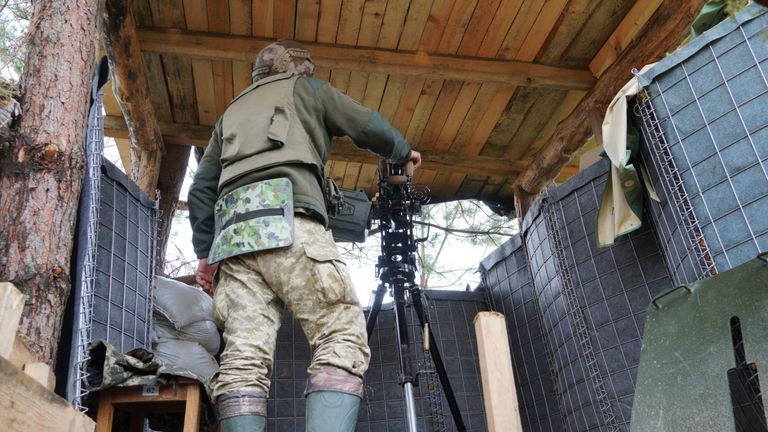
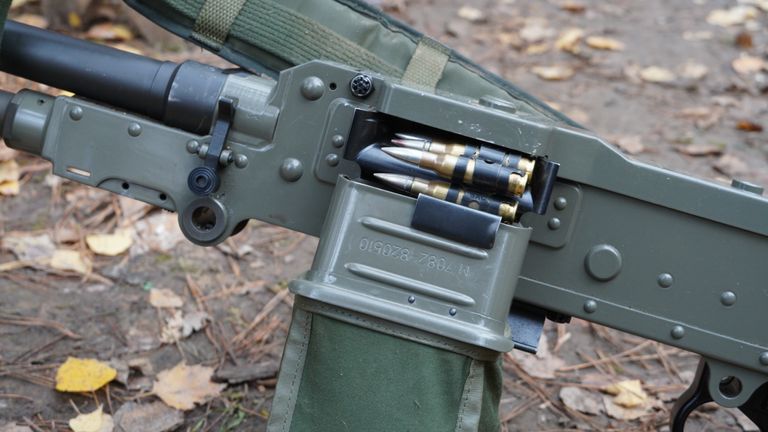
But of course, it isn’t really “just work”. Through the sights of a heavy machine gun, you can see Belarus, just a few kilometres away. The Russian border is not much further away, and shells are fired over regularly. We can hear the regular booms as they land.
Many people around here have left. Those who remain have become accustomed to violence raining down on them – they use bicycles instead of cars, because bikes don’t attract drones.
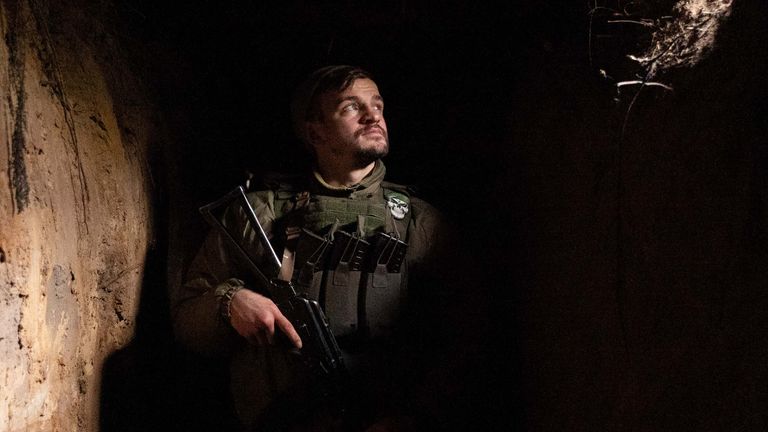
Barack is a border guard stationed at the triple frontier between Russia, Belarus and Ukraine
Bonhomie, determination and adrenaline
Not far away is a small village that stands right on the border, cut off from the world. It was once home to 100 people but has been almost completely demolished. Maybe ten people remain, and they are almost unreachable.
We are the first foreign journalists to come here and spend time with these guards. What we find is a blend of bonhomie, determination and adrenaline. They’ve already seen one Russian invasion here and they fear another.
Thousands of newly mobilised Russian troops have been sent to Belarus this month to create a so-called “regional force” to defend the border.
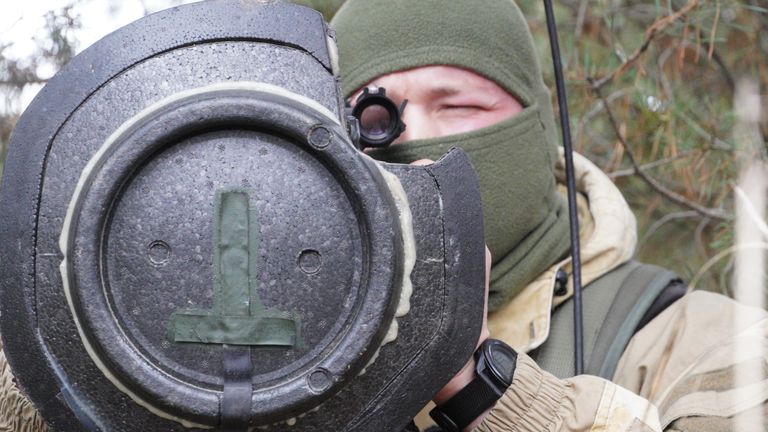
A man in a balaclava readies a British-made NLAW missile launcher
In theory, it is a collaboration between the two countries, but few, beyond the Kremlin or Minsk, take that at face value. Just about everyone else sees it as a device for strengthening the Russian presence ahead of a possible attack, designed to stretch Ukrainian resources by opening up another offensive.
There is a precedent, of course. Back in February, Russian troops came over this border and took over the area. They formed a long convoy of vehicles that set off in the direction of Kyiv, before eventually withdrawing in April.
Since then, the border guards have been preparing. They have dug long trenches, where you walk through mud in near darkness with thoughts of World War One in your mind. And yet, in one of these underground rooms, we see computer terminals linked to the Starlink satellite systems.
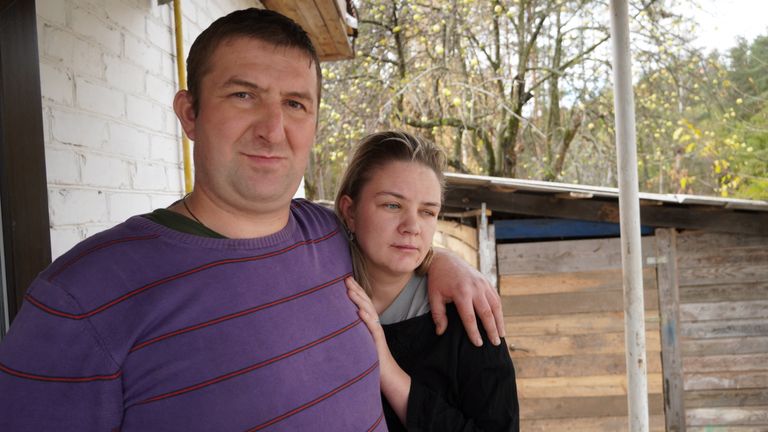
Oleksander and Olga’s ceiling fell in on them after an explosion rocked their home
I talk to Barack in a room carved out from the trench. There are wooden boards on the floor and a crude bunk bed in the corner. He laughs when I say it feels like we’ve gone back a century, but agrees. I ask him about the Russian troop build-up a short distance away.
“They are becoming more aggressive, but our Ukrainian forces give them a bloody nose!” he laughs again.
‘We need more weapons’
They have a variety of weaponry – heavy machine guns, anti-tank missiles, rifles, ammunition and so on. There are minefields around us and a variety of concealed look-out posts. The job of preparing to resist a huge invading army is an intimidating one. It’s not one that they’re really trained for, but it’s one they’ve embraced.
The trouble is that while the spirit is boundless, the resources are not.
“We need more weapons because we don’t know the intensity of the possible attack. We do not know how long we will need to maintain the defence on the border,” says Halyna, the spokesperson for the Chernihiv border guard unit.
Click to subscribe to Ukraine War Diaries wherever you get your podcasts
“We are reacting to the raising of the risk by the invasion with more preparation, more fortification – we want to stop them at the border.
“We need heavy weapons. If they send infantry, you can use assault rifles and machine guns and it will all be contained. The problem begins when tanks and their armoured personnel carriers come from their side.”
What, I ask, were the lessons they learned from the February attack?
“That they are unpredictable. This is the first lesson. And they are not our friends.”
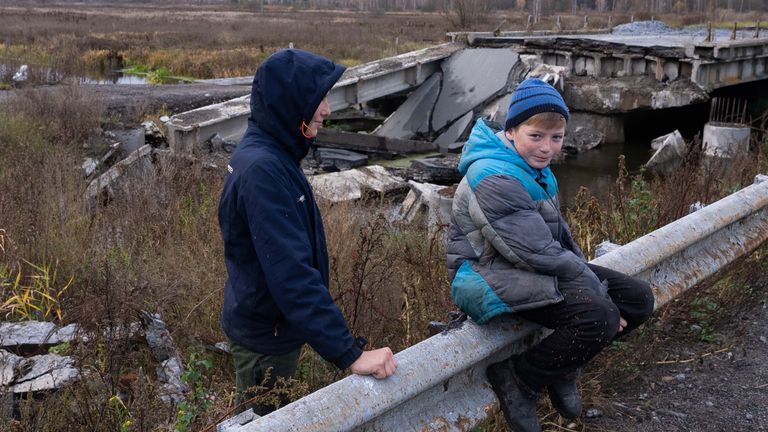
Much of the infrastructure around Horodnia hasn’t been repaired since the last assault by Russian troops
It is a lesson that came as a brutal shock to many people in this region, where Ukrainians, Belarusians and Russians have mixed for so many years. The nearest town to this border is Horodnia, which was the first to be taken by the Russians and the last to be relinquished.
They have rebuilt and repainted, but you can still see scars. A little out of town, we came down a rough road and found burnt out trucks, craters, shell casing and even an unexplored rocket lying in the woods.
‘No more brotherly Belarus, no more good Russia’
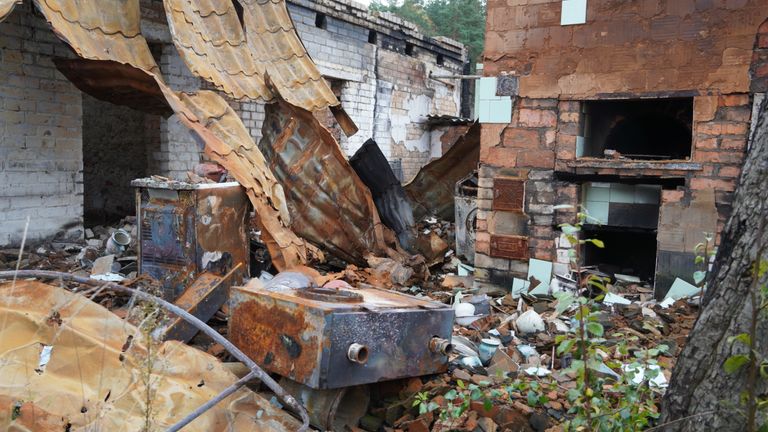
The houses bear witness to the violence. Oleksander and Olga remember it well. An explosion shook their house so violently that the ceiling fell in on their heads. “There are relatives of ours in Russia and everywhere but now the situation is such that we cheer exclusively for our country,” says Oleksander.
“There is no longer a friendly, brotherly Belarus, or a good Russia. There is only us and them – enemies. This is it.”
It is tempting to be intoxicated by this bravado. Certainly, Ukraine is a nation where resilience is armoured by a sense of grievance and the support of so much of the world. But it is also a nation whose heart has broken.
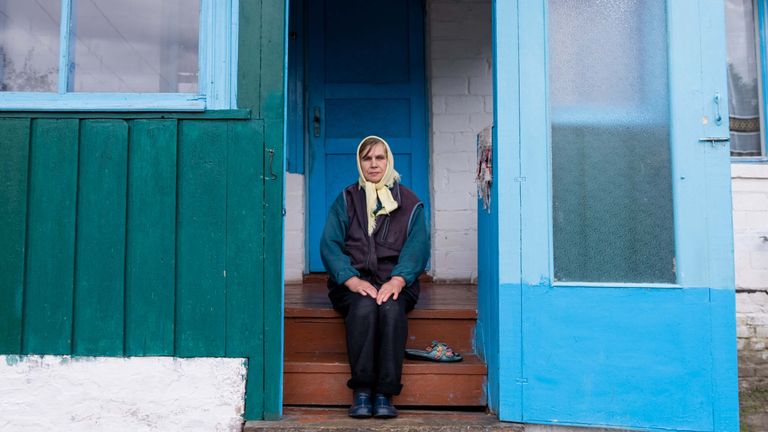
Nadia lives not far from the triple frontier between Belarus-Russia-Ukraine. She is Belarusian but lives in Ukraine
There is a house at the end of the street that is burnt out. It was bombed, caught fire and was remorselessly wrecked. Nadia watched all this happen from over the road, terrified. She raised the alarm, brought as much water as she could and then cried.
Not long after, her mother died.
Nadia is Belarusian but came here many years ago. Now she is fragile and scared, prepared to hide from another Russian invasion in the outside cellar where she keeps potatoes for the winter. But she fears it would simply collapse and seal her in.
“There is no rest for us here. My nerves are completely gone. What has Ukraine done to them? We have such great people here. They are peaceful people.
“So many people were killed. So many kids. So much grief.” And she weeps.

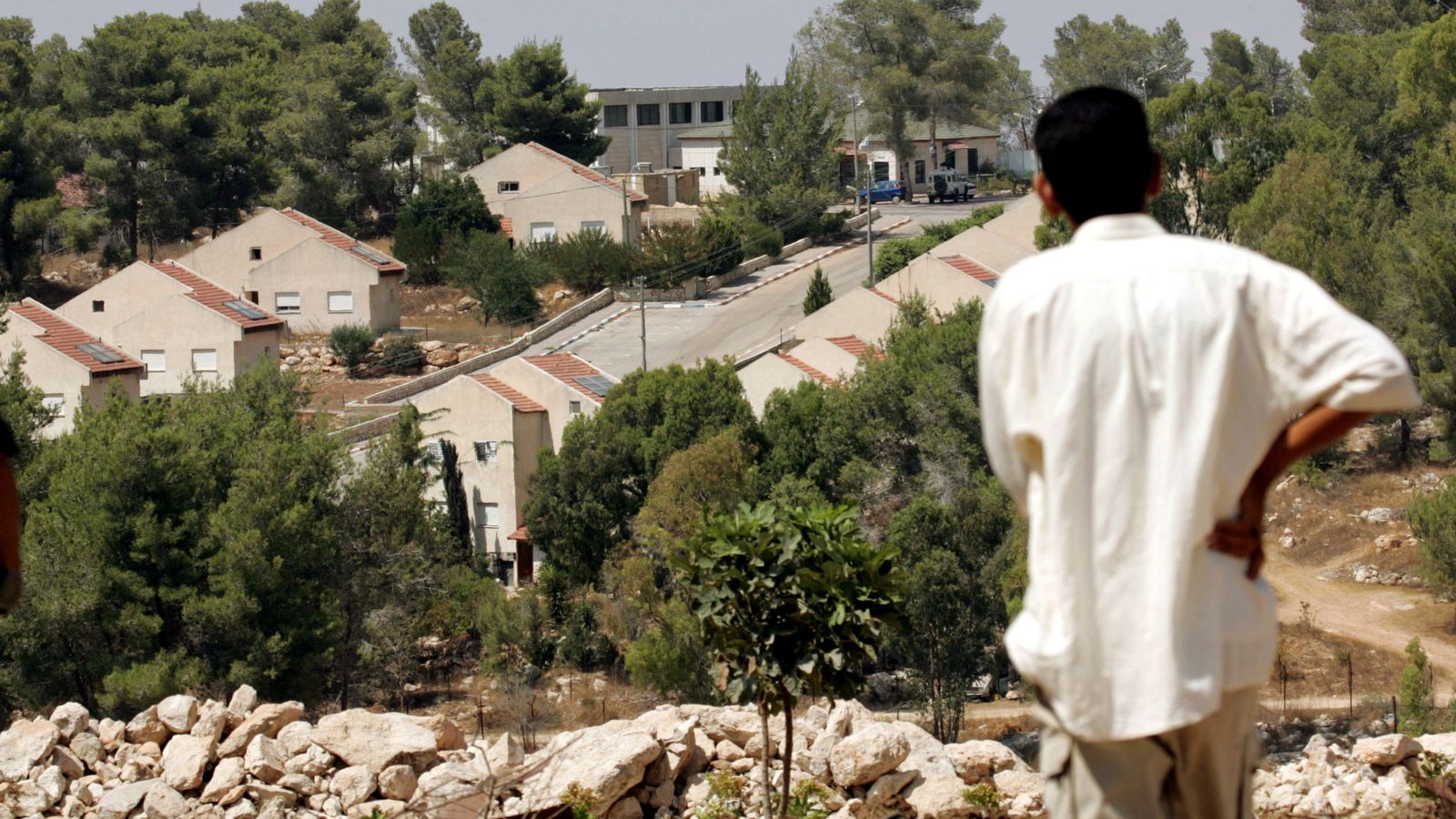
Israel has approved 19 new Jewish settlements in the occupied West Bank in a fresh blow to the possibility of a Palestinian state.
The move brings the number of new settlements over the past few years to 69, a new record, according to Israel‘s far-right finance minister Betzalel Smotrich.
Widely considered illegal under international law, the settlements have been criticised for fragmenting the territory of a future Palestinian state by confiscating land and displacing residents.
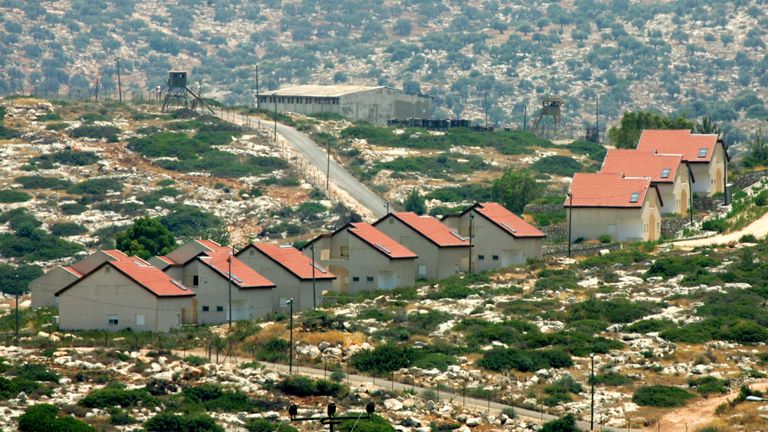
Ganim pictured in 2005. Pic: Reuters
Under Israel’s current government, figures show, the number of settlements in the West Bank has surged by nearly 50%, rising from 141 in 2022, to 210 with the new approvals, according to Peace Now, an anti-settlement watchdog.
The government’s latest action retroactively authorises some previously-established outposts or neighbourhoods of existing settlements, and the creation of settlements on land where Palestinians were evacuated.
It also approves Kadim and Ganim, two of the four settlements dismantled in 2005, and which Israelis were previously banned from re-entering as part of Israel’s withdrawal from the Gaza Strip.
Since Israel repealed the 2005 act in March 2023, there have been multiple attempts to resettle them.
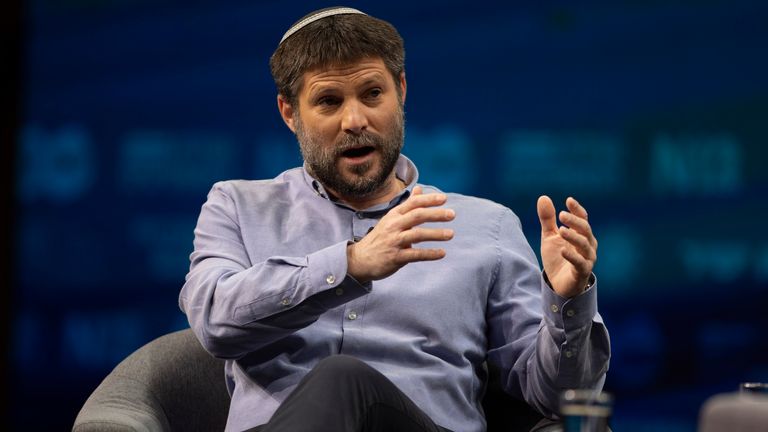
Betzalel Smotrich is among prominent names backing the settlements. Pic: AP
The move comes amid mounting pressure from the US to move ahead with the second phase of the Gaza ceasefire, which took effect on 10 October.
Mr Smotrich is one of a number of figures now prominent in Israel’s government who back the settlements.
The West Bank, east Jerusalem, and Gaza are claimed by the Palestinians for their future state, but were captured by Israel in the 1967 war.
Read more:
Analysis: Gaza longs for normality, but quasi-anarchy reigns
Two brothers killed in Israeli drone strike on Gaza
Today over 500,000 Jews are settled in the West Bank, in addition to over 200,000 in contested east Jerusalem.
Settlements can range in size from a single dwelling to a collection of high-rises, and the occupied territories are also host to a number of unauthorised Israeli outposts.
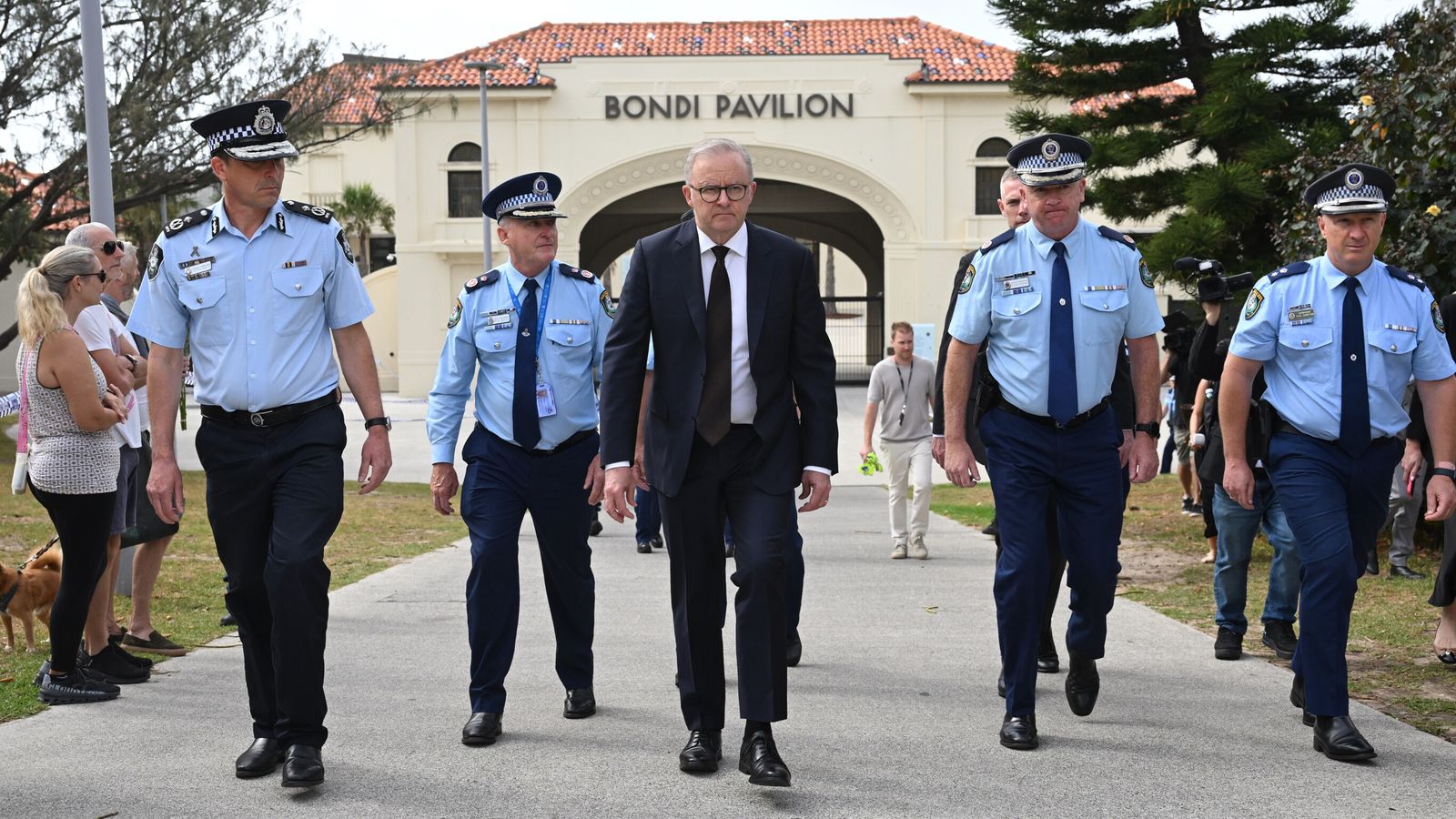
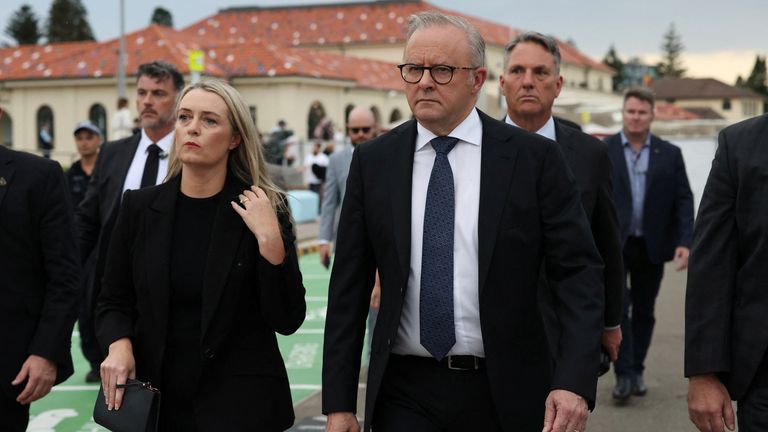
Australia’s prime minister was met with boos and insults when he arrived at a Bondi Beach vigil for victims of last week’s gun attack.
Prime Minister Anthony Albanese was booed when his name was announced on the stage set up in front of the crowd – amid anger that the premier hasn’t done more to tackle rising antisemitism in Australia.
In contrast, New South Wales Premier Chris Minns’s name was greeted with cheers and a standing ovation.
The premier was thanked for his leadership and for not missing “a funeral, synagogue service, or an opportunity to be with the Jewish community this week”.
Before going to the vigil, Albanese had announced a review of the country’s police and intelligence agencies a week after the deadly Bondi Beach gun attack.
Albanese said the review, led by a former chief of Australia’s spy agency, would probe whether federal police and intelligence agencies have the “right powers, structures, processes and sharing arrangements in place to keep Australians safe”.
The review comes as Australia marks a day of reflection to honour those killed and injured by two gunmen at Sydney’s Bondi Beach.
Authorities invited Australians to light a candle on Sunday evening, the start of the eighth and final day of the Jewish festival of lights, “as a quiet act of remembrance with family, friends or loved ones” of the victims.
Australia’s Prime Minister Anthony Albanese and his wife arrive at a Bondi Beach attack vigil
An evening memorial event at Bondi Beach will take place under a heavy police presence, including officers carrying long-arm firearms, police said in a statement.
A minute’s silence was also held at 6.47pm (7.47am UK time).
Earlier this week, around 700 people on paddle boards and surfboards took to the sea at Bondi Beach, forming a huge circle in a show of solidarity.
Gaps in the system
The attack exposed gaps in gun-license assessments and information-sharing between agencies that politicians have said they want to plug.
Albanese has announced a nationwide gun buyback, while gun safety experts say the nation’s gun laws, among the world’s toughest, are full of loopholes.
Authorities believe the gunmen were inspired by Islamic State.
“The ISIS-inspired atrocity last Sunday reinforces the rapidly changing security environment in our nation.
“Our security agencies must be in the best position to respond,” Albanese said in a statement, adding that the review would conclude by the end of April.
Albanese has been under pressure from critics who say his centre-left government has not done enough to curb a surge in antisemitism since the start of the war in Gaza.
Read more at Sky News:
US seizes another tanker off Venezuela
Engineer becomes first wheelchair user in space
The prime minister has since vowed to strengthen hate laws in the wake of the attack.
On Saturday, the government of New South Wales, which includes Sydney, committed to introducing a bill to ban the display of symbols and flags of “terrorist organisations”, including those of Islamic State, Hamas and Hezbollah.
Authorities say Islamic State flags were found in the car the attackers took to Bondi.
One of the alleged gunmen, Sajid Akram, 50, was shot dead by police at the scene.
His 24-year-old son Naveed Akram, who was also shot by police and emerged from a coma on Tuesday, has been charged with 59 offences, including murder and terrorism, according to police.
He remains in custody in hospital.
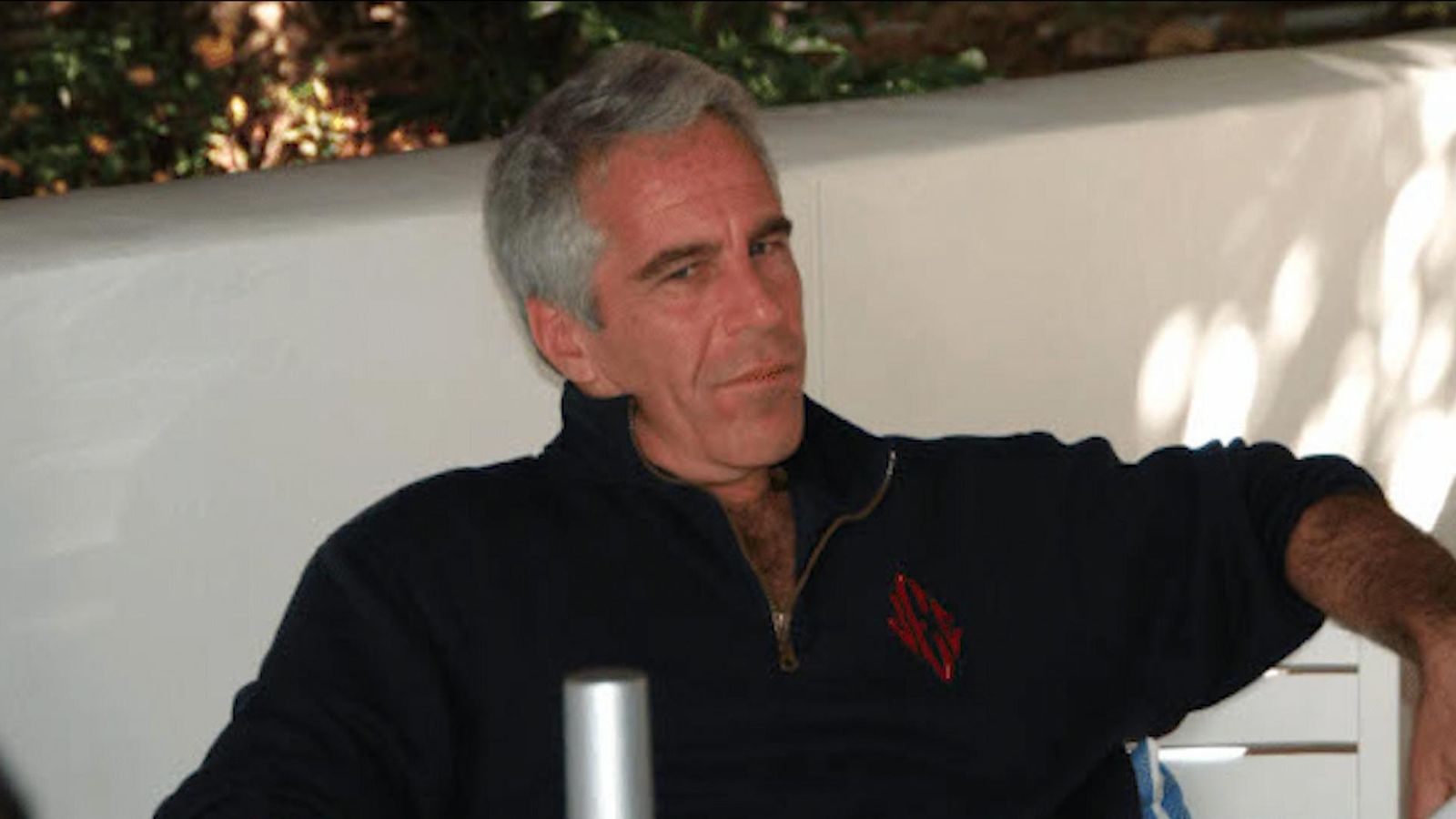
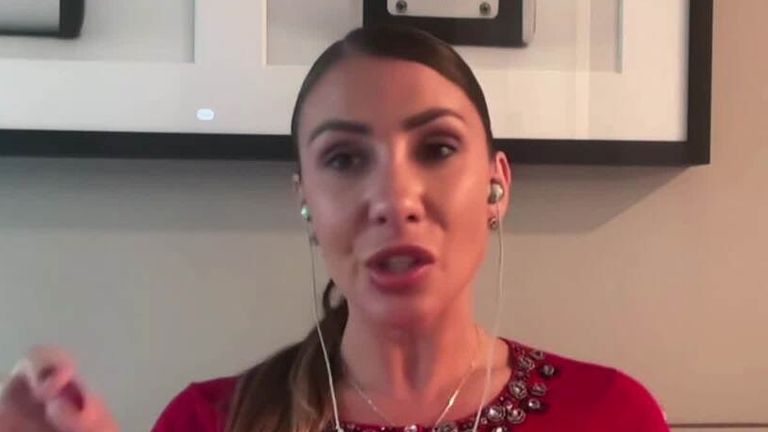
Several victims of Jeffrey Epstein have told Sky News that the incomplete release of the files relating to the dead paedophile financier have left them feeling shocked, outraged and disappointed.
Thousands of files relating to Epstein, who died in prison in 2019 while awaiting trial on sex trafficking charges, were made public late on Friday – but only a fraction of them have been released so far, with many heavily redacted.
‘Nothing transparent about release’
Marina Lacerda, a Brazilian-born survivor who suffered sexual abuse by Epstein as a teenager, expressed her disappointment over the incomplete release, calling it “a slap in our faces”.
“We were all excited yesterday before the files came out,” she told Sky News presenter Anna Botting.
“And when they did come out, we were just in shock, and we see that there is nothing there that is transparent. So it’s very sad, it’s very disappointing.”
Ms Lacera said she had just turned 14 when she met Epstein before “our relationship, our friendship I should say” ended when she was 17.
“At that point, he had made it very clear to me that I was old, that I was no longer fun for him. So, he booted me out, and I was no longer needed for him,” she said.
Epstein files – latest updates
The Department of Justice (DoJ) suggests that 1,200 victims and their families have effectively been shielded from view in the released documents.
Ms Lacera said: “From what I know, [the number of Epstein victims] is over a thousand, but that’s just what the DoJ can collect or the FBI can collect, but I presume there may be more than that.”
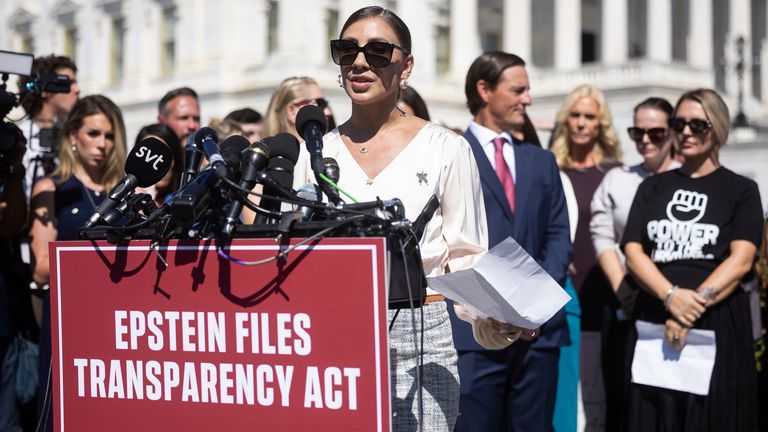
Marina Lacerda spoke outside the US Capitol in favour of the Epstein Files Transparency Act. Pic: AP
‘No way it’s not a cover-up’
Ashley Rubright met the late sex offender when she was just 15 in Palm Beach and was subject to abuse over several years.
Asked about her dissatisfaction with yesterday’s government release and if there was a sense of a cover-up operation, she noted that there had been knowledge of Epstein’s crimes “for so, so long”.
“There’s no way that there’s not a cover-up – what it is, I don’t know,” she told Sky News’ US correspondent James Matthews.
“I just hope that nobody’s allowed to fly under the radar with their involvement.”
Regarding the extent of the redactions, she said: “I’m so not shocked, but let down. Disappointed.
“Seeing […] completely redacted pages, there’s no way that that’s just to protect the victims’ identities, and there better be a good reason. I just don’t know if we’ll ever know what that is.
“We’ve been left behind since day one. That’s why I think we’re all fighting so loud now, because we’re tired of it.”

Ashley Rubright speaks at a rally in support of Epstein victims. Pic: Reuters
‘He wanted to man-handle me’
Another survivor, Alicia Arden, told Sky News that she met Epstein in a California hotel room in 1997 for an audition, when she was a 25-year-old model and actress.
“He let me in and he started looking over my portfolio, which is customary to do in a talent audition, and then he insinuated, ‘oh, you should come closer to me and let me see your body’,” she said.
Epstein then started “taking off my top and my pants and touching my rear end and my breasts”.
“He goes, ‘let me come over here and spin for me and let me man-handle you. Let me man-handle you.’ And I got very nervous and started to cry. I said, ‘I have to go, Jeffrey. I don’t really think this is gonna work out’,” Ms Arden said.
“He got a phone call and I was crying in front of him. And he said, ‘I have this beautiful girl in front of me and she’s very upset’. I said ‘I’m gonna leave’ and he offered me $100 and I said ‘I’m not a prostitute’.”
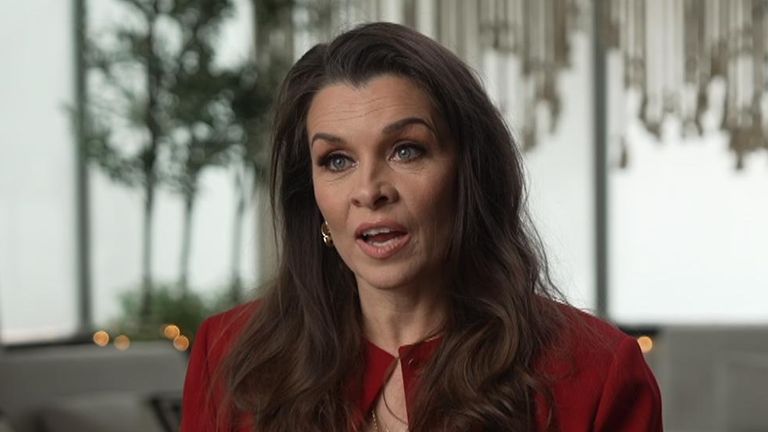
Alicia Arden
She said she went to the Santa Monica Police Department to file a report.
“That was as difficult, and I’m like shaking telling you, but as difficult as being in the hotel room with him because they weren’t supportive at all about it,” she said. Her redacted report was included in previous files.
‘Epstein was a monster’
Asked what she thought about Epstein now, she said: “He’s a monster […] and just horrible. I mean, I’m trembling thinking about him and talking about him.
“If I could do anything, I’m happy I got the police report filed. If they would have pursued him and maybe gone over the hotel [where he was] essentially living, then I could have maybe saved the girls. I’ve always thought that.”
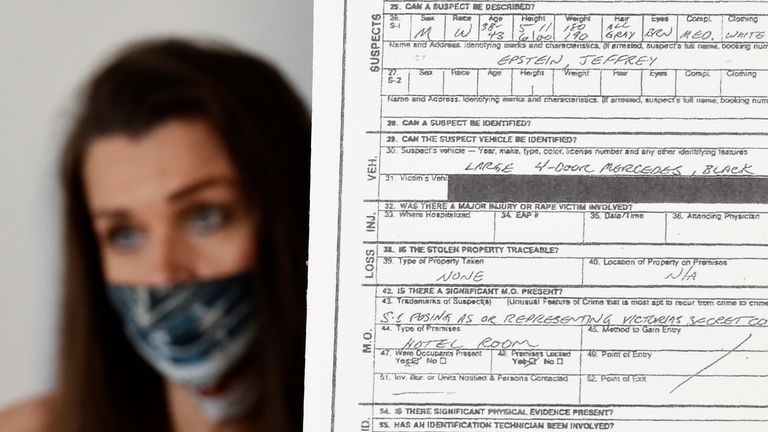
Ms Arden’s redacted police report. Pic: AP
Ms Arden does not believe she has seen justice as one of Epstein’s victims.
“I want to see all of the files come out. I want all of the men in there or women that were trafficking these girls, and they shouldn’t be able to walk around free and not pay for if they did something,” she said.
“They should be actually arrested if they’re in the files and it’s proven that they did horrible things to these girls, and they should lose their jobs, their lives, their homes, their money, and pay for what they did, and it was all supposed to come out, and it hasn’t.”
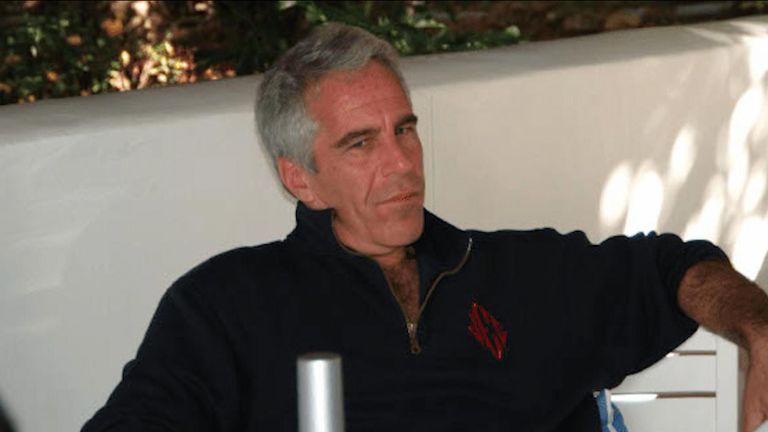
Jeffrey Epstein died in prison in 2019 while awaiting trial on federal sex trafficking charges
‘I feel redeemed’ by file release
Maria Farmer, who made a complaint to the Miami FBI in 1996 in which she alleged that Epstein stole and sold photos she had taken of her 12- and 16-year-old sisters, expressed gratitude for the release of the files.
“This is amazing. Thank you for believing me. I feel redeemed. This is one of the best days of my life,” she said in a statement through her lawyers.
“I’m crying for two reasons. I want everyone to know that I am shedding tears of joy for myself, but also tears of sorrow for all the other victims that the FBI failed.”

Annie Farmer holds a photo of herself and her sister, Maria Farmer, when they were victims of Epstein. Pic: AP
A positive-leaning reaction also came from Dani Bensky, who said she was sexually abused by Epstein when she was 17 years old.
She told Sky News’ US partner network NBC News: “There is part of me that feels a bit validated at this moment, because I think so many of us have been saying, ‘No, this is real, like, we’re not a hoax’.
“There’s so much information, and yet not as much as we may have wanted to see.”
‘It is not over’
Lawyer Gloria Allred, who has represented several Epstein victims, told Sky News about the partial release on Friday: “It’s very disappointing that all of the files were not released yesterday as required and, in fact, mandated by law.
“The law didn’t say they could do this over a period of time, it didn’t say that weeks could go by.”
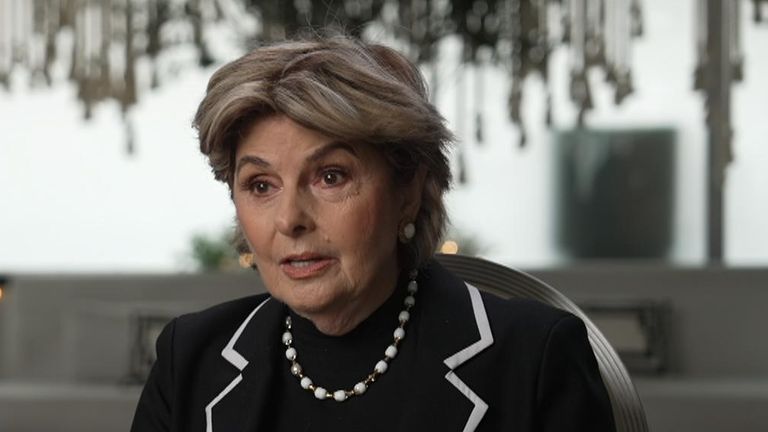
Lawyer Gloria Allred
Deputy attorney general Mr Blanche said additional file disclosures can be expected by the end of the year.
“But that’s not what the law says. So clearly, the law has been violated. And it’s the Department of Justice letting down the survivors once again,” Ms Allred said.
The lawyer labelled the incomplete release of the files a “distraction”, adding: “This is not over, and it won’t be over until we get the truth and transparency for the survivors.”
Read more:
Links between Epstein and UK revealed
Photos of Jeffrey Epstein’s circle among files
Writing on body seen in images released by Democrats
Trump, Clinton, Andrew and others seen in previous release
‘Only redactions required by law’
The tranche of material was released just hours before a legal deadline in the US following the passing of the Epstein Files Transparency Act – and at the same time as a US strike targeting Islamic State fighters in Syria.
The US deputy attorney general, Todd Blanche, said the justice department was continuing to review the remaining files and was withholding some documents under exemptions meant to protect the victims.
But Sky News’ James Matthews said the significance of the files “is undermined by the lack of context”, while some Democrats and Republicans criticised the partial release as failing to “comply with law”.
Meanwhile, the justice department has defended the redactions made in the released files.
“The only redactions being applied to the documents are those required by law – full stop. Consistent with the statute and applicable laws, we are not redacting the names of individuals or politicians unless they are a victim,” it quoted deputy attorney general Mr Blanche in a post on X.
The Trump administration has claimed to be the most transparent in history.
👉 Follow Trump100 on your podcast app 👈
In a statement, the White House claimed the release also demonstrated its commitment to justice for Epstein’s victims, criticising previous Democratic administrations for not doing the same.
But that statement ignored that the disclosures only happened because Congress forced the administration’s hand with a bill demanding the release, after Trump officials declared earlier this year that no more Epstein files would be made public.
-
 Sports2 years ago
Story injured on diving stop, exits Red Sox game
-
 Sports3 years ago
‘Storybook stuff’: Inside the night Bryce Harper sent the Phillies to the World Series
-
 Sports2 years ago
Game 1 of WS least-watched in recorded history
-
 Sports3 years ago
Button battles heat exhaustion in NASCAR debut
-
 Sports3 years ago
MLB Rank 2023: Ranking baseball’s top 100 players
-
Sports4 years ago
Team Europe easily wins 4th straight Laver Cup
-
 Environment3 years ago
Japan and South Korea have a lot at stake in a free and open South China Sea
-
 Environment1 year ago
Here are the best electric bikes you can buy at every price level in October 2024