
Rocking the Mullett: Tales from the Coyotes’ new home


TEMPE, Ariz. — Charles Lutz stood at the top of the student section at Mullett Arena, the college hockey rink that will house the NHL’s Arizona Coyotes for at least the next three seasons. Below him were Arizona State University students dressed like a pineapple, a banana and a character from “Squid Game,” undulating to the beat of a drum line that provided the soundtrack for the Coyotes’ home opener against the Winnipeg Jets on Friday.
“People say there aren’t Coyotes fans. Well, yes, Virginia: There are Coyotes fans,” Lutz said, surveying the 4,600 fans in attendance.
He was a “day one” Coyotes supporter: a season-ticket holder at American West Arena in Phoenix and then in Glendale, where the team played 18 years. That was before the city refused to renew the Coyotes’ arena lease, necessitating the move to Arizona State University’s brand-new Mullett Arena. While perfectly monikered for hockey, the arena was named for a family that has financially backed Arizona State’s Division I men’s hockey program.
“The entire history of the Coyotes is ‘Where will we be next?’ or ‘Where will we play?'” Lutz said. “I think this is finally the turning point in the Coyotes’ history.”
For a franchise that has had more turning points than a cornfield maze, the move to an NCAA-sized rink is the latest twist. It has inspired reactions from around the NHL ranging from second-hand cringing to intense curiosity.
“It’s different for us, different for the away teams, but it’s great,” Arizona forward Christian Fischer said. “You hear all the stuff [that] teams probably don’t want to come here, for whatever reason. Well, that’d be great for us. Let’s use that as motivation to make it damn hard to play here.”
What’s it like to experience hockey at the Mullett? We asked fans and players as the Coyotes opened their temporary home in Tempe.
The student section experience
Jackson Dunn was an exasperated banana.
The Arizona State University student had purchased tickets to the Coyotes’ first game against the Jets along with some friends. The team is selling between 250 and 400 student-section tickets each game for $25 apiece — an incredible bargain, given there isn’t another seat in Mullett that sells for less than $100.
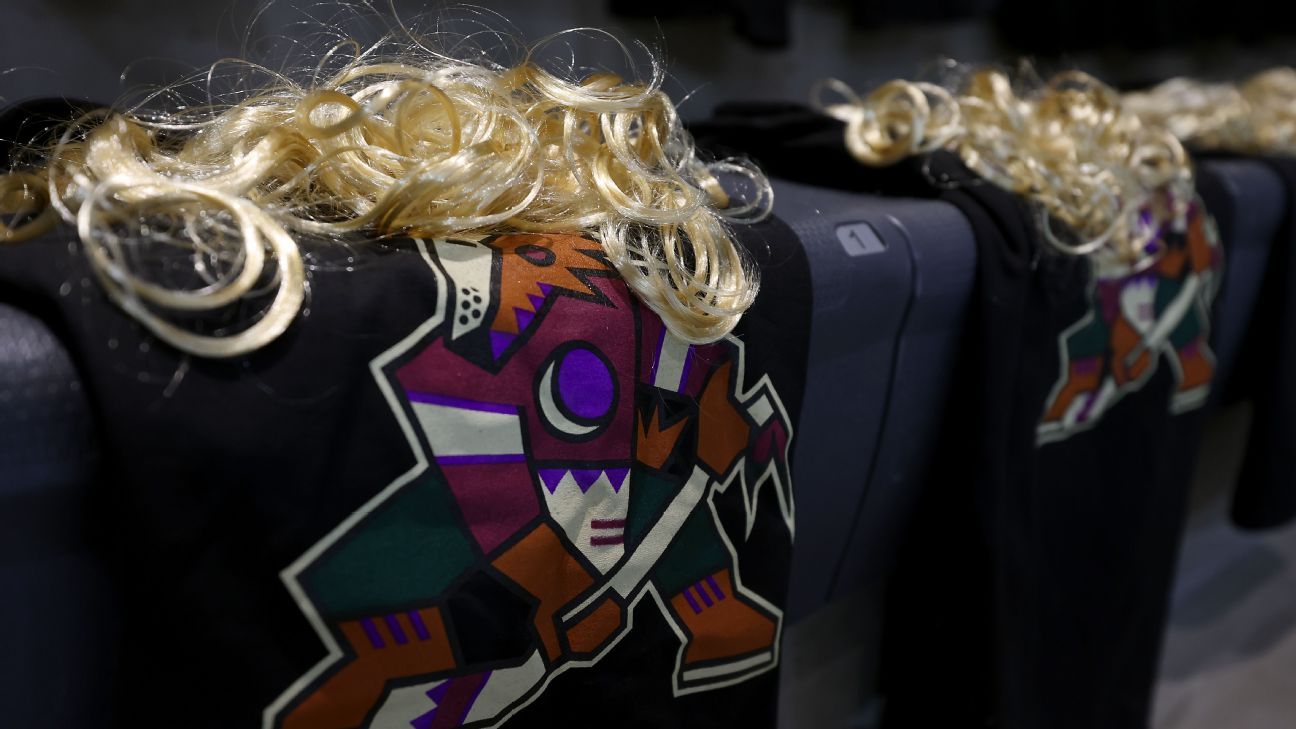
One friend was dressed like a penguin. Another like a pineapple. Dunn wore a sleeveless banana costume. All of them were rocking the commemorative mullets the Coyotes provided to each fan on opening night, with blonde hair cascading down the back, and “GO COYOTES GO!” and “YOU DO YOU” on the headband.
“First of all, I love the Minions. Their favorite food, in general, is a banana,” Dunn said, standing among fans who were wearing more jerseys than fruit. “Also, it’s Halloween [weekend] and we thought there would be more people in costume. But I guess not!”
Dunn is exactly the kind of fan the Coyotes find appealing at ASU: This was his first NHL game.
“I’m a Seattle Kraken fan. I’m brand-new to hockey. I’m not a Coyotes fan,” he said. “I went to the ASU game last week and it was a great atmosphere. The tickets are $25, so might as well.”
Coyotes president and CEO Xavier A. Gutierrez said the team expects to foster new fandom on campus.
“We have actually created something called Coyotes U, which has a specific student fan club in which they will have special-price tickets to be there,” he said. “We’ve wanted to expose hockey and our organization to the great students here. This is the largest public university in the country. We thought it was an incredible opportunity for us to bring them here, to have them be exposed and to make lifelong fans.”
In turn, the Coyotes get an infusion of youthful exuberance at each home game. Against the Jets, the student section started the game’s first “Let’s go Coyotes!” (pronounced “Kai-yotes”) chant and kept the energy going. The students imported some NCAA hockey game standards, chanting “You can’t do that!” on the game’s first penalty and “It’s all your fault” after Winnipeg goalie David Rittich surrendered the game’s first goal. They were whipped into a frenzy during T-shirt tosses.
Dunn and friends weren’t the only ones in costume in the student section. One of the drum line’s drummers watched a group of men dressed in matching checkered jumpsuits walk into the student section.
“That’s the dance team,” the drummer said.
“What’s the dance team?” I inquired.
“They’re a team and they have to dance. They have the music in them. Like how I have to play this drum,” he said, giving it a gentle wallop with his stick.
It turns out this was not, in fact, the dance team. It was a bachelor party from Boston, taking advantage of the low ticket prices to attend an NHL game while in Tempe.
Which is to say that not every fan seated in the student section was a student.
Mark Brezden, dressed in a suit jacket festooned with Jets logos, was seated with several Winnipeg fans. He didn’t know the fans giving him grief all game were mostly ASU students.
“Oh s—, is that what this is? The student section? I didn’t realize it until now,” he said, laughing.
Brezden explained that he has used the same Arizona ticket rep for the past 10 years when he and his friends would travel down from Winnipeg for games. “They’ve been good for us,” he said.
Fans of Canadian NHL teams would always populate the stands at Coyotes games in Glendale. Some fans in attendance at Mullett Arena wondered what the crowds would look like when teams like the Toronto Maple Leafs visit Tempe — how many of those 5,000 seats would contain visiting jerseys?
“The reality is Canadians love hockey,” Gutierrez said with a laugh, “and this is the second-largest Canadian snowbird market in the country. As a result, we have a lot of Canadian fans here and we welcome them — as long as they cheer for the Coyotes.”
When asked what they thought of the arena, Brezden exchanged an awkward glance with his friend and fellow Jets fans Ron Burley.
“I mean, it’s a means to an end, right?” Burley said. “There’s something bigger coming.”
The die-hard experience
Before the game, Lutz joined around 100 Coyotes fans outside Mullet Arena for a fanfest that included a DJ, a face painter and a “red carpet” arrival for players.
He was wearing a Robert Esche jersey, a goalie who last played for the then-Phoenix Coyotes in 2002. The front of his sweater was a sea of commemorative pins. He pointed to two of them that identify him as a “day one” Coyotes fan in their inaugural season. They were located near a red heart with the words “I’m special” in Braille that he wears in honor of his daughter, who is blind.
“I love this [arena], because it’s going to keep us in Arizona until the new arena gets built,” he said.
Like many of the fans outside the student section, Lutz was a season-ticket holder in Glendale whose seats were transferred to ASU.
“It was easy. They did the best they could to find your seats,” he said. “We were upper level, and as you can see, there really is no upper level here.”
The average ticket price at Mullett Arena is $170, $16 above the league average. It was about $90 for an average ticket in Glendale.
“We’re paying a few shekels extra. I had to sell my spleen and kidney, but I made it happen,” Lutz said with a laugh.
The longtime Coyotes fans with whom we spoke expressed concerns about ticket prices and the lack of accoutrements one finds in larger arenas. But uniformly, they all praised one thing: the geographical advantages of playing in Tempe.
The Coyotes’ first season in Tempe marks the first time Tim McKinstry will be a season-ticket holder. He has been a fan of the team for years but cited the same issue many have cited for the Coyotes’ failure to attract big crowds in Glendale: For 18 years, they played in an arena located a significant distance from their fan base.
“It would take me an hour to get to Glendale. I rode my bike here,” McKinstry said.
He said he’s “excited but a little bit nervous” about the team’s plans for a new arena in Tempe.
After Glendale opted not to renew the Coyotes’ lease at what’s now known as Desert Diamond Arena, they needed a new home. They entered into negotiations with Arizona State University to potentially share the Sun Devils’ men’s hockey team’s new arena while seeking to build their own building and entertainment complex in Tempe.
A vote from the city council will come on Nov. 29. Craig Morgan of PHNX Sports reports that the Tempe City Council is likely to refer the Coyotes’ arena and entertainment district proposal to referendum, leaving a vote in citizens’ hands.
“Sometimes the city makes deals and it ends up costing the taxpayers a little bit of money,” McKinstry said. “Overall, it’s promising. I guess we’ll see what happens.”
The Shane Doan experience
No one played more games (1,540), scored more goals (402) or tallied more points (972) as a Coyote than Shane Doan. The 21-year NHL veteran, who last played in 2017, was the Coyotes’ chief hockey development officer before taking a step back from the role before the season.
What would Shane Doan, the player, think about calling Mullett Arena home?
“You know what? It’s cool. It’s a unique experience that you don’t get very often,” he said. “It takes you back a little bit to where you played junior and where you played in college. And this is a great college or junior rink.”
Doan’s favorite aspect of the Mullett experience: Having fans right on top of the players.
“It’s going to be something that the fans won’t normally get to experience [at an NHL game],” he said. “They’re going to get to see some of the great players on the ice that are a level that you never get to see. And then you get to see all of our fans up close and personal.”
“It’s going to be a little more intimate. Everyone is going to see the reactions on the bench. You might even hear some people’s reactions. That’ll be fun,” Doan added. “We’ll see how it all works out. It’s going to be something that people talk about.”
As a player and an executive, he has seen some … let’s call it “stuff” through the years with this organization.
“What?” he said, laughing. “Nah, what are you talking about?”
Hypothetically, had someone told Doan several years ago that the Coyotes would be kicked out of Glendale and playing in a college hockey arena in Tempe, how would he have reacted?
“If you think that you can predict what’s going to happen, that’s usually when you’re a fool,” he said. “This has been an adventure. We’re trying to keep her going. The end goal is what we’re focused on. If we can get to that, then it’ll all have been worth it.”
Doan played a key role in the opening night festivities. He dropped the ceremonial first puck with his son Josh, an Arizona State player who was drafted in the third round last year by the Coyotes. Josh Doan actually flew from Las Vegas for the event before rejoining the Sun Devils on the road.
“He’s a huge fan of the Coyotes. Obviously getting drafted by them is crazy and unique,” the elder Doan said. “To have an opportunity to take part in something like this, in what’s sort of his building, it’s special.”
There’s no “sort of” about it: Mullett Arena is the home of the Sun Devils, and the Coyotes are temporary tenants. The ASU hockey logo is on every seat. There’s a giant “FEAR THE FORK” slogan on the wall behind one net.
“Personally, I never thought [this] would happen. The building was designed for Arizona State hockey and college hockey,” said Greg Powers, head coach of the ASU hockey team. “But I was selfishly excited about what this does for our program. You can’t walk into that arena and not know that it [belongs to] Arizona State. Our brand is going to get out there. That’s good for us.”
The relationship between the teams hasn’t been completely harmonious. The Coyotes are scheduled to play four home games, after six on the road to open the season, prior to the completion of an annex next to the arena. That building will house NHL-quality dressing rooms and other facilities. But for these first four games, the Coyotes are using the visiting locker rooms as their dressing area, while road teams are getting geared up in a temporary dressing room built on top of an adjoining ice rink in the building.
In other words, the Coyotes aren’t using the Sun Devils’ locker room.
“There are some NCAA compliance concerns with rubbing elbows with [NHL players], literally sharing a locker room,” Powers explained. “But for my standpoint, most importantly, you’re getting into this whole musical chairs thing, and that’s something I’m not interested in.
“They’re not going to take the building with them. When they leave, they’re going to leave behind a beautiful building with two pro dressing rooms and offices, a medical facility and some workout rooms.”
The visiting players’ experience
Winnipeg Jets defenseman Nate Schmidt was college roommates with Coyotes forward Nick Bjugstad and faced off against him in a college rink on Friday night as NHL players.
“I had a hell of a time in college. I’m a little too old to go back. Don’t have any eligibility left,” Schmidt joked. “You know, they’re making the best out of a tough situation here.”
While the annex is being completed, the visiting locker room at Mullett Arena consists of a few lines of weathered lockers contained within temporary walls, all of it atop an ice rink covered in black rubber mats. Some on social media likened it to a Nathan Fielder “rehearsal” of an NHL game, and it’s an apt comparison.
“It’s different. The ground is cold from being on top of the ice. When you take your shoes off, it’s a little chilly on the feet,” Winnipeg rookie Cole Perfetti said. “But we knew it was temporary. We knew what we were coming into. It’s unique. It’s pretty cool to be the first team to ever be a part of this. It’s weird. But it’s cool.”
From a game-play perspective, the visiting Jets echoed the comments made by Coyotes players leading up to the game: The boards were lively and the ice was tremendously fast.
“I think you go out there for pregame skate, and within your first 10 strides you know,” Arizona’s Fischer said. “When you go play in Edmonton you just step out for warm-ups and you’re flying out there for whatever reason. There’s also other places that’s not that case, and you notice that pretty quickly. I’d be curious to know how the Jets feel, but from our standpoint, we haven’t had the greatest ice here in the past couple of years, so that’s probably why you’re hearing that the most.”
How did the Jets feel?
“The ice was great. It was unbelievable. Even for warm-ups,” Perfetti said. “Coming from L.A. last night where the ice … well, it wasn’t the best. We were fighting the puck a little bit. But this ice was great. The boards were great. It was awesome.”
One interesting aspect of the Mullett Arena experience: Adjusting to the size of the rink.
“Everything felt tiny in the first period. Everything just felt congested and small,” Schmidt said. “Maybe because there’s no upper deck, I don’t know. It all felt very tight and then it settled down as the game went on.”
Blake Wheeler, who scored the winner in overtime, said the arena experience felt different.
“Five thousand people, man. It’s all right,” he said.
Did it remind Wheeler of his college days skating for Minnesota?
“I played in front of 10,000,” he said, smiling. “All in all, it was made out to be much worse than it was. As long as you’ve got a spot to put your gear on and talk about the game, it really is a beautiful college hockey rink. I’ve played in worse arenas, that’s for sure.”
The Coyotes players’ experience
As they left the ice on opening night, the Coyotes were cheered by the remaining fans in the student section. To the outside, it was a crowd of 4,600 fans, with capacity slightly reduced due to television broadcast and media overflow needs. To an Arizona player, it was something they rarely had in Glendale: a sellout.
“Just to see a full building, it’s a new chapter of hockey here, being in Tempe,” Coyotes star forward Clayton Keller said. “Hopefully they keep showing up.”
GM Bill Armstrong believes they will. The Coyotes aren’t expected to be contenders. Armstrong has acknowledged the importance of highly drafted players in ultimately building a winner in the desert. But he also wants his team to exhibit a work ethic that lays the groundwork for future success, while connecting with fans now.
“I think we can have a special flavor here. We’re a physical team. We’re a grinding team. I would like to think we’re one of the hardest-working teams in the National Hockey League,” Armstrong said. “If you come to see us play, you’re gonna get your money’s worth. And when you come to see us in this building, you’re gonna have one of the best seats in the NHL.”
Many of the Coyotes players on the current roster won’t be there when the team moves into its next home. But for now, they appreciate the uniqueness of their temporary home, especially as it compares to their previous one.
“I thought the energy of the crowd was great. Something that we’ve missed as players, especially guys that have been here for a while,” Fischer said. “It’s a fun place to play. There’s a lot of noise about the outside and the details of it, but we’re playing a hockey game. It’s loud, and the fans are cheering for us, that’s all we really care about. It’s a cool little rink.”

-
Mark Schlabach
Indiana quarterback Fernando Mendoza, who led the No. 1 Hoosiers to a perfect 13-0 record and their first Big Ten title since 1967, captured the 91st Heisman Trophy on Saturday night.
Mendoza beat out quarterbacks Diego Pavia (Vanderbilt) and Julian Sayin (Ohio State) and running back Jeremiyah Love (Notre Dame) to take home the trophy during a ceremony in New York.
Mendoza, who played two seasons at California before joining the Hoosiers this season, completed 71.5% of his pass attempts for 2,980 yards with 39 total touchdowns.
He was only the second Heisman Trophy finalist from Indiana. Running back Anthony Thompson was runner-up to Houston quarterback Andre Ware in one of the closest votes in 1989.
With Mendoza, Pavia and Love expected to move on to the NFL after this season, who are the top returning Heisman Trophy candidates for 2026?
In compiling the list of potential candidates, I projected that quarterbacks John Mateer (Oklahoma), Ty Simpson (Alabama) and Dante Moore (Oregon); receivers Carnell Tate (Ohio State), Zachariah Branch (Georgia) and Makai Lemon (USC); and running back Emmett Johnson (Nebraska) will turn pro (along with the aforementioned finalists from this year).
Here is a look at some of the top potential contenders (in no particular order):


2025 stats: 80 catches, 1,086 receiving yards, 12 total touchdowns
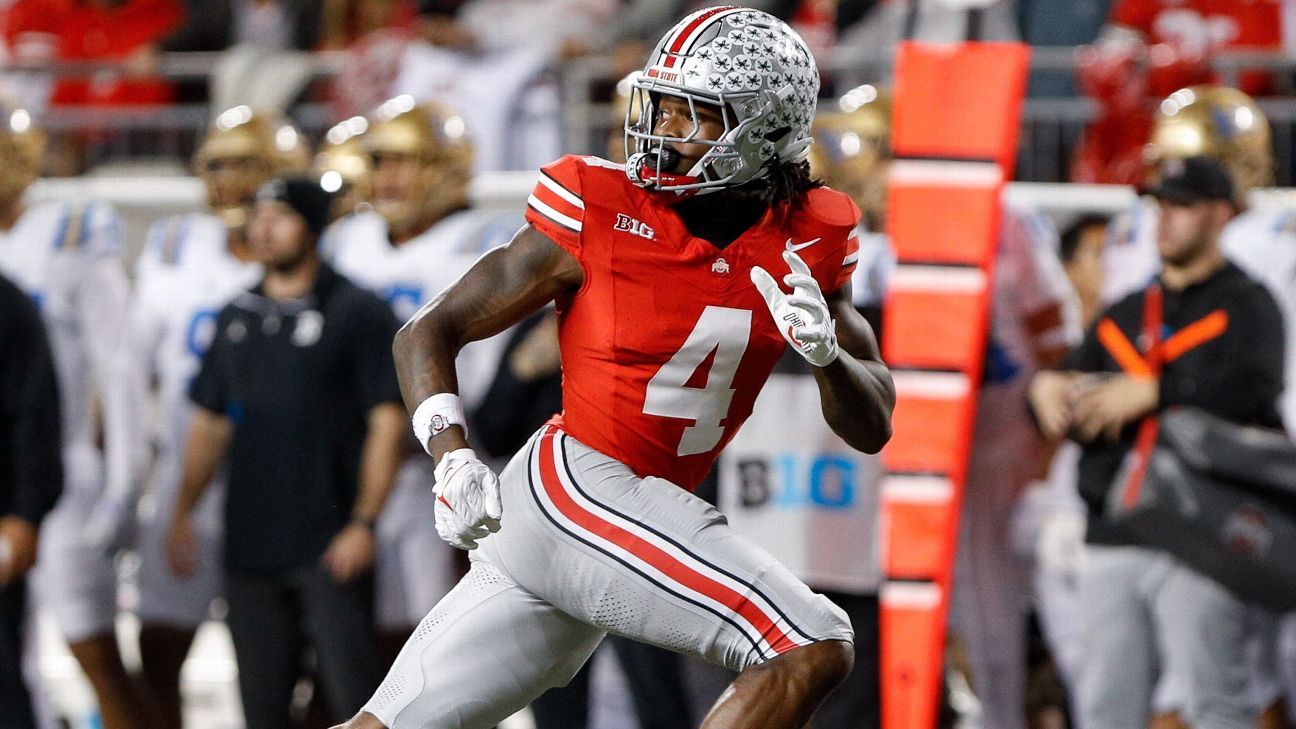
Smith’s highlight reel of acrobatic, one-handed catches continues to grow, and he arguably has been the best player in college football this season. He was the fastest Buckeyes player to reach career marks of 2,000 receiving yards (24 games), 100 catches (20) and 25 touchdown receptions (25).
2025 stats: 78.4% completion pct, 3,323 passing yards, 31 touchdowns, 6 interceptions
Sayin might have captured the Heisman Trophy this season if Ohio State’s offense hadn’t flopped in its 13-10 loss to Indiana in the Big Ten championship game. In his first season as a starter, Sayin is on pace to break the NCAA single-season pass completion record of 77.4%, set by Oregon’s Bo Nix in 2023.

2025 stats: 70.7% completion pct, 2,691 passing yards, 442 rushing yards, 31 total touchdowns
In his first full season as Georgia’s starting quarterback, Stockton helped guide the Bulldogs to a 12-1 record and SEC title. His legs and right arm were a big reason the Bulldogs averaged 31.9 points, despite enduring myriad injuries on the offensive line. Stockton was at his best when the game was on the line — he completed 86% of his passes with 11 touchdowns and one interception in the fourth quarter against ranked opponents.

2025 stats: 84 receptions, 970 receiving yards, 7 receiving touchdowns
Toney’s teammates call him “Baby Jesus,” and the true freshman delivered in a big way in his first season with the No. 10 Hurricanes. He ranks sixth in the FBS with 84 catches and had 1,328 all-purpose yards. Toney even threw for two scores. Not bad for an 18-year-old who would be a senior in high school if he hadn’t reclassified to the class of 2025.

2025 stats: 61.4% completion pct, 2,942 passing yards, 32 total touchdowns
Even after all the hand-wringing about Manning being overrated at the start of the season, the former five-star recruit ended up putting together a good campaign, throwing for 2,942 yards with 24 touchdowns. The No. 13 Longhorns need to find some offensive linemen (he was sacked 23 times) and receivers to help him in 2026.

2025 stats: 65.5% completion pct, 3,016 passing yards, 24 total touchdowns
Ole Miss officials have submitted a waiver to the NCAA on Chambliss’ behalf for another season of eligibility. He played his first three seasons at Division II Ferris State before transferring to Ole Miss this year. He was named SEC Newcomer of the Year after taking over the starting job in the third game of the season.

2025 stats: 1,560 rushing yards, 16 touchdowns
A transfer from Louisiana-Monroe, Hardy led the FBS with 130 rushing yards per game and was No. 2 with 1,560 total rushing yards. He had eight 100-yard games for the Tigers, including a whopping 300-yard effort with three touchdowns in a 49-27 victory against Mississippi State on Nov. 15.

2025 stats: 61.8% completion pct, 2,932 passing yards, 466 rushing yards, 31 total touchdowns
Reed announced this week that he plans to stay at Texas A&M next season, which is great news for the No. 7 Aggies. He was a threat with the ball in his hands, throwing for 2,932 yards with 25 touchdowns and running for 466 yards with six scores. His decision-making needs to continue to improve, so he can cut down on his 10 interceptions.

2025 stats: 63.6% completion pct, 3,117 passing yards, 20 total touchdowns
There’s a reason new Bears coach Tosh Lupoi took a late-night flight to Hawai’i to make sure Sagapolutele was staying at Cal. He was only the second true freshman in FBS history to pass for 200 yards or more in each of his first 11 starts. In the Bears’ late-season upsets of then-No. 21 SMU and No. 15 Louisville, Sagapolutele passed for a combined 653 yards with six touchdowns and no picks.
2025 stats: 1,279 rushing yards, 20 touchdowns
After transferring from Missouri, Lacy helped the No. 6 Rebels win 11 games in the regular season for the first time. He ranks No. 2 in the FBS with 20 rushing touchdowns and piled up 1,279 yards on the ground. Will he follow former coach Lane Kiffin to LSU or remain with the Rebels in 2026?

2025 stats: 66.2% completion pct, 3,431 passing yards, 29 total touchdowns
If Maiava returns to the No. 16 Trojans for another season, he’ll probably flourish in Lincoln Riley’s offense. This year, he threw for 3,431 yards with 23 touchdowns and 8 interceptions. He ranks No. 1 with a 91.2 total QBR. According to Pro Football Focus, he was second in the FBS with 26 big-time throws. (A big-time throw is defined as a high-difficulty, high-value pass.)
2025 stats: 1,035 rushing yards, 6 total touchdowns
Jackson became the fifth true freshman in OSU history to produce a 1,000-yard season, joining Robert Smith (1990), Maurice Clarett (2002), JK Dobbins (2017) and TreVeyon Henderson (2021). That’s good company. And, of course, he’d be the second Bo Jackson to collect a stiff-armed trophy.

2025 stats: 70.2% completion pct, 4,129 passing yards, 36 total touchdowns
Mestemaker is one of the best stories in college football. He didn’t start a single game in high school, then joined North Texas as a walk-on. This season, he led the FBS with 4,129 passing yards, helping him capture the Burlsworth Trophy as the top walk-on in the country. Will he join former Mean Green coach Eric Morris at Oklahoma State in 2026?

CJ Carr, QB, Notre Dame
2025 starts: 66.6% completion pct, 2,741 passing yards, 24 touchdowns
Fighting Irish coach Marcus Freeman entrusted Carr to lead his offense after a heated battle in preseason camp. The decision paid off, as Carr put together one of the best performances by a first-time starter in Notre Dame history. He threw for at least one touchdown in each of his first 12 starts, becoming the first Irish player to do that since Everett Golson in 2012-14. Carr’s 24 passing touchdowns are tied for the most in the first 12 starts by a Notre Dame player since 1966.

2025 stats: 70% completion pct, 2,850 passing yards, 595 rushing yards, 27 total touchdowns
Williams is one of the best dual-threat quarterbacks in the FBS, and his ability to run and throw was on display in the Huskies’ 38-19 victory against Rutgers on Oct. 10. He became the first player in school history to pass for at least 400 yards (400) and run for at least 100 (136) in the same game. Williams was second on the team with 595 rushing yards.
Others to watch: Sam Leavitt, QB, TBA; Cam Coleman, WR, Auburn; Brendan Sorsby, QB, Cincinnati; Josh Hoover, QB, TCU; Darian Mensah, QB, Duke; Nate Frazier, RB, Georgia; LJ Martin, RB, BYU; Bear Bachmeier, QB, BYU; LaNorris Sellers, QB, South Carolina; Bryce Underwood, QB, Michigan

-
Adam Rittenberg
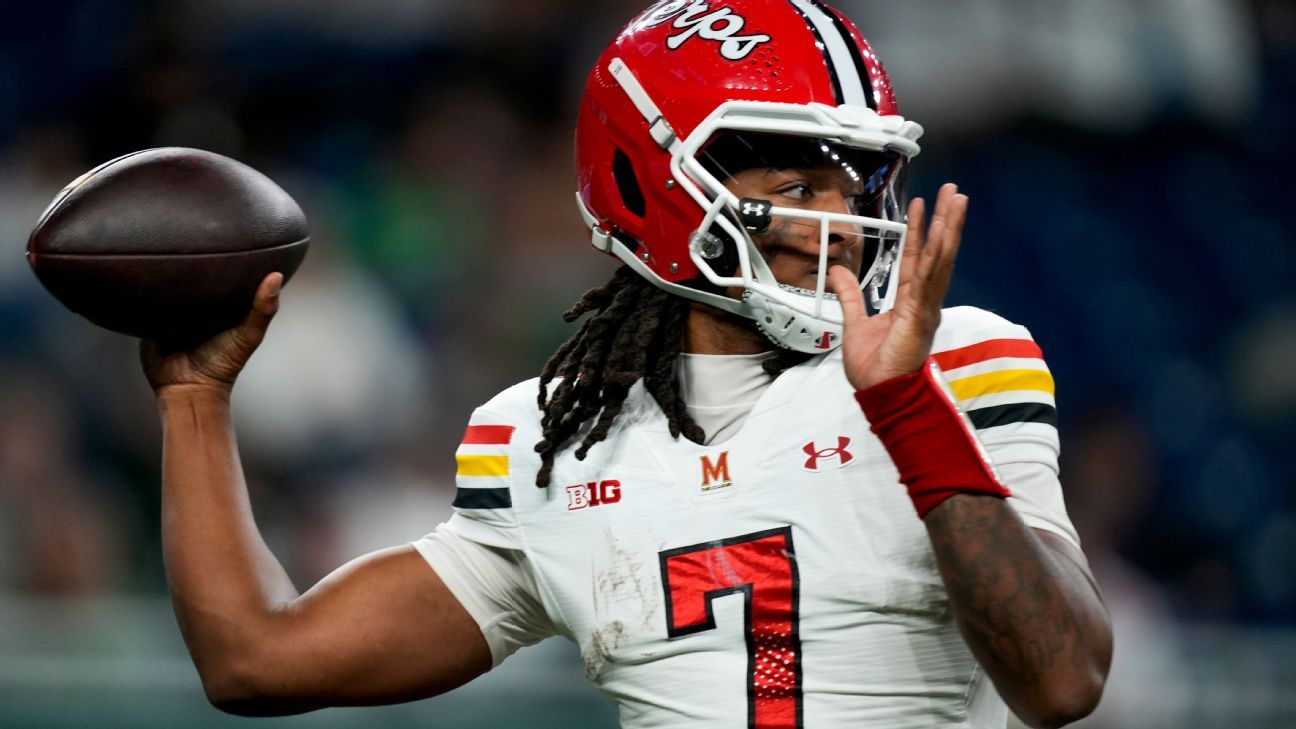
Maryland quarterback Malik Washington, who set the team’s freshman passing record this fall, will return to the Terrapins for the 2026 season.
Washington set Maryland freshman records for passing yards (2,963) and completions (273) this season, while connecting on 17 touchdown passes. He reached 200 passing yards in all but one game and finished as just the second Big Ten freshman since 1996 to record at least 2,500 passing yards and at least 300 rushing yards.
“Representing this team, this area, means so much to me and my family,” Washington said in a statement Saturday. “This is home and we’re going to continue keeping the best athletes from this area here with the Terps. I believe in everyone in our facility and I know we’re building something that our fans will be excited about for years to come.”
Washington, the nation’s No. 134 recruit in the 2025 class, grew up in Severn, Maryland, about 30 miles from Maryland’s campus. Despite a 4-8 record that included only one Big Ten win, Maryland announced that coach Mike Locksley, who recruited Washington, would return in 2026. Locksley will enter his eighth season as Maryland’s coach.
“Malik is a Terp through and through and I’m thrilled he’s coming back to lead this football team,” Locksley said in a statement. “He means so much to this area and this area means so much to him. What we saw from Malik this past season is only the tip of the iceberg. He has such a bright future and he’s already started putting the work in towards the 2026 season.”

-
 Sports2 years ago
Story injured on diving stop, exits Red Sox game
-
 Sports3 years ago
‘Storybook stuff’: Inside the night Bryce Harper sent the Phillies to the World Series
-
 Sports2 years ago
Game 1 of WS least-watched in recorded history
-
 Sports3 years ago
Button battles heat exhaustion in NASCAR debut
-
 Sports3 years ago
MLB Rank 2023: Ranking baseball’s top 100 players
-
Sports4 years ago
Team Europe easily wins 4th straight Laver Cup
-
 Environment3 years ago
Japan and South Korea have a lot at stake in a free and open South China Sea
-
 Environment1 year ago
Here are the best electric bikes you can buy at every price level in October 2024