

AMD misses but still ekes out 29% revenue growth

AMD President and CEO Lisa Su speaks during an AMD event at CES in Las Vegas on Jan. 6, 2020.
Bridget Bennett | Bloomberg | Getty Images
Advanced Micro Devices shares rose as much as 3% in extended trading on Tuesday after the chipmaker announced earnings and quarterly guidance that failed to meet Wall Street’s expectations
Here’s how the company did:
- Earnings: 67 cents per share, adjusted, vs. 68 cents per share as expected by analysts, according to Refinitiv.
- Revenue: $5.57 billion, vs. $5.62 billion as expected by analysts, according to Refinitiv.
Overall, AMD’s revenue grew by 29% year over year in the fiscal third quarter, which ended Sept. 24, according to a statement. Net income fell 93% to $66 million, mainly because of AMD’s $49 billion acquisition in February of Xilinx, a maker of chips called field-programmable gate arrays.
On Oct. 6, AMD issued preliminary results for the fiscal third quarter that lagged guidance it provided in August, given fewer chip shipments because of a weaker PC market than expected. The stock fell almost 14% in its largest decline in a single trading session since March 2020.
With respect to guidance, AMD said it sees $23.50 billion in full-year revenue, down from the $26.3 billion forecast the company gave in August. Analysts polled by Refinitiv had expected $23.88 billion. The company contracted its adjusted gross margin outlook to 52% from 54% in August.
AMD said its Data Center segment generated $1.61 billion in revenue in the fiscal third quarter, up 45% and slightly below the StreetAccount consensus of $1.64 billion. The unit includes contributions from Xilinx and distributed computing startup Pensando, which cost AMD $1.9 billion in an acquisition completed in May.
The chipmaker has seen healthy demand for shipments of its server chips that carry the code name Genoa. AMD plans to launch Epyc data center chips on Nov. 10.
The data center business “at least for now, looks decent, and quite a bit better than what’s going on with Intel,” said Stacy Rasgon, senior semiconductor analyst at Bernstein, in an interview on CNBC’s “Closing Bell: Overtime” after AMD announced its results. “There’s a lot of uncertainty about what they were going to say about data center, particularly in the wake of Intel’s report where Intel had called for the market to decline in Q4. This is probably why the stock is up now. The guide itself is quite weak, but it seems likely that it’s isolated to PCs.”
The Gaming segment produced $1.63 billion in revenue. That was up about 14% and in line with the $1.63 billion consensus among analysts surveyed by StreetAccount. The company touted healthy demand for console chips as the holidays approach for Microsoft and Sony.
The Embedded segment that includes some Xilinx sales delivered $1.30 billion, up from $79 million in the year-ago quarter and in line with the $1.30 billion StreetAccount consensus.
AMD’s Client unit, which the chipmaker had warned about in October, came up with $1.02 billion in revenue. That was down nearly 40% but in excess of the $1.17 billion StreetAccount consensus. Four days after AMD gave preliminary results, technology industry researcher Gartner said third-quarter PC shipments fell 19.5%, the steepest decline the company has seen since it started following the market in the mid-1990s. During the quarter AMD announced Ryzen 7000 desktop PC chips, and AMD pointed to positive reviews of the products.
All four of the segments delivered slightly more revenue than AMD had said to expect in its October warning.
Notwithstanding the after-hours fluctuation, AMD stock has slipped 58% so far this year, while the S&P 500 index is down 19% over the same period.
Executives will discuss the results with analysts on a conference call starting at 5 p.m. ET.
This is breaking news. Please check back for updates.
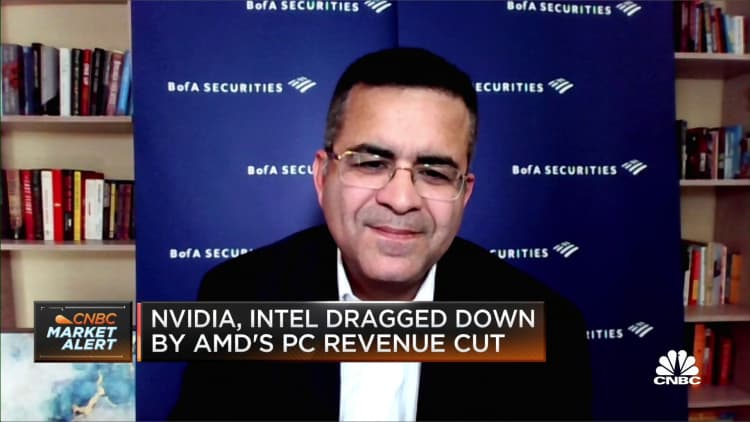
WATCH: PC weakness hitting semi stocks like AMD, says BofA’s Vivek Arya


The stock market graphic of Zillow Group is displayed on a smartphone with the logo of Zillow in the background on Feb. 21, 2021.
Sopa Images | Lightrocket | Getty Images
Zillow shares plunged more than 9% on Monday on worries that the online real estate platform could have a big new competitor: Google Search.
Google appears to be running tests on putting real estate sale listings into its search results. Over the weekend, real estate tech strategist Mike DelPrete published mobile phone screenshots of Google Search results showing real estate listings, which appeared to be powered by real estate data company “HouseCanary.”
The listings allowed users to view the full details of a property’s page, request a tour and contact an agent — similar to the functions offered on Zillow.com’s online marketplace portal. Google’s home searches appear to work only in select markets and on mobile devices as testing is underway.
The decline in Zillow signals investors are bracing for the eventual impact of Google’s foray into the real estate market. The stock was down at least 11% at one point during Monday’s session.
However, Wall Street analysts were quick to point out that Zillow’s exposure to organic search is fairly small, limiting potential downside at least in the near term as more details around Google’s product come to light.
Wells Fargo analyst Alec Brondolo, who has an equal weight rating on Zillow, said he would not “expect a meaningful financial impact from listings on Google shifting from organic to paid” — given that Zillow is not overly dependent on organic search results for traffic.
“The listings product appears similar to Google Hotel Metasearch results; introduction could increase traffic cost to Zillow, but disintermediation unlikely,” Brondolo said in a Monday note to clients. “In the hotel category, Google merchandises hotel rooms in search results as a metasearch ad product for OTAs. We would expect a similar approach in real estate, with Zillow, Homes.com, Realtor.com, etc. bidding for home listing ad units rather than Google attempting to monetize directly with an ad product sold to agents.”
Zillow stock over the past year.
But some analysts see Google’s testing as a longer-term headwind to Zillow and other online real estate portals.
Goldman Sachs’ Michael Ng wrote in a note to clients that he believes the search engine’s real estate listings, which he said are an advertising format for buy-side agents, directly compete with Zillow’s Premier Agent program by “facilitating lead generation” for agents from prospective buyers.
“While we don’t expect a direct near-term impact on Zillow’s business, given that most of Zillow’s traffic is direct (e.g., Zillow.com, StreetEasy.com, mobile apps) and Google’s new product is currently limited to select markets and mobile browsers, we view this development as a long-term risk for real estate portals like Zillow,” Ng, who remains neutral on Zillow, wrote in a note to clients.
Jason Helfstein of Oppenheimer said that Google’s expansion into real estate could impact the number of consumers going to Zillow.com — which was 228 million in the third quarter — and therefore could take a hit on the company’s ability to monetize its platform. “The impact would likely take years to play out and would need to be rolled out across the US to meaningfully impact real estate portal traffic,” Helfstein said in a recent note, to be sure.
Zillow shares are down more than 8% year to date.
Neither Google nor Zillow responded immediately to CNBC’s request for comment.


-
 Sports2 years ago
Story injured on diving stop, exits Red Sox game
-
 Sports3 years ago
‘Storybook stuff’: Inside the night Bryce Harper sent the Phillies to the World Series
-
 Sports2 years ago
Game 1 of WS least-watched in recorded history
-
 Sports3 years ago
Button battles heat exhaustion in NASCAR debut
-
 Sports3 years ago
MLB Rank 2023: Ranking baseball’s top 100 players
-
Sports4 years ago
Team Europe easily wins 4th straight Laver Cup
-
 Environment3 years ago
Japan and South Korea have a lot at stake in a free and open South China Sea
-
 Environment1 year ago
Here are the best electric bikes you can buy at every price level in October 2024