
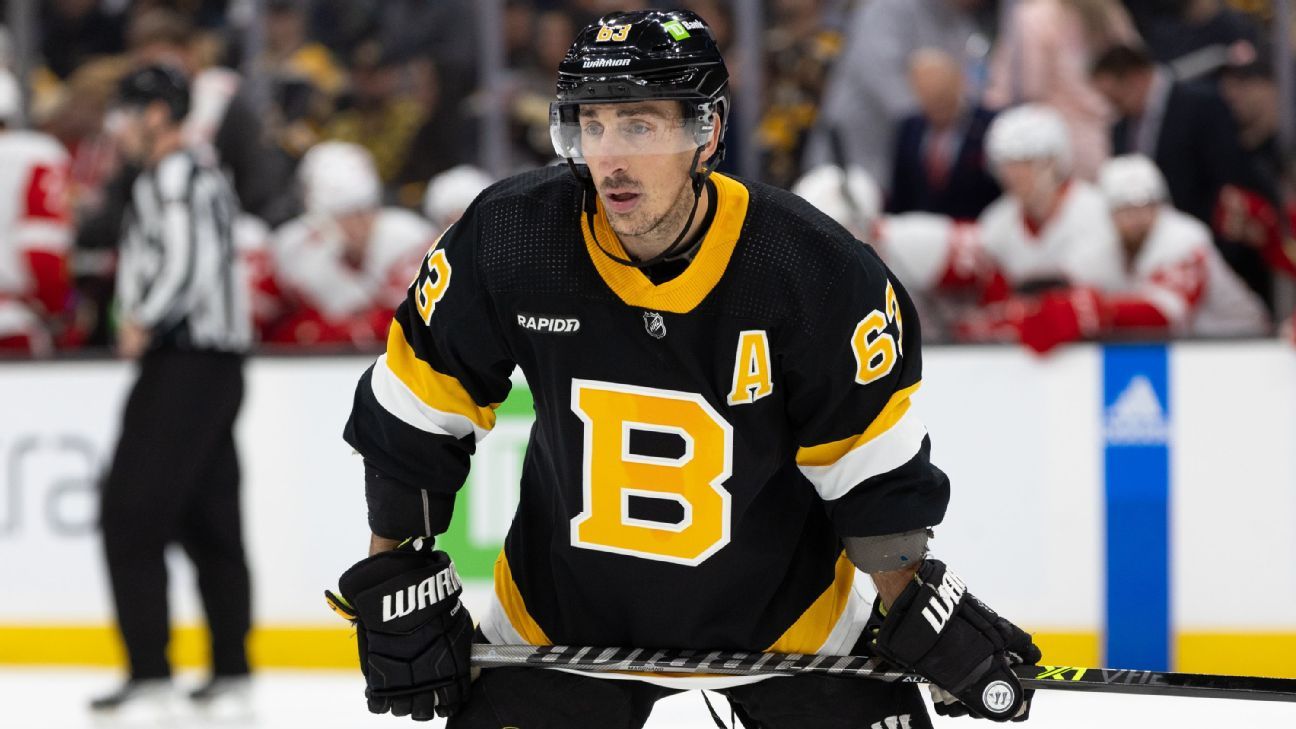
How Brad Marchand returned from injury a month ahead of schedule

There’s a famous story about Brad Marchand‘s exit meetings in Boston after his rookie season.
Throughout Marchand’s draft process and early in his pro hockey career, he was often reminded of what he couldn’t achieve. NHL teams believed he was too small (a 5-foot-9 forward was especially undersized as he was breaking in). Scouts said Marchand’s skating wasn’t good enough. NHL evaluators believed discipline was an issue. He was told his skill set probably didn’t have a high ceiling.
Marchand, a third-round pick in 2006, got called up to the NHL for a 20-game stint in 2010. “After the year I met with Peter Chiarelli, then the GM, and he said, ‘Look, you got a taste of it, you got to play some games, be around the playoffs, see what the NHL is like,'” Marchand recalls. “He said, ‘Next year, if you can come in and be a good energy player, play on the fourth line, maybe get 10 goals, I think that would be a great year for you.'”
Marchand, who was 21 at the time, didn’t like that outlook. The winger’s response: “I think I could get 20 goals in this league.”
“[Chiarelli] kind of looked at me and laughed,” Marchand said. “I hadn’t scored a goal in the league at that point. I had one assist in 20 games. I hadn’t done much. I think it took him by surprise.”
There’s one thing you should know about Brad Marchand: Set limitations, and it fuels him with determination. He’s often bucking other people’s expectations for him.
Just look at the latest example: He defied doctors and returned more than a month ahead of schedule following double hip surgery, scoring two goals and adding an assist in his first game back this past Thursday.
MARCHAND SCORED 21 GOALS during his sophomore season — and his career has since taken off to heights that perhaps only he imagined. At 34, he is one of the league’s premiere superstars. He’s still pesky — few hound pucks like Marchand does, and he still lives up to his nickname as the “Little Ball of Hate” — but no player in the NHL plays with that edge and consistently puts up his production.
Since that 2010 exit meeting, only Alex Ovechkin, Steven Stamkos, John Tavares and Patrick Kane have scored more goals than Marchand’s 353.
This past offseason, Marchand hit a crossroads. The Bruins were eliminated in the first round of the playoffs by the Carolina Hurricanes in seven games. Fans wondered if Boston’s core was aging out and another Stanley Cup window had closed.
Marchand battled lower body injuries the past several seasons. Despite a groin procedure, and a sports hernia surgery, issues kept flaring up.
Marchand was presented a choice by the Bruins’ medical team: He could get hip surgery, or continue trying to play through it, and try to strengthen his body that way.
“They said, ‘We think you should do the surgery, but it’s up to the player,'” Marchand said. “I didn’t want to miss time. We finished earlier than we had planned to, so that bought me a few more weeks.”
His goal was to play as long as possible, so he decided getting the surgery was a good idea.
Then another decision: Surgery on one hip or both hips? Marchand asked his doctor if they only did one hip, could they guarantee he wouldn’t have to get the other hip done in a few years?
Marchand didn’t want to have to go through this process again at age 36 or 37.
Once the doctor said no, Marchand decided a double hip arthroscopy and labral repair was his best option.
“One of the first things the doctor told me after [surgery] was, ‘You’re lucky you did both, because you would’ve been done in a year or two,” Marchand said. “Because at that point I would’ve needed a whole hip replacement and my career would’ve been over.”
Then the doctor told Marchand something he didn’t want to hear: The recovery timeline was six months. He would be sidelined until American Thanksgiving.
Marchand didn’t like that outlook. So he found a way to change it.
“Personally, I feel like if you’re told something, it’s just a limitation that you’re setting for yourself — or in this case for my recovery,” Marchand said. “Six months, that’s a long time. And especially when I heard the breakdown for why I needed it. Unfortunately it was because I needed extra time to get back in shape. My instant thought was ‘All right, how can we get this done sooner?'”
MARCHAND LEVELED WITH his medical team. “I said, ‘We can do this one of two ways,'” he recalled. “You can help me where I’m doing it, and we make sure I don’t get hurt. Or I’m just going to do it behind your back, because I’m going to do what I feel I need to do to get back early, and I’ll probably injure myself because I don’t know what I should be doing, and I’m going to do it anyway.”
Marchand said he wanted to play opening night. The medical team countered with a more realistic compromise.
Everyone agreed to circle the last week of October on the calendar, roughly five weeks ahead of schedule.
The first part of the rehab process involved rest.
“We had a newborn at home, and I felt worse for my wife than myself,” Marchand said. “I was fine, all I had to do was lay on my couch.”
Then, Marchand returned home to Halifax. He hadn’t been able to spend time at home over the past two summers amid the COVID-19 pandemic and wanted the chance to see family.
Marchand’s trainer in Halifax (Matt MacIntyre) and Boston (Scott Waugh) stayed in constant communication. “Everyone was on the same page,” he said. “Which was important.”
Marchand flew back to Boston every 7-10 days to get checked out.
He wasn’t cleared to skate until October, which was the hardest part. For most of the summer, he also couldn’t lift anything heavier than 20 pounds, so rehab included a lot of stretching and body weight exercises.
“I have a lot of anxiety every summer about my routine, when I’m skating,” Marchand said. “It was very tough to put that aside and accept the fact I can’t do it.”
But he focused on what he could do. To keep his conditioning up, that meant biking.
“I needed to hammer bike rides, so I said give me bike rides where I’m not going to injure myself,” Marchand said. “I started doing two bike rides a day, one at morning one at night, about a month before I was supposed to.”
Marchand agreed with the medical team: If he was feeling sore, he’d take days off. But that happened only a few times.
And by the time he returned to Boston ahead of the season, he was right on track with that late October return.
For Marchand, it all stems back to his philosophy as a player.
“If you’re not setting goals, and you’re not putting things out there that you want to attain, then you’re just being stagnant and there are people around you that will surpass you and work to be better than you,” he said.
Often Marchand’s career has been framed around proving people wrong. He sees it differently: He’s constantly proving himself right.
At 34, he credits his success to his work on the “mental side of the game” — something he devotes more time to as the years go on.
“I don’t think people realize how big that is — how you can change your game and your confidence and perspective of who you are as a player and where you can end up,” he said. “The more work I put into that, the more I realized what I could accomplish in the league.”

-
Greg Wyshynski
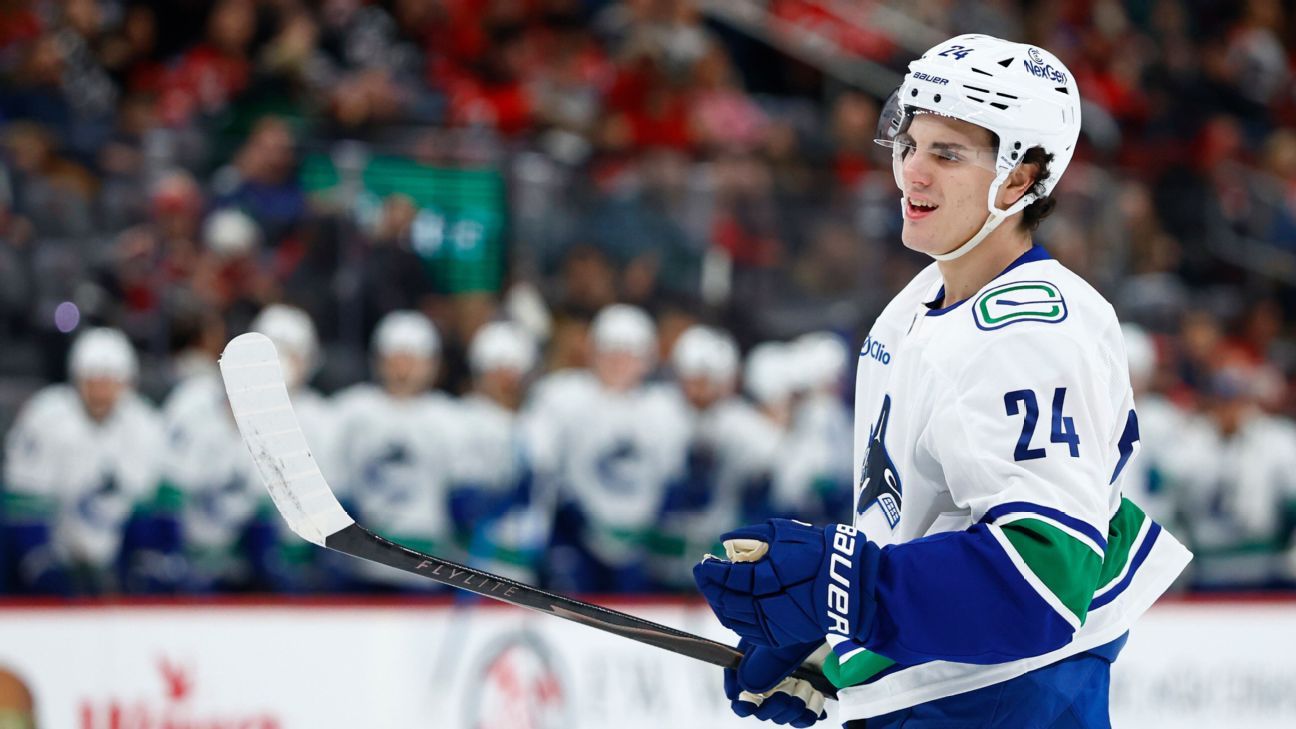
NEWARK, N.J. — Zeev Buium was the Minnesota Wild‘s defenseman of the future until they made him the centerpiece of the Quinn Hughes trade last Friday, shipping the 20-year-old in a package to the Vancouver Canucks for their star captain.
Buium said he doesn’t feel he was misled about his status with the Wild before the trade.
“I don’t think anything they told me was a lie. I really don’t,” Buium said Sunday after the Canucks’ 2-1 road victory over the New Jersey Devils. “[Wild GM] Bill Guerin is an unbelievable person. He’s such a smart guy. He wants to try and win now, and that’s a move he thought was best for the team. At the end of the day, you have to do what’s best for the team.”
Buium was traded to Vancouver along with center Marco Rossi, winger Liam Ohgren and a 2026 first-round pick for Hughes, the 26-year-old Norris Trophy winner who is considered one of the best defensemen in hockey. Hughes had 432 points in 459 games heading into Sunday’s action and was the leading scorer on Vancouver (23 points in 26 games) before Friday’s blockbuster trade.
Buium had two points in his debut with the Canucks, both on the power play. He earned an assist on Jake DeBrusk‘s opening goal and then was credited with his fourth goal of the season when his pass deflected off the stick of Devils defenseman Brenden Dillon.
He was drafted 12th overall in 2024 by the Wild and was an offensive dynamo with the University of Denver for two seasons (98 points in 83 games). He had 14 points in 31 games as a rookie this season before the trade.
Guerin called Buium a “special kid and a special human,” but he indicated that the Wild’s bid for Hughes was only successful because Buium was a part of it.
“I love that kid, but you have to give something to get something,” Guerin said.
Buium didn’t take the trade personally, but he said he’ll use it as motivation.
“I don’t think it’s [Guerin] saying, ‘You’re not good enough’ or ‘We don’t believe in you.’ But I think he sees me needing to develop a little bit more,” Buium said. “I think it works out for both teams. I’m going to do my best to show the Canucks that they made a good trade. Hopefully, I can turn into a player like that.”

-
Mark Schlabach
Indiana quarterback Fernando Mendoza, who led the No. 1 Hoosiers to a perfect 13-0 record and their first Big Ten title since 1967, captured the 91st Heisman Trophy on Saturday night.
Mendoza beat out quarterbacks Diego Pavia (Vanderbilt) and Julian Sayin (Ohio State) and running back Jeremiyah Love (Notre Dame) to take home the trophy during a ceremony in New York.
Mendoza, who played two seasons at California before joining the Hoosiers this season, completed 71.5% of his pass attempts for 2,980 yards with 39 total touchdowns.
He was only the second Heisman Trophy finalist from Indiana. Running back Anthony Thompson was runner-up to Houston quarterback Andre Ware in one of the closest votes in 1989.
With Mendoza, Pavia and Love expected to move on to the NFL after this season, who are the top returning Heisman Trophy candidates for 2026?
In compiling the list of potential candidates, I projected that quarterbacks John Mateer (Oklahoma), Ty Simpson (Alabama) and Dante Moore (Oregon); receivers Carnell Tate (Ohio State), Zachariah Branch (Georgia) and Makai Lemon (USC); and running back Emmett Johnson (Nebraska) will turn pro (along with the aforementioned finalists from this year).
Here is a look at some of the top potential contenders (in no particular order):


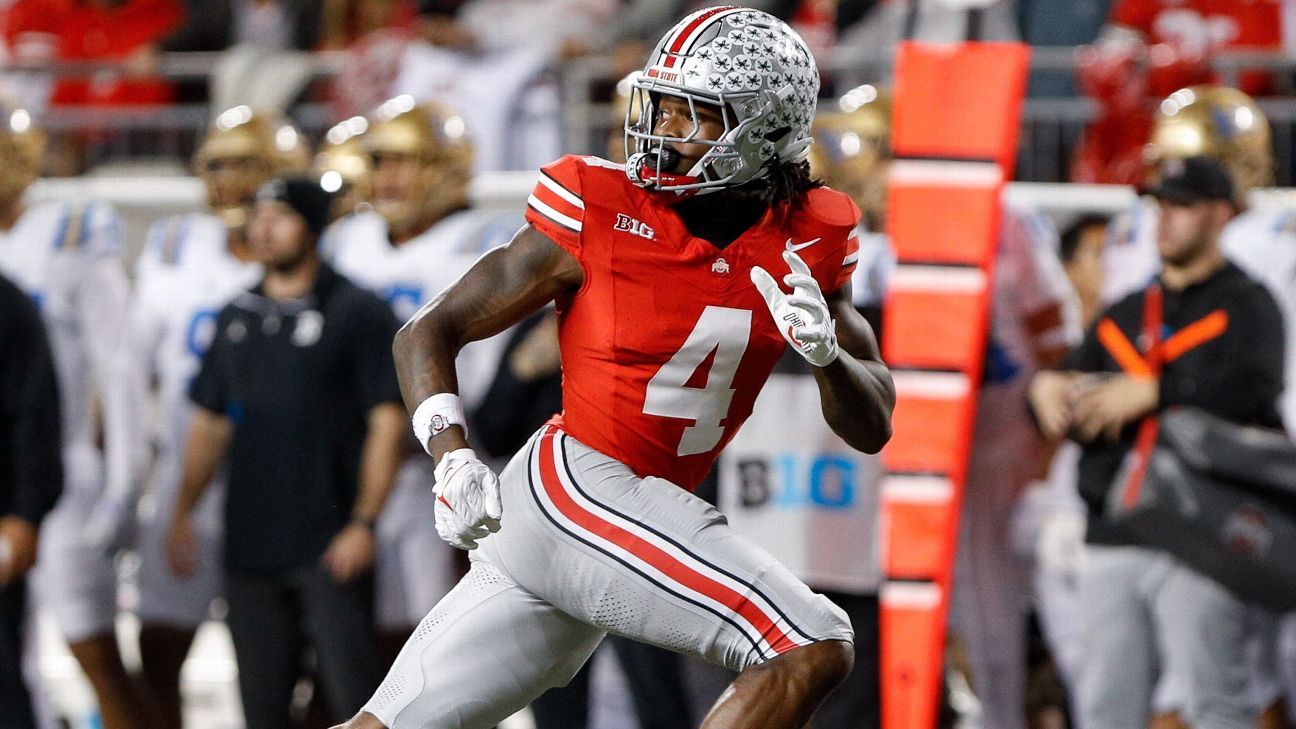
2025 stats: 80 catches, 1,086 receiving yards, 12 total touchdowns
Smith’s highlight reel of acrobatic, one-handed catches continues to grow, and he arguably has been the best player in college football this season. He was the fastest Buckeyes player to reach career marks of 2,000 receiving yards (24 games), 100 catches (20) and 25 touchdown receptions (25).
2025 stats: 78.4% completion pct, 3,323 passing yards, 31 touchdowns, 6 interceptions
Sayin might have captured the Heisman Trophy this season if Ohio State’s offense hadn’t flopped in its 13-10 loss to Indiana in the Big Ten championship game. In his first season as a starter, Sayin is on pace to break the NCAA single-season pass completion record of 77.4%, set by Oregon’s Bo Nix in 2023.

2025 stats: 70.7% completion pct, 2,691 passing yards, 442 rushing yards, 31 total touchdowns
In his first full season as Georgia’s starting quarterback, Stockton helped guide the Bulldogs to a 12-1 record and SEC title. His legs and right arm were a big reason the Bulldogs averaged 31.9 points, despite enduring myriad injuries on the offensive line. Stockton was at his best when the game was on the line — he completed 86% of his passes with 11 touchdowns and one interception in the fourth quarter against ranked opponents.

2025 stats: 84 receptions, 970 receiving yards, 7 receiving touchdowns
Toney’s teammates call him “Baby Jesus,” and the true freshman delivered in a big way in his first season with the No. 10 Hurricanes. He ranks sixth in the FBS with 84 catches and had 1,328 all-purpose yards. Toney even threw for two scores. Not bad for an 18-year-old who would be a senior in high school if he hadn’t reclassified to the class of 2025.

2025 stats: 61.4% completion pct, 2,942 passing yards, 32 total touchdowns
Even after all the hand-wringing about Manning being overrated at the start of the season, the former five-star recruit ended up putting together a good campaign, throwing for 2,942 yards with 24 touchdowns. The No. 13 Longhorns need to find some offensive linemen (he was sacked 23 times) and receivers to help him in 2026.

2025 stats: 65.5% completion pct, 3,016 passing yards, 24 total touchdowns
Ole Miss officials have submitted a waiver to the NCAA on Chambliss’ behalf for another season of eligibility. He played his first three seasons at Division II Ferris State before transferring to Ole Miss this year. He was named SEC Newcomer of the Year after taking over the starting job in the third game of the season.

2025 stats: 1,560 rushing yards, 16 touchdowns
A transfer from Louisiana-Monroe, Hardy led the FBS with 130 rushing yards per game and was No. 2 with 1,560 total rushing yards. He had eight 100-yard games for the Tigers, including a whopping 300-yard effort with three touchdowns in a 49-27 victory against Mississippi State on Nov. 15.

2025 stats: 61.8% completion pct, 2,932 passing yards, 466 rushing yards, 31 total touchdowns
Reed announced this week that he plans to stay at Texas A&M next season, which is great news for the No. 7 Aggies. He was a threat with the ball in his hands, throwing for 2,932 yards with 25 touchdowns and running for 466 yards with six scores. His decision-making needs to continue to improve, so he can cut down on his 10 interceptions.

2025 stats: 63.6% completion pct, 3,117 passing yards, 20 total touchdowns
There’s a reason new Bears coach Tosh Lupoi took a late-night flight to Hawai’i to make sure Sagapolutele was staying at Cal. He was only the second true freshman in FBS history to pass for 200 yards or more in each of his first 11 starts. In the Bears’ late-season upsets of then-No. 21 SMU and No. 15 Louisville, Sagapolutele passed for a combined 653 yards with six touchdowns and no picks.
2025 stats: 1,279 rushing yards, 20 touchdowns
After transferring from Missouri, Lacy helped the No. 6 Rebels win 11 games in the regular season for the first time. He ranks No. 2 in the FBS with 20 rushing touchdowns and piled up 1,279 yards on the ground. Will he follow former coach Lane Kiffin to LSU or remain with the Rebels in 2026?

2025 stats: 66.2% completion pct, 3,431 passing yards, 29 total touchdowns
If Maiava returns to the No. 16 Trojans for another season, he’ll probably flourish in Lincoln Riley’s offense. This year, he threw for 3,431 yards with 23 touchdowns and 8 interceptions. He ranks No. 1 with a 91.2 total QBR. According to Pro Football Focus, he was second in the FBS with 26 big-time throws. (A big-time throw is defined as a high-difficulty, high-value pass.)
2025 stats: 1,035 rushing yards, 6 total touchdowns
Jackson became the fifth true freshman in OSU history to produce a 1,000-yard season, joining Robert Smith (1990), Maurice Clarett (2002), JK Dobbins (2017) and TreVeyon Henderson (2021). That’s good company. And, of course, he’d be the second Bo Jackson to collect a stiff-armed trophy.

2025 stats: 70.2% completion pct, 4,129 passing yards, 36 total touchdowns
Mestemaker is one of the best stories in college football. He didn’t start a single game in high school, then joined North Texas as a walk-on. This season, he led the FBS with 4,129 passing yards, helping him capture the Burlsworth Trophy as the top walk-on in the country. Will he join former Mean Green coach Eric Morris at Oklahoma State in 2026?

CJ Carr, QB, Notre Dame
2025 starts: 66.6% completion pct, 2,741 passing yards, 24 touchdowns
Fighting Irish coach Marcus Freeman entrusted Carr to lead his offense after a heated battle in preseason camp. The decision paid off, as Carr put together one of the best performances by a first-time starter in Notre Dame history. He threw for at least one touchdown in each of his first 12 starts, becoming the first Irish player to do that since Everett Golson in 2012-14. Carr’s 24 passing touchdowns are tied for the most in the first 12 starts by a Notre Dame player since 1966.

2025 stats: 70% completion pct, 2,850 passing yards, 595 rushing yards, 27 total touchdowns
Williams is one of the best dual-threat quarterbacks in the FBS, and his ability to run and throw was on display in the Huskies’ 38-19 victory against Rutgers on Oct. 10. He became the first player in school history to pass for at least 400 yards (400) and run for at least 100 (136) in the same game. Williams was second on the team with 595 rushing yards.
Others to watch: Sam Leavitt, QB, TBA; Cam Coleman, WR, Auburn; Brendan Sorsby, QB, Cincinnati; Josh Hoover, QB, TCU; Darian Mensah, QB, Duke; Nate Frazier, RB, Georgia; LJ Martin, RB, BYU; Bear Bachmeier, QB, BYU; LaNorris Sellers, QB, South Carolina; Bryce Underwood, QB, Michigan
-
 Sports2 years ago
Story injured on diving stop, exits Red Sox game
-
 Sports3 years ago
‘Storybook stuff’: Inside the night Bryce Harper sent the Phillies to the World Series
-
 Sports2 years ago
Game 1 of WS least-watched in recorded history
-
 Sports3 years ago
Button battles heat exhaustion in NASCAR debut
-
 Sports3 years ago
MLB Rank 2023: Ranking baseball’s top 100 players
-
Sports4 years ago
Team Europe easily wins 4th straight Laver Cup
-
 Environment3 years ago
Japan and South Korea have a lot at stake in a free and open South China Sea
-
 Environment1 year ago
Here are the best electric bikes you can buy at every price level in October 2024