
Lyft shares fall after disappointing revenue, active rider miss

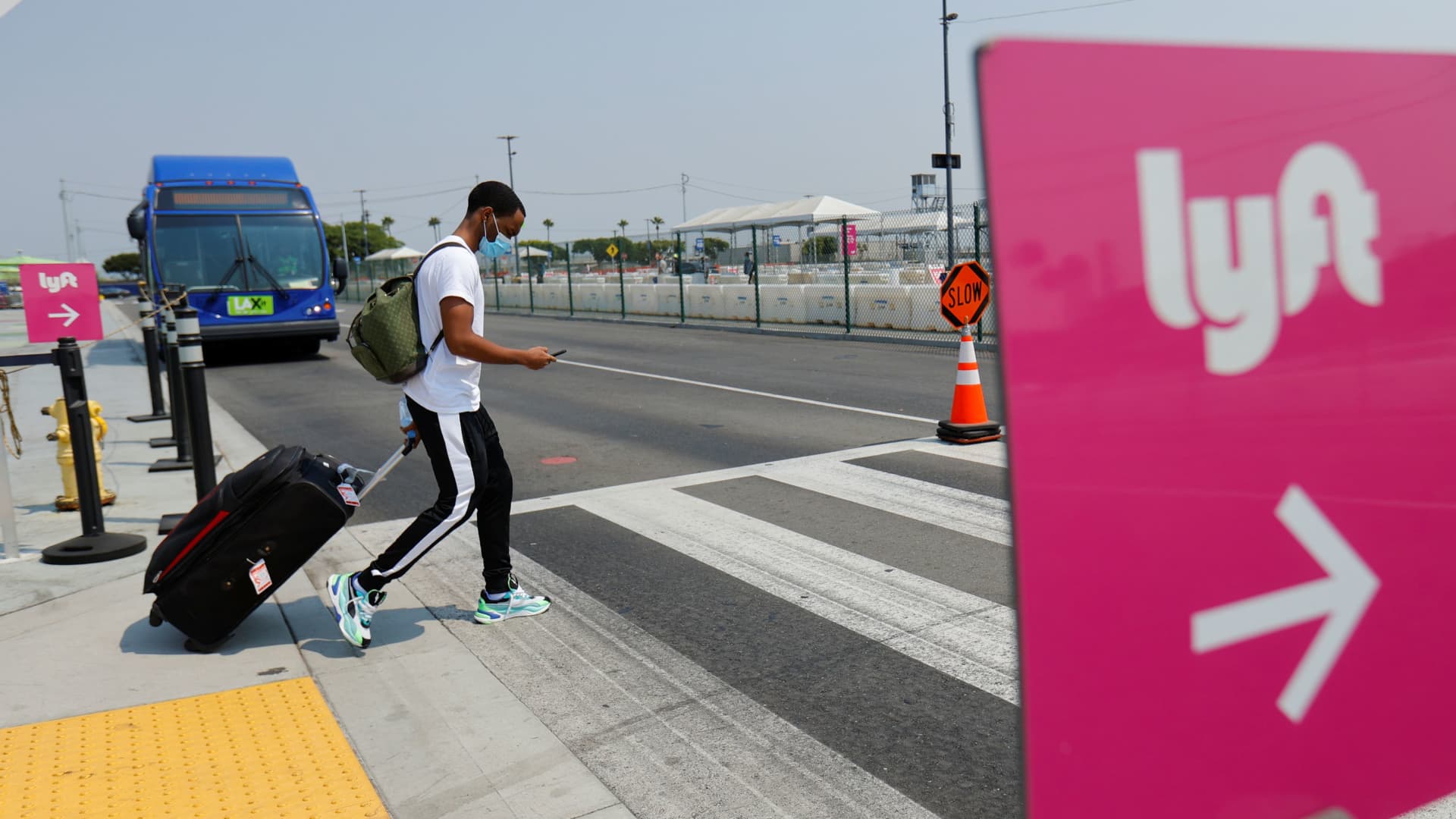
A traveler arriving at Los Angeles International Airport looks for ground transportation during a statewide day of action to demand that ride-hailing companies Uber and Lyft follow California law and grant drivers “basic employee rights” in Los Angeles, California, U.S., August 20, 2020.
Mike Blake | Reuters
Shares of Lyft plunged more than 19% in early trading Tuesday, a day after the company reported worse-than-expected revenue for the third quarter, and active riders missed analysts’ estimates.
Here’s how the company did:
- Earnings: 10 cents per share, adjusted, vs. 7 cents per share, according to analysts surveyed by Refinitiv
- Revenue: $1.05 billion, vs. $1.06 billion, according to analysts surveyed by Refinitiv
The rideshare company recorded 20.3 million active riders in the third quarter, short of Wall Street’s projected 21.2 million, according to StreetAccount. The number of people using its service also remains below pre-pandemic levels. Lyft had 22.9 million active riders in the fourth quarter of 2019, for example.
Revenue of $1.05 billion also came in below analysts’ expected $1.06 billion. That represented year-over-year growth of 22%, marking the slowest revenue expansion in more than a year.
The lackluster results come after Uber last week beat analysts’ estimates for revenue and said passenger numbers were higher than before than pandemic, putting pressure on its rideshare rival to prove it can recover from its pandemic slump.
Lyft recently joined a slew of tech companies in slashing costs amid a worsening economic outlook. The company said last week it would cut 13% of its workforce, citing expectations of a looming recession in the next year and rising rideshare insurance costs.
Lyft CEO Logan Green said on the company’s earnings call that it is not seeing any concerning macro trends in the fourth quarter. For the current quarter, Lyft said it expects to report revenue between $1.15 billion and $1.17 billion, which is in line with consensus estimates of $1.16 billion, according to StreetAccount.
WATCH: Lyft beats EPS but misses on revenue and active riders
Technology
ServiceNow in talks to acquire cybersecurity startup Armis in potential $7 billion deal, Bloomberg reports


Oracle CEO Clay Magouyrk appears on a media tour of the Stargate AI data center in Abilene, Texas, on Sept. 23, 2025.
Kyle Grillot | Bloomberg | Getty Images
Oracle on Friday pushed back against a report that said the company will complete data centers for OpenAI, one of its major customers, in 2028, rather than 2027.
The delay is due to a shortage of labor and materials, according to the Friday report from Bloomberg, which cited unnamed people. Oracle shares fell to a session low of $185.98, down 6.5% from Thursday’s close.
“Site selection and delivery timelines were established in close coordination with OpenAI following execution of the agreement and were jointly agreed,” an Oracle spokesperson said in an email to CNBC. “There have been no delays to any sites required to meet our contractual commitments, and all milestones remain on track.”
The Oracle spokesperson did not specify a timeline for turning on cloud computing infrastructure for OpenAI. In September, OpenAI said it had a partnership with Oracle worth more than $300 billion over the next five years.
“We have a good relationship with OpenAI,” Clay Magouyrk, one of Oracle’s two newly appointed CEOs, said at an October analyst meeting.
Doing business with OpenAI is relatively new to 48-year-old Oracle. Historically, Oracle grew through sales of its database software and business applications. Its cloud infrastructure business now contributes over one-fourth of revenue, although Oracle remains a smaller hyperscaler than Amazon, Microsoft and Google.
OpenAI has also made commitments to other companies as it looks to meet expected capacity needs.
In September, Nvidia said it had signed a letter of intent with OpenAI to deploy at least 10 gigawatts of Nvidia equipment for the San Francisco artificial intelligence startup. The first phase of that project is expected in the second half of 2026.
Nvidia and OpenAI said in a September statement that they “look forward to finalizing the details of this new phase of strategic partnership in the coming weeks.”
But no announcement has come yet.
In a November filing, Nvidia said “there is no assurance that we will enter into definitive agreements with respect to the OpenAI opportunity.”
OpenAI has historically relied on Nvidia graphics processing units to operate ChatGPT and other products, and now it’s also looking at designing custom chips in a collaboration with Broadcom.
On Thursday, Broadcom CEO Hock Tan laid out a timeline for the OpenAI work, which was announced in October. Broadcom and OpenAI said they had signed a term sheet.
“It’s more like 2027, 2028, 2029, 10 gigawatts, that was the OpenAI discussion,” Tan said on Broadcom’s earnings call. “And that’s, I call it, an agreement, an alignment of where we’re headed with respect to a very respected and valued customer, OpenAI. But we do not expect much in 2026.”
OpenAI declined to comment.
WATCH: Oracle says there have been ‘no delays’ in OpenAI arrangement after stock slide
-
 Sports2 years ago
Story injured on diving stop, exits Red Sox game
-
 Sports3 years ago
‘Storybook stuff’: Inside the night Bryce Harper sent the Phillies to the World Series
-
 Sports2 years ago
Game 1 of WS least-watched in recorded history
-
 Sports3 years ago
Button battles heat exhaustion in NASCAR debut
-
 Sports3 years ago
MLB Rank 2023: Ranking baseball’s top 100 players
-
Sports4 years ago
Team Europe easily wins 4th straight Laver Cup
-
 Environment3 years ago
Japan and South Korea have a lot at stake in a free and open South China Sea
-
 Environment1 year ago
Here are the best electric bikes you can buy at every price level in October 2024