
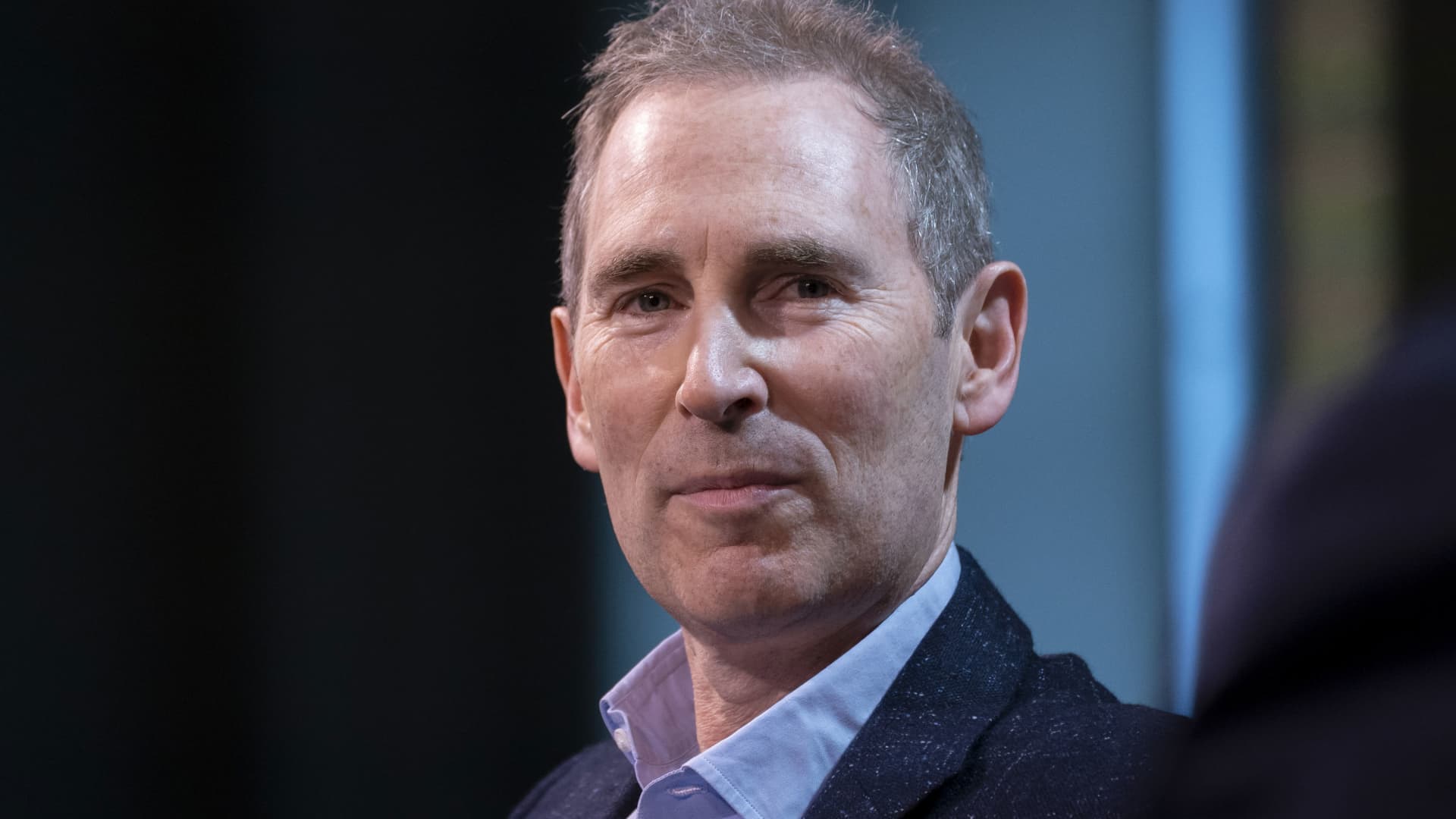
Amazon reportedly plans to lay off about 10,000 employees starting this week


Beta Technologies shares surged more than 9% after air taxi maker Eve Air Mobility announced an up to $1 billion deal to buy motors from the Vermont-based company.
Eve, which was started by Brazilian airplane maker Embraer and is now under Eve Holding, said the manufacturing deal could equal as much as $1 billion over 10 years. The Florida-based company said it has a backlog of 2,800 vehicles.
Shares of Eve Holding gained 14%.
Eve CEO Johann Bordais called the deal a “pivotal milestone” in the advancement of the company’s electric vertical takeoff and landing, or eVTOL, technology.
“Their electric motor technology will play a critical role in powering our aircraft during cruise, supporting the maturity of our propulsion architecture as we progress toward entry into service,” he said in a release.
Technology
Amazon to let cloud clients customize AI models midway through training for $100,000 a year


Attendees pass an Amazon Web Services logo during AWS re:Invent 2024, a conference hosted by Amazon Web Services, at The Venetian hotel in Las Vegas on Dec. 3, 2024.
Noah Berger | Getty Images
Amazon has found a way to let cloud clients extensively customize generative AI models. The catch is that the system costs $100,000 per year.
The Nova Forge offering from Amazon Web Services gives organizations access to Amazon’s AI models in various stages of training so they can incorporate their own data earlier in the process.
Already, companies can fine-tune large language models after they’ve been trained. The results with Nova Forge will lean more heavily on the data that customers supply. Nova Forge customers will also have the option to refine open-weight models, but training data and computing infrastructure are not included.
Organizations that assemble their own models might end up spending hundreds of millions or billions of dollars, which means using Nova Forge is more affordable, Amazon said.
AWS released its own models under the Nova brand in 2024, but they aren’t the first choice for most software developers. A July survey from Menlo Ventures said that by the middle of this year, Amazon-backed Anthropic controlled 32% of the market for enterprise LLMs, followed by OpenAI with 25%, Google with 20% and Meta with 9% — Amazon Nova had a less than 5% share, a Menlo spokesperson said.
The Nova models are available through AWS’ Bedrock service for running models on Amazon cloud infrastructure, as are Anthropic’s Claude 4.5 models.
“We are a frontier lab that has focused on customers,” Rohit Prasad, Amazon head scientist for artificial general intelligence, told CNBC in an interview. “Our customers wanted it. We have invented on their behalf to make this happen.”
Nova Forge is also in use by internal Amazon customers, including teams that work on the company’s stores and the Alexa AI assistant, Prasad said.
Reddit needed an AI model for moderating content that would be sophisticated about the many subjects people discuss on the social network. Engineers found that a Nova model enhanced with Reddit data through Forge performed better than commercially available large-scale models, Prasad said. Booking.com, Nimbus Therapeutics, the Nomura Research Institute and Sony are also building models with Forge, Amazon said.
Organizations can request that Amazon engineers help them build their Forge models, but that assistance is not included in the new service’s $100,000 annual fee.
AWS is also introducing new models for developers at its Reinvent conference in Las Vegas this week.
Nova 2 Pro is a reasoning model whose tests show it performs at least as well as Anthropic’s Claude Sonnet 4.5, OpenAI’s GPT-5 and GPT-5.1, and Google’s Gemini 3.0 Pro Preview, Amazon said. Reasoning involves running a series of computations that might take extra time in response to requests to produce better answers. Nova 2 Pro will be available in early access to AWS customers with Forge subscriptions, Prasad said. That means Forge customers and Amazon engineers will be able to try Nova 2 Pro at the same time.
Nova 2 Omni is another reasoning model that can process incoming images, speech, text and videos, and it generates images and text. It’s the first reasoning model with that range of capability, Amazon said. Amazon hopes that, by delivering a multifaceted model, it can lower the cost and complexity of incorporating AI models into applications.
Tens of thousands of organizations are using Nova models each week, Prasad said. AWS has said it has millions of customers. Nova is the second-most popular family of models in Bedrock, Prasad said. The top group of models are from Anthropic.
WATCH: Amazon set to kick off AI conference next week: Maxim’s Tom Forte on what to expect
-
 Sports2 years ago
Story injured on diving stop, exits Red Sox game
-
 Sports3 years ago
‘Storybook stuff’: Inside the night Bryce Harper sent the Phillies to the World Series
-
 Sports2 years ago
Game 1 of WS least-watched in recorded history
-
 Sports3 years ago
Button battles heat exhaustion in NASCAR debut
-
 Sports3 years ago
MLB Rank 2023: Ranking baseball’s top 100 players
-
Sports4 years ago
Team Europe easily wins 4th straight Laver Cup
-
 Environment3 years ago
Japan and South Korea have a lot at stake in a free and open South China Sea
-
 Environment1 year ago
Here are the best electric bikes you can buy at every price level in October 2024