

Elizabeth Holmes: How Theranos founder went from billionaire darling of Silicon Valley to the brink of prison


“Don’t worry about the future, we’re in good hands.”
So said former US president Bill Clinton in 2015, as he introduced Elizabeth Holmes to an adoring New York crowd.
It seemed an uncontroversial statement at the time, as he hailed the achievements of a woman who had become America’s youngest self-made female billionaire after taking Silicon Valley by storm.
A hub for the world’s biggest tech companies, the only thing more synonymous with this infamous stretch of northern California than scientific breakthroughs and innovative gadgets were the rich white men who were invariably behind them – turtleneck jumpers and smart trouser-sneaker combos in tow.
Bill Clinton and Elizabeth Holmes at the Clinton Global Initiative’s 2015 meeting in New York
Holmes – a high school computer whizz turned Harvard dropout – was a bona fide gatecrasher, her stunning rise to the cover of Forbes magazine powered by her founding health technology firm Theranos and its rapid ascent to a peak valuation of $9bn. Look back on what it was promising to deliver, and it’s easy to see why.
Revolutionary blood tests were at the heart of its pitch, ones which could be performed at phenomenal speed with merely a small drop required – and no needles.
Holmes’s catchphrase became “change the world”, such were her assertions that the equipment her company had developed could test for dozens of diseases in one fell swoop.
She insisted it would change healthcare in the US, not just by speeding up and streamlining trips to the doctor, but by eventually rendering such visits obsolete by selling the gizmos in stores.
It took more than a decade for such claims to be exposed as the stuff of science-fiction, but Holmes’s shameless willingness to talk the talk regardless helped her become one of the darlings of Silicon Valley, raising hundreds of millions from investors and venture capitalists.
As Theranos grew, her public image was crafted to perfection to make her the perfect face of one of America’s most exciting companies, famously adopting the aforementioned turtlenecks from her idol Steve Jobs, the late Apple founder, and speaking in a strikingly deep voice which added extra gravitas to her every word.
Fame isn’t for everyone, but for Holmes it seemed elementary.
Nothing, it seemed, could go wrong. Until it did. Big time.
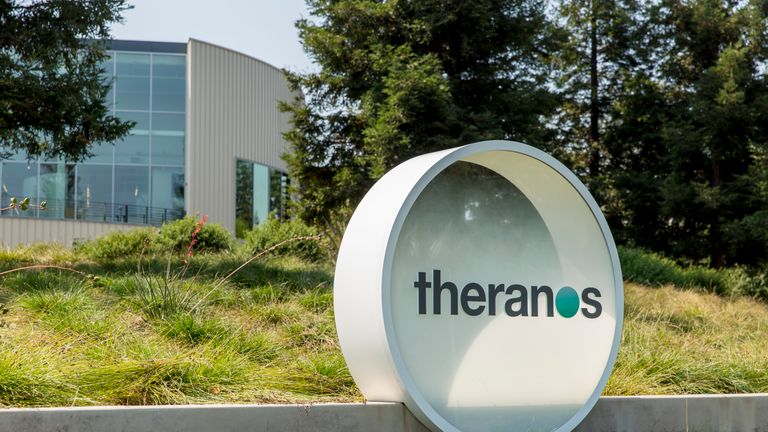
Theranos reached a value of $9bn
How the lie was exposed
Holmes’s empire began to unravel upon the publication of a bombshell expose by The Wall Street Journal, which reported that Theranos’s technology was profoundly flawed.
The devices used to collect people’s blood, which the firm dubbed “nanotainers”, were said to be so far off the mark that Theranos had in fact been using other companies’ equipment to carry out blood tests in its laboratories.
The most distressing piece of the Journal’s report was that the company’s ex-chief scientist, Briton Ian Gibbons, had tried to take his own life after telling his wife the tech did not work. He died shortly after from liver failure.
The stories emerged just a month after Holmes had shared the stage with Bill Clinton.
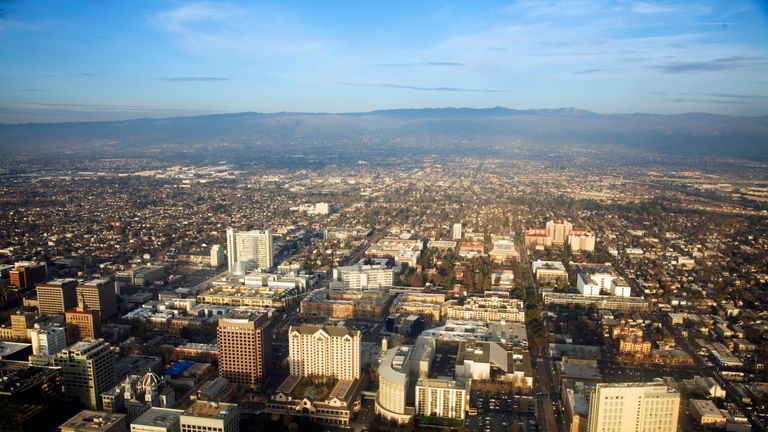
Silicon Valley is home to some of the biggest names in tech
As described by Sky’s Ian King when Theranos went bust in 2018, three years after the Journal’s report, key to the company keeping the wool fixed firmly over the public’s eyes until then had been an almost cult-like culture among its executives and staff, and one of extreme secrecy.
Neither are unique to Silicon Valley – some of the big tech personalties who have emerged over the years remain an odd focus of worship in some corners of the internet – but rarely have they combined to such destructive effect.
The journalist who broke the story, John Carreyrou, has since written a book on the scandal called Bad Blood, which stands to be turned into a feature film. There’s perhaps a cruel irony that it’s being produced by Apple, the company whose late co-founder was a source of such inspiration for Holmes.
Her rise and fall also inspired a hit podcast series called The Dropout, and a subsequent Hulu series of the same name starring Amanda Seyfried.
The show presents Holmes as a brave, smart, single-minded young woman determined to succeed, and she is initially easy to root for. As Apple designer Ana Arriola tells Holmes in a scene when she attempts to recruit her following the launch of the first iPhone: “Honestly, it’s just really exciting to me that you’re a young female CEO, instead of a cocky little boy in a sweatshirt.”
But Holmes’s goal of becoming a wealthy star of the biotech scene quickly overcomes all other instincts – including a willingness to tell the truth.
It’s a trait that left some staff feeling deeply uneasy, not just Gibbons and Arriola, who describes her time at Theranos on her LinkedIn page as “altruism through corrupt unethical science-fiction”.

Amanda Seyfried as Holmes in The Dropout: Pic Disney+
How a life unravelled
Carreyrou’s revelations, which Holmes has admitted trying to silence, sparked investigations by medical and financial regulators in the US. In a development which would once have been unthinkable, the now 34-year-old was facing criminal charges in 2018.
She and the president of Theranos, ex-lover Romesh Balwani (who she has since accused of sexual assault), were accused of engaging “in a multi-million-dollar scheme to defraud investors, a separate scheme to defraud doctors and patients”, and each faced two counts of conspiracy to commit wire fraud and nine counts of wire fraud.
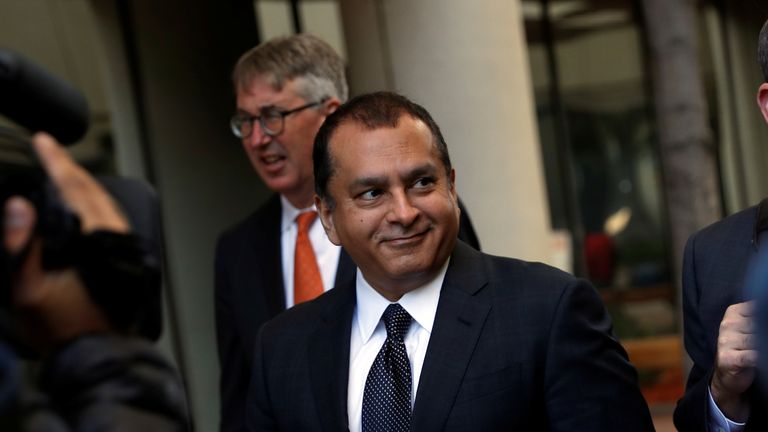
Former Theranos president Ramesh Balwani
Among those defrauded investors were the likes of Rupert Murdoch and the American pharmacy giant Walgreens, while similarly big names had been attracted to Theranos’s board of directors.
Among them were former secretaries of state Henry Kissinger and George Shultz, and an ex-director of the US Centers for Disease Control.
All of them had been hoodwinked by Holmes, who had founded Theranos aged just 18 and quickly learned how to tell her backers exactly what they wanted – and she needed them – to hear.
As Eric Jackson, a startup founder and author of The PayPal Wars, put it to Sky News: “There is almost endemic to the system a need to, I don’t want to say exaggerate, but to tell a narrative that’s compelling to investors. At a certain point hype does have to be in line with credibility, if not you’re in an instance of good old-fashioned fraud.”
Whether it was a matter of delusion, falling victim to the treacherous “fake it ’til you make it” culture that permeates American startups, or something more sinister, Holmes maintained during her trial that she initially believed her company’s purportedly revolutionary blood tests were real.
“I wanted to convey the impact the company could make for people and for health care,” she told the court of her meetings with investors.
To prosecutors, such assertions were the consequence of a woman who was “out of time and out of money”.
Having launched her company by repurposing family funds meant for her Harvard degree, taking it mainstream meant doing whatever it took to attract her big time investors and venture capitalists.
The once-enamoured former US secretary of defence Jim Mattis, who joined the company board, told the trial: “There just came a point when I didn’t know what to believe about Theranos any more.”
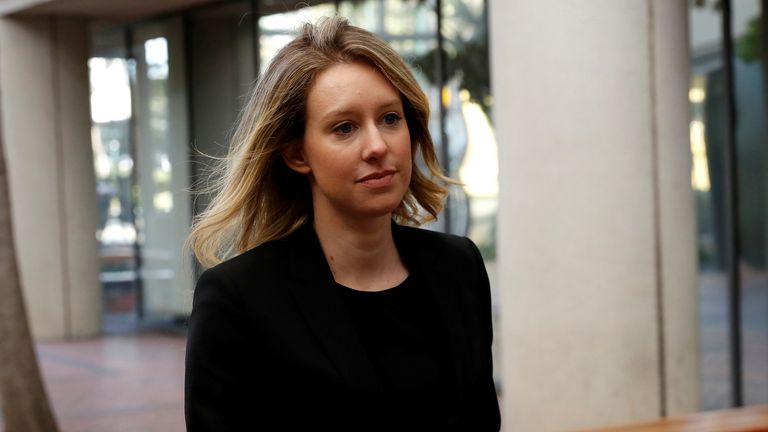
Holmes arrives for a hearing in San Jose in 2019
‘She chose lies when we needed truth’
Holmes’s sentencing on Friday comes after she was convicted of fraud earlier this year, her years-long scam having failed to move the jury as it had done her backers.
After a case which gripped the world, just as her rise to fame had done, US federal prosecutors want the judge to jail her for 15 years, a term considered appropriate for “one of the most substantial white collar offences Silicon Valley or any other district has seen”.
Balwani has been left waiting until next month for his sentencing, having also been convicted of multiple fraud counts during a separate trial.
For more on science and technology, explore the future with Sky News at Big Ideas Live 2022.
Find out more and book tickets here

In a 46-page brief last week, assistant US attorney Robert S Leach wrote of Holmes: “She repeatedly chose lies, hype, and the prospect of billions of dollars over patient safety and fair dealing with investors.
“Elizabeth Holmes’ crimes were not failing, they were lying – lying in the most serious context, where everyone needed her to tell the truth.”
A counter document from Holmes’s attorneys, totalling 82 pages, insisted her reputation had been permanently and unfairly destroyed, given it had turned her into a “caricature to be mocked and vilified”.
They are appealing for a sentence of no more than 18 months.
More than 130 friends, family, former investors and employees have also submitted letters to the judge, Edward Davila of San Jose, California, to appeal for leniency.
Senator Cory Booker used his to hail Holmes, still only 38, as someone who “can, despite mistakes, make the world a better place”.
Whether that’s true or not, she won’t be able to from behind bars.
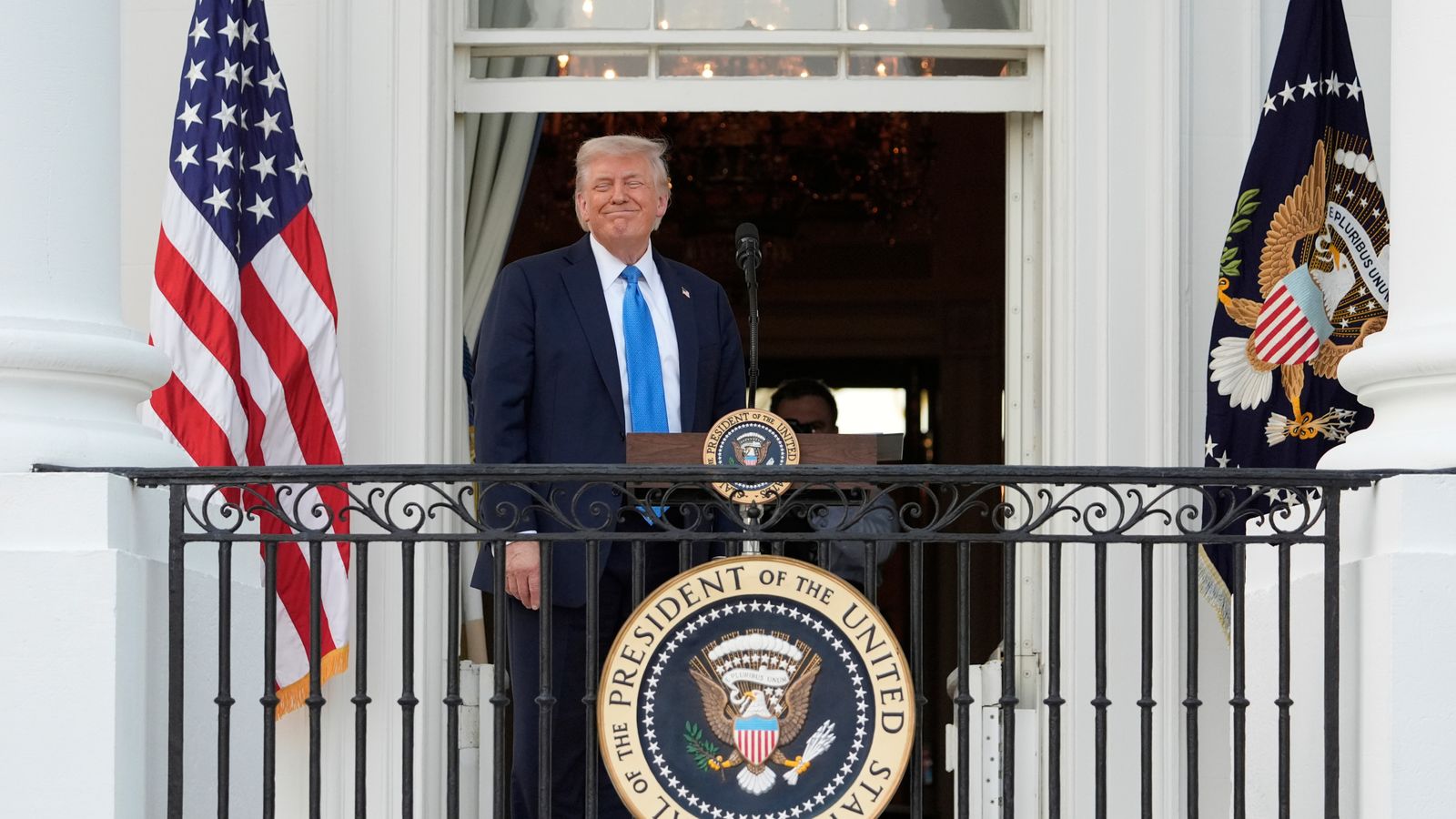
President Trump’s “America First” agenda has been spelt out in a new White House National Security Strategy that should make stark reading for allies and foes of the United States alike.
The new 33-page document outlines an upending of American foreign policy objectives and priorities which have stood largely unchanged through different administrations stretching back decades.
The document says American strategy went “astray” over many years. It seeks to reframe America’s strategic interests as being far narrower now than at any time in its modern history.
Among the key points, the document says:
• Europe faces “civilizational erasure” and could be “unrecognisable in 20 years or less”
• “Certain NATO members will become majority non-European” within a few decades
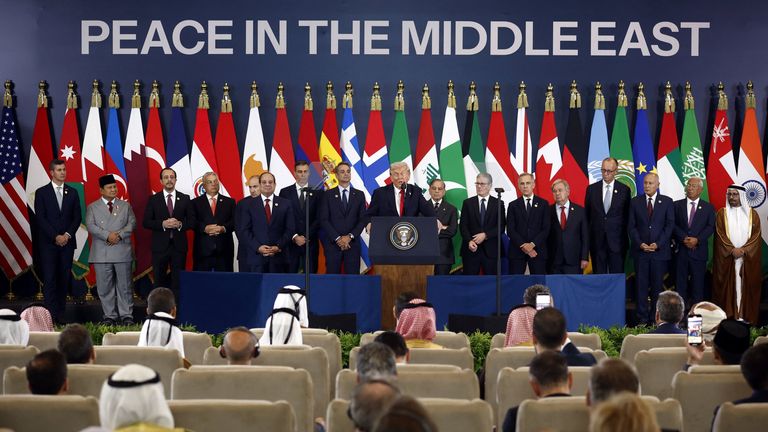
• America will “shift away” from the “burden” of the Middle East seeing it now as a “source and destination of international investment”
• In the Western hemisphere, America should pursue a policy of “enlist and expand… restoring American pre-eminence”
• In Africa, American policy focus should be on trade not “providing and spreading liberal ideology”
America will ‘shift away’ from the ‘burden’ of the Middle East. Pic: Reuters
In black-and-white, the text articulates a dramatic strategic shift which has been playing out at lightning speed over the past year.
The document underlines the end of the concept of America as an arbiter of the democratic rules-based order.
“American foreign policy elites convinced themselves that permanent American domination of the entire world was in the best interests of our country. Yet the affairs of other countries are our concern only if their activities directly threaten our interests,” the paper says.
Every US administration publishes at least one National Security Strategy during a presidential term.
The focus of this one is starkly different from that published by President Biden in 2022.
It’s also notably different from the document which President Trump published during his first term. His 2017 paper cast the world as a contest between “repressive regimes” and “free societies”.
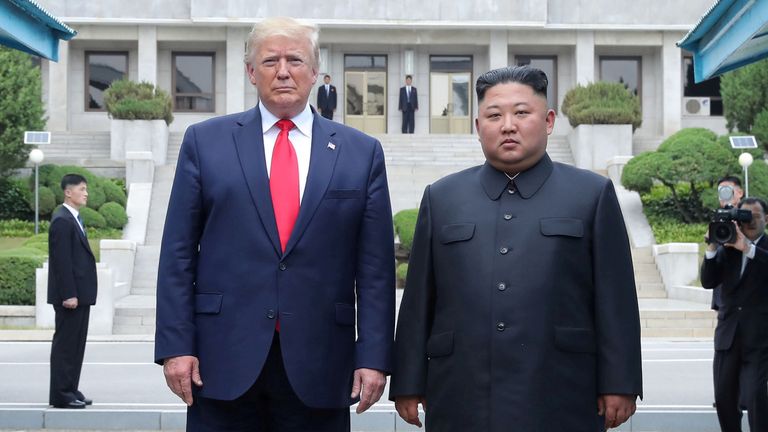
Trump doesn’t want the US to be the arbiter of the democratic rules-based order. Pic: Reuters
This new one places the necessity to do trade above the imposition of values.
“We seek good relations and peaceful commercial relations with the nations of the world without imposing on them democratic or other social change that differs widely from their traditions and histories.”
Mass migration and Europe
The new document is highly critical of mass migration.
It warns that uncontrolled migration is destroying the concept of nation states which could impact America’s strategic alliances and the countries it counts as reliable allies.
The paper is particularly critical of Europe, of the European Union as a concept and of individual European nations.
“Should present trends continue, the continent will be unrecognizable in 20 years or less,” the paper says.
It continues: “As such, it is far from obvious whether certain European countries will have economies and militaries strong enough to remain reliable allies.
“Many of these nations are currently doubling down on their present path. We want Europe to remain European, to regain its civilizational self-confidence, and to abandon its failed focus on regulatory suffocation.”
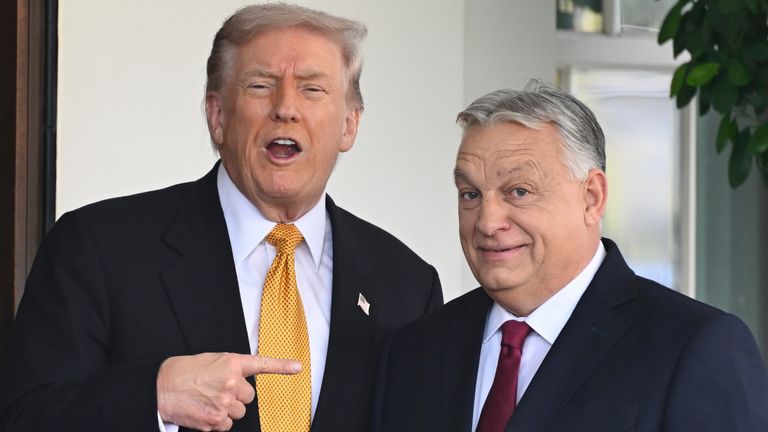
Trump will seek to support ‘patriotic European parties’. Pic: AP
The document’s language around the politics of governing parties across Europe is particularly stark.
Regarding Ukraine, the document says: “The Trump Administration finds itself at odds with European officials who hold unrealistic expectations for the war perched in unstable minority governments, many of which trample on basic principles of democracy to suppress opposition.
“A large European majority wants peace, yet that desire is not translated into policy, in large measure because of those government’s subversion of democratic processes.”
👉 Tap to follow Trump100 wherever you get your podcasts👈
The document outlines how his administration will seek to support “patriotic European parties”.
This is entirely in line with President Trump’s rhetoric but still represents a major departure from the longstanding principle of not interfering in the politics of allies.
It says: “American diplomacy should continue to stand up for genuine democracy, freedom of expression, and unapologetic celebrations of European nations’ individual character and history.
“America encourages its political allies in Europe to promote this revival of spirit, and the growing influence of patriotic European parties indeed gives cause for great optimism.”

Trump has at times had a fiery relationship with Ukraine’s President Zelenskyy. Pic: Reuters
Ukraine and Russia
On European-Russia relations, the document raises the prospect of war but curiously does not presume that such a conflict would involve America.
“Managing European relations with Russia will require significant US diplomatic engagement, both to reestablish conditions of strategic stability across the Eurasian landmass, and to mitigate the risk of conflict between Russia and European states.”
Read more from Sky News:
Germany introduces controversial military service law
Netflix agrees $72bn deal for Warner Bros studios
By contrast, President Biden’s National Security Strategy, published in 2022, underlined repeatedly the “iron-clad” commitment the United States had to Europe’s security.
Chinese risk and opportunity
The document presents Asia and the Indo-Pacific region as a source of opportunity for strategic and economic cooperation.

Maintaining US military strength over China is also outlined. Pic: Reuters
“President Trump is building alliances and strengthening partnerships in the Indo-Pacific that will be the bedrock of security and prosperity long into the future…”
And specifically on China, the paper presents a goal of “economic vitality” achieved through a balanced economic relationship between the two countries combined with an “ongoing focus on deterrence to prevent war”.
Deterrence would be achieved, it outlines, by maintaining preeminent military strength over China.
It says: “This combined approach can become a virtuous cycle as strong American deterrence opens up space for more disciplined economic action, while more disciplined economic action leads to greater American resources to sustain deterrence in the long term.”
Hemispheres of influence
In line with President Trump’s focus on spheres of influence, particular focus is given to the western hemisphere.
There are clear references to the impact of drugs from south and central America into the US and more subtle references to control of the arctic.
“The United States will reassert and enforce the Monroe Doctrine to restore American pre-eminence in the Western Hemisphere, and to protect our homeland and our access to key geographies throughout the region,” the paper says.
It continues: “We will deny non-Hemispheric competitors the ability to position forces or other threatening capabilities, or to own or control strategically vital assets, in our hemisphere.”
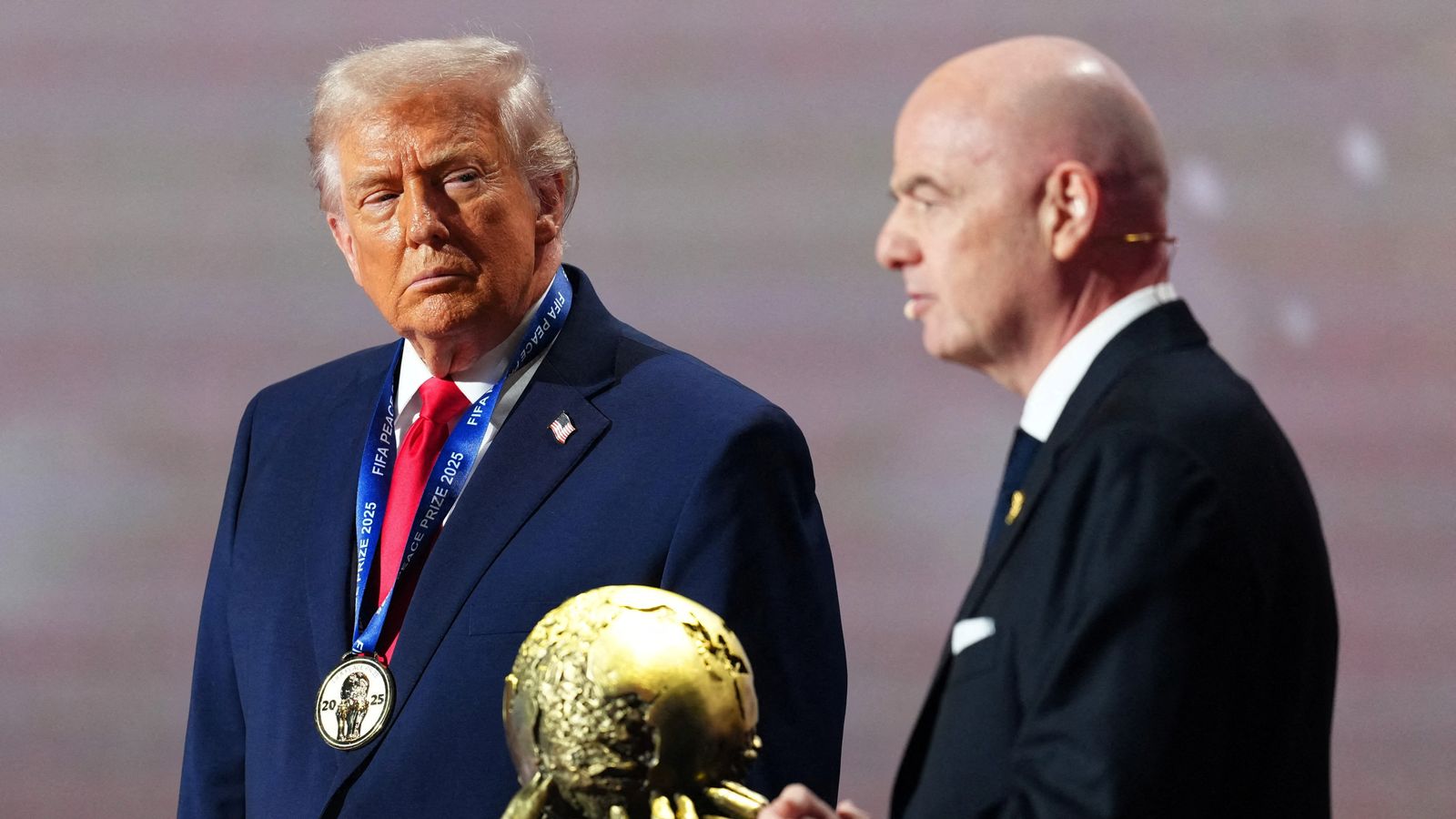
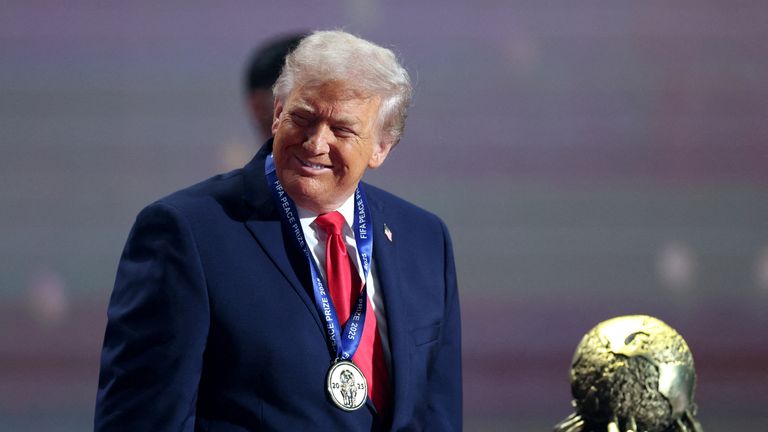
US President Donald Trump has been awarded FIFA’s new peace prize at the draw for next year’s World Cup.
FIFA President Gianni Infantino presented Mr Trump with a large golden trophy – formed of hands holding the earth – and a gold medal, which he wore around his neck.
The certificate, which Mr Infantino handed over at Washington DC’s Kennedy Center on Friday, recognises the US president for his actions to “promote peace and unity around the world”.
World football’s governing body, which announced the annual award last month, said it would be given to “individuals who have taken exceptional and extraordinary actions for peace”.
World Cup draw latest: Home nations and Republic of Ireland await fate
Mr Trump said it was “truly one of the greatest honours of my life”.
He said: “We saved millions and millions of lives. The Congo is an example – over 10 million people killed. It was heading for another 10 million very quickly.”
US President Donald Trump. Pics: Reuters
He also pointed to India and Pakistan, saying, “so many wars that we were able to end, in some cases a little before they started”.
Ahead of the draw, Mr Trump told reporters he did not care about the prize, but noted that he had “settled eight wars” in nearly 11 months in office.
The United States, along with Canada and Mexico, will host the tournament in 2026.
Mr Infantino, who has built up a strong relationship with the US president, backed him for the Nobel Peace Prize earlier this year.
Read more from Sky News:
Netflix agrees blockbuster $72bn deal for Warner Bros studios
Several sites go down after Cloudfare outage
“This is what we want from a leader – a leader that cares about the people,” Mr Infantino said of Mr Trump.
The FIFA leader said to Mr Trump, “this is your prize, this is your peace prize”.
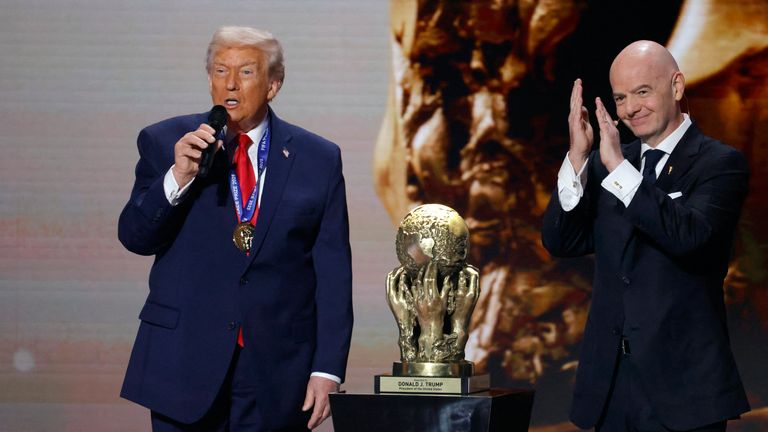
US President Donald Trump and FIFA President Gianni Infantino. Pic: Reuters
Mr Trump thanked his family, including his wife, first lady Melania Trump, and praised the leaders of the other two host nations – Canadian Prime Minister Mark Carney and Mexican President Claudia Sheinbaum – in his brief remarks.
Mr Infantino has often spoken about football as a unifier for the world, but the prize is a departure from the federation’s traditional focus on sport.
FIFA has described the prize as one that rewards “individuals who have taken exceptional and extraordinary actions for peace, and by doing so have united people across the world”.
The award comes during a week where Mr Trump’s administration has been under scrutiny for lethal strikes on alleged drug boats in the Caribbean and as Mr Trump hardens his rhetoric against immigrants.
The Nobel Peace Prize this year was eventually awarded to Venezuelan opposition leader Maria Corina Machado, who said shortly after receiving the prize that she was dedicating it in part to Mr Trump for “his decisive support of our cause”.
Netflix has agreed a $72bn (£54bn) deal to secure Warner Bros Discovery’s film and TV studios and supercharge its library through rights to top franchises including Harry Potter and Game Of Thrones.
It had been reported that the US streaming giant was in exclusive talks over the deal following a bidding war for the assets.
Paramount Skydance and Comcast, the ultimate owner of Sky News, were the rival suitors for the bulk of WBD that also includes HBO, the HBO Max streaming platform and DC Studios.
Money latest: Budget airline launches six new routes
While Netflix has agreed a $27.75 per share price with WBD, which equates to the $72bn purchase figure, the deal gives the assets a total value of $82.7bn.
It will see WBD come under Netflix ownership once its remaining Discovery Global division, mostly legacy cable networks including CNN and the TNT sports channels, is separated.
However, the agreement is set to attract scrutiny from competition regulators, particularly in the United States and Europe.
Both WBD and Netflix do not see the prospect of the deal being completed until late 2026 or 2027.
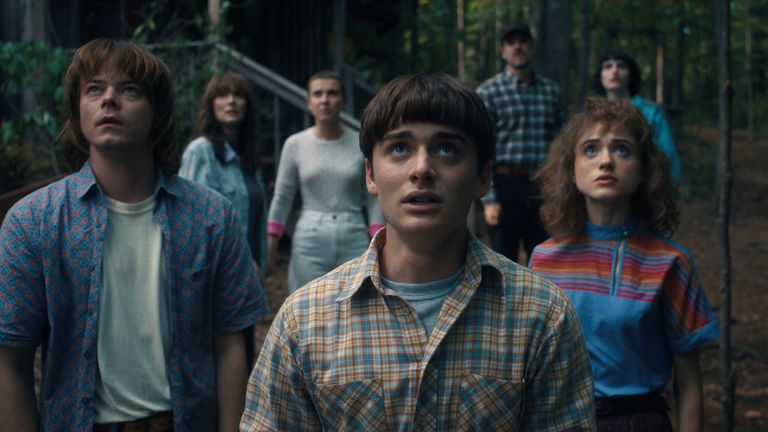
The main stumbling block is likely to be the fact that Netflix, which has hits including Stranger Things and Squid Game, is already the world’s biggest streaming service.
Stranger Things is one of Netflix’s biggest hits. Pic: Netflix
Further drama could come in the form of a complaint by Paramount, which had previously made a bid for the whole company.
CNBC reported this week that Paramount had claimed the auction process was biased in favour of Netflix.
Entertainment news provider Variety has also reported that major studios fear an institutional crisis for Hollywood unless the move is blocked.
Ted Sarandos, the co-chief executive of Netflix, said: “By combining Warner Bros’ incredible library of shows and movies – from timeless classics like Casablanca and Citizen Kane to modern favourites like Harry Potter and Friends – with our culture-defining titles like Stranger Things, KPop Demon Hunters and Squid Game, we’ll be able to do that even better.
“Together, we can give audiences more of what they love and help define the next century of storytelling.”
Netflix shares were trading down more than 3% in pre-market deals but recovered much of that loss when Wall Street opened. Those for WBD were up by more than 2%.
David O’Hara, managing director at the advisory firm MKI Global Partners, said of the proposed deal: “The 12-18 month timeline signals a long antitrust review, but despite the overlap between Netflix and HBO Max, there is a path to approval through possible HBO divestment.
“Netflix would not accept a $5.8bn break fee if it didn’t see at least a small chance of the deal closing.”
-
 Sports2 years ago
Story injured on diving stop, exits Red Sox game
-
 Sports3 years ago
‘Storybook stuff’: Inside the night Bryce Harper sent the Phillies to the World Series
-
 Sports2 years ago
Game 1 of WS least-watched in recorded history
-
 Sports3 years ago
Button battles heat exhaustion in NASCAR debut
-
 Sports3 years ago
MLB Rank 2023: Ranking baseball’s top 100 players
-
Sports4 years ago
Team Europe easily wins 4th straight Laver Cup
-
 Environment3 years ago
Japan and South Korea have a lot at stake in a free and open South China Sea
-
 Environment1 year ago
Here are the best electric bikes you can buy at every price level in October 2024