Connect with us

Published

on

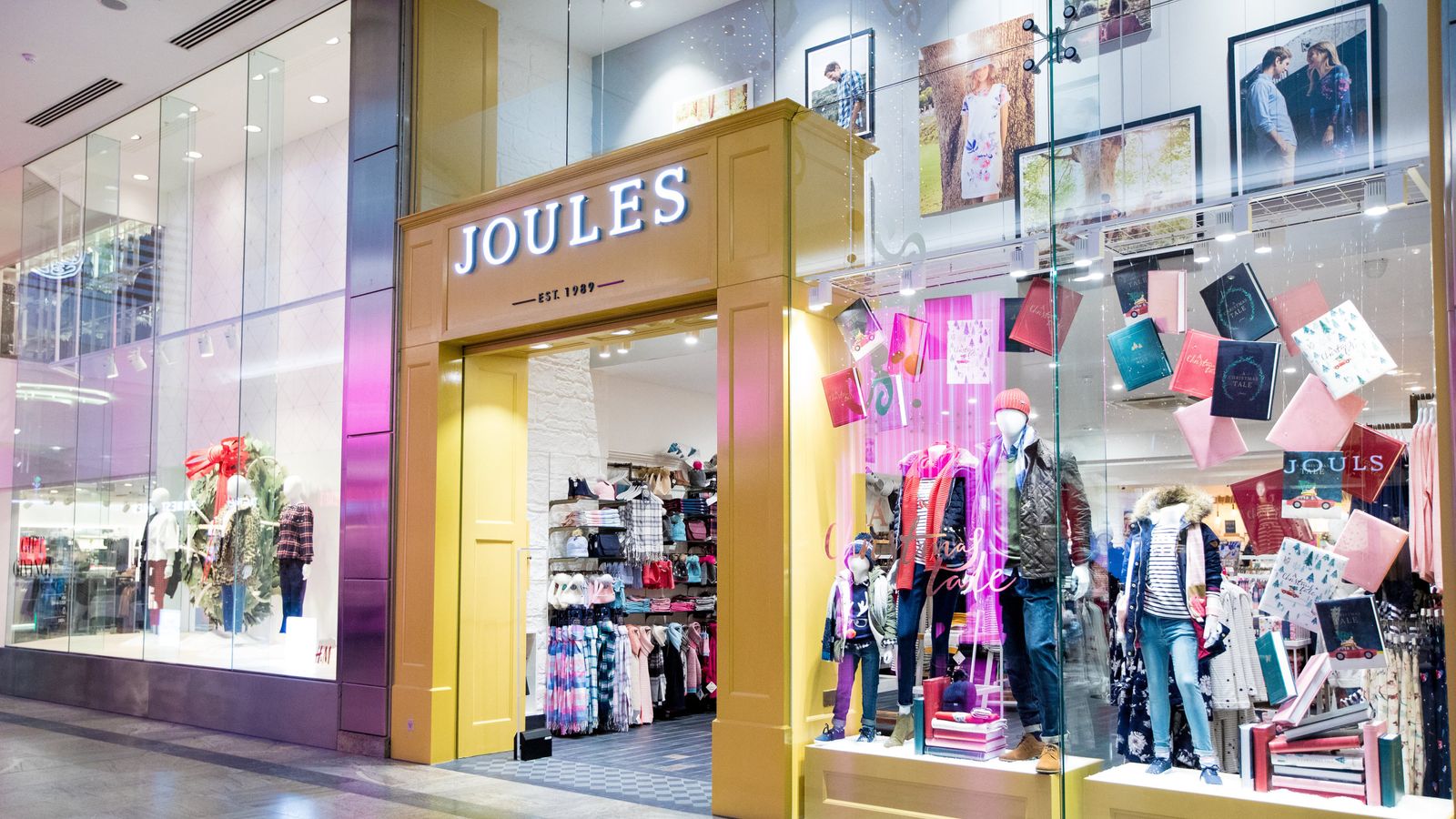
Collapsed fashion retailer Joules will live on after Next agreed a rescue deal that preserves most of its stores and jobs.

Under the deal Next will pick up 100 of its 132 stores and only 133 of 1,600 staff will lose their jobs.

TFG, the owner of the Hobbs, Whistles and Phase Eight womenswear brands, appeared to be the frontrunner on Wednesday in an auction process to secure an agreement with Joules’ administrator, Interpath Advisory.

Joules is the second major UK acquisition for the fashion-to-homewares retailer in as many months.

Next snapped up the brand, website and intellectual property of Made.com on 9 November.

Joules had been trading as normal since a failure to secure new investment pushed it towards insolvency a fortnight ago.

The clothing, footwear and accessories retailer collapsed after its finances, profitability and cash generation came under pressure amid the cost of living crisis.

It had been in talks with both Next and TFG about new investment beforehand.

Continue Reading

Business

COVID schemes’ fraud and error cost taxpayers £11bn

Published

on

By

COVID schemes' fraud and error cost taxpayers £11bn

COVID-19 fraud and error cost the taxpayer nearly £11bn, a government watchdog has found.

Pandemic support programmes such as furlough, bounce-back loans, support grants and Eat Out to Help Out led to £10.9bn in fraud and error, COVID Counter-Fraud Commissioner Tom Hayhoe’s final report has concluded.

Lack of government data to target economic support made it “easy” for fraudsters to claim under more than one scheme and secure dual funding, the report said.

Weak accountability, bad quality data and poor contracting were identified as the primary causes of the loss.

The government has said the sum is enough to fund daily free school meals for the UK’s 2.7 million eligible children for eight years.

An earlier report from Mr Hayhoe for the Treasury in June found that failed personal protective equipment (PPE) contracts during the pandemic cost the British taxpayer £1.4 billion, with £762 million spent on unused protective equipment unlikely ever to be recovered.

Factors behind the lost money had included government over-ordering of PPE, and delays in checking it.

More on Covid-19

This breaking news story is being updated and more details will be published shortly.

Please refresh the page for the latest version.

You can receive breaking news alerts on a smartphone or tablet via the Sky News app. You can also follow us on WhatsApp and subscribe to our YouTube channel to keep up with the latest news.

Continue Reading

Business

Magnum debut suffers a chill as Ben & Jerry’s row lingers

Published

on

By

Magnum debut suffers a chill as Ben & Jerry's row lingers

Shares in The Magnum Ice Cream Company (TMICC) have fallen slightly on debut after the completion of its spin-off from Unilever amid a continuing civil war with one of its best-known brands.

Shares in the Netherlands-based company are trading for the first time following the demerger.

It creates the world’s biggest ice cream company, controlling around one fifth of the global market.

Primary Magnum shares, in Amsterdam, opened at €12.20 – down on the €12.80 reference price set by the EuroNext exchange, though they later settled just above that level, implying a market value of €7.9bn – just below £7bn.

The company is also listed in London and New York.

Money latest: The cheapest days to travel by plane

Unilever stock was down 3.1% on the FTSE 100 in the wake of the spin off.

More from Money

The demerger allows London-headquartered Unilever to concentrate on its wider stable of consumer brands, including Marmite, Dove soap and Domestos.

The decision to hive off the ice cream division, made in early 2024, gives a greater focus on a market that is tipped to grow by up to 4% each year until 2029.

Ben & Jerry's accounts for a greater volume of group revenue now under TMICC. Pic: Reuters
Image:
Ben & Jerry’s accounts for a greater volume of group revenue now under TMICC. Pic: Reuters

But it has been dogged by a long-running spat with the co-founders of Ben & Jerry’s, which now falls under the TMICC umbrella and accounts for 14% of group revenue.

Unilever bought the US brand in 2000, but the relationship has been sour since, despite the creation of an independent board at that time aimed at protecting the brand’s social mission.

The most high-profile spat came in 2021 when Ben & Jerry’s took the decision not to sell ice cream in Israeli-occupied Palestinian territories on the grounds that sales would be “inconsistent” with its values.

Unilever responded by selling the business to its licensee in Israel.

A series of rows have followed akin to a tug of war, with Magnum refusing repeated demands by the co-founders of Ben & Jerry’s to sell the brand back.

Please use Chrome browser for a more accessible video player

Sept: ‘Free Ben & Jerry’s’

Magnum and Unilever argue its mission has strayed beyond what was acceptable back in 2000, with the brand evolving into one-sided advocacy on polarising topics that risk reputational and business damage.

TMICC is currently trying to remove the chair of Ben & Jerry’s independent board.

It said last month that Anuradha Mittal “no longer meets the criteria” to serve after internal investigations.

An audit of the separate Ben & Jerry’s Foundation, where she is also a trustee, found deficiencies in financial controls and governance. Magnum said the charitable arm risked having funding removed unless the alleged problems were addressed.

The Reuters news agency has since reported that Ms Mittal has no plans to quit her roles, and accused Magnum of attempts to “discredit” her and undermine the authority of the independent board.

Magnum boss Peter ter Kulve said on Monday: “Today is a proud milestone for everyone associated with TMICC. We became the global leader in ice cream as part of the Unilever family. Now, as an independent listed company, we will be more agile, more focused, and more ambitious than ever.”

Commenting on the demerger, Hargreaves Lansdown equity analyst Aarin Chiekrie said: “TMICC is already free cash flow positive, and profitable in its own right. The balance sheet is in decent shape, but dividends are off the cards until 2027 as the group finds its footing as a standalone business.

“That could cause some downward pressure on the share price in the near term, as dividend-focussed investment funds that hold Unilever will be handed TMICC shares, the latter of which they may be forced to sell to abide by their investment mandate.”

Continue Reading

Business

Netflix takeover of Warner Bros ‘could be a problem’, Donald Trump says

Published

on

By

Netflix takeover of Warner Bros 'could be a problem', Donald Trump says

Donald Trump has said he will be “involved” in the decision on whether Netflix should be allowed to buy Warner Bros, as the $72bn (£54bn) deal attracts a media industry backlash.

The US president acknowledged in remarks to reporters there “could be a problem”, acknowledging concerns over the streaming giant’s market dominance.

Crucially, he did not say where he stood on the issue.

Money latest: The cheapest days to travel by plane

It was revealed on Friday that Netflix, already the world’s biggest streaming service by market share, had agreed to buy Warner Bros Discovery’s TV, film studios and HBO Max streaming division.

The deal aims to complete late next year after the Discovery element of the business, mainly legacy TV channels showing cartoons, news and sport, has been spun off.

But the deal has attracted cross-party criticism on competition grounds, and there is also opposition in Hollywood.

Please use Chrome browser for a more accessible video player

Netflix agrees $72bn takeover of Warner Bros

The Writers Guild of America said: “The world’s largest streaming company swallowing one of its biggest competitors is what antitrust laws were designed to prevent.

“The outcome would eliminate jobs, push down wages, worsen conditions for all entertainment workers, raise prices for consumers, and reduce the volume and diversity of content for all viewers.”

File pic: Reuters
Image:
File pic: Reuters

Republican Senator, Roger Marshall, said in a statement: “Netflix’s attempt to buy Warner Bros would be the largest media takeover in history – and it raises serious red flags for consumers, creators, movie theaters, and local businesses alike.

“One company should not have full vertical control of the content and the distribution pipeline that delivers it. And combining two of the largest streaming platforms is a textbook horizontal Antitrust problem.

“Prices, choice, and creative freedom are at stake. Regulators need to take a hard look at this deal, and realize how harmful it would be for consumers and Western society.”

Paramount Skydance and Comcast, the parent company of Sky News, were two other bidders in the auction process that preceded the announcement.

The Reuters news agency, citing information from sources, said their bids were rejected in favour of Netflix for different reasons.

Paramount’s was seen as having funding concerns, they said, while Comcast’s was deemed not to offer so many earlier benefits.

Read more:
Why Netflix could yet get its way in Trump’s America
Netflix flexes its muscles – and could yet get its way

Paramount is run by David Ellison, the son of the Oracle tech billionaire Larry Ellison, who is a close ally of Mr Trump.

The president said of the Netflix deal’s path to regulatory clearance: “I’ll be involved in that decision”.

On the likely opposition to the deal. he added: “That’s going to be for some economists to tell. But it is a big market share. There’s no question it could be a problem.”

Continue Reading

Trending