
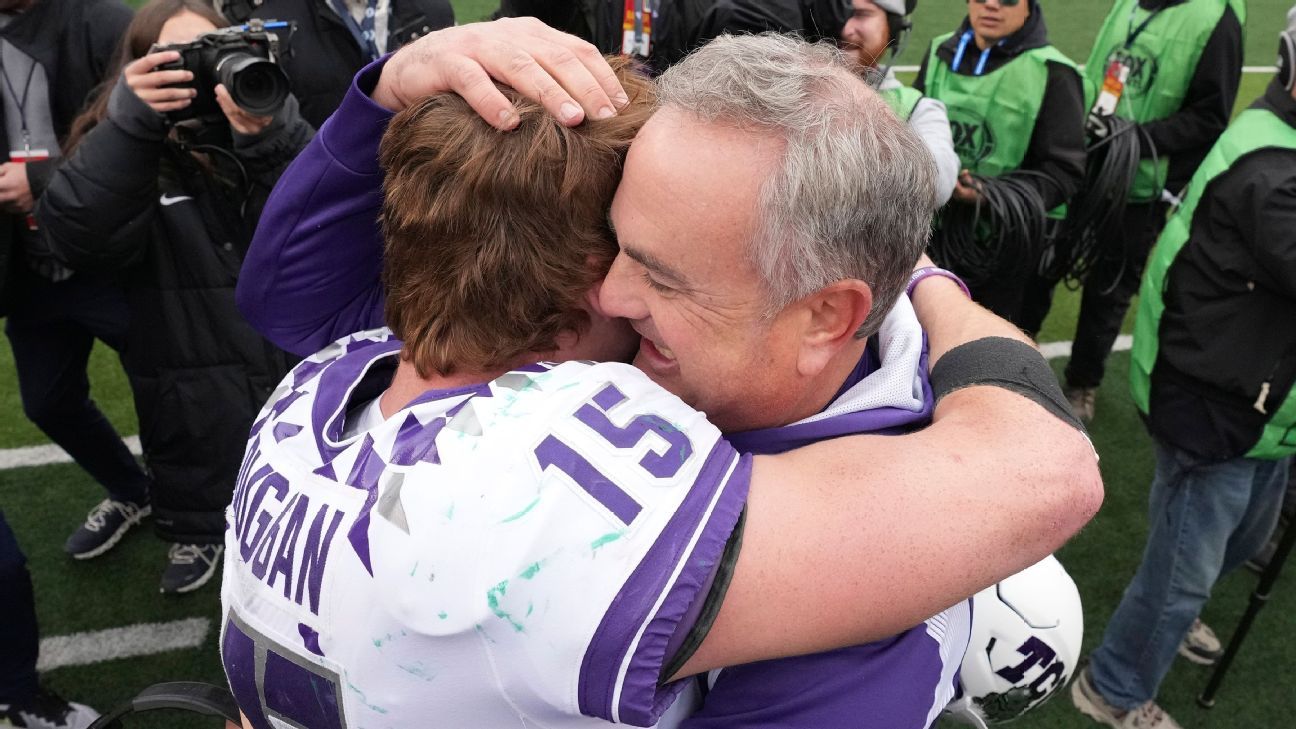
The Hypnotoad, a Mercedes and those postgame videos: 12 stories to explain TCU’s 12-0 season

One year and one day ago, on Nov. 30, 2021, Sonny Dykes landed in a helicopter at midfield of Amon G. Carter Stadium, awash in purple lights, for his arrival as the new head coach at TCU. It was a flashy introduction for the decidedly unflashy West Texan making a 40-mile trip to Fort Worth all the way from Dallas.
But 366 days later, Dykes is still adjusting to being the center of attention, because he still hasn’t lost a game in his career as TCU’s coach. His 12-0 Horned Frogs are No. 3 in the latest College Football Playoff rankings and are playing for a Big 12 championship against No. 10 Kansas State in the conference championship game on Saturday at AT&T Stadium in Arlington (noon ET, ABC/ESPN App).
It’s good to be Sonny Dykes right now. His team’s frantic, chaotic season of destiny, augmented with quite a bit of weirdness, has made the Horned Frogs a national curiosity. There’s an animated psychedelic amphibian that has captivated fans and inspired the team (“The Hypnotoad is powerful stuff,” Dykes said in an actual postgame news conference). The creative team’s bizarre postgame videos are puzzling, yet mesmerizing.
And now Dykes gets to travel all of 18 miles to play for a Big 12 title. If he didn’t feel like taking the bus, he could do that in style, too, thanks to a booster and longtime friend. Fin Ewing III, a Dallas car dealer and TCU grad who furnishes the coach’s car, came and picked up Dykes’ GMC Sierra (the Texas Edition, naturally) to swap it with a loaner befitting the coach’s lofty new status.
“I brought him a Mercedes, and he said he didn’t want anything that fancy,” Ewing said. “I said, ‘Dykes, lemme ask you a question. Are you undefeated?’ He said yeah, and I said, “Well get your ass in there.’ Now he looks like Jethro Bodine driving an S-Class.”
That’s a Beverly Hillbillies reference, but Dykes isn’t up and moving back to California anytime soon. Six seasons after Cal fired him, he has TCU on the cusp of being the first Texas team to land a spot in the playoff since it began eight years ago.
It’s been a surreal season for the Horned Frogs, full of memorable moments and storylines. Here are 12 that tell the tale of TCU’s 12-0 season.
Start of a new era
Ask any player on TCU’s team when they had a sense this year was going to be different, and you’ll get the same answer. It was that same day Dykes arrived in the helicopter, when they heard from him and strength coach Kaz Kazadi.
“The very first day — I don’t even think we’d gotten back in school yet — we get a text from Coach Kaz saying, ‘5:30 a.m. workouts, be here early at 5 o’clock,'” offensive lineman Wes Harris said. “We were like oh my gosh, no way. But I’ll tell you what, dude, it brought everybody together and kind of made everybody realize you know, we’ve always had the dudes to do it.”
Steve Avila, the Frogs’ Outland Trophy semifinalist at left guard, said Kazadi didn’t waste any time setting the tone.
“That is the last time you will ever look at me and question what I’m doing,” he told the team in that first meeting.
Kazadi is an intimidating presence, a 6-foot-2 former linebacker who was a Butkus Award semifinalist at Tulsa before playing five years of pro football. He is always watching, asking players, “You holding?” to make sure they have a bottle of water on them to stay hydrated. If they don’t, they hit the ground for push-ups.
For Dykes, Kazadi, who has a Master’s degree from Missouri in counseling psychology, is a trusted voice who spends more time with the players than anyone.
“He is so different than most strength coaches,” Dykes said. “You know how Matthew McConaughey is Texas’ Minister of Culture? I think Kaz is our Minister of Culture. At some point I got to where I completely 100% trusted his instincts. He’s trying to get the guys bigger, faster, stronger, like everybody is. But he’s got an element of sports psychology in every single workout. He sees every bit of time in the weight room as an opportunity to build the team.”
His role was crucial in earning the buy-in that first-year coaches need. Players have welcomed the accountability that he demands. And in a season when TCU has played a physical brand of football, repeatedly wearing teams out in the second half, his work has spoken for itself.
A return to SMU
Before there were any dreams of an undefeated season or a pressure-cooked playoff referendum every week, there was Dykes’ Sept. 24 return to SMU, where the feelings were still raw from his departure for their Iron Skillet rival that they’ve played 101 times. To add to the pressure, TCU was 0-11 against SMU, Kansas State, West Virginia and Iowa State since 2018, which Dykes was partially responsible for, beating the Horned Frogs in 2019 and 2021 (they didn’t play in 2020).
The game was circled by Mustangs fans, drawing 35,569, the largest crowd for a regular-season game in Ford Stadium’s 23-year history and the school’s first sellout since 2015.
The Horned Frogs escaped an SMU comeback attempt and pulled out a 42-34 win. Asked afterward if any of the booing or jeers affected him, Dykes said, “Not really. If I can’t do that, I need to go work for Ricky Chicken at Chicken Express,” a Texas fast-food chain owned by a TCU booster and board of trustees member, Ricky Stuart.
But Dykes also got emotional after the performance of quarterback Max Duggan, who completed 22 of 29 passes for 278 yards and three touchdowns in his second start of the season after beginning the year as a backup to Chandler Morris, who got injured.
“I’m probably as proud of Max as any player I’ve been around,” Dykes said after the game, choking back tears as his eyes watered. “He started 28 or 29 games coming into this season. He has a coaching change, which is hard to go through, especially when you were recruited by the staff before. He loses the job, which is really hard, he’s getting ready to be a senior. And he never blinks. He never thought of himself one time. How many people can you say that about? You can say that about Max Duggan, that’s for sure.”
Duggan breaks through
Duggan’s 278 yards against SMU came during a scorching seven-game stretch in which he topped that mark each game and threw 24 touchdowns, including throwing for 302 yards and three TDs while adding 116 and two scores rushing the next week against Oklahoma. It sparked a 55-24 win over the then-No. 18 Sooners in front of a sellout crowd at home and a nationally televised ABC game, landing Duggan on the national stage.
Duggan established career highs in yards (3,070), leads the Big 12 with 29 touchdown passes to just three interceptions (one came on a Hail Mary attempt at the end of a half), and is completing 67% of his passes, second-best in school history for a season. He is fourth nationally in efficiency rating (171.3) and tied for second in the country with 16 TD passes of more than 20 yards. He has thrived under Garrett Riley, TCU’s 33-year-old offensive coordinator and quarterback coach.
“I’m gonna let it kind of fly,” Duggan said. “I think that’s the thing that Coach Dykes and Coach Riley brought into our room and our offense as a team is just be bold, be aggressive, stop being reckless, but just go out there, don’t be afraid to make mistakes. You kind of see that on Saturdays.”
In many ways, Duggan, a former starter-turned-backup-turned-undefeated quarterback, symbolizes the unselfish nature of this year’s team.
“I’d do anything for that guy,” offensive lineman Wes Harris said. “He’s got the heart of a warrior and he’s just a leader. He’s a winner. He doesn’t care who’s playing or who makes the winning play.”
Now, Duggan, who was named the Big 12 Offensive Player of the Year on Wednesday, appears to be a lock for a Heisman invite to New York.
“It just means I’m playing with a lot of great people and under a great coaching staff,” Duggan said. “If it happened, it’d show more to those guys than it would to me.”
The Horned Frogs’ ground force
Riley and Dykes are both Texas Tech grads, and Dykes worked with Riley’s brother Lincoln in Lubbock. But that’s not what drew Dykes to the younger Riley.
“One of the things about the Air Raid that always concerned me was when we got in late-game situations,” Dykes said. “We would sometimes get in these one-score games and you get down to the nitty-gritty and you can’t get it done.”
So he hired Riley from Appalachian State, where he had been the running backs coach, because, Dykes said, he always admired the Mountaineers’ detailed approach to the running game. He said he wanted Riley specifically because he viewed things differently than he did and wanted to “combine those sensibilities.” While Dykes is a former OC himself, he prefers to let Riley run his own show, rather than offer input during game-planning.
Kendre Miller, who became the starter at running back this year after the transfer of Zach Evans to Ole Miss, has been a dependable playmaker under Riley. He has rushed for 1,260 yards and 16 touchdowns. More importantly, he’s averaged 7.03 yards per carry in the second half when TCU has a lead and forces a missed tackle once every three carries in that situation. Only Texas’ Bijan Robinson and Illinois’ Chase Brown have forced more second-half missed tackles, both on more carries (26 more for Robinson, 70 for Brown).
TCU, which has been a big-play threat all year, has been able to pound the ball in the second half, running 56.5% of the time, more than some old-school teams like Wisconsin. Riley, in his first year as a Power 5 coordinator, was recently named a finalist for the Broyles Award, given to the top assistant coach in the country.
“That part’s been good for me, to have the kind of team that will stay patient enough to run it and to keep chipping away,” Dykes said. “All of a sudden, it seems like we’ll start to take control of games and the third and fourth quarter. There’s a confidence that comes from that.”
The secret weapon
If you look at the TCU staff directory, you’ll see Jeff Jordan’s smiling mug next to his title: assistant athletic director for player personnel. No bio, that’s it. If you see Jordan on the sideline during a game, chances are he’s within a few feet of Dykes.
That’s because he’s Dykes’ confidant on everything from strategy to clock management to analytics. During the Horned Frogs’ comeback win against Baylor, Dykes said he and Jordan plotted out the dramatic final drive before TCU got the ball back, play by play. Then they did exactly what they said they’d do, and won the game on a walk-off field goal.
After spending 29 years as a high school coach, including 15 as the head coach at Garland High, a Dallas suburb, along with 28 years as a scout and film grader for the Dallas Cowboys, Dykes said Jordan has a rare mix of expertise for his duties on the field and off.
“I think he’s the most uniquely qualified person for his position in the country,” Dykes said.
Dykes was one of the early adopters of rebuilding a roster through the transfer portal when he arrived at SMU in 2018. Jordan was a key part of that operation because of his Texas high school connections and scouting background. He estimates that while working part-time for the Cowboys, he scrubbed through 1,000 games a year for more than 25 years. Most of what his job entailed was finding diamonds in the rough at small schools and running them up the ladder.
“We found Kenny Gant, who was at Savannah State and Larry Allen, who was at Sonoma State and Eric Williams, who was from Central State of Ohio and the list just goes on and on,” Jordan said of a few of his discoveries in the Cowboys’ glory days. “I was a really young guy and you’re figuring out there’s some good football players — Hall of Fame level — everywhere.”
Now, he trains those same eyes on the transfer portal. Which brings us to…
The unheralded transfers
Dykes was impressed with the speed on the top end of the roster when he took over. But there were a few major spots that needed shoring up. Dykes said the Frogs have been more reliant on transfers than people may realize.
They addressed one area of need by signing a nuclear engineering major who originally was recruited to the Naval Academy to play lacrosse before begging the football coaches to give him a shot. Johnny Hodges, now a 6-2, 240-pound linebacker, eventually decided he wanted a change of scenery and entered his name in the portal with two games to go last season, but found no takers.
“I probably reached out to 60 college coaches, every Power 5,” Hodges said. “Not a single one responded.”
Until Jordan, who had seen him play against them at SMU, and took his tape to new defensive coordinator Joe Gillespie.
“He was a guy that I think a lot of people just kind of got scared off of, because they thought he was the stereotypical Navy kid,” Jordan said. “He’s not gonna be able to run, he’s not gonna be athletic enough. If you sat and watched his film, you’re like, this guy’s a lot more athletic than people give him credit for being.”
Hodges is now TCU’s leading tackler with 76, including 7.5 for a loss, with one of those being a key solo tackle on Texas’ Bijan Robinson on fourth-and-1 in a 17-10 win. He was named the Big 12’s Defensive Newcomer of the Year.
Josh Newton, who was named to the Big 12’s first team on defense and is Pro Football Focus’ No. 1-graded corner in the conference, was a Louisiana-Monroe transfer who has emerged as a true lockdown option opposite Thorpe Award finalist Tre’Vius Hodges-Tomlinson. Newton has also become a leader in the locker room this year, reminding the Horned Frogs how fortunate they are to be in this position.
This ain’t the end… ?#GoFrogs #DFWBig12Team pic.twitter.com/TBJWJVxGXM
— TCU Football (@TCUFootball) November 25, 2022
Players from Stephen F. Austin (DL Caleb Fox), UConn (DL Lwal Uguak) and Louisiana (RB Emani Bailey) have all been key contributors.
“There’s hasn’t been a ton of schools that dip down into the Group of Five,” Jordan said. “I think spending four years [at SMU], we know there’s a lot of good players in there. You don’t ever write off a guy just because of his pedigree.”
The Believer
In offseason workouts, coaches often bring in other coaches for an outsiders’ perspective. In August, Dykes invited former Pitt, Arizona State and Hawaii coach Todd Graham, who he’s known for years, to evaluate the program for a week. He was stunned by what Graham told him, which was at odds with what everyone expected from this team, including maybe Dykes himself.
“I love talking to people that see things differently than I do,” Dykes said, noting that Graham had visited him in his first season at SMU and told him he was in trouble, before a 5-7 season.
“Todd is very direct,” he said.
This time around, however, he had a completely different view. Graham told him they were going to win the Big 12.
Dykes laughed about it this week. “I said, ‘Well, I’m not quite as optimistic as you are. But I think we have a chance to have a good team.'”
So what did Graham see that led him to that prediction?
“I go visit a lot of programs. Coach [Mike] Norvell who worked for me is at Florida State, Billy Napier at Florida, Dan Lanning at Oregon, I visited all those places,” Graham said. “You find kids are kind of guarded, like, ‘Hey, where do I fit? Do I trust these guys?’ There was none of that [at TCU]. I didn’t just watch. I went to different position meetings. I went on the field and watched each coach teach. And there’s a high level of teaching and accountability with elite discipline.”
So yes, he said he truly believed the Horned Frogs would win the conference. And he’s not surprised that they are on the cusp of doing it on Saturday after the job he’s seen Dykes do this year.
It doesn’t just happen,” Graham said. “People say, ‘Oh, he’s winning with somebody else’s players.’ That’s all a bunch of bull. That same bunch, what was their record last year?”
‘TCU is just not supposed to do that against Texas’
All season long, Dykes has compared this team to a boxer. On Nov. 12, in a hotel ballroom the night before TCU played Texas, he reminded his team that being patient and physical has been their recipe for success.
“Let’s keep swinging,” he said. “That’s why we’ve been so damn good in the second half. Punch, punch, punch, keep punching. Every one of those punches adds up. That’ll happen tomorrow if we handle our business correctly.”
It did. In one of the Frogs’ biggest tests of the season, in front of 104,203 fans — the second-biggest crowd in Texas history — they won 17-10 by stifling one of the best offenses in the country.
Under new defensive coordinator Joe Gillespie, TCU held Texas to 199 total yards, its fewest in a home game since the Big 12 began play in 1996. Robinson had just 29 rushing yards on 12 carries, his fewest in the past two seasons, and Texas was held to three offensive points (the Longhorns’ lone touchdown came on a fumble return late in the fourth quarter).
It was the type of win reminiscent of Texas coach Darrell Royal’s 1961 quote comparing the Frogs to cockroaches after a 3-0 loss spoiled the Longhorns’ perfect season,. “It’s not what they eat and tote off,” he said, “it’s what they fall into and mess up that hurts.”
“TCU is just not supposed to do that against Texas, you know?” Dykes said this week.
But they did, and Gillespie is a big reason. Dykes hired the former Texas high school coach away from Tulsa to his first Power 5 job, seeing his 3-3-5 defense as a kind of counterpart to the Air Raid offense, based mostly on repetition and flexibility.
“I think the scheme is important, but the fit on the staff, just the kind of person he is really overshadowed the scheme,” Dykes said. “Those players want to make him proud because they like him and respect him so much. He’s a huge part of this season. I think we’re just getting started. We’re going to be one of the best defenses in college football.”
The Bazooka goes boom
The Horned Frogs’ dream of a CFP berth might’ve sunk into the Brazos behind Baylor’s McLane Stadium on Nov. 19 without a play that’s oft-practiced but rarely used.
Trailing 28-26, Dykes puzzled viewers across the country by running the ball on third-and-7 at the Baylor 26 with no timeouts and 22 seconds left in the game. Then, special teams coach Mark Tommerdahl called “Bazooka,” where the field-goal unit sprints out, gets set and launches a kick all while the clock is counting down. Kicker Griffin Kell jogged out onto the field casually, and holder Jordy Sandy calmly made sure everyone was set and waited for the clock to wind down. Kell drilled the 40-yarder, and TCU survived, heading out of Waco with a 29-28 win.
THE HORNED FROGS WIN!!!! ? STAYING UNDEFEATED! @TCUFootball pic.twitter.com/MEYDSI1FT8
— FOX College Football (@CFBONFOX) November 19, 2022
Tommerdahl, who has been coaching special teams for more than 30 years, said he thinks this is the first time he’s ever called Bazooka in a game-winning situation. But he and Dykes were confident after working together for eight years at three different schools, and have always made Bazooka the first rep, run full speed, of field-goal practices on Thursday. Of the Frogs’ comeback wins this season, this one was the most frantic, even if Dykes swears it wasn’t. But it wasn’t even the most unlikely, according to ESPN Analytics’ win probabilities:
• Week 6: Kansas’ win probability was as high as 68.4% with 7:36 remaining in the third quarter when the Jayhawks took a 17-10 lead.
• Week 7: Oklahoma State’s was at 96.1% when Duggan threw an incomplete pass on third down with 13:36 remaining in the 4th and the Cowboys leading 30-16.
• Week 8: Kansas State’s was at 91.2% with the Wildcats leading 28-10 with 3:32 remaining in the 2nd.
• Week 12: Baylor had a 92.1% chance to win with 6:48 remaining in the 4th quarter and the Bears leading 28-20.
“I ain’t gonna sit here and tell you we don’t look at the scoreboard,” Harris said. “But I don’t think there’s really that much of a difference … I don’t think it would matter if we’re up by 60 or down by 60. We’re still gonna be out there swinging and givin’ it hell.”
All glory to the Hypnotoad
TCU’s brand has gone national this year. Winning helps a bunch. But the Hypnotoad helps even more.
The frog with the hypnotic eyes was born from an animated sci-fi show called “Futurama” that originally ran from 1999-2003. TCU’s athletics marketing team adopted it for videos to use as a free-throw distraction at basketball games, and several different versions to use during pregame and key moments at football games.
But this year, these new transplants into the football program fully embraced it. And why not? It’s truly been a game-changer. In the Horned Frogs’ first matchup against Kansas State on Oct. 22, the Hypnotoad made an appearance on the video boards with TCU trailing 28-24 with five minutes left in the third quarter and the Wildcats facing a third-and-6 at the TCU 30.
The psychedelic frog appeared, and the crowd immediately went nuts. K-State quarterback Will Howard attempted to run for a first down and was stopped short. On the next play, kicker Chris Tennant missed a 44-yard field goal. Four plays later, Duggan hit Quentin Johnston for a quick-strike 55-yard touchdown, to give TCU its first lead of the day. They ended up winning 38-28.
After a 34-24 victory over Texas Tech on Nov. 5, Dykes said he could feel the energy change in the stadium after the Hypnotoad appeared.
“Strangely enough, for the first time this season, I noticed it,” Dykes said in his postgame news conference. “I also noticed we made a bunch of big plays right after. I’m not a big believer in coincidence, you know what I’m saying? I think there may be something to it. Hey man, the Hypnotoad is powerful stuff.”
Those videos: ‘I don’t understand what’s going on’
Jon Petrie won’t try to make any sense of his postgame videos celebrating a victory. He can’t. TCU’s coordinator of creative video, who just moved to Fort Worth this year from Maine, just started making weird stuff, and now he’s trapped in a prison of his own creation.
“If someone wasn’t on the internet and you tried to explain it to them, you’d sound like a crazy person,” Petrie said, comparing the videos to college football’s version of Jackson Pollock paintings. “Someone will ask me, ‘Is it good this week?’ I mean, I don’t know. I don’t think it’s supposed to be good? Isn’t that what makes it good? It’s supposed to be bad.”
We won’t argue. See for yourself. Here’s Petrie’s handiwork for the victory over Baylor.
justbearly.mp4 #GoFrogs #DFWBig12Team pic.twitter.com/zvvpw2RIUK
— TCU Football (@TCUFootball) November 19, 2022
“I think it’s funny when Baylor fans will share it and say, ‘This hurts,'” Petrie said. “What should hurt is a highlight reel. Or the final kick. Not Winnie the Pooh floating into the heavens.”
Petrie has tried to rationalize why he started making them. But he gave up.
“I didn’t expect us to be this good,” he said. “It’s unexplainable to me. So it’s as if I’m expressing it. I don’t understand what’s going on. I just kind of got this job.”
Sonny finishes strong, passes Spike
With the Frogs’ bye week coming way back on Sept. 17, TCU has run the gauntlet, in Dykes’ words. They played 10 straight weeks, ending with a 4-7 Iowa State team that had lost six of its games by one score or less. It was a dangerous matchup for a team that had already clinched a spot in the conference championship, and Dykes was clearly nervous about a trap game, particularly against a team with a suffocating defense that had only allowed a high of 31 points this year and only allowed three other teams over 20 points.
For years, Dykes had been dogged by dropping games late in the season. He even raised the issue himself on Oct. 15 after a 43-40 double-overtime win over Oklahoma State.
“Historically, our team has gotten off to good starts and not finished very well,” Dykes said after the game. “So it’s going to be a challenge for us to finish down the stretch. We know that. This is a different team. It doesn’t matter what happened in the past here or where I’ve been. We’re going to write a different story.”
On Saturday, his Horned Frogs crushed the Cyclones, 62-14.
The “Sonny Swoon” was a thing of the past. TCU completed a 12-0 regular season, a first for a Big 12 team since Texas in 2009. In the process, Dykes passed his father, the late Texas Tech coach Spike Dykes, in career wins with his 83rd.
“It’s a pretty sweet deal to do it. … To go 12-0 and pass him in career wins,” Dykes said. “I kind of felt him all year with me, it seems like, a little bit with this team. I know he would certainly get a kick out of our guys and the way that they work and the kind of people that they are. Because it’s a heck of a group.”
On Wednesday, Dykes was named the Big 12 coach of the year, which his dad won in 1996. He’s the first coach in league history to win the award in his first season.
Now there’s one game left for TCU to try to claim its own Big 12 title and cement a spot in the College Football Playoff.
“When you take over a program, it’s always wait till we get my guys,” Dykes said. “Man, I think from Day 1, these guys have tried to be my guys. And they have been my guys.”
Harris said the feeling is mutual from the players’ perspective.
“I feel like we can go line up against the Dallas Cowboys and play against ’em,” he said. “I don’t know if the score would show that, but shoot, at least we think that way, right? We’ve got the same guys. It’s just they’ve instilled this mindset into us and look at where it’s taken us.”
The Horned Frogs have been charmed all year, but as they head toward the finish line, they’re securing their place as one of the biggest outliers in college football history. TCU was coming off a 5-7 season, hadn’t been to a bowl game in three years and hadn’t won more than seven games in a season since 2017.
TCU became the first current Power 5 school to have a perfect regular-season record under a new coach after finishing below .500 in the previous season since Ohio State in 1944.
And with a win on Saturday, Dykes would be just the sixth coach in major college football history to go 13-0 in a single season, behind Ryan Day (2019 Ohio State), Chris Petersen (2006 Boise State), Samuel Thorne (1896 Yale), George Washington Woodruff (1892 Penn) and Walter Camp (1888 Yale).
Those other five coaches took over teams that had lost a combined seven games the season before, and four of those were at Boise, which had won 36 games in the three seasons before finishing 9-4 in 2005, the year before Petersen took over.
It’s been a magical year for Dykes, the low-key coach who formerly was more popular among athletic directors and administrators — Texas and Oklahoma both kicked the tires on him for their openings in recent years — than fans on Twitter.
His desk is covered in letters from well-wishers, known and unknown. There was even one of those hand-written notes from legendary Kansas State coach Bill Snyder, mentioning how proud Spike was — and still is — of him.
This summer, he could go anywhere in Fort Worth, and he didn’t draw much attention. But on Sunday, after polishing off an undefeated regular season, he walked into a taco shop by campus and a kindly older woman excitedly greeted the toast of college football. As he walked away, she shouted across the restaurant:
“God bless and go Frogs!”

-
David Hale
The first College Football Playoff rankings came out five weeks ago. They looked a lot like tonight’s rankings.
We’ve had precious little movement at the top, with a few teams jockeying up or down a slot, but effectively no seismic shifts in the landscape. BYU and Texas are the only two teams that were projected in the field in the committee’s first ranking that aren’t now — and they’re just barely on the outside with reasonable arguments for inclusion.
Teams ranked in the top 18 by the committee this year are a combined 55-9, with six of those losses coming to other teams ranked in the top 18. All three outliers are courtesy of — you guessed it — the ACC (Louisville to Cal, Virginia to Wake and Georgia Tech to Pitt).
That’s a massive anomaly. Last year, top-18 teams at this point had lost 19 games, including 14 to teams outside their own grouping. Top-10 teams are 33-4 this year. In the first 11 years of the playoff, top-10 teams had lost an average of nine games by this point in the season.
The two words that best describe this year’s playoff push are “status quo.”
That, of course, has been bad news for all the teams on the outside looking in — from those with valid cases such as Miami, BYU and Vanderbilt, to underdogs such as USC, Utah or Arizona that might’ve had a shot in a more chaotic year.
But the real loser in this copy and paste rankings season is all the fans who just want to see things get weird. It’s a sad state of affairs when we’re left to rely on MACtion and the ACC to do all the heavy lifting when it comes to college football drama. The power players need to step up — or, perhaps, ratchet down — their game to add a bit more drama.
The good news is, the committee’s ad hoc reasoning, mushmouthed explanations and mind-boggling about-faces still leave plenty to argue about, even if the big picture hasn’t changed all that much.
Here’s this week’s biggest slights, snubs and shenanigans.


It’s not entirely clear how this committee values wins. For the past month, the priority has certainly appeared to be about which team has the better losses (unless, of course, you’re Alabama).
That seems a foolish way to prioritize playoff teams, since the goal of the playoff isn’t to lose to good teams but to win games.
Does Texas have a bad loss? Yes. A 29-21 defeat to woeful Florida — even if the Gators also played Georgia and Ole Miss close and just walloped a team that beat Alabama head-to-head — is problematic.
But look who Texas has beaten: No. 7 Texas A&M by 10, No. 8 Oklahoma by 17 and No. 14 Vandy by three (in a game they led by 24 in the fourth quarter). That’s the résumé of a team capable of winning a national championship — even if the Horns were also capable of losing to a second-rate SEC team.
Are we trying to find teams with the most upside or give participation trophies to the ones which have not lost an ugly one? (Except, again, Alabama.)
And it’s not as if the committee believes an extra loss is disqualifying. Oklahoma, Alabama, Notre Dame and Miami all have two losses and are ranked ahead of one-loss BYU (more on that in a moment), so what’s the harm of moving a three-loss Texas ahead of a two-loss team that has accomplished less?
This all comes back to the most frequent and justified criticism of the committee: The same rules aren’t applied evenly. In some cases, record matters. In some cases, best wins matter. In some cases, better losses matter. The standard varies based on the team being considered. But if the committee is going to err in favor of any team, it should probably do so for one that’s proved — not once, not twice, but three times — that it can beat an elite opponent.
Oh, and moving Texas up ahead of, say, Notre Dame would also have the added bonus of allowing the committee to sidestep another tricky situation. Which leads us to…


We’re putting these two teams together because we’ve already lamented the committee’s utterly disingenuous evaluation of them repeatedly, so it feels redundant to keep going down the same rabbit hole. But, for the sake of two programs being astonishingly misevaluated, let’s do one more round.
For Miami, the logic is obvious: The Canes beat Notre Dame head-to-head.
But let’s keep going. Miami’s two losses — SMU and Louisville — would rank as the fourth- and fifth-toughest games on Notre Dame’s schedule, had the Irish played them. Instead, Notre Dame has cruised through an essentially listless slate. Six of Notre Dame’s 10 wins came against teams that beat zero or one other Power 4 opponent. Stanford — seriously, Stanford! — is Notre Dame’s fourth-best win (by record). Yes, Notre Dame played well enough in losses to two very good teams, but one of those teams has the same record and is somehow ranked lower! Even if this is strictly about the “eye test,” there’s little argument for ignoring the head-to-head outcome. Notre Dame’s strength of record is 13th. Miami’s is 14th. Notre Dame’s game control is fifth. Miami’s is sixth. If all else is the same, how is head-to-head not the deciding factor?
Yet, here’s a little more salt in the wound for the Canes: Had Florida State finished 6-2 instead of 2-6 in ACC play, Miami would’ve won the (fifth) tiebreaker for a spot in the ACC title game and could’ve locked up its place in the playoff by simply beating Virginia. Instead, the Canes will sit at home and watch and hope and, at this point, probably get left out. Chess, not checkers, by rival FSU.
As for BYU, the committee’s desire to overlook the Cougars makes no sense. Let’s take a look at a blind résumé, shall we? (Note: Best wins and composite top 40 based on an average of SP+, FPI and Sagarin ratings.)
Team A: No. 6 strength of record, No. 14 game control, best win vs. No. 11, next vs. No. 28, loss to No. 5, four wins vs. composite top 40, five wins vs. teams that finished 7-5 or better
Team B: No. 7 strength of record, No. 10 game control, best win vs. No. 13, next vs. No. 27, loss to No. 7, three wins vs. composite top-40, two wins vs. teams that finished 7-5 or better
Now, just based on that information, Team A would seem the obvious choice. Now what if I told you Team B just lost its head coach, too?
That’s right, Team A is BYU and Team B is Ole Miss. Every bit of data here suggests the Cougars are, at worst, on even footing with the Rebels or ahead, and yet the committee has Ole Miss ranked five spots higher.
This is, arguably, the second year in a row in which BYU was clearly the most overlooked team in the country.

A week ago, Notre Dame was ranked one spot ahead of Alabama.
Then on Saturday, the Irish beat 4-8 Stanford by 29 (in a game they at one point led 42-3), while Alabama beat 5-7 Auburn by seven (in a game the Tigers had a chance to tie before fumbling in Tide territory late).
The committee looked at those two results and said, “You know what, we like what we saw from the Tide! Move ’em up!”
What could possibly be the logic for shifting opinions on these two teams? The only other team that jumped another winning team was Texas, and the Longhorns beat the No. 3 team in the country emphatically, not a second-tier team that fired its head coach a month ago.
Oh, and hasn’t the committee made it pretty clear losses are supposed to matter? Well, Notre Dame has two losses to teams ranked in the top 12. Alabama got beat by a Florida State team that finished 5-7.
Even by the eye test, this makes little sense. Notre Dame has proved to be one of the most complete, dominant teams in the country, with a secondary that’s near impossible to throw on, a rookie quarterback who has been nearly flawless and a running back who might well be the best player in the country. Alabama, on the other hand, has a one-note offense that can’t run the football.
We’re not believers in using advanced metrics as a ranking of accomplishment, but if this is simply a “who’s better” debate…
-
SP+ ranks Notre Dame fifth and Alabama 12th.
-
FPI ranks Notre Dame third and Alabama sixth.
-
Sagarin ranks Notre Dame second and Alabama seventh.
-
FEI ranks Notre Dame fourth and Alabama ninth.
So, again, we ask: Why would the committee possibly make this change?
We’d wager you know the answer. That sticky Canes vs. Irish head-to-head debate is a real headache for the committee. But if Notre Dame’s currently the last team in and something unexpected happens this weekend (hello, BYU over Texas Tech), then the committee can do as it did in 2014 and wash its hands of a tough choice and keep both Notre Dame and Miami out.
(It’s also interesting that a seven-point win over a team with a losing record is enough to jump Notre Dame, but a 31-point win over a ranked Pitt did nothing for Miami’s relative placement with the Irish despite — and we’re not sure anyone has mentioned this yet — a head-to-head win!)
But, speaking of Alabama…


4. Championship game participants
Step into the time machine with us for a moment, all the way back to championship week 2024. Here’s the state of play: Alabama, at 9-3, is ranked No. 11, the first team out of the playoff and also out of the SEC title game. Still, the Tide and the SEC hope there’s a pathway to salvation because SMU — 11-1 and ranked eighth — still has a game to play against Clemson in the ACC championship. If the Mustangs were to lose, couldn’t the committee then justify slotting SMU behind Alabama based on another data point, even though the Tide were simply sitting at home watching the action?
This was the case being made throughout the run up to the ACC championship last season. SMU, which should’ve been celebrating a miraculously successful first season in the Power 4, spent hours upon hours defending itself against criticism that it didn’t belong in the same conversation with big, bad Bama. Rhett Lashlee hinted he thought the committee’s vote was rigged, SMU players lamented their status on the chopping block despite a ranking that should’ve put them safely in the playoff field, and SEC commissioner Greg Sankey made the rounds arguing that Alabama’s (and Ole Miss’ and South Carolina’s) strength of schedule ought to put them ahead of SMU (and others).
OK, back to the present day. Here we are with Alabama sitting perilously on the dividing line between in the field and out — a week ago, it would have been the last team in, but of course the committee had other ideas this time around — with a game to play against Georgia in the SEC championship. An ACC team (Miami) sits just a tick behind the Tide in the rankings, but it will be off this week.
So, what happens if Alabama loses?
The comparison to last year’s SMU isn’t even a particularly fair one. The Mustangs were at No. 8 before the ACC title game. Alabama is at No. 9 (and probably should be a spot or two lower). SMU’s game against Clemson was new territory. A loss to Georgia will actually undermine Alabama’s best argument for inclusion — the three-point win in Athens in September. And while SMU did make the playoff field last year, a last-second loss on a 56-yard field goal still dropped the Mustangs from No. 8 to No. 10 in the rankings.
Play this scenario out now: Alabama, ranked at No. 9, plays a team that currently counts as the Tide’s best win. Imagine if Georgia wins the rematch and does so convincingly. The committee docked SMU two spots for a last-second loss, so surely it will do at least that much to Alabama for a more convincing defeat, right? And here’s the other thing: Even with the ACC title game loss last year, SMU was 11-2 — one less loss than Alabama had. A Tide loss in the SEC title game will be defeat No. 3 — one more than Notre Dame or Miami or (presumably) BYU.
It’s hard not to see a conspiracy here given the committee’s inexplicable flip-flop between Alabama and Notre Dame. It’s hard not to see brand bias in how the Tide’s championship week narrative diverges from SMU’s a year ago. It’s not at all hard to envision a scenario where Alabama loses to Georgia, gets in as the last team anyway, and it’s all explained away as a completely reasonable decision.

Well, the committee finally weighed in on more than one team outside the Power 4 — mostly because it was just impossible to find enough Power 4 teams worth ranking — and the news isn’t good for JMU. With the committee deciding already that North Texas is the higher ranked team, the Dukes’ only hope for the playoff would seem to be a Duke win in the ACC title game.
But what exactly has the committee seen to warrant that decision? Check out the numbers.
Best win (by average FPI, SP+ and Sagarin ranking)
JMU: No. 54 Old Dominion
UNT: No. 62 Washington State
Next best
JMU: No. 62 Washington State
UNT: No. 68 Navy
Loss
JMU: No. 29 Louisville
UNT: No. 24 USF
Wins vs. bowl-eligible
JMU: six
UNT: five
Strength of record
JMU: 18th
UNT: 22nd
FPI
JMU: 28th
UNT: 37th
There are certainly some check marks in North Texas’ favor, including a more impressive win over common opponent Washington State and a slightly better SP+ ranking, but on the whole, James Madison has had the tougher path here. That can change should UNT beat Tulane, but the committee should’ve waited for that to happen. Instead, it has made it clear JMU isn’t sniffing the playoff unless it comes at the expense of the ACC.
Also angry this week: Vanderbilt Commodores (10-2, No. 14); The ACC leadership who voted on its tiebreaker policies; Manny Diaz, who has to try to make a coherent argument for his five-loss Duke Blue Devils getting in ahead of a one-loss JMU; Every 8-4 team with a markedly better résumé than 9-3 Houston, which isn’t ranked this week; and Lane Kiffin’s yoga instructor and Juice Kiffin’s dog walker.
Welcome to the party, James Madison.
With the inclusion of JMU at No. 25 in the selection committee’s penultimate ranking — its first appearance all season — the possibility of the ACC being excluded from the playoff entirely just got real. Five-loss Duke is nowhere to be found in the ranking.
If Duke beats Virginia in the ACC championship game, it’s not guaranteed a spot in the 12-team field. It could open the door for two Group of 5 conference champions to compete for a national title, and if the playoff were today, it would be Tulane out of the American and JMU from the Sun Belt. The ACC’s best team, Miami, is still on the outside.
At No. 12, the Hurricanes still need some help, but Alabama increased its chances of earning a spot as the SEC runner-up with a small promotion to No. 9. The conference championship games can still alter the picture, but hope on the bubble is dwindling.
Bubble Watch accounts for what we have learned from the committee so far — and historical knowledge of what it means for teams clinging to hope. Teams with Would be in status below are looking good after the committee’s fifth ranking. For each Power 4 conference, we’ve also listed Still in the mix. Teams that are Out will have to wait until next year.
The conferences below are listed in order of the number of bids they would receive, ranked from the most to least, based on the selection committee’s latest ranking.
Jump to a conference:
ACC | Big 12 | Big Ten
SEC | Independent | Group of 5
Bracket
SEC


Would be in: Alabama, Georgia, Oklahoma, Ole Miss, Texas A&M. Right now, the Crimson Tide are the last SEC at-large team in the field. Alabama will face Georgia in the SEC championship game, but the committee could have a difficult decision if Alabama loses and finishes as a three-loss runner-up. The Tide would have defeated Georgia during the regular season but lost to the Bulldogs in the championship game. Even in moving up a spot to No. 9 this week — ahead of Notre Dame — it still seems as if they have a little more margin for error, but how the SEC title game unfolds could matter. And how far Alabama drops could determine if the SEC gets four or five teams in the field. Alabama could finish as the committee’s highest-ranked three-loss team and still be excluded from the playoff to make room for a conference champion — as they were last year.
A Georgia win should lock up a first-round bye and a top-four finish for the Bulldogs, while a loss should still put them in position to host a first-round game. Georgia beat Ole Miss, so it would be surprising to see the Bulldogs drop below the Rebels with a loss, even though the Bulldogs would have one more defeat. With a 35-10 drubbing of Texas also on its résumé, Georgia would still have a strong enough case to finish as the committee’s top two-loss team.
At No. 6, the selection committee moved the Rebels up one spot, so clearly the departure of coach Lane Kiffin to LSU didn’t hurt Ole Miss or its chances of hosting a first-round home game. The bigger reasoning was a promotion after winning the Egg Bowl combined with Texas A&M losing to Texas.
Still in the mix: Texas. The Longhorns moved up to No. 13, but the win against Texas A&M wasn’t enough to put them into the field after the fifth ranking. Texas is stuck behind Miami in part because of its loss to Florida, which Miami beat. Even if BYU and Alabama were knocked out with title game losses, that still probably won’t be enough for Texas to get into the field because the bracket has to make room for conference champions.
Out: Arkansas, Auburn, Florida, Kentucky, LSU, Mississippi State, Missouri, South Carolina, Tennessee, Vanderbilt
Big Ten


Would be in: Indiana, Ohio State, Oregon. Both Indiana and Ohio State are CFP locks — even if they lose in the conference title game — and the runner-up will still have a strong case for a top-four finish and a first-round bye. The loser’s only loss will be to a top-two team, but it could fall behind Georgia in the top four if the Bulldogs win the SEC, and/or Texas Tech if it wins the Big 12.
The Ducks punctuated their résumé with a respectable win at Washington and should be secure in their playoff position, probably hosting a first-round game. Oregon received a small boost to No. 5 after Texas A&M lost to Texas.
Still in the mix: None.
Out: Illinois, Iowa, Maryland, Michigan, Michigan State, Minnesota, Nebraska, Northwestern, Penn State, Purdue, Rutgers, UCLA, USC, Washington, Wisconsin
Big 12

Would be in: Texas Tech. The Red Raiders will play BYU in the Big 12 title game and have a great case to be in the playoff regardless of the outcome. It’s highly unlikely the selection committee would drop the Red Raiders out of the field as a two-loss Big 12 runner-up — especially considering they would have a regular-season win against the eventual conference champion. It’s also possible Texas Tech earns a first-round bye as a top-four seed if the Red Raiders win the Big 12. The committee moved them into the top four Tuesday night following Texas A&M’s loss during Rivalry Week.
Still in the mix: BYU. If BYU doesn’t win the Big 12, it’s unlikely to earn an at-large bid as the conference runner-up because the Cougars are already on the bubble and would be eliminated during the seeding process if the playoff were today. It’s not impossible, though. If Alabama finishes as a three-loss SEC runner-up, it could at least open the door for debate. BYU would have lost to Texas Tech twice, and Alabama would have defeated Georgia, the eventual SEC champ once — and it was on the road. If BYU wins the Big 12, it’s the ideal scenario for the conference because it would have two teams in the playoff.
Out: Arizona, Arizona State, Baylor, Cincinnati, Colorado, Houston, Iowa State, Kansas, Kansas State, Oklahoma State, TCU, UCF, Utah, West Virginia
ACC


Would be in: TBD. The ACC championship game will feature Virginia and Duke, and if five-loss Duke wins, it’s possible the ACC is excluded from the playoff since Duke is not part of the CFP rankings. If Virginia wins, it will represent the league in the playoff, as the two-loss Cavaliers are ranked in the top 20. And no, Miami did not play Duke or Virginia during the regular season. Duke lost to Tulane, which is the top Group of 5 playoff contender and will reach the playoff if it wins the American. Duke also lost to UConn. And it has already lost to Virginia 34-17 on Nov. 15.
Still in the mix: Miami. The Canes are still the committee’s highest-ranked ACC team, but they would be excluded if the playoff were today to make room for a conference champion. That means the ACC winner could knock the league’s best team out of the playoff. The committee isn’t ignoring Miami’s head-to-head win against Notre Dame, but it also isn’t comparing the Canes only to the Irish. Miami also needs to earn an edge against BYU — which the committee has deemed better than Miami to this point. Miami inched closer to Notre Dame because Bama moved up Tuesday, but with neither team playing in a conference championship game, would the committee flip them on Selection Day with a BYU loss?
Out: Boston College, Cal, Clemson, Florida State, Georgia Tech, Louisville, North Carolina, NC State, Pitt, SMU, Stanford, Syracuse, Virginia Tech, Wake Forest
Independent
Would be in: Notre Dame. The Irish have done everything right since their 0-2 start, running the table and doing it with consistent dominance regardless of opponent. At No.10, Notre Dame is in a precarious position. If BYU wins the Big 12 and enters the field, that could bump out the Irish. If BYU wins the Big 12, both BYU and Texas Tech are highly likely to make the playoff, which means someone currently in the top 10 would have to be excluded.
Group of 5

Would be in: Tulane. If the Green Wave win the American, they will represent the Group of 5 in the playoff. Tulane is currently the highest ranked Group of 5 team, but if North Texas beats Tulane on Friday, the Mean Green would be the most likely team to reach the CFP, given the overall strength of the American Conference this season.

Still in the mix: James Madison, North Texas. JMU (11-1) has clinched the East Division and a spot in the Sun Belt Conference championship game, where it will face Troy (8-4) on Friday. North Texas will face Tulane in the American, and if it wins, it’s more likely to represent the Group of 5 in the playoff than JMU because of its schedule strength. JMU could still be considered, though, if Duke wins the ACC, giving the Group of 5 two playoff teams in the 12-team field. With JMU earning a spot in the top 25 this week, the situation became more probable.
Bracket
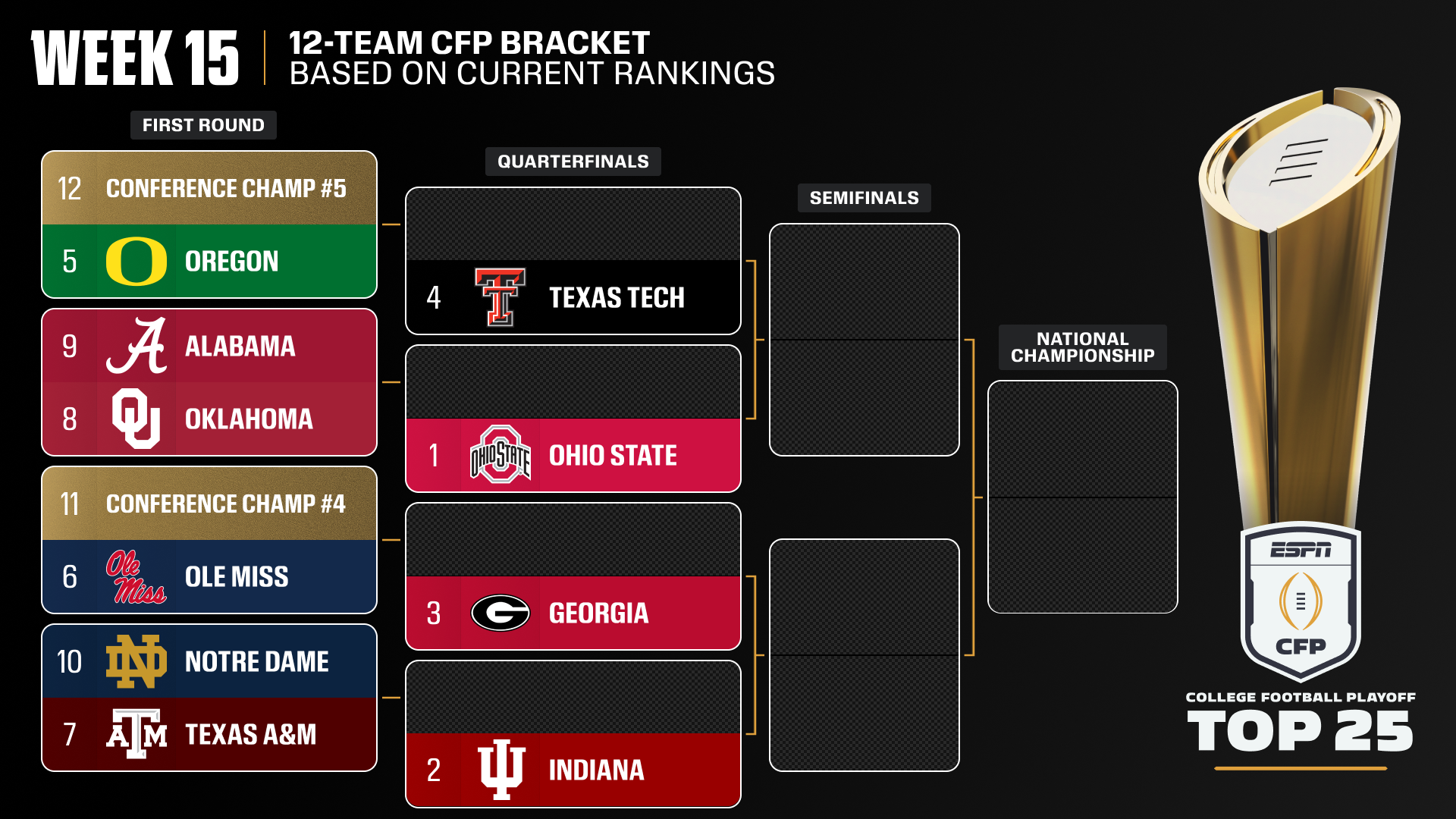
Based on the committee’s fifth ranking, the seeding would be:
First-round byes
No. 1 Ohio State (Big Ten champ)
No. 2 Indiana
No. 3 Georgia (SEC champ)
No. 4 Texas Tech (Big 12 champ)
First-round games
On campus, Dec. 19 and 20
No. 12 Tulane (American champ) at No. 5 Oregon
No. 11 Virginia (ACC champ) at No. 6 Ole Miss
No. 10 Notre Dame at No. 7 Texas A&M
No. 9 Alabama at No. 8 Oklahoma
Quarterfinal games
At the Goodyear Cotton Bowl, Capital One Orange Bowl, Rose Bowl Presented by Prudential and Allstate Sugar Bowl on Dec. 31 and Jan. 1.
No. 12 Tulane/No. 5 Oregon winner vs. No. 4 Texas Tech
No. 11 Virginia/No. 6 Ole Miss winner vs. No. 3 Georgia
No. 10 Notre Dame/No. 7 Texas A&M winner vs. No. 2 Indiana
No. 9 Alabama/No. 8 Oklahoma winner vs. No. 1 Ohio State
-
 Sports2 years ago
Story injured on diving stop, exits Red Sox game
-
 Sports3 years ago
‘Storybook stuff’: Inside the night Bryce Harper sent the Phillies to the World Series
-
 Sports2 years ago
Game 1 of WS least-watched in recorded history
-
 Sports3 years ago
Button battles heat exhaustion in NASCAR debut
-
 Sports3 years ago
MLB Rank 2023: Ranking baseball’s top 100 players
-
Sports4 years ago
Team Europe easily wins 4th straight Laver Cup
-
 Environment3 years ago
Japan and South Korea have a lot at stake in a free and open South China Sea
-
 Environment1 year ago
Here are the best electric bikes you can buy at every price level in October 2024