

William and Kate met by chants of ‘USA, USA’ and pockets of booing as race row clouds visit


The Prince and Princess of Wales’ first overseas trip since the Queen’s death has been overshadowed by controversy at home.
William and Kate arrived in Boston yesterday for a three-day visit before the Earthshot Prize, the prince’s environmental awards ceremony, on Friday.
Hours earlier, the prince’s godmother resigned from her duties at Buckingham Palace after repeatedly asking a black visitor “where she really came from”.
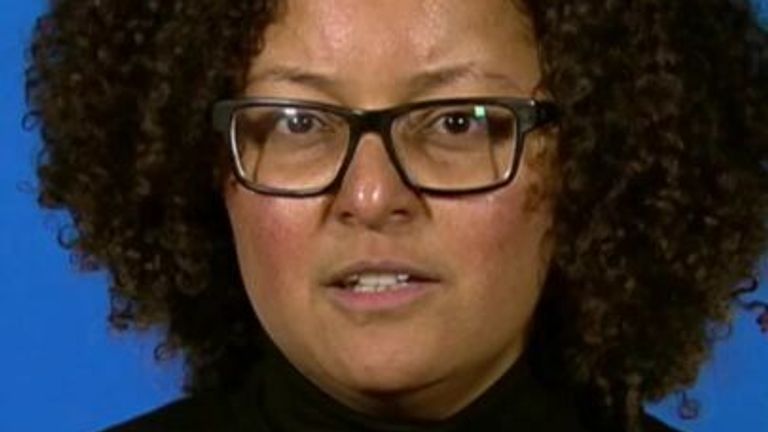
Ngozi Fulani

Lady Susan Hussey
A Kensington Palace spokesman who spoke to William before he boarded his flight said Lady Susan Hussey’s comments were “unacceptable” and that “racism has no place in our society”.
He added that Lady Hussey, 83, was right to have stepped aside from her honorary role as Lady of the Household with immediate effect.
The monarchy has faced allegations of institutional racism since Ngozi Fulani, a British-born charity boss, revealed what had happened at an event in Buckingham Palace on Tuesday.
Lady Hussey, who served as the Queen’s lady in waiting for more than 60 years, has offered her “profound apologies for the hurt caused”.
William focused on the Earthshot Prize as he greeted crowds in Boston, saying: “We are both looking forward to spending the next few days learning about the innovative ways the people of Massachusetts are tackling climate change.”
The White House has confirmed that the royal couple are set to meet Joe Biden, the president, later this week.
William and Kate sat courtside to watch an NBA game and were booed by small pockets of the crowd around the stadium when they were introduced by an announcer and shown on the big screen.
At one point, some fans in the crowd could be heard loudly cheering “USA, USA” when the couple appeared on the screens in the centre above the court.

Ngozi Fulani, left, and the Queen Consort at the palace on Tuesday
Charity boss reacts to resignation
Buckingham Palace said yesterday that it was taking the incident “extremely seriously” and described Lady Hussey’s comments as “unacceptable and deeply regrettable”.
Ms Fulani works as an advocate for survivors of domestic abuse and described the exchange as a “violation”.
Speaking to LBC, the chief executive of Sistah Space said “nobody from the palace has spoken to me”, but she would be “happy to have a conversation to bring about a positive solution”.
Reflecting further, she said: “To be honest I wish that the lady could be spoken to and know the damage she has caused and preferably not be front-facing.
“But for her to resign, that has nothing to do with me. I don’t feel good about that. She’s an elder and in my culture we respect elders.
“Conversations need to be had with the relevant people so this kind of thing doesn’t happen again.”
Last year, the Duchess of Sussex claimed that a member of the royal household raised concerns about what colour skin her son Archie would have before he was born.
Hussey ‘interrogated’ Fulani – witness
Royals must ‘step up’
Mandu Reid, leader of the Women’s Equality Party, who was standing next to Ms Fulani and witnessed the exchange, said she was “stunned”.
“It was really uncomfortable. If Ngozi was a white woman there is no way that line of questioning would have taken place. It’s not what you expect,” she told Sky News.
“We weren’t gate crashers, but we were made to feel almost like trespassers.”
Asked if she was reassured by Lady Hussey stepping down and apologising, she said no – and that the royals need to “step up” and acknowledge that “institutional racism is part of the culture”.

Americans will be able to visit national parks for free on Donald Trump’s birthday next year, but will no longer be able to do so on Martin Luther King Jr Day or Juneteenth.
The Department of the Interior has released a list of what it calls “resident-only patriotic fee-free days” for next year.
Mr Trump‘s birthday, which falls on the Flag Day national holiday, has been added to the list, as has the Fourth of July weekend and President Theodore Roosevelt’s birthday.
However, Martin Luther King Day and Juneteenth have been removed. Juneteenth was recognised in 2021 under Joe Biden’s administration and commemorates the end of slavery in the US.
Also removed are the anniversary of the Great American Outdoors Act in August and the National Public Lands Day in September.
“President Trump’s leadership always puts American families first,” the US interior secretary Doug Burgum said.
“These policies ensure that US taxpayers, who already support the National Park System, continue to enjoy affordable access, while international visitors contribute their fair share to maintaining and improving our parks for future generations.”
Read more from Sky News:
White House: Europe ‘unrecognisable in 20 years or less’
Trump awarded FIFA peace prize at World Cup draw
The department said it was also introducing “America-first entry free policies”, which means US residents will continue to “enjoy affordable pricing” while international visitors “will pay a higher rate to help support the care and maintenance of America’s parks”.
It said the annual pass will cost $80 (£60) for US residents and $250 (£187) for nonresidents, with nonresidents without an annual pass paying a $100 (£75) per person fee to enter 11 of the most visited national parks, in addition to the standard entrance fee.
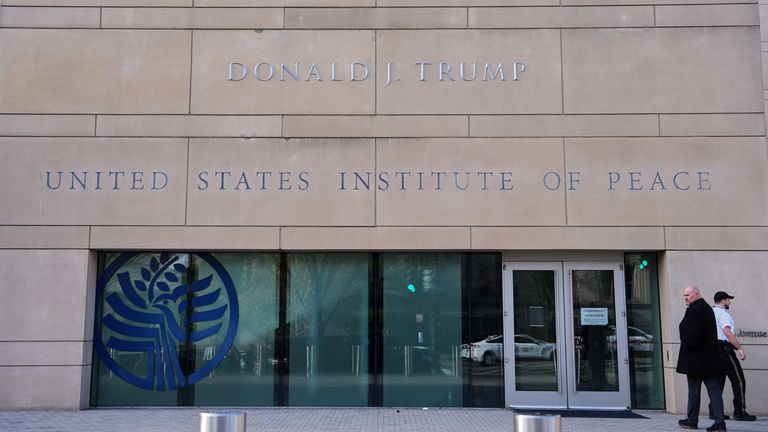
The US Institute of Peace. Pic: AP
Trump renames US Institute of Peace after himself
The decision to make his birthday a ‘free’ day comes after Mr Trump’s name was added to the sign on the headquarters building of the United States Institute of Peace in Washington DC.
The State Department shared a photo of the building’s new facade and called Mr Trump “the greatest dealmaker in our nation’s history”.
He has also unsuccessfully put himself forward for the Nobel Peace Prize, sought to put his name on the planned NFL stadium in Washington DC, and had a new children’s savings programme named after him.
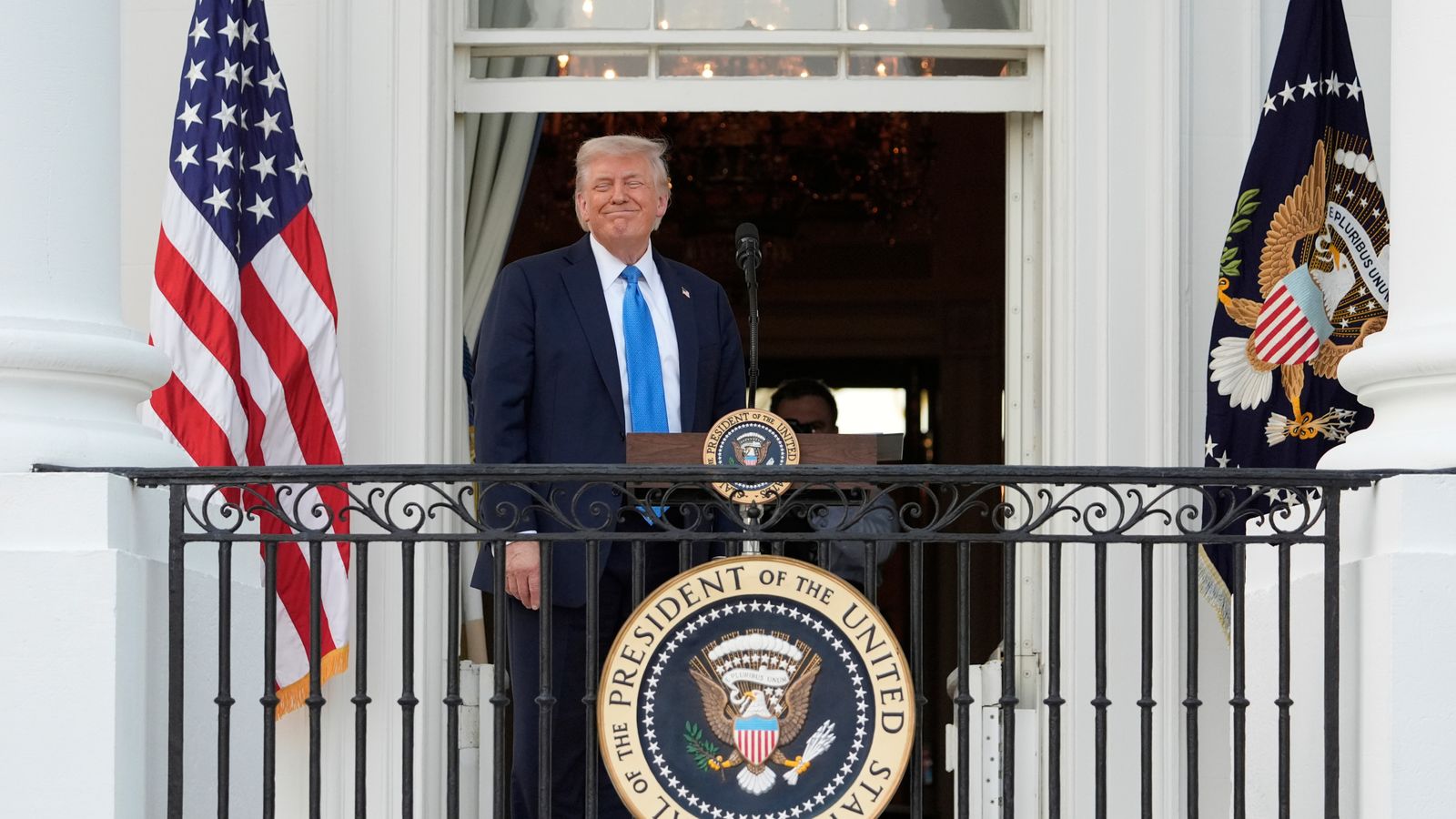
President Trump’s “America First” agenda has been spelt out in a new White House National Security Strategy that should make stark reading for allies and foes of the United States alike.
The new 33-page document outlines an upending of American foreign policy objectives and priorities which have stood largely unchanged through different administrations stretching back decades.
The document says American strategy went “astray” over many years. It seeks to reframe America’s strategic interests as being far narrower now than at any time in its modern history.
Among the key points, the document says:
• Europe faces “civilizational erasure” and could be “unrecognisable in 20 years or less”
• “Certain NATO members will become majority non-European” within a few decades
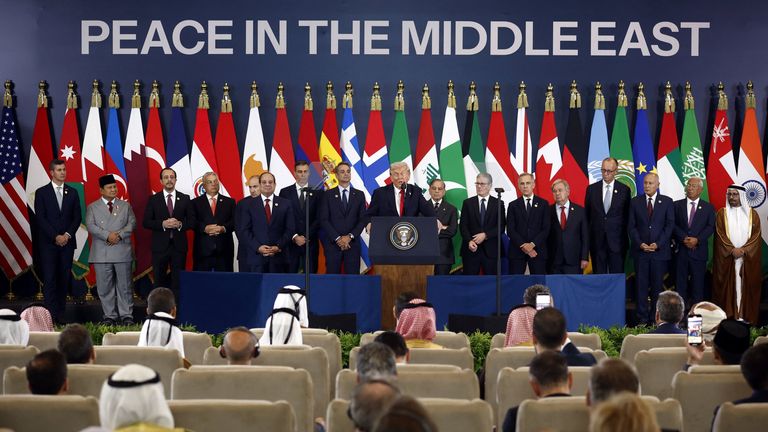
• America will “shift away” from the “burden” of the Middle East seeing it now as a “source and destination of international investment”
• In the Western hemisphere, America should pursue a policy of “enlist and expand… restoring American pre-eminence”
• In Africa, American policy focus should be on trade not “providing and spreading liberal ideology”
America will ‘shift away’ from the ‘burden’ of the Middle East. Pic: Reuters
In black-and-white, the text articulates a dramatic strategic shift which has been playing out at lightning speed over the past year.
The document underlines the end of the concept of America as an arbiter of the democratic rules-based order.
“American foreign policy elites convinced themselves that permanent American domination of the entire world was in the best interests of our country. Yet the affairs of other countries are our concern only if their activities directly threaten our interests,” the paper says.
Every US administration publishes at least one National Security Strategy during a presidential term.
The focus of this one is starkly different from that published by President Biden in 2022.
It’s also notably different from the document which President Trump published during his first term. His 2017 paper cast the world as a contest between “repressive regimes” and “free societies”.
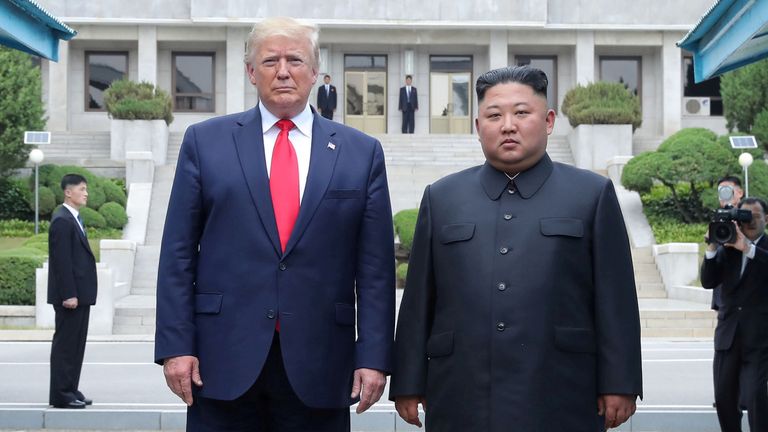
Trump doesn’t want the US to be the arbiter of the democratic rules-based order. Pic: Reuters
This new one places the necessity to do trade above the imposition of values.
“We seek good relations and peaceful commercial relations with the nations of the world without imposing on them democratic or other social change that differs widely from their traditions and histories.”
Mass migration and Europe
The new document is highly critical of mass migration.
It warns that uncontrolled migration is destroying the concept of nation states which could impact America’s strategic alliances and the countries it counts as reliable allies.
The paper is particularly critical of Europe, of the European Union as a concept and of individual European nations.
“Should present trends continue, the continent will be unrecognizable in 20 years or less,” the paper says.
It continues: “As such, it is far from obvious whether certain European countries will have economies and militaries strong enough to remain reliable allies.
“Many of these nations are currently doubling down on their present path. We want Europe to remain European, to regain its civilizational self-confidence, and to abandon its failed focus on regulatory suffocation.”
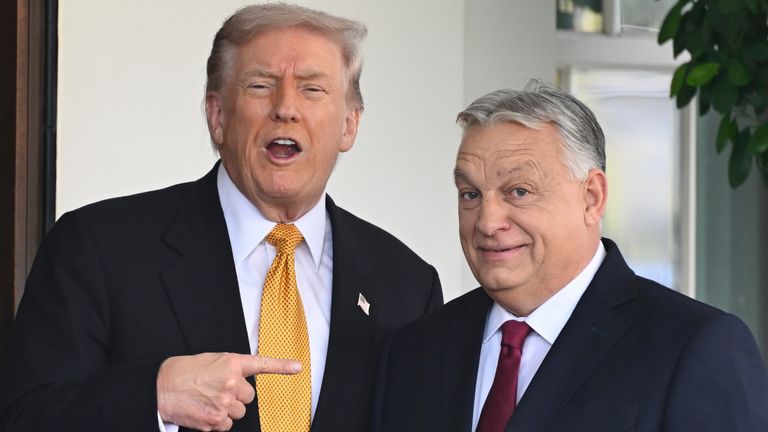
Trump will seek to support ‘patriotic European parties’. Pic: AP
The document’s language around the politics of governing parties across Europe is particularly stark.
Regarding Ukraine, the document says: “The Trump Administration finds itself at odds with European officials who hold unrealistic expectations for the war perched in unstable minority governments, many of which trample on basic principles of democracy to suppress opposition.
“A large European majority wants peace, yet that desire is not translated into policy, in large measure because of those government’s subversion of democratic processes.”
👉 Tap to follow Trump100 wherever you get your podcasts👈
The document outlines how his administration will seek to support “patriotic European parties”.
This is entirely in line with President Trump’s rhetoric but still represents a major departure from the longstanding principle of not interfering in the politics of allies.
It says: “American diplomacy should continue to stand up for genuine democracy, freedom of expression, and unapologetic celebrations of European nations’ individual character and history.
“America encourages its political allies in Europe to promote this revival of spirit, and the growing influence of patriotic European parties indeed gives cause for great optimism.”

Trump has at times had a fiery relationship with Ukraine’s President Zelenskyy. Pic: Reuters
Ukraine and Russia
On European-Russia relations, the document raises the prospect of war but curiously does not presume that such a conflict would involve America.
“Managing European relations with Russia will require significant US diplomatic engagement, both to reestablish conditions of strategic stability across the Eurasian landmass, and to mitigate the risk of conflict between Russia and European states.”
Read more from Sky News:
Germany introduces controversial military service law
Netflix agrees $72bn deal for Warner Bros studios
By contrast, President Biden’s National Security Strategy, published in 2022, underlined repeatedly the “iron-clad” commitment the United States had to Europe’s security.
Chinese risk and opportunity
The document presents Asia and the Indo-Pacific region as a source of opportunity for strategic and economic cooperation.

Maintaining US military strength over China is also outlined. Pic: Reuters
“President Trump is building alliances and strengthening partnerships in the Indo-Pacific that will be the bedrock of security and prosperity long into the future…”
And specifically on China, the paper presents a goal of “economic vitality” achieved through a balanced economic relationship between the two countries combined with an “ongoing focus on deterrence to prevent war”.
Deterrence would be achieved, it outlines, by maintaining preeminent military strength over China.
It says: “This combined approach can become a virtuous cycle as strong American deterrence opens up space for more disciplined economic action, while more disciplined economic action leads to greater American resources to sustain deterrence in the long term.”
Hemispheres of influence
In line with President Trump’s focus on spheres of influence, particular focus is given to the western hemisphere.
There are clear references to the impact of drugs from south and central America into the US and more subtle references to control of the arctic.
“The United States will reassert and enforce the Monroe Doctrine to restore American pre-eminence in the Western Hemisphere, and to protect our homeland and our access to key geographies throughout the region,” the paper says.
It continues: “We will deny non-Hemispheric competitors the ability to position forces or other threatening capabilities, or to own or control strategically vital assets, in our hemisphere.”
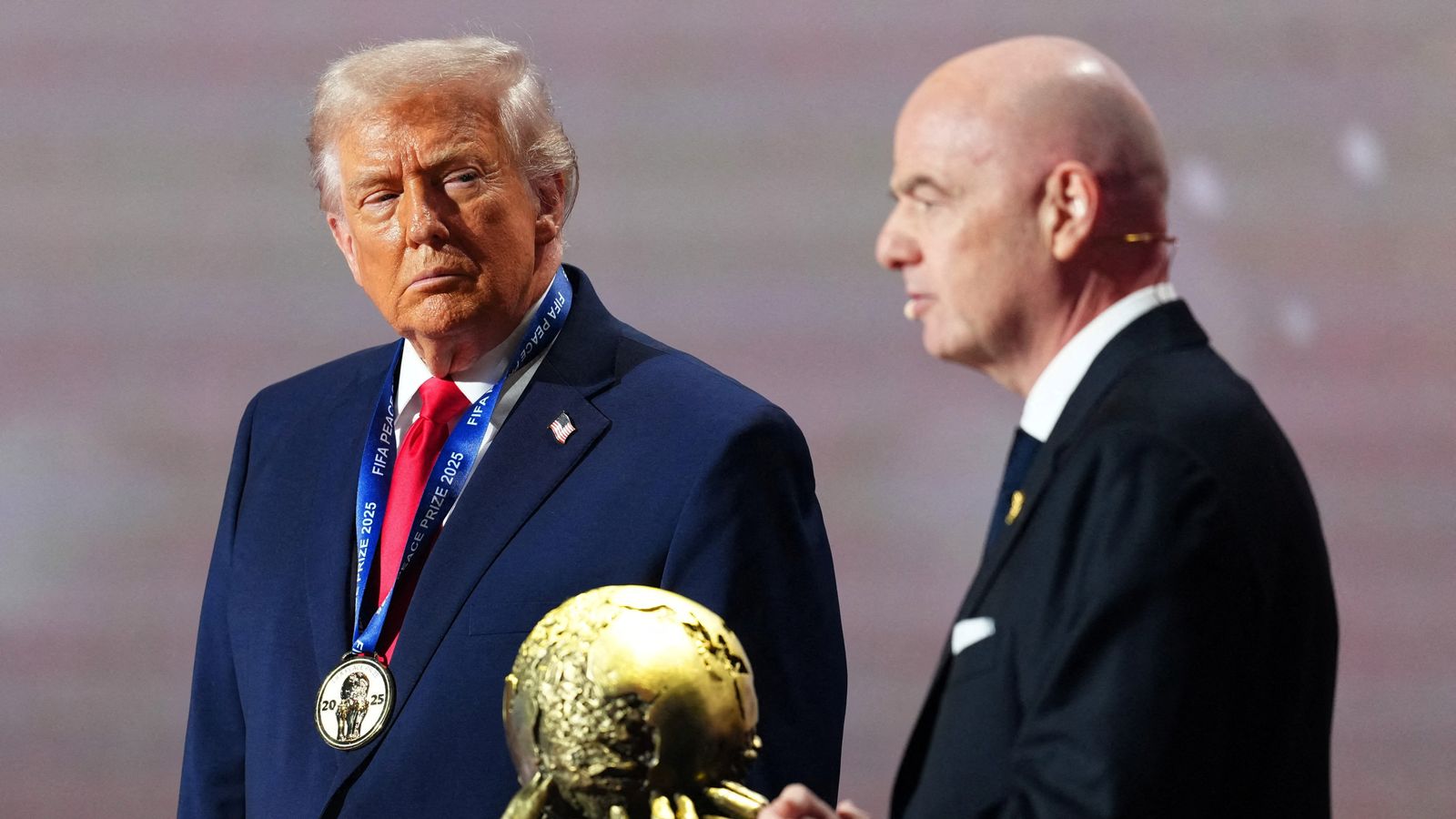
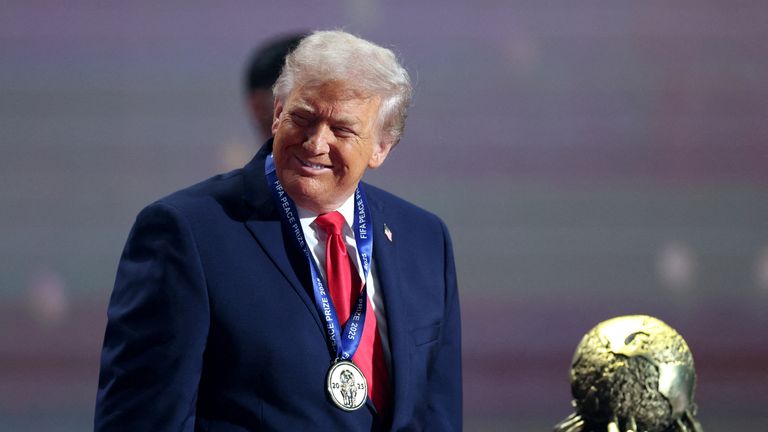
US President Donald Trump has been awarded FIFA’s new peace prize at the draw for next year’s World Cup.
FIFA President Gianni Infantino presented Mr Trump with a large golden trophy – formed of hands holding the earth – and a gold medal, which he wore around his neck.
The certificate, which Mr Infantino handed over at Washington DC’s Kennedy Center on Friday, recognises the US president for his actions to “promote peace and unity around the world”.
World football’s governing body, which announced the annual award last month, said it would be given to “individuals who have taken exceptional and extraordinary actions for peace”.
World Cup draw latest: Home nations and Republic of Ireland await fate
Mr Trump said it was “truly one of the greatest honours of my life”.
He said: “We saved millions and millions of lives. The Congo is an example – over 10 million people killed. It was heading for another 10 million very quickly.”
US President Donald Trump. Pics: Reuters
He also pointed to India and Pakistan, saying, “so many wars that we were able to end, in some cases a little before they started”.
Ahead of the draw, Mr Trump told reporters he did not care about the prize, but noted that he had “settled eight wars” in nearly 11 months in office.
The United States, along with Canada and Mexico, will host the tournament in 2026.
Mr Infantino, who has built up a strong relationship with the US president, backed him for the Nobel Peace Prize earlier this year.
Read more from Sky News:
Netflix agrees blockbuster $72bn deal for Warner Bros studios
Several sites go down after Cloudfare outage
“This is what we want from a leader – a leader that cares about the people,” Mr Infantino said of Mr Trump.
The FIFA leader said to Mr Trump, “this is your prize, this is your peace prize”.
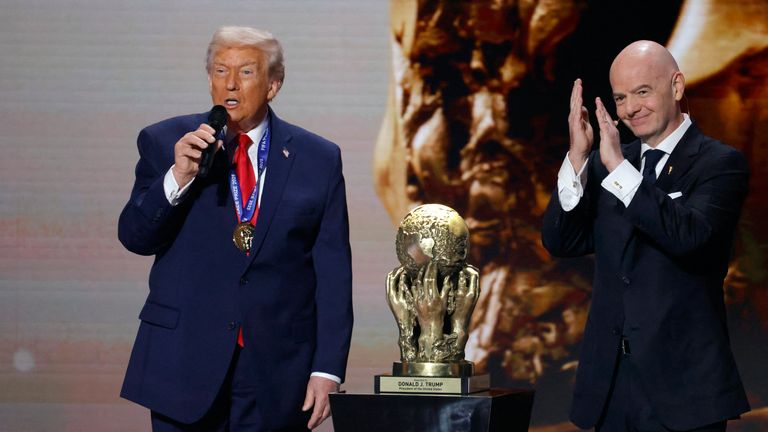
US President Donald Trump and FIFA President Gianni Infantino. Pic: Reuters
Mr Trump thanked his family, including his wife, first lady Melania Trump, and praised the leaders of the other two host nations – Canadian Prime Minister Mark Carney and Mexican President Claudia Sheinbaum – in his brief remarks.
Mr Infantino has often spoken about football as a unifier for the world, but the prize is a departure from the federation’s traditional focus on sport.
FIFA has described the prize as one that rewards “individuals who have taken exceptional and extraordinary actions for peace, and by doing so have united people across the world”.
The award comes during a week where Mr Trump’s administration has been under scrutiny for lethal strikes on alleged drug boats in the Caribbean and as Mr Trump hardens his rhetoric against immigrants.
The Nobel Peace Prize this year was eventually awarded to Venezuelan opposition leader Maria Corina Machado, who said shortly after receiving the prize that she was dedicating it in part to Mr Trump for “his decisive support of our cause”.
-
 Sports2 years ago
Story injured on diving stop, exits Red Sox game
-
 Sports3 years ago
‘Storybook stuff’: Inside the night Bryce Harper sent the Phillies to the World Series
-
 Sports2 years ago
Game 1 of WS least-watched in recorded history
-
 Sports3 years ago
Button battles heat exhaustion in NASCAR debut
-
 Sports3 years ago
MLB Rank 2023: Ranking baseball’s top 100 players
-
Sports4 years ago
Team Europe easily wins 4th straight Laver Cup
-
 Environment3 years ago
Japan and South Korea have a lot at stake in a free and open South China Sea
-
 Environment1 year ago
Here are the best electric bikes you can buy at every price level in October 2024