
NFL Sunday Ticket goes to YouTube in seven-year, $2 billion annual deal

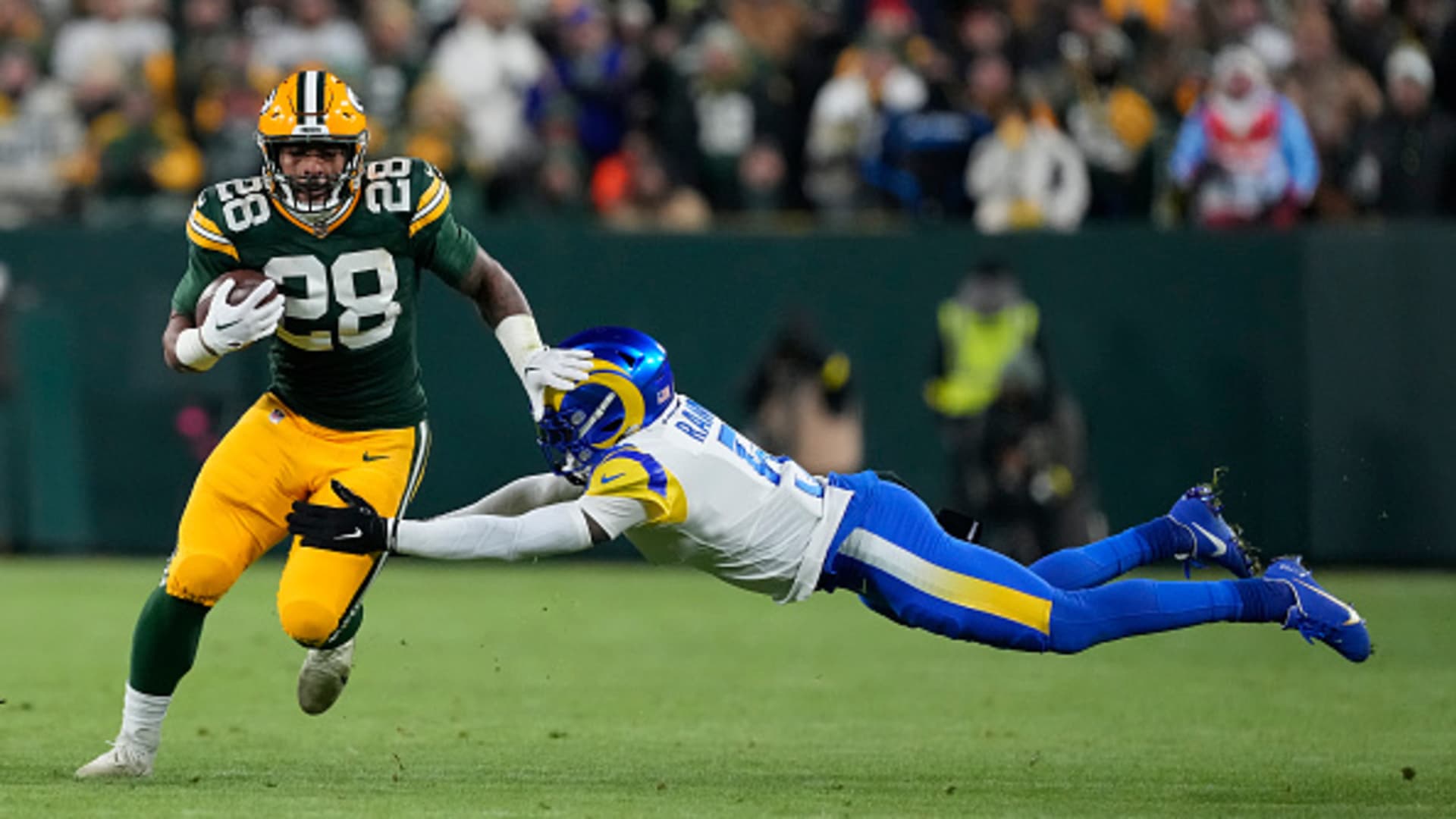
AJ Dillon #28 of the Green Bay Packers avoids a tackle by Jalen Ramsey #5 of the Los Angeles Rams during the first half at Lambeau Field on December 19, 2022 in Green Bay, Wisconsin.
Patrick Mcdermott | Getty Images
The National Football League announced Thursday its Sunday Ticket subscription package would go to Google’s YouTube TV starting next season, marking the league’s second media rights deal with a streaming service.
YouTube will pay roughly $2 billion a year for the residential rights of the Sunday Ticket package, according to people familiar with the matter. The deal runs for seven years, one of the people said.
related investing news

The agreement will elevate YouTube’s profile in the competitive streaming space. At the start of the 2023-24 season, Sunday Ticket will be available two ways: as an add-on package on YouTube TV and as a standalone a-la-carte option on YouTube Primetime Channels, which allows you to subscribe to individual streaming services and channels as well as watch movies.
In the latter option, consumers will be able to subscribe only to Sunday Ticket without having a YouTube TV subscription. Pricing hasn’t been determined for either option.
“For a number of years we have been focused on increased digital distribution of our games and this partnership is yet another example of us looking towards the future and building the next generation of NFL fans,” NFL Commissioner Roger Goodell said in Thursday’s announcement.
DirecTV has had the rights to Sunday Ticket since its inception in 1994, paying $1.5 billion annually for them since the last renewal in 2014. DirecTV’s currently Sunday Ticket offering, which requires you to subscribe to the service, has a $79.99 a month base option, and an package with extra features for $149.99 a month. The satellite-TV provider now has approximately 13.5 million customers, down significantly from the earlier days of the package’s offering due to cord-cutting, and had been losing $500 million annually on the package, one of the people said.
DirecTV didn’t place a bid to keep its contract going. Still, it has been open to offering the games for commercial establishments, such as bars and restaurants, similar to its agreement with Amazon for “Thursday Night Football,” according to people familiar with the matter.
The deal with YouTube TV does not include commercial rights, which could boost the value of the package, and the NFL is still sorting that out, according to one of the people.
NFL Media not included
The deal with YouTube TV does not include a stake in NFL Media, which includes the linear cable channels NFL Network and RedZone, as well as NFL.com. The league had been shopping the properties alongside the Sunday Ticket package, but was unable to secure a bid that included NFL Media, as CNBC previously reported.
A U.S.-only product, Sunday Ticket is the only way fans can watch live NFL Sunday afternoon games outside of their local markets on broadcast stations CBS and Fox.
It’s the last NFL package to land a media rights renewal. Last year, Paramount‘s CBS, Fox and Comcast‘s NBC agreed to pay more than $2 billion annually for 11-year packages, while Disney is paying about $2.7 billion per year for Monday Night Football, CNBC previously reported.
The deal comes as the league has been pushing for to have its games on more streaming outlets. Goodell has said the league was pushing for Sunday Ticket to end up on a streaming service. “I think that’s best for consumers at this stage,” Goodell previously told CNBC.
Amazon secured the rights to “Thursday Night Football,” making it the first streaming-only platform to air NFL games, paying about $1 billion per year. Meanwhile, traditional broadcast partners like NBC and CBS simulcast games on their streaming services.
The league had been in negotiations for some time to find a new owner for Sunday Ticket. Apple, Amazon, and Disney’s ESPN were among interested bidders for the package at one point or another, CNBC previously reported.
YouTube vs. Apple and Amazon
YouTube TV is an internet bundle of broadcast and cable networks that mirrors a traditional linear pay-TV operator. Its base plan costs $64.99 a month. In July, Google announced YouTube TV surpassed 5 million customers, including trial subscriptions.
YouTube Primetime Channels, which will be the a la carte option for Sunday Ticket, is a distribution platform similar to subscribing to networks and streaming services through Amazon’s Prime Channels.
To compare, Apple recently signed a 10-year deal for the rights to air Major League Soccer games. The tech giant recently announced the MLS Season Pass would launch in February, and would be available to fans on the Apple TV app for $14.99 a month per season. For subscribers of its streaming service, Apple TV+, which already pay $4.99 a month, they can sign up for $12.99 a month.
In recent months, YouTube TV emerged as a strong contender for the rights, given it could provide a lot of what the league was hoping to achieve with a new Sunday Ticket partner – a technology platform with a large balance sheet and global reach, and the ability to support bundled legacy TV.
For a time, it seemed Apple was close to attaining the rights. The company has been expanding its sports footprint for its Apple TV+ streaming service. It recently inked a 10-year deal with Major League Soccer that begins in 2023, and last year began airing Friday night Major League Baseball games.
However, discussions broke down due to existing restrictions around the Sunday Ticket rights, and Apple had wanted more flexibility with how to distribute the package, CNBC previously reported.
Amazon had also been considered another top contender, considering it already airs “Thursday Night Football” games and is a streaming-only platform.
While those contests primarily air on Prime, DirecTV distributes the games commercially, in bars, restaurants, hotels and retailers. The two reached a multi-year deal before the season started. DirecTV is interested in delivering Sunday Ticket games in a similar capacity, people familiar with the matter have said.


Anthony Noto, CEO of SoFi, speaking with CNBC at the annual Allen & Co. Media and Technology Conference in Sun Valley, Idaho on July 10th, 2025.
David A. Grogan | CNBC
SoFi shares fell almost 6% in extended trading Thursday after the fintech company announced a $1.5 billion stock offering.
The company, which provides online loans and other banking services, said in a press release that it will use the proceeds for “general corporate purposes, including but not limited to enhancing capital position, increasing optionality and enabling further efficiency of capital management, and funding incremental growth and business opportunities.”
The announced offering comes after SoFi’s market cap almost doubled so far in 2025. The stock price is up more than sixfold since the end of 2022.
A company’s share price often drops on a planned share sale as the offering dilutes the value of existing holders’ stakes.
In its third-quarter earnings release in late October, SoFi reported revenue growth of 38% from a year earlier to $961.6 million, while net income more than doubled to $139.4 million. The company reported cash and equivalents of $3.25 billion.


Lisa Jackson, senior vice president of environment, policy and social initiatives at Apple Inc., speaks during the TechCrunch Disrupt 2017 in San Francisco, California, U.S., on Tuesday, Sept. 19, 2017.
David Paul Morris | Bloomberg | Getty Images
Apple’s general counsel, Kate Adams, and its vice president for environment, policy, and social initiatives, Lisa Jackson, are retiring from the company, the iPhone maker announced on Thursday.
Jennifer Newstead, Meta’s chief legal officer, will become Apple’s new general counsel in March, and Jackson’s government affairs staff will report to her starting late next year, Apple said.
The two executives, who both reported to Apple CEO Tim Cook, are the latest members of senior leadership to exit the company. In recent weeks, Apple’s head software designer said he was leaving to join Meta, while Apple said its AI chief was retiring, along with its chief operating officer.
Adams joined Apple from Honeywell and became general counsel in 2017, and oversaw legal matters including litigation, global security, and the company’s privacy initiatives. Under Adams, Apple grappled with rising antitrust scrutiny and regulation around the world, including major lawsuits in the U.S. over the iPhone App Store’s restrictions and fees.
Jackson joined Apple in 2013, and led the company’s diversity programs as well as much of its policy work in Washington, D.C. Before that, she spent four years as administrator of the U.S. Environmental Protection Agency, a position she was appointed to by President Barack Obama.
With her emphasis in areas like social justice and renewable energies, Jackson’s job lost relevance during the second Trump administration, which has publicly denounced diversity, equity and inclusion programs and slammed efforts to combat climate change.
Apple has faced increased tariffs from the Trump administration, and Cook has met with President Donald Trump several times to tout the company’s American manufacturing plans as part of an effort to influence policy.
Jackson was instrumental in Apple’s launch of its Racial Equity and Justice Initiative following the 2020 murder of George Floyd. She then helped expand the company’s equity and justice efforts to other countries, including the U.K., Mexico and New Zealand, according to a report published in 2023.
“At Apple, we pledge that our resolve will not fade,” Jackson wrote in a section of that report. “We won’t delay action. We will work, each and every day, on the urgent task of advancing equity.”
Jackson also worked on Apple’s environmental image. Her job “focused on reducing greenhouse gases, protecting air and water quality, preventing exposure to toxic contamination, and expanding outreach to communities on environmental issues,” according to her bio on the company’s website. She discussed Apple’s plans to become carbon neutral at iPhone launch events.
Jackson also accompanied Cook to several official functions in Washington, including state dinners.
Apple CEO Tim Cook and Apple Vice President Lisa Jackson arrive at the White House for a state dinner on April 10, 2024 in Washington, DC.
Tasos Katopodis | Getty Images
Newstead, who will become Apple’s top lawyer, has overseen Meta’s legal and regulatory matters pertaining to its family of apps like Facebook, Instagram, WhatsApp since 2019. A Meta spokesperson said Newstead will be staying through the end of the year and that the company is actively searching for her replacement.
Prior to Meta, Newstead served as a Trump-appointed legal advisor at the State Department during the president’s first administration in 2019.
Before that, she was a partner at Davis Polk & Wardwell and a general counsel of the White House Office of Management and Budget, among other roles in the U.S. government.
CNBC’s Jonathan Vanian contributed to this story.
WATCH: Apple AI chief steps down


A general view of the Microsoft office building is seen in Cologne, Germany, on November 18, 2025.
Nurphoto | Nurphoto | Getty Images
Microsoft said Thursday that it will increase the prices of Office productivity software subscriptions for commercial and government clients on July 1.
The company’s Office applications, which include Word, Excel, PowerPoint and Outlook, have been facing increased competition in recent years from Google.
“We are continuously investing and innovating our platform for the future,” Nicole Herskowitz, corporate vice president for Microsoft 365 and Copilot, wrote in a blog post. “In the last year, we released more than 1,100 features across Microsoft 365, Security, Copilot, and SharePoint.” The new features have added value to the suites, she wrote.
Price hikes for commercial Office subscriptions have been infrequent. In 2022, Microsoft raised prices of its productivity bundles for the first time since launching the original Office 365 subscriptions in 2011. Microsoft changed the name of Office 365 to Microsoft 365 in 2020. In January, Microsoft announced a price hike for consumer Office bundles.
Microsoft offers Office 365 subscriptions for commercial use that include access to its productivity applications, along with higher-priced Microsoft 365 subscriptions that also include Windows operating system updates.
Here’s a breakdown of the commercial price changes:
- For small and medium-sized businesses, Microsoft 365 Business Basic will cost $7 per person per month, up from $6.
- Microsoft 365 Business Standard will be available for $14, up from $12.50.
- Microsoft 365 Business Premium will continue to cost $22.
- The entry-level Office 365 E1 offering for enterprises will still be sold for $10.
- Office 365 E3 will jump 13% to $26 from $23.
- The Microsoft 365 E3 package including Windows for enterprises will rise 8% to $39 from $36.
- The full-featured Microsoft 365 E5 will increase to $60 from $57.
- For front-line workers such as cashiers, Microsoft 365 F1 subscriptions will cost $3, up from $2.25.
- Microsoft 365 F3 will be available for $10, up from $8.
The U.S. Defense Department and other government clients will face similar percentage price increases.
The various subscriptions all exclude access to the $30 Microsoft 365 Copilot add-on that draws on generative artificial intelligence models. Some companies have started widely rolling out Copilot, while others have held off on expanding their deployments, CNBC reported last week.
In many cases, organizations receive discounts off of list prices, but Microsoft has cut back on direct volume deals for some types of customers.
Almost 43% of Microsoft’s $77.7 billion in fiscal first-quarter revenue came from its Productivity and Businesses Processes segment, which includes Office. In October, the company said revenue from Microsoft 365 commercial cloud services jumped 17%, while seats increased 6%, mainly from products targeting small and medium-sized businesses and front-line workers.
-
 Sports2 years ago
Story injured on diving stop, exits Red Sox game
-
 Sports3 years ago
‘Storybook stuff’: Inside the night Bryce Harper sent the Phillies to the World Series
-
 Sports2 years ago
Game 1 of WS least-watched in recorded history
-
 Sports3 years ago
Button battles heat exhaustion in NASCAR debut
-
 Sports3 years ago
MLB Rank 2023: Ranking baseball’s top 100 players
-
Sports4 years ago
Team Europe easily wins 4th straight Laver Cup
-
 Environment3 years ago
Japan and South Korea have a lot at stake in a free and open South China Sea
-
 Environment1 year ago
Here are the best electric bikes you can buy at every price level in October 2024