
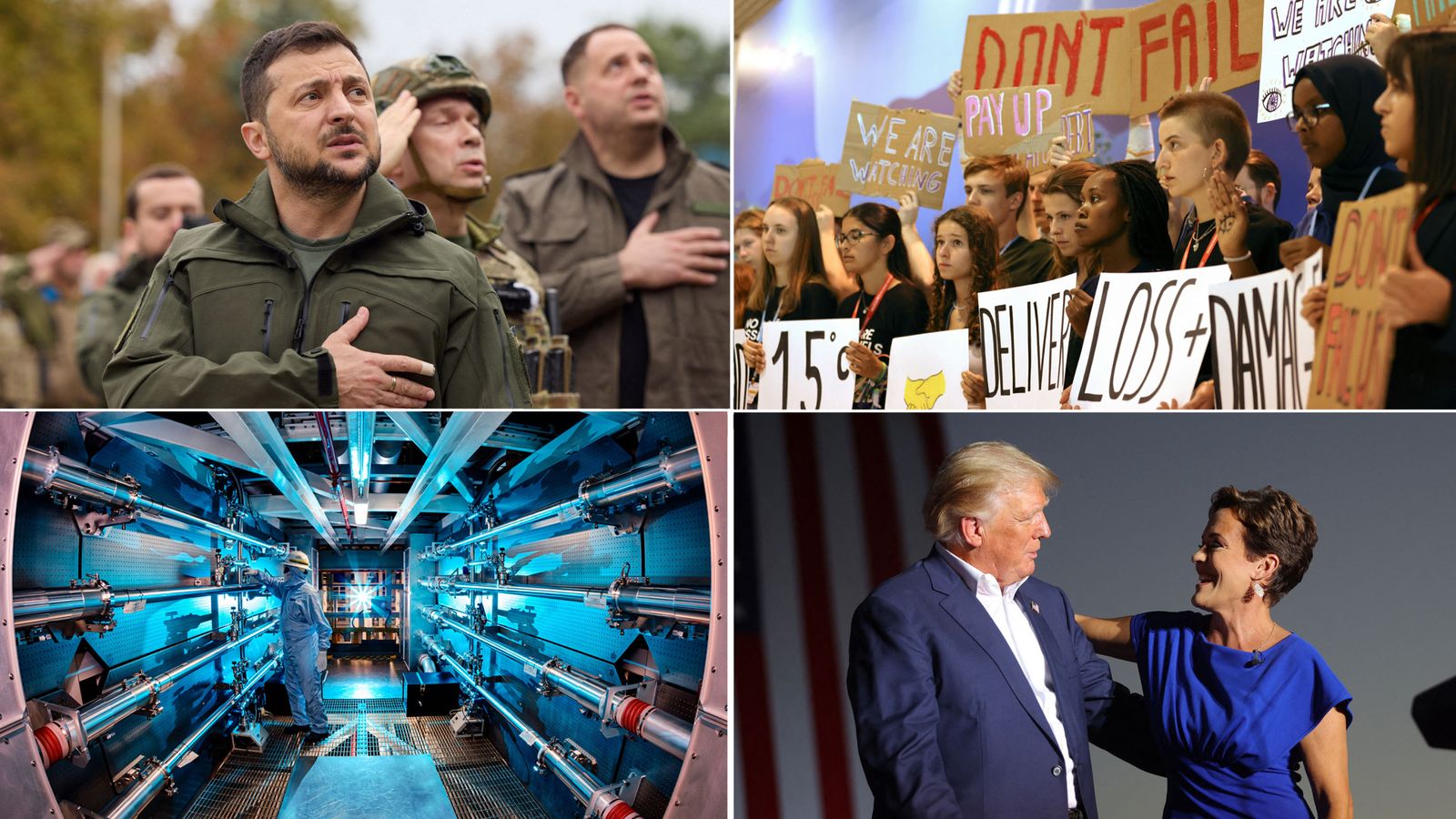
Adam Boulton: The glimmers of hope and reasons to be cheerful as 2022 ends

2022 has been a tough year, in which the UK has often been hit harder than its peer countries in the G7 – the club of the world’s wealthiest democracies.
Russia’s bloody attack on Ukraine led to dramatic spikes in energy costs.
A global cost of living crisis has been driven by soaring inflation and interest rates.
In the UK, hard-pressed workers across the public sector are striking.
Unprecedented political instability in the governing Conservative Party means there have been three different prime ministers in the same year.
Meanwhile, billions of us are grappling with digital technology and connectivity. Some fear social media is rendering traditional representative democracy impossible while handing power to autocrats and unaccountable corporations. Online communication has certainly made us angrier and less tolerant of others.
The world’s population passed eight billion people this year, further increasing the existential pressure humanity is placing on the planet. Extreme weather events attributed to global warming are more frequent than ever.
Globally, the COVID pandemic has claimed more than six million lives, and it is not over either, with a million more deaths predicted in China as the Communist Party reverses its zero-COVID policy.
Taken together, these problems paint a dark picture of life in 2022, yet as we try to cope with them there are glimmers of hope. As we head into the New Year, I want to lift the gloom and rustle up some reasons to be cheerful.
Hope and unity emerge from war in Ukraine
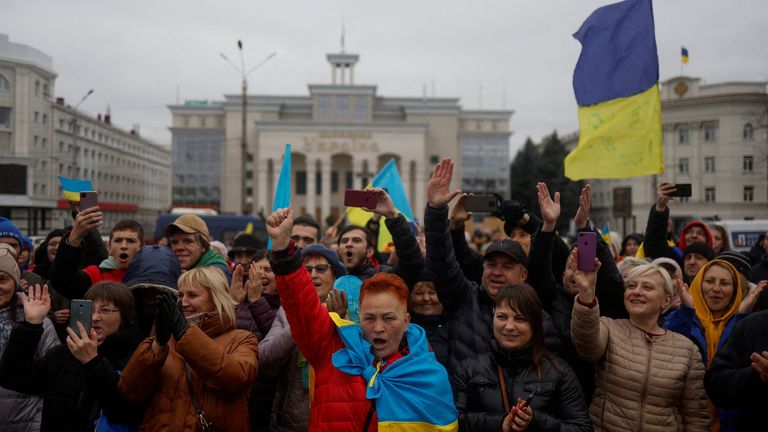
Ukrainians celebrate Russia’s withdrawal from Kherson in November
No one should minimise the horror of the war in Ukraine, which has claimed tens of thousands of lives on both sides and is still enduring the deliberate destruction by an aggressor of a modern European state. Russia’s superiority in size may still mean that Ukraine never gets back all its territory.
Still, the course of the war so far has confounded all President Vladimir Putin’s calculations and shattered the dreams of dictatorial regimes elsewhere. Russia did not conquer in a few days.
The Western democracies did not prove weak and venal. NATO is not “brain-dead”, as President Emmanuel Macron sneered a few years ago. It is stronger, with Finland and Sweden joining the military alliance.
Led by the US, UK and Poland, Western nations have given billions of dollars in military assistance while accommodating refugees. Just as importantly, the thirst of the Ukrainian people and their leaders for liberty, peace and democracy, stressed by President Volodymyr Zelenskyy in his impassioned address to the joint session of the US Congress, reminded us all of the values which should unite us and which are worth fighting for.
Click to subscribe to the Sky News Daily wherever you get your podcasts
For all their faults, Prime Ministers Boris Johnson and Liz Truss gave Ukraine solid support, even though it cut across their key post-Brexit foreign policy of turning away from Europe. British governments from now on are likely to grasp the importance of good relations with the UK’s closest and largest trading bloc, based on practical co-operation rather than ideology.
A healthy democracy
There is no going back on leaving the EU. But the UK has the chance to enter a new phase without obsessing over the question of Europe, which has dogged the Tory party at least since the 1990s, bedevilling the nation in the process.
Conservative governments no longer have an excuse to be distracted from dealing directly with more important questions such as growth, productivity, and fairness.
If the ruling party does not adapt and address these issues, opinion polls and recent local and by-elections suggest that the electorate may be ready to make a change.
Whatever the outcome at the next election, this is the sign of healthy democracy. Something the increasingly restless people of Russia, China and Iran, for example, are not able to enjoy.
In elections in the West this year, the tide appeared to be turning against populist leaders with links to Russia.
Candidates most associated with Donald Trump, who called Putin a “genius”, fared badly in November’s midterm elections. The Democrats kept control of the Senate. In France, President Macron was re-elected in April, defeating a challenge from Marine Le Pen of the far-right National Rally.
Game-changing future technology

US scientists carried out the first ever nuclear fusion experiment to achieve a net energy gain
In an era of modern communications, the world should not and cannot de-globalise. The knock from the loss of Russian energy has led, however, to increased emphasis on the importance of producing our own green energy and trading with friendly and stable partners.
2022 will be a record year for commissioning renewable energy programmes, a trend which was already accelerating before the Ukraine invasion.
Other scientific breakthroughs this year point to game-changing future technologies. In the US, experimenters have for the first time achieved atomic fusion, producing more energy than was used to trigger it.
Chinese scientists claim to have found a way to produce hydrogen by electrolysing salt water. Applied on an industrial scale, this would dramatically increase the supply and cheapness of a potentially “green” fuel.
A test case in the Amazon

A climate activist protests at the COP27 climate summit in Egypt
There were two important world meetings on the environment this year – COP27 in Egypt on climate change and COP15 in Canada on biodiversity.
Neither was dramatic, but both re-affirmed commitments already moving in the right direction. Crucially, at both summits, richer nations agreed to remove one of the biggest obstacles to moving faster.
They agreed, though so far more in principle than practice, to pay poorer nations for loss and damage caused by Western industrialisation and to protect vital ecosystems. Both are battles against time and the pace of degradation.
Brazil will be a test case. Deforestation in the Amazon increased catastrophically under encouragement from outgoing President Jair Bolsonaro. Lula da Silva, who takes office in January, campaigned successfully on a commitment of zero deforestation in the rain forests, wetlands, and savannah. He has re-appointed a highly committed environment minister,
Marina Silva, and upped the budget to combat destruction.
We’re living longer and healthier
68.7% of the world population have now had at least one dose of a COVID vaccine. A total of thirteen billion doses have been dispensed. The capacity of the disease to kill is receding.
An anti-malaria vaccine also became a live possibility this year. Global life expectancy went up to 73 years in 2022, albeit by 0.24%. A woman born in Britain this year can expect to live to 83 – that’s 21 years progress on the average female life span in 1926, the year Queen Elizabeth II was born.
Life expectancy increases are plateauing in the UK and US. The most dramatic advances are in poorer countries. Today, 9.2% of the world population live in what is defined as extreme poverty, compared to 36% in 1990. That is still more than a billion people. In the same period, deaths of children five and under has fallen from 34,200 each day to 14,200.
Pioneers believe that mankind is on the brink of a much greater transformation in both preventative and therapeutic medicine – thanks to the use of AI technology in mapping the human genome and proteins, and the possibilities of so-called CRISPR gene editing.
A better tech universe
We are not in control of the ways online technology is changing almost every aspect of our lives. Authoritarian regimes use it to control information and their own citizens. In free societies, trolls and conspiracy theorists send untruths around the world, aided by bots from hostile nations.
Ordinary people go on social media to vilify others and to “cancel” them. The furore on both sides over Jeremy Clarkson’s casually vicious comments on Meghan Markle are just the latest example.
Meanwhile, tech companies and entrepreneurs have become absurdly wealthy.
Read more:
Where do our Christmas traditions come from?
Sky News editors give their verdicts on what might happen next
In 2022, we began to respond to this stupidity haltingly. The US government legislated against passing strategically vital tech to China. The UK government considered essential issues in the Online Safety Bill. The EU moved against US tech cartels.
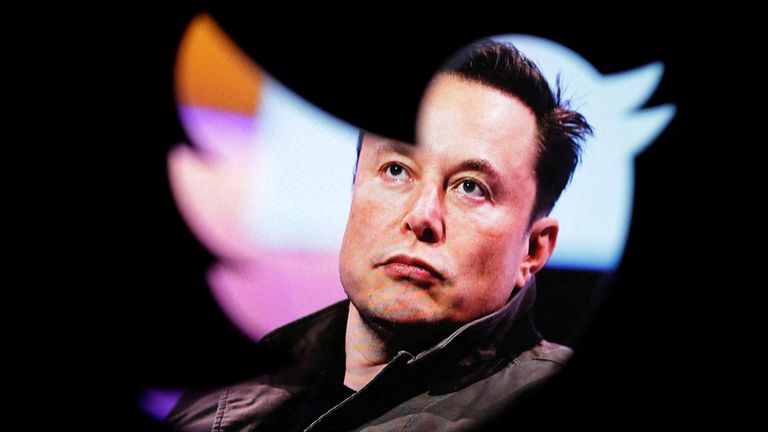
FTX collapse into fraud burst the cryptocurrency bubble. Elon Musk’s humiliating mismanagement of Twitter showed the world that tech geniuses do not have all the answers. A better, less uneven, tech universe should emerge from all this, not least because the rising generations are growing up in it.
Beyond the metaverse, digging deep into the worlds of politics, health, and the environment unearths some reasons to be cheerful as this year ends.
All the same in 2023, as teachers write at the bottom of report cards, MUST DO BETTER.

Can it be a coincidence that US planes attacked Syria around the very time the Epstein files were released?
It would be cynical – but then again, it would be how politics works.
The deadline-day release of the Epstein files had White House media management written all over it, unredacted.
Initial searches for Trump’s name within the Department of Justice search function returned nothing, while the presence of former president Bill Clinton, on the other hand, was everywhere.
It is PR strategy 101 – front-load the release of documents with the Democrat stuff and save any possible Trump content for a soft landing sometime between Christmas and New Year.
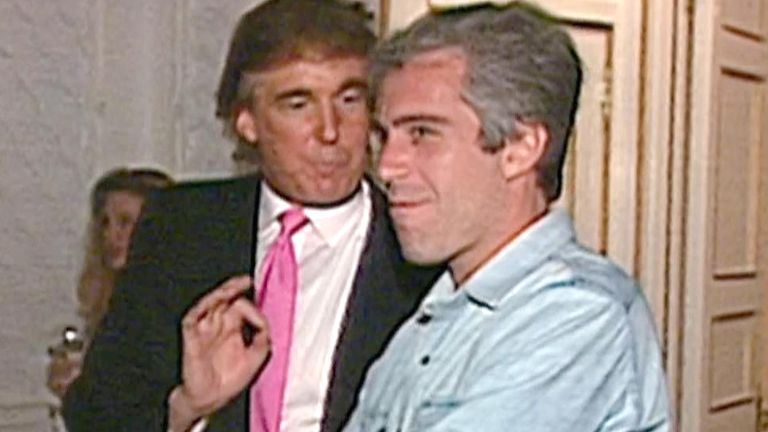
Donald Trump and Jeffrey Epstein. Pic: NBC
Epstein files latest: What we found inside – as critics accuse ‘document dump’ of breaking law
By that time, the public will have softened its focus on the story – it’s what the festive season does.
The presence of celebrity in the latest release might also feather Trump’s bed.
It’s clear that iconic superstars like Mick Jagger and Diana Ross were courted by Epstein as innocents, ignorant of his criminality. To see them in the files cements a narrative of a monster who lured the unsuspecting into his orbit.
We support Jagger and Ross as treasured icons, so we remind ourselves that simply being included in the files doesn’t equate to wrongdoing or knowledge of it. In turn, it shapes an empathy around the predicament that will extend to Trump and, perhaps, the benefit of any doubt.
Of course, not everyone will see it that way – the people who see a cynical exercise in delay and obfuscation, constituting a gross insult to the Epstein survivors at the heart of the story.
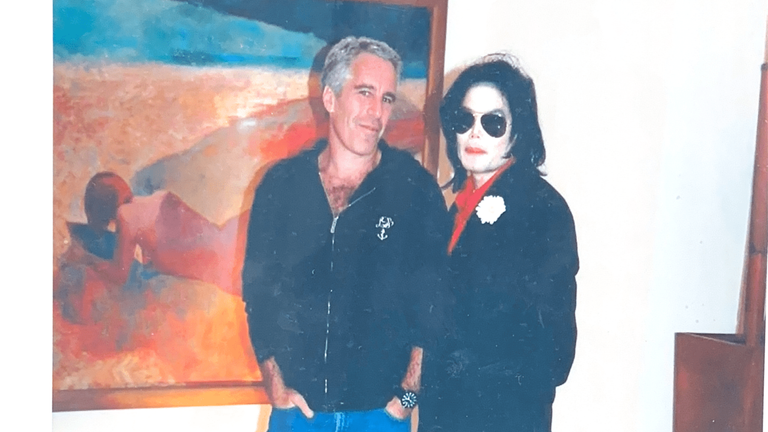
Jeffrey Epstein and Michael Jackson. Pic: US DoJ
Read more:
Mystery text quoting price for ‘girl’ included in new pictures
Trump administration criticised over partial Epstein files release
For all the talk (by the Trump administration) of a tight time scale and a willingness to act transparently, survivors and their supporters point out that Donald Trump could have published all the Epstein files long ago, never mind drip feed them with wide-ranging redactions.
Not to have done so is an affront to them and an attempt to evade accountability.
For all the talk about the release of the files, their significance is undermined by the lack of context. We are shown pictures and documents that reflect the life of a thoroughly unpleasant individual who inflicted suffering on an industrial scale. But with redactions, and without explanations, we are left having to join the dots in an effort to establish criminal behaviour and blame.
It is a level of uncertainty surrounding the Epstein files and a source of dissatisfaction to survivors, for whom justice further delayed is justice further denied.
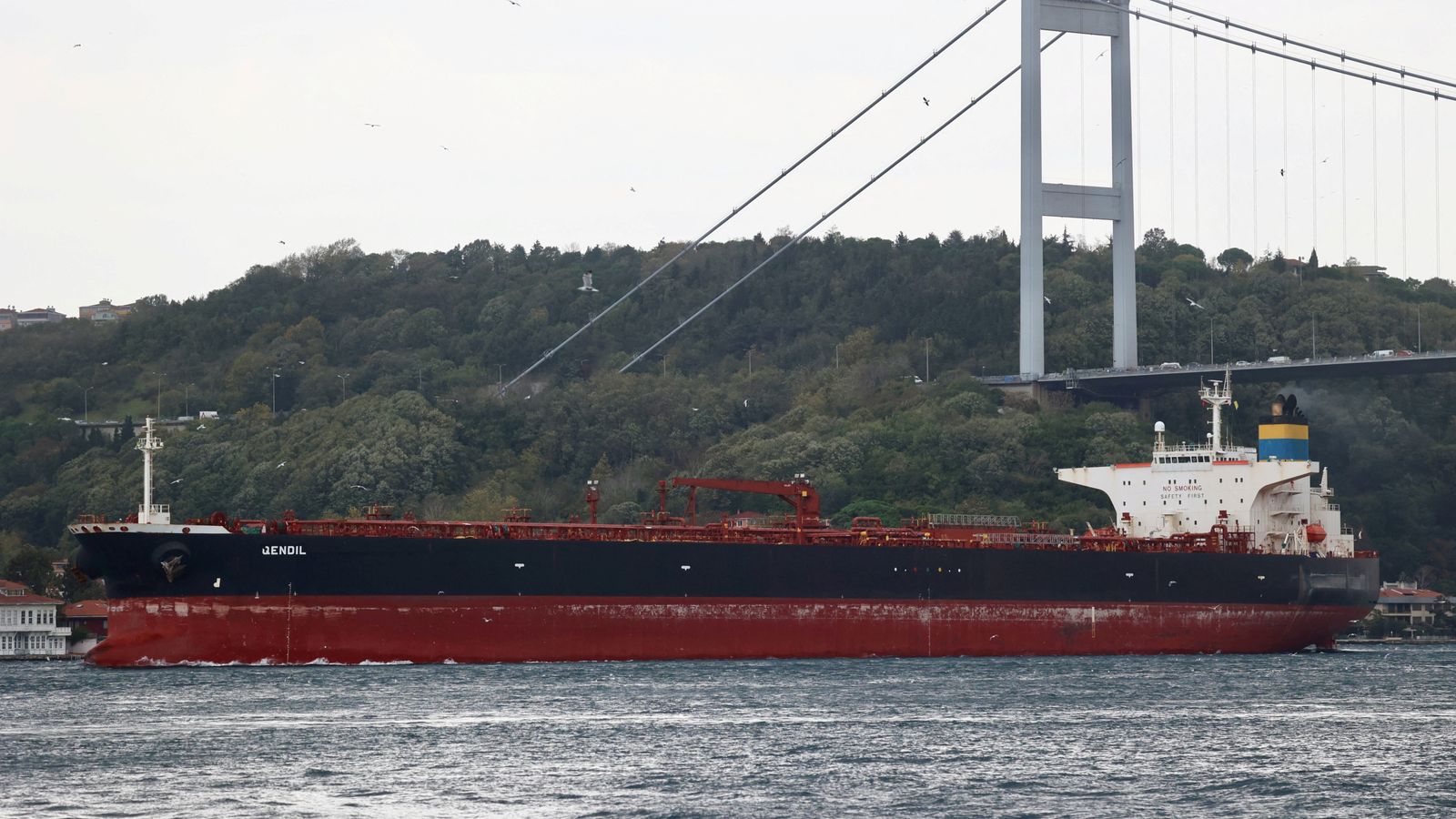
Ukraine has struck a Russian tanker in the Mediterranean Sea for the first time, a Kyiv intelligence source has said.
The ship, called the Qendil, suffered “critical damage” in the attack, according to a member of the SBU, Ukraine’s internal security agency.
The tanker is said to be part of Russia’s so-called “shadow fleet” – a group of ageing vessels that Kyiv alleges helps Moscow exports large quantities of crude oil despite Western sanctions.
The SBU source said Ukrainian drones hit the ship in neutral waters more than 2,000 kilometres (1,243 miles) from Ukraine.
They said: “Russia used this tanker to circumvent sanctions and earn money that went to the war against Ukraine.
“Therefore, from the point of view of international law and the laws and customs of war, this is an absolutely legitimate target for the SBU.
“The enemy must understand that Ukraine will not stop and will strike it anywhere in the world, wherever it may be.”
The vessel was empty at the time of the attack, the Ukrainian source added.
Speaking during a live TV event, Vladimir Putin, the Russian president, claimed the attack would not disrupt supplies, but vowed that Russia would retaliate nonetheless.
He added that Russia regularly responded with “much stronger strikes” against Ukraine.
Putin also warned against any threat to blockade Russia’s coastal exclave Kaliningrad, which he said would “just lead to unseen escalation of the conflict” and could trigger a “large-scale international conflict”.
Read more:
The mercenaries fighting for Russia
British man who fought for Ukraine jailed
Sky military analyst Michael Clarke said Ukraine’s claim about causing significant damage to the ship was “probably true”.
He added: “The Ukrainians obviously feel that they can legitimise this sort of operation.”

The Qendil, pictured near Istanbul last month. Pic: Reuters
The attack comes after the European Union announced it would provide a €90bn (£79bn) interest-free loan to Ukraine.
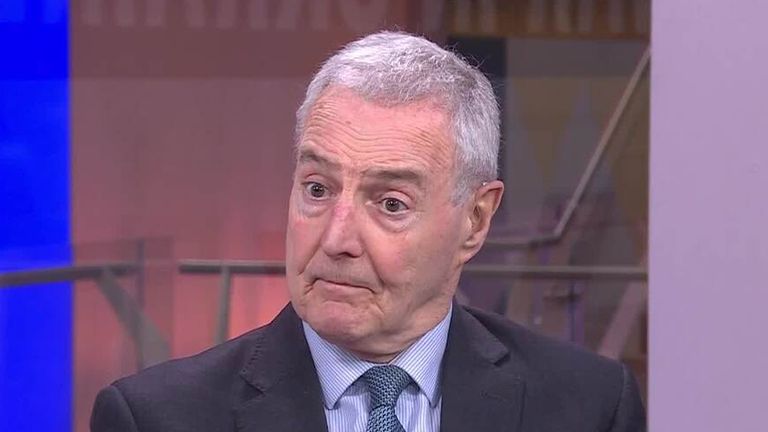
Oleksandr Merezhko, the chairman of the foreign affairs committee in the Ukrainian parliament, told Sky News that the money would “tremendously enhance” Kyiv’s defensive capabilities.
However, he said the International Monetary Fund estimated that Ukraine needed $137bn to “keep running”.
“The aggressor should be punished”, Mr Merezhko added, as he argued that frozen Russian assets in Europe should be used to help fund his country’s defence.
He vowed that Ukraine would “continue to fight” for the move, adding that it was “a matter of justice”.
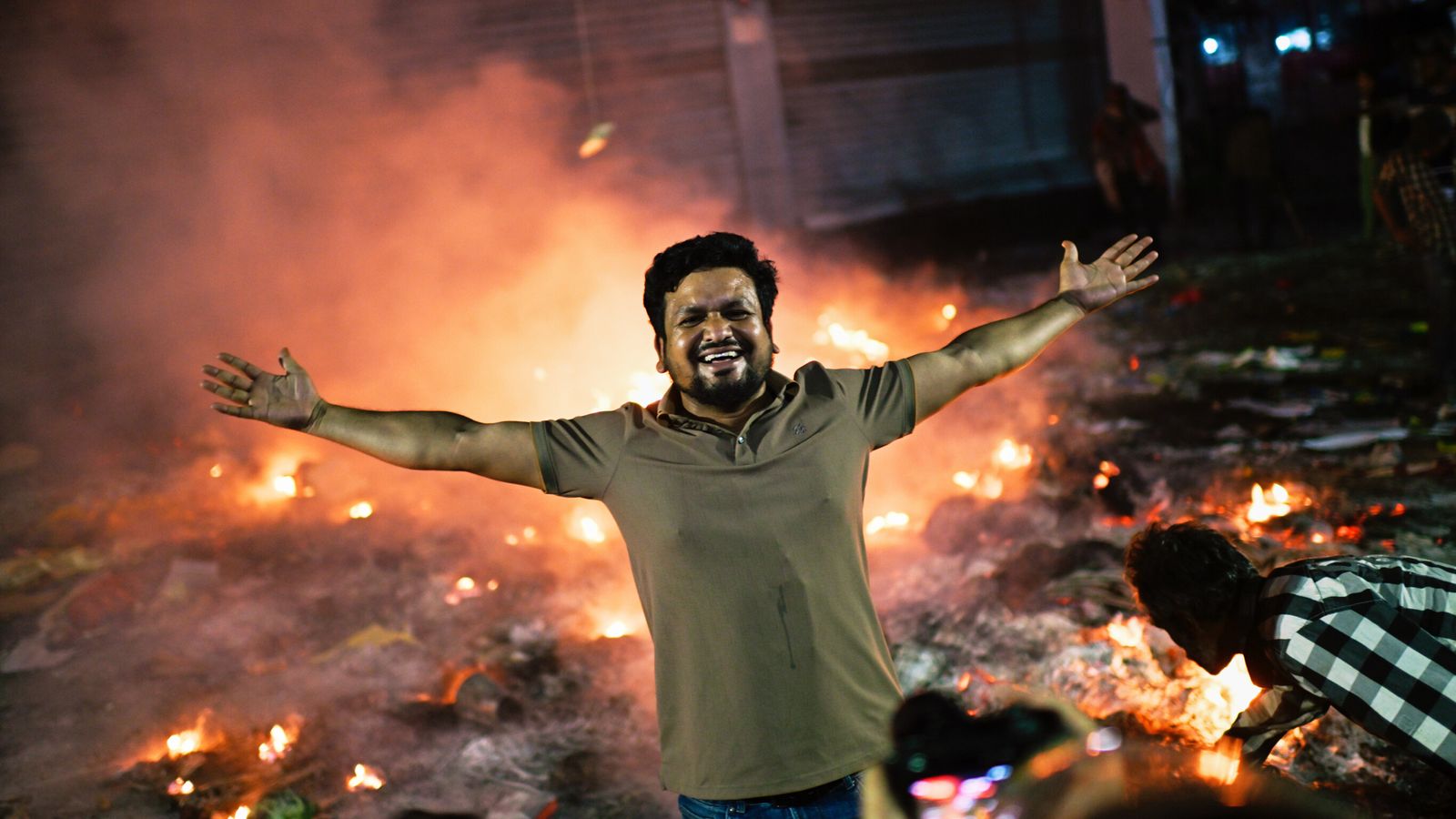
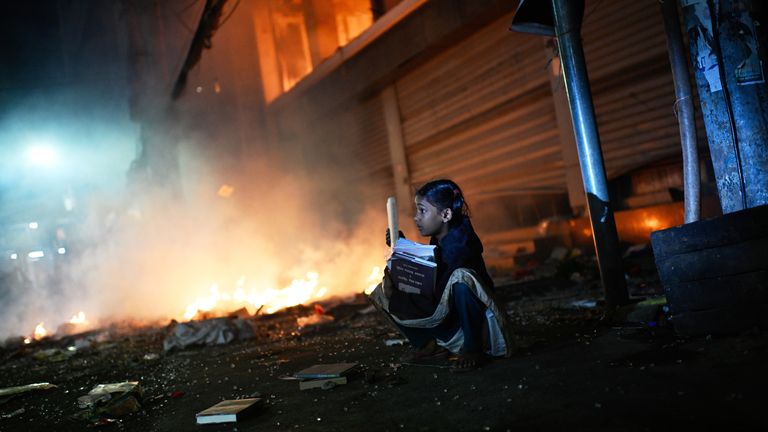
Protesters have stormed the headquarters of two major newspapers in Bangladesh, amid widespread unrest following the death of a political activist.
A mob set fire to the offices of the Bengali-language Prothom Alo daily newspaper and the English-language Daily Star in the capital Dhaka, leaving journalists and other staff stuck inside.
The Bengali-language Prothom Alo daily was one of the two newspapers that were targeted. Pic: AP.
One of the Daily Star’s journalists, Zyma Islam, wrote on Facebook: “I can’t breathe anymore. There’s too much smoke.”
Both dailies stopped updating their online editions after the attacks and did not publish broadsheets on Friday.
Troops were deployed to the Star building and firefighters had to rescue the journalists trapped inside. The blaze was brought under control early on Friday.
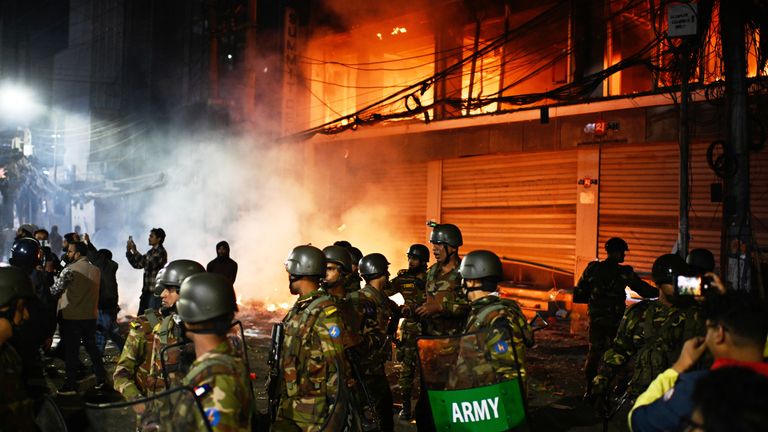
The latest protests erupted a year after the July Revolution ousted PM Sheikh Hasina. Pic: PA.
Political activist Sharif Osman Hadi died in hospital late on Thursday, six days after the youth leader was shot while riding on a rickshaw in Dhaka.
Bangladesh’s interim government urged people on Friday to resist violence as police and paramilitary troops fanned out
across the capital and other cities following the protests overnight. They have sparked concerns of fresh unrest ahead of national elections, which Mr Hadi had been due to stand in.
He was a prominent activist in the political uprising last year that forced the then Prime Minister Sheikh Hasina to flee the country. Mr Hadi spent six days on life support in a hospital in Singapore before he succumbed to his injuries.
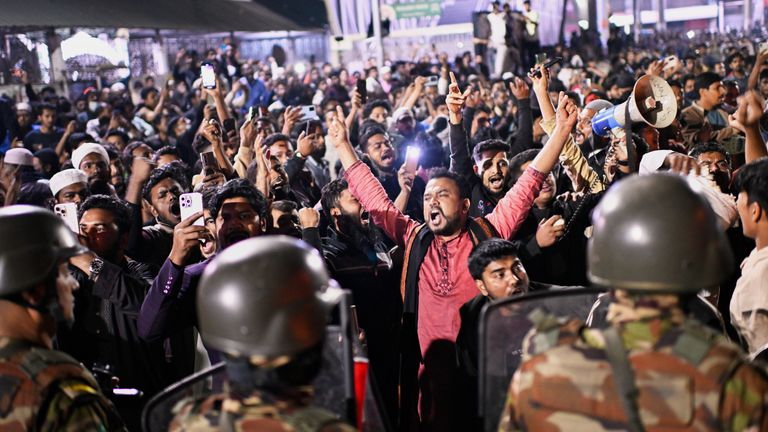
Mr Hadi died a week after he was shot by a man on a motorbike. Pic: PA.
Hundreds of protesters took to the streets following news of Mr Hadi’s death on Thursday night, where they rallied at Shahbagh Square near the Dhaka University campus, according to media reports.
A group of demonstrators gathered outside the head office of the Muslim-majority country’s leading Bengali-language Prothom Alo daily, before vandalising the building and setting it on fire.
A few hundred yards away, another group of protesters pushed into the Daily Star offices and set fire to the building. The protesters are believed to have targeted the papers for their alleged links with India and closeness to Bangladesh‘s interim leader, Nobel Peace Prize laureate Muhammad Yunus.
Read more:
Ex-Bangladesh PM Sheikh Hasina sentenced to death
UK MP Tulip Siddiq sentenced by Bangladeshi court
Although calm had returned to much of the country on Friday morning, protesters carrying national flags and placards
continued demonstrating at Shahbagh Square in Dhaka, chanting slogans and vowing not to return until justice was served.
👉 Tap here to follow The World with Richard Engel and Yalda Hakim wherever you get your podcasts 👈
Last year’s mass uprising erupted from student protests against a quota system that awarded 30% of government jobs to relatives of veterans.
The July 2024 protest, which resulted in as many as 1,400 deaths according to the United Nations, was dubbed the first “Gen Z” revolution.
Bangladesh’s former prime minister Sheikh Hasina Wazed was forced to resign in August 2024 and fled to India. She was later sentenced to death in absentia.
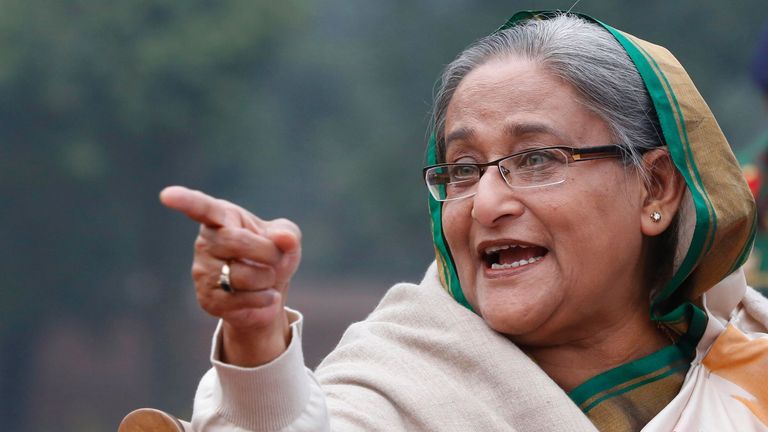
Sheikh Hasina was sentenced to death in absentia. Pic: AP
Dr Yunus was then sworn in as interim leader.
The country’s Islamists and other opponents of Ms Hasida have accused her government for being subservient to India.
Mr Hadi was a fierce critic of Ms Hasina and neighbouring India.
He had planned to run as an independent candidate in a constituency in Dhaka at the next national elections due to be held in February.
Authorities said they had identified the suspects in Mr Hadi’s shooting, and the assassin was also likely to have fled to India. Two men on a motorbike followed Hadi and one opened fire before they fled the scene.
-
 Sports2 years ago
Story injured on diving stop, exits Red Sox game
-
 Sports3 years ago
‘Storybook stuff’: Inside the night Bryce Harper sent the Phillies to the World Series
-
 Sports2 years ago
Game 1 of WS least-watched in recorded history
-
 Sports3 years ago
Button battles heat exhaustion in NASCAR debut
-
 Sports3 years ago
MLB Rank 2023: Ranking baseball’s top 100 players
-
Sports4 years ago
Team Europe easily wins 4th straight Laver Cup
-
 Environment3 years ago
Japan and South Korea have a lot at stake in a free and open South China Sea
-
 Environment1 year ago
Here are the best electric bikes you can buy at every price level in October 2024