
The boldest bitcoin calls for 2023 are out — and a 1,400% rally or a 70% plunge may be on the cards

A worsening macroeconomic climate and the collapse of industry giants like FTX and Terra have weighed on bitcoin’s price this year.
STR | Nurphoto via Getty Images
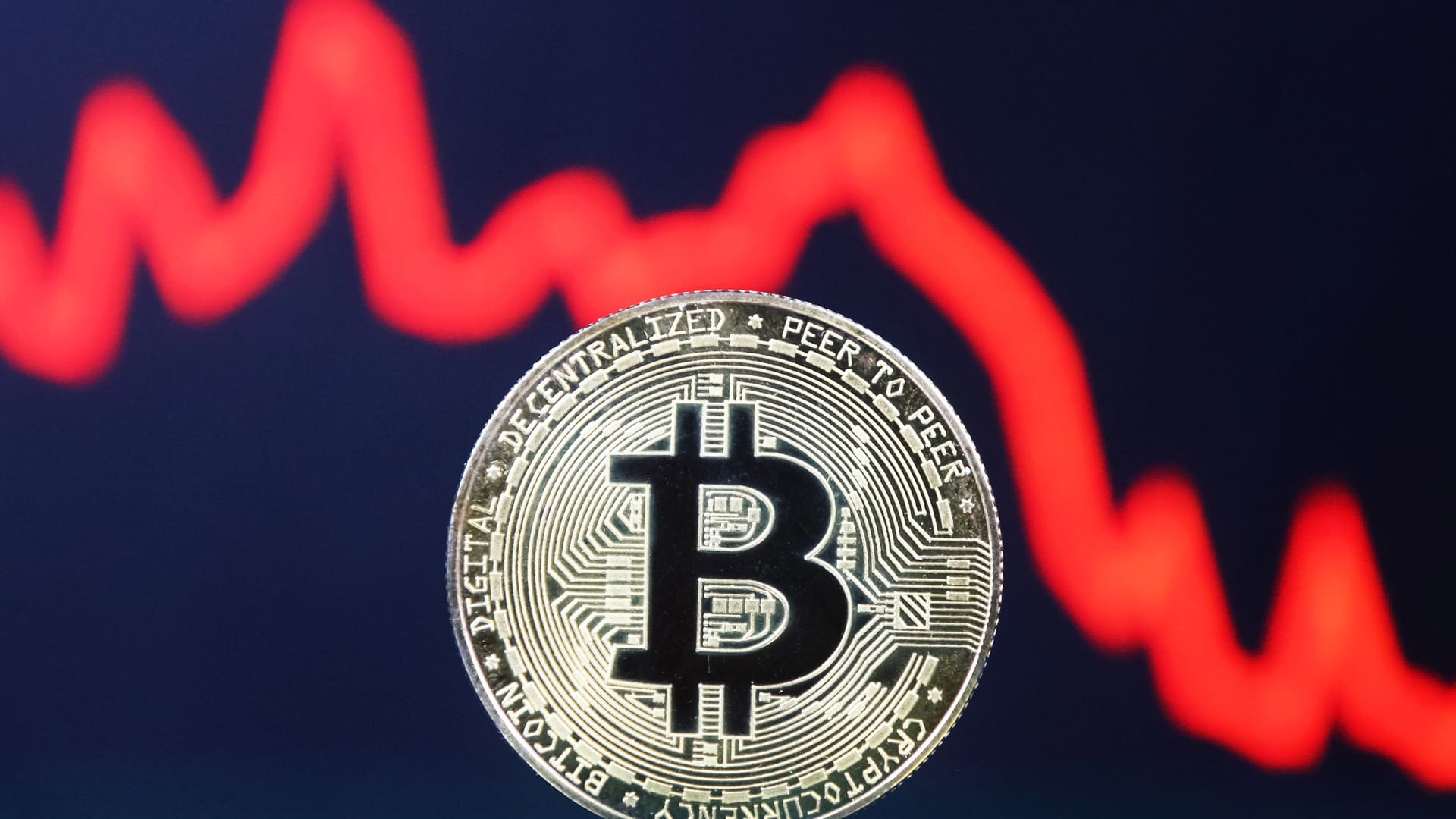
2022 was a rough year for crypto. More than $1.3 trillion was wiped off the value of the market. And bitcoin, the world’s largest digital coin, saw its price slump more than 60%.
Investors were caught off guard by a wave of collapses in the industry from stablecoin project terraUSD to crypto exchange FTX, as well as a worsening macroeconomic climate. Those who made predictions about bitcoin’s price in the past year really missed the mark.
But with 2023 now here, some market players have stuck their neck out with price calls for what could be another volatile year.
Interest rates around the world are on the rise, and that’s weighing on risk assets like stocks and bitcoin. Investors are also watching how the FTX saga, which resulted in the arrest of the company’s founder Sam Bankman-Fried in the Bahamas, will develop.
CNBC rounds up some of the boldest price calls for bitcoin in 2023.
Tim Draper: $250,000
Bitcoin bull Tim Draper had one of the most optimistic calls on bitcoin of 2022, predicting the token would be worth $250,000 by the end of the year.
In November, the billionaire venture capitalist said he’s extending the timeline for that prediction until mid-2023. Even after the collapse of FTX, he’s convinced the coin will hit the quarter-of-a-million milestone.
“My assumption is that since women control 80% of retail spending, and only 1 in 7 bitcoin wallets are currently held by women that the dam is about to break,” Draper told CNBC via email.
Bitcoin would need to rally 1,400% in order for it to trade at that level.
Despite the depressed prices and trading volumes drying up, there could be reason to suspect the market has found a bottom, according to Draper.
“I suspect that the halvening in 2024 will have a positive run,” he said.
The halvening, or halving, is an event that happens every four years in which bitcoin rewards to miners are cut in half. This is viewed by some investors as positive for bitcoin’s price, as it squeezes supply. The next halving is slated to happen sometime in 2024.
Bitcoin miners, who use power-intensive machines to verify transactions and mint new tokens, are being squeezed by the slump in prices and rising energy costs.
These actors accumulate massive piles of digital currency, making them some of the biggest sellers in the market. With miners offloading their holdings to pay off debts, that should remove most of the remaining selling pressure on bitcoin.
That’s historically a good sign for bitcoin, said Vijay Ayyar, vice president of corporate development at crypto exchange Luno.
“In prior down markets, miner capitulation has usually indicated major bottoms,” Ayyar told CNBC. “Their cost to produce becomes greater than the value of bitcoin, hence you have a number of miners either switching off their machines … or they need to sell more bitcoin to keep their business afloat.”
“If the market reaches a point where it’s absorbing this miner sell pressure sufficiently, one can assume that we’re seeing a bottoming period.”
Standard Chartered: $5,000
For some market participants, the worst is yet to come.
In a Dec. 5 research note, Standard Chartered said bitcoin may sink as low as $5,000. The prediction, one of the bank’s list of “surprises” that are being “under-priced” by markets, would represent a 70% plunge from current prices.
“Yields plunge along with technology shares” in Standard Chartered’s nightmare 2023 scenario, “and while the Bitcoin sell-off decelerates, the damage has been done,” said Eric Robertsen, the bank’s global head of research.
“More and more crypto firms and exchanges find themselves with insufficient liquidity, leading to further bankruptcies and a collapse in investor confidence in digital assets,” he added.
Robertsen said the scenario has a “non-zero probability of occurring in the year ahead” and falls “materially outside of the market consensus or our own baseline views.”
Mark Mobius: $10,000
Veteran investor Mark Mobius had a relatively successful 2022 in terms of his price call. In May, he forecast bitcoin would drop to $20,000 when it was trading above $28,000.
Loading chart…
He said bitcoin would fall to $10,000 in 2022. That did not happen. However, Mobius told CNBC that he is sticking for his $10,000 price call in 2023.
The investor, who made his name at Franklin Templeton Investments, told CNBC that his bear case for bitcoin stemmed from rising interest rates and general tighter monetary policy from the U.S. Federal Reserve.
“With higher interest rates, the attraction of holding or buying Bitcoin or other cryptocurrencies becomes less attractive since just holding the coin does not pay interest,” Mobius said via email.
Carol Alexander: $50,000
Carol Alexander, professor of finance at Sussex University, wasn’t far off the mark with her prediction that bitcoin would slip to $10,000 in 2022.
Now, she thinks the cryptocurrency could be set for gains — but not for reasons you might expect.
The catalyst would be more dominos from the FTX fallout tipping over, Alexander said. If this happens, she expects the price of bitcoin will top $30,000 in the first quarter, and then $50,000 by quarters three or four.
“There will be a managed bull market in 2023, not a bubble — so we won’t see the price overshooting as before,” she told CNBC.
“We’ll see a month or two of stable trending prices interspersed with range-bounded periods and probably a couple of short-lived crashes.”
Alexander’s reasoning is that, with trading volumes evaporating with traders on edge, large holders known as “whales” will likely step in to prop up the market. The wealthiest 97 bitcoin wallet addresses account for 14.15% of the total supply, according to fintech firm River Financial.
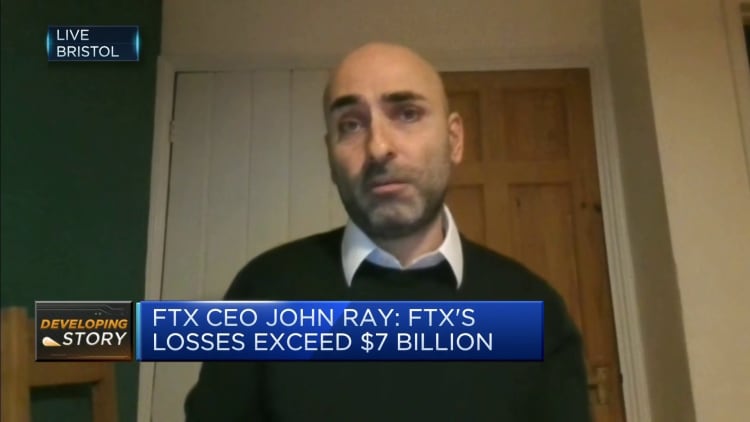
Some investors have given up trying to predict the price of bitcoin. For Antoni Trenchev, CEO of crypto lending platform Nexo, the recent events are a sobering moment.
Bitcoin was on a “positive path” earlier in 2022, with institutional adoption rising, but “a few major forces interfered,” he said.
Trenchev once predicted bitcoin surging to a peak of $100,000 by early 2023. Now, he’s done trying to predict the price.
Laith Khalaf, financial analyst at AJ Bell, suggested attempts to forecast bitcoin’s price are futile.
“We could be sitting here talking this time next year and it could be at $5,000 or 50,000 it just wouldn’t surprise me because the market is so heavily driven by sentiment,” he told CNBC’s “Squawk Box Europe.“


The VC arms of Google and Nvidia have invested in Swedish vibe coding startup Lovable’s $330 million Series B at a $6.6 billion valuation, the company announced on Thursday.
The news confirms an earlier story from CNBC, which reported on Tuesday that Lovable had raised at that valuation, trebling its valuation from its previous round in July, and that the investors included U.S. VC firms Accel and Khosla Ventures.
CapitalG, one of Google’s VC divisions, and Menlo Ventures led the round. Alongside Accel and Khosla, Nvidia venture arm NVentures, actor Gwyneth Paltrow’s VC firm Kinship Ventures, Salesforce Ventures, Databricks Ventures, Atlassian Ventures, T.Capital, Hubspot Ventures, DST Global, EQT Global, Creandum and Evantic also participated.
The fresh funds take Lovable’s total raised in 2025 to over $500 million.
“Lovable has done something rare: built a product that enterprises and founders both love,” said Laela Sturdy, managing partner at CapitalG in a statement accompanying the announcement.
“The demand we’re seeing from Fortune 500 companies signals a fundamental shift in how software gets built.”
Lovable’s platform uses AI models from providers like OpenAI and Anthropic to help users build apps and websites using text prompts, without technical knowledge of coding.
The startup reported $200 million in annual recurring revenue (ARR) in November, just under a year after achieving $1 million in ARR for the first time. It was founded in 2023 by Anton Osika and Fabian Hedin.
Vibe coding startups have seen big interest from VCs in recent times, as investors bet on their promise of drastically reducing the time it takes to create software and apps.
In the U.S., Anysphere, which created coding tool Cursor, raised $2.3 billion at a $29.3 billion valuation in November. In September, Replit hit a $3 billion price tag after picking up $250 million and Vercel closed a $300 million round at a $9.3 billion valuation.


The Micron logo is seen displayed at the 8th China International Import Expo.
Sheldon Cooper | Lightrocket | Getty Images
Micron Technology‘s stock jumped 15% after the company signaled robust demand for its memory chips and blew away fiscal first-quarter estimates.
During an earnings call with analysts, Micron, which makes memory storage used for computers and artificial intelligence servers, said data center needs have fueled greater demand for its products.
Micron said it expects the total addressable market for high-bandwidth memory to hit $100 billion by 2028, growing at a 40% compounded annual growth rate. Management also upped its capital expenditures guidance to $20 billion from $18 billion.
“We are more than sold out,” said business chief Sumit Sadana. “We have a significant amount of unmet demand in our models and this is just consistent with an environment where the demand is substantially higher than supply for the foreseeable future.
Micron topped Wall Street estimates for the fiscal first quarter and issued blowout guidance.
The company reported adjusted earnings of $4.78 per share on $13.64 billion in revenue, surpassing LSEG estimates for earnings of $3.95 per share and $12.84 billion in sales.
Revenues in the current quarter are expected to hit about $18.70 billion, blowing past the $14.20 billion expected by LSEG. Adjusted earnings are forecast to reach $8.42, versus expectations of $4.78 per share.
JPMorgan upped its price target on the stock following the results, citing the favorable pricing setup, while Bank of America upgraded shares to a buy rating.
Morgan Stanley called the results the best revenue and net income upside in the “history of the U.S. semis industry” outside of Nvidia.
“If AI keeps growing as we expect, we believe that the next 12 months are going to have broader coat tails to the AI trade than just the processor names and memory would be the biggest beneficiary,” analysts wrote.
WATCH: Micron shares spike on better-than-expected quarterly results

Micron year-to-date stock chart.
Technology
Trump defends economy, CPI report returns, monster Medline IPO, and more in Morning Squawk

-
 Sports2 years ago
Story injured on diving stop, exits Red Sox game
-
 Sports3 years ago
‘Storybook stuff’: Inside the night Bryce Harper sent the Phillies to the World Series
-
 Sports2 years ago
Game 1 of WS least-watched in recorded history
-
 Sports3 years ago
Button battles heat exhaustion in NASCAR debut
-
 Sports3 years ago
MLB Rank 2023: Ranking baseball’s top 100 players
-
Sports4 years ago
Team Europe easily wins 4th straight Laver Cup
-
 Environment3 years ago
Japan and South Korea have a lot at stake in a free and open South China Sea
-
 Environment1 year ago
Here are the best electric bikes you can buy at every price level in October 2024