
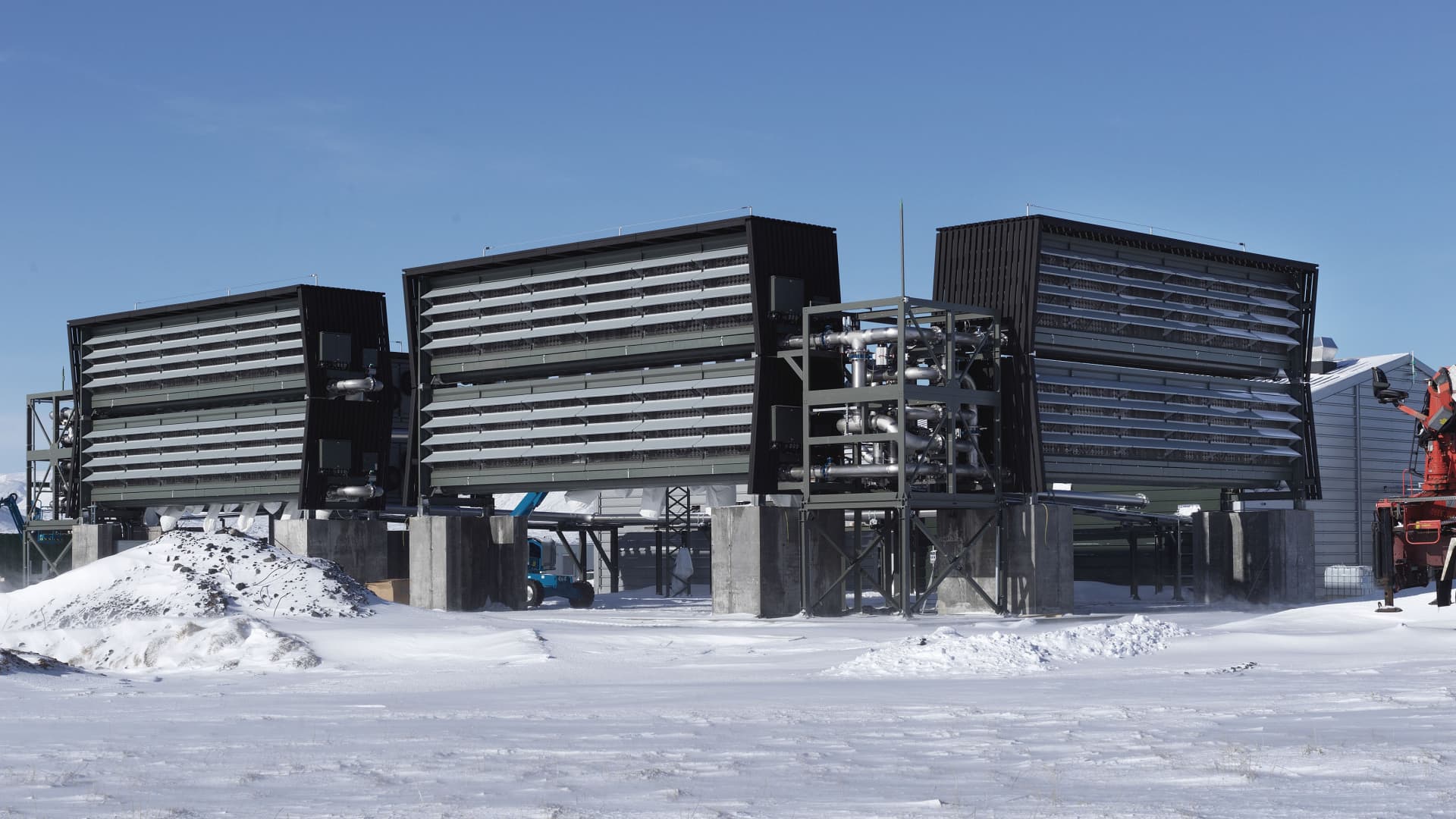
Swiss company that counts Microsoft as a customer says it’s removed CO2 from the air and put it in the ground

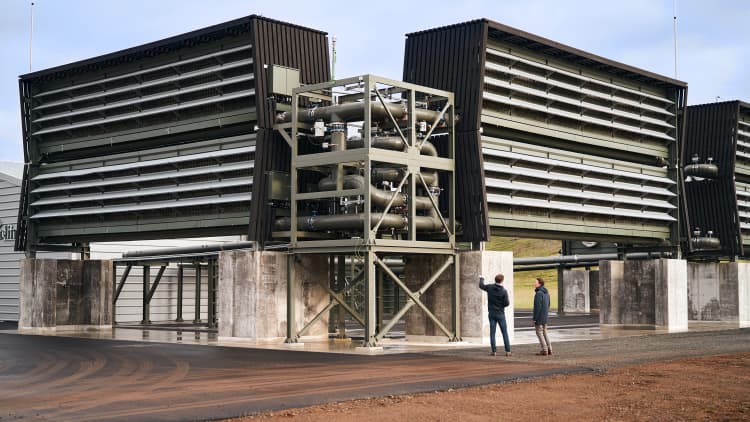
Climeworks’ carbon removal plant in Hellisheidi, Iceland.
Photo courtesy Climeworks
Swiss company Climeworks announced Thursday that it has successfully taken carbon dioxide out of the air and put it in the ground where it will eventually turn into rock. It the first time a company has successfully both taken carbon dioxide out of the atmosphere and then put it underground to be locked away permanently.
The development has been a long time coming. Christoph Gebald and Jan Wurzbacher co-founded Climeworks in 2009 as a spinoff of ETH Zürich, the main technical university in Switzerland’s largest city. They have been scaling the technology for direct carbon removal, wherein machines vacuum greenhouse gasses out of the air.
Over the last couple of years, Microsoft, Stripe and Shopify have all bought carbon removal services from Climeworks in a bid to help kickstart the nascent industry. Now Climeworks is actually starting to remove the carbon dioxide and put it underground.
The cost of carbon dioxide removal and storage for these corporate clients is confidential and depends on how much the companies pay to have removed and over what period of time. But the general price for carbon removal runs to several hundred dollars per ton. Individuals can also pay to Climeworks to remove carbon dioxide to offset their personal emissions.
In addition to getting corporate clients to pay for future removals, Climeworks has raised more than $780 million to scale up from a wide variety of investors including venture capitalist John Doerr and the the insurance company Swiss Re.
Climeworks’ largest carbon dioxide removal facility is located in Iceland, where it partners with CarbFix, which stores the gas underground. CarbFix dissolves carbon dioxide in water then intermingles that mixture with basalt rock formations. Natural processes convert the material to solid carbonate minerals in about two years.
In June, Climeworks announced it had begun construction of its second commercial-sized plant in Iceland that will capture and store 36,000 metric tons per year of carbon dioxide. Even when complete, that will amount to a tiny percentage of the total global emissions of carbon dioxide released into the air each year: In 2021, they hit a record high of 36.3 billion metric tons, according to the International Energy Agency.


Firefly’s CEO Jason Kim reacts during the company’s IPO at the Nasdaq MarketSite in New York City, U.S., August 7, 2025.
Jeenah Moon | Reuters
Last week’s liftoff also coincided with President Donald Trump‘s “space superiority” executive order, signed on Friday, that aims to create a permanent U.S. base on the moon.
Investors have also gained more clarity on the future of NASA following a whirlwind drama since Trump won the election.
Last week, the Senate confirmed Jared Isaacman as NASA administrator more than a year after he was first nominated to the position.
Trump withdrew the nomination from the Elon Musk ally earlier this year amid a public fallout, but renominated Isaacman in November.
Transportation Secretary Sean Duffy was tapped to temporarily run the space agency in the interim.


Google parent Alphabet on Monday announced it will acquire Intersect, a data center and energy infrastructure company, for $4.75 billion in cash in addition to the assumption of debt.
Alphabet said Intersect’s operations will remain independent, but that the acquisition will help bring more data center and generation capacity online faster.
In recent years, Google has been embroiled in a fierce competition with artificial intelligence rivals, namely OpenAI, which kick-started the generative AI boom with the launch of its ChatGPT chatbot in 2022. OpenAI has made more than $1.4 trillion of infrastructure commitments to build out the data centers it needs to meet growing demand for its technology.
With its acquisition of Intersect, Google is looking to keep up.
“Intersect will help us expand capacity, operate more nimbly in building new power generation in lockstep with new data center load, and reimagine energy solutions to drive US innovation and leadership,” Sundar Pichai, CEO of Google and Alphabet, said in a statement.
Google already had a minority stake in Intersect from a funding round that was announced last December. In a release at the time, Intersect said its strategic partnership with Google and TPG Rise Climate aimed to develop gigawatts of data center capacity across the U.S., including a $20 billion investment in renewable power infrastructure by the end of the decade.
Alphabet said Monday that Intersect will work closely with Google’s technical infrastructure team, including on the companies’ co-located power site and data center in Haskell County, Texas. Google previously announced a $40 billion investment in Texas through 2027, which includes new data center campuses in the state’s Haskell and Armstrong counties.
Intersect’s operating and in-development assets in California and its existing operating assets in Texas are not part of the acquisition, Alphabet said. Intersect’s existing investors including TPG Rise Climate, Climate Adaptive Infrastructure and Greenbelt Capital Partners will support those assets, and they will continue to operate as an independent company.
Alphabet’s acquisition of Intersect is expected to close in the first half of 2026, but it is still subject to customary closing conditions.
WATCH: Here’s what’s happening to electricity bills in states with the most data centers

-
 Sports2 years ago
Story injured on diving stop, exits Red Sox game
-
 Sports3 years ago
‘Storybook stuff’: Inside the night Bryce Harper sent the Phillies to the World Series
-
 Sports2 years ago
Game 1 of WS least-watched in recorded history
-
 Sports3 years ago
Button battles heat exhaustion in NASCAR debut
-
 Sports3 years ago
MLB Rank 2023: Ranking baseball’s top 100 players
-
Sports4 years ago
Team Europe easily wins 4th straight Laver Cup
-
 Environment3 years ago
Japan and South Korea have a lot at stake in a free and open South China Sea
-
 Environment1 year ago
Here are the best electric bikes you can buy at every price level in October 2024