
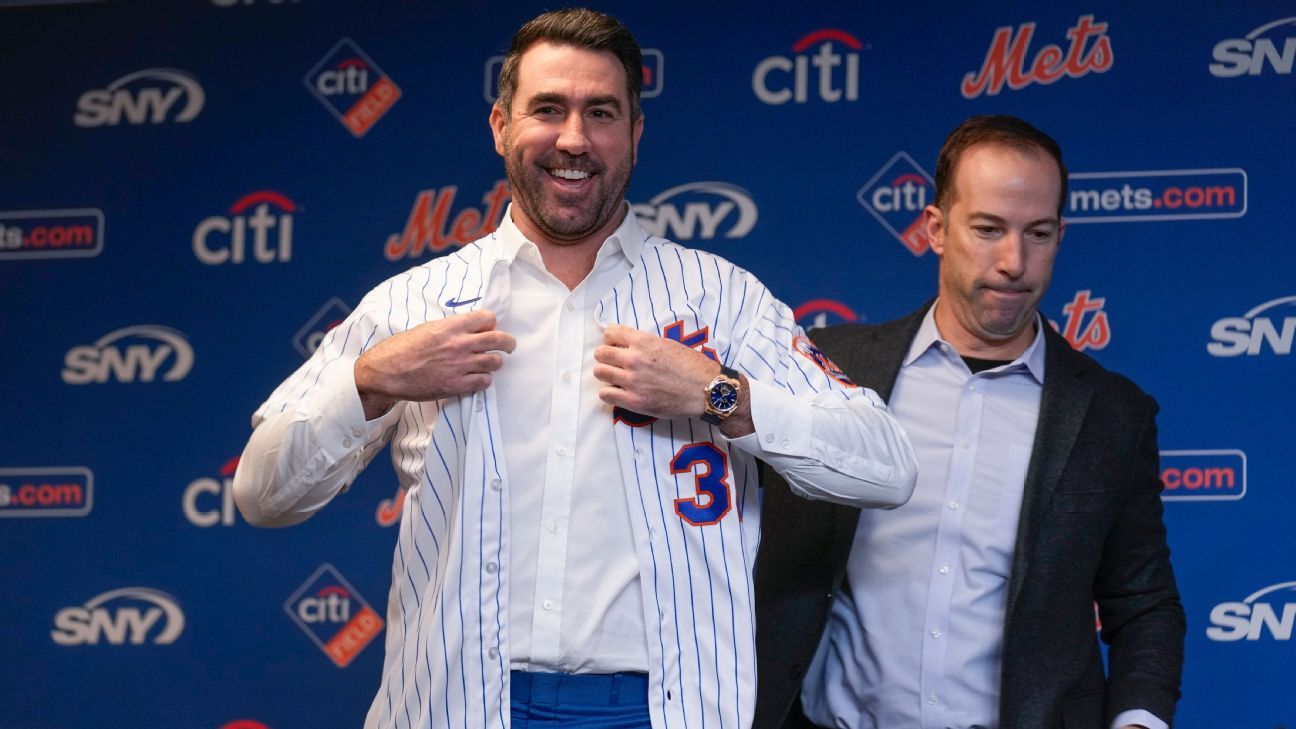
Passan: The eight things we learned from MLB’s $3.8 billion offseason


-
Jeff PassanESPN
Spring training starts in less than a month. Every major free agent is signed. Almost all of the second- and third-tier ones have jobs, too. It’s almost like Major League Baseball free agency doesn’t need to bleed into the beginning of a new season.
With that clarity, we can find takeaways, lessons and trends — the sort of things that inform not only the past three months but the season to come and, possibly, the years ahead. Teams have guaranteed players a record $3.8-plus billion this winter. Maybe it is an outlier — a confluence of a free agent class with a bigger-than-usual group of star-caliber talent, a new collective bargaining agreement that juiced spending and a handful of motivated owners willing to ignore convention and logic in search of winning. Or perhaps it’s just the new norm.
Time will tell. Either way, there is plenty to chew on — some of it indicative of that new era, some reinforcing long-held thoughts. All of it, though, is representative of a free agency period that won’t be forgotten anytime soon.
Here are eight things free agency taught us.
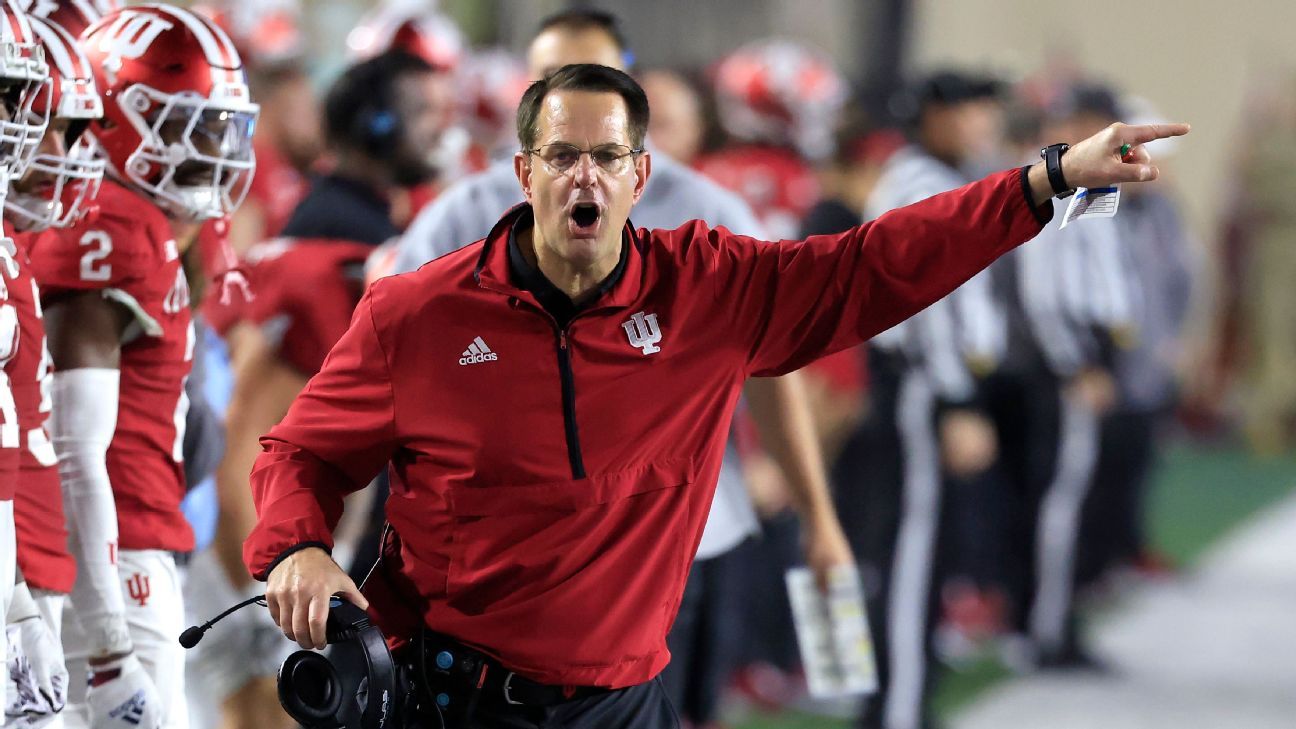

Indiana‘s Curt Cignetti exceeded expectations again this season, and it earned him a second consecutive honor as The Associated Press Coach of the Year in college football.
Cignetti is the first coach to win the award in back-to-back years since it was first presented in 1998. He is the fourth coach to win it twice, joining Brian Kelly, Gary Patterson and Nick Saban.
The 64-year-old Cignetti is 24-2 while leading the Hoosiers to unprecedented heights in his two seasons since leaving James Madison of the Championship Subdivision to take over what had been the losingest program in major college football. Last year, the Hoosiers won their first 10 games, were ranked as high as No. 5 in the AP Top 25 and reached the first round of the College Football Playoff.
He outdid himself this year, showing his smashing debut was not a one-off.
Indiana is 13-0, Big Ten champion for the first time since 1967, No. 1 in the AP poll for the first time and the top seed for the CFP. He also is coach of Indiana’s first Heisman Trophy winner, quarterback Fernando Mendoza, the AP Player of the Year.
Cignetti was a landslide winner for Coach of the Year in voting by the nationwide panel of 52 media members who cover college football. Cignetti received 47 first-place votes. Texas Tech’s Joey McGuire and Vanderbilt’s Clark Lea received two each, and Virginia’s Tony Elliott got one.
The magnitude of Cignetti’s work at Indiana can’t be overstated.
In 2022, the Hoosiers became the first Bowl Subdivision program to reach 700 all-time losses. They entered this season with 714, a figure that still stands, and they’ve since been passed by Northwestern (717) for the dubious FBS mark.
In a program that had never won more than nine games in a season before Cignetti’s arrival, the Hoosiers have double-digit wins for a second straight year and completed a regular season without a loss for the first time.
Cignetti had said before last week that his program was chasing Ohio State in recruiting and on the field. The 13-10 win over the Buckeyes in the Big Ten championship game marked another milestone.
“It’s another step we need to take as a program,” he said after the game. “It’s a great win, obviously. And we’re going to go in the playoffs as the No. 1 seed. And a lot of people probably thought that wasn’t possible. But when you get the right people and you have a plan and they love one another and play for one another and they commit, anything’s possible.”


-
Rachel Kryshak
Close
Rachel Kryshak
ESPN
- Rachel Kryshak is a professional data consultant specializing in data communication and modelling. She’s worked in the NHL and consulted for professional teams across North American and Europe. She hosts the Staff & Graph Podcast and discusses sports from a data-driven perspective.
-
Greg Wyshynski

In his first game as the greatest player ever acquired by the Minnesota Wild, Quinn Hughes immediately started doing Quinn Hughes things for his new team.
It was a home game against the Boston Bruins on Sunday. The star defenseman looked up the ice and started sprinting. He saw four Bruins deep in their own zone, leaving plenty of room for Hughes to smoothly glide over the blue line and turn a Ryan Hartman pass into a goal, snapping the puck past goalie Jeremy Swayman.
The fans roared. The Wild’s social media team declared “WELCOME TO QUINNESOTA” when posting the highlight.
Welcome, indeed.
“It felt like we had a little more swagger out there today,” goalie Filip Gustavsson said.
Ecstatic that their team landed the coveted defenseman in a trade last Friday, Wild fans gave Hughes an ovation as he left the ice in warmups, then another during starting lineups. They cheered every time he touched the puck.
“That was pretty special, honestly,” Hughes said after Minnesota’s 6-2 win. “I know it’s a hockey market, but that was exciting.”
Also exciting: When one of the NHL’s superstar players is traded in-season to a surprise destination.
1:47
Why Quinn Hughes’ trade to Wild puts rest of NHL on notice
Greg Wyshynski breaks down why he loves the trade of Quinn Hughes to the Minnesota Wild.
Hughes, 26, played for the Vancouver Canucks for eight seasons, establishing himself as a franchise player and one of the world’s premier defensemen. He’s been a finalist for the Norris Trophy in two straight seasons, winning the award in 2024. Since 2022, he’s second only to Colorado Avalanche star Cale Makar (372 points) in points by a defenseman, with 336.
The Canucks were going nowhere except into a rebuild. Hughes was going to walk away as a free agent in the summer of 2027. So the decision was made by Vancouver president of hockey operations Jim Rutherford and the Hughes camp to seek a trade.
“It was a tough situation,” Hughes said. “But I felt like it was time. And I think Jim did, too.”
Hughes didn’t end up in New Jersey, where his brothers Jack and Luke play. He didn’t end up in Detroit, in the state the Hughes family calls home. He didn’t end up on any of the teams heavily rumored to be discussing a trade for him.
Quinn Hughes ended up in Minnesota, to the shock of the NHL. That’s because the Wild were never mentioned as a destination, and because of what the team traded to acquire him. The Wild gave up three former first-round selections — center Marco Rossi, forward Liam Ohgren and defenseman Zeev Buium — and a 2026 first-round pick to acquire Hughes, with no guarantee that he’ll sign an extension in Minnesota.
How did this trade happen? What does it mean for the teams involved and the teams that didn’t — or couldn’t — make this trade?
After conversations with around a dozen NHL executives, agents and players from around the league, here’s the behind-the-scenes story on one of the most significant trades in recent hockey history — and the aftershocks.
Why Quinn Hughes is no longer in Vancouver
To understand why Hughes is no longer with the Canucks, it’s important to understand how things got so bleak as to have him want to leave now.
In May 2020, former Vancouver GM Jim Benning announced that amateur scouting director Judd Brackett could not reach a new contract agreement and would part ways with the team.
Brackett and highly respected scout Dan Palango left Vancouver and joined the Wild under GM Bill Guerin. In a short time, Brackett terraformed the Wild’s prospect field. He had a hand in drafting every player the Wild just traded to Vancouver for Hughes — who, it should be said, Vancouver selected at seventh overall in 2018 on Brackett’s advice.
The next five Canucks drafts after Brackett left produced just one selection who played more than 50 NHL games: defenseman Elias N. Pettersson, taken 80th overall in 2022.
As the Canucks’ prospect pool was drying up, there was trouble among the veterans.
In September 2022, Vancouver signed J.T. Miller to a seven-year, $56 million contract, which started a domino effect. The Canucks essentially chose Miller over pending free agent center Bo Horvat, who was traded the following January to the New York Islanders. In doing so, the Canucks overlooked the personal issues between Miller and star center Elias Pettersson that had been growing since the regime that preceded Rutherford and his general manager, Patrick Allvin.
In January 2025, the internal drama had intensified to the point where Miller was traded to the New York Rangers.
So began Vancouver’s need to bolster the center position, which was among the team’s strongest prior to Horvat’s trade. Many in the league still wonder how the Canucks’ fortunes would be different if Horvat had been extended in the summer of 2022.
Vancouver finished with a .549 points percentage last season, missing the playoffs. Coach Rick Tocchet decided to leave the Canucks for the Philadelphia Flyers. Tocchet and Hughes were close, but the coach’s exit was a symptom of larger issues.
Addressing reporters after the trade, Rutherford said his team started to believe Hughes wasn’t going to sign an extension over a year and a half ago. Allvin said the team thought “about a year ago” that this “might be the path that Quinn wants to go.” But both Vancouver ownership and management refused to accept that fate.
“We were trying to do everything to convince him to stay,” Allvin said.
Case in point: the Miller trade and its aftermath. The Canucks acquired the oft-injured 26-year-old center Filip Chytil from the Rangers along with a lottery-protected 2025 first-round pick. Rather than use that pick, Vancouver moved it to the Pittsburgh Penguins for more immediate help: Defenseman Marcus Pettersson, 29, who signed a six-year, $33 million contract extension after the trade. Pittsburgh then turned that Rangers pick into a pair of low first-rounders in a trade with Philadelphia.
Vancouver continued to make counterintuitive decisions for a team on the road to a potential post-Hughes rebuild. The Canucks extended 30-year-old goalie Thatcher Demko (three years, $25.5 million) and 29-year-old winger Conor Garland (six years, $36 million), who both would have been unrestricted free agents next summer. They brought back unrestricted free agent winger Brock Boeser, 28, on a seven-year, $50.75 million deal that carries a full no-movement clause until 2029.
Trying to convince Hughes to stay extended to off-ice moves. When Tocchet left for the Flyers, the Canucks elevated assistant coach Adam Foote — who had one year of previous head coaching experience, with the Western Hockey League’s Kelowna Rockets in 2019-20 — to the big job. Foote was responsible for coaching the Canucks’ defensemen, and the hire was immediately labeled as a way to curry favor with Hughes.
Following the trade, Rutherford said there was nothing “concrete” about Hughes’ future until last offseason, when his agent Pat Brisson had informed the Canucks that “it was highly unlikely that [Hughes] was going to sign an extension” in Vancouver.
“He wanted to be closer to his family, closer to his brothers, wanted to play with his brothers at some point,” Rutherford said. “It doesn’t mean it has to be in the next couple of years. He could do it in his 30s, I suppose. So that was really around the time that I was pretty much 100% sure that there wasn’t going to be any convincing him to change his mind.”
NHL sources indicated that the machinery on this trade didn’t start turning until around U.S. Thanksgiving, when Brisson and Hughes had discussions with Canucks management and ownership about potential landing spots.
The Canucks were 9-12-2 and hovering near the Western Conference basement heading into Thanksgiving. Because of that mediocre start, Rutherford and Allvin informed the rest of the NHL that they were looking to make trades. While their motivation was moving pending unrestricted free agents such as forwards Evander Kane and Kiefer Sherwood, the memo kicked up interest in whether Hughes was available, too.
Suddenly, the captain was answering questions about his future after practices and games. He was asked about it during a charity event at a local food bank.
“He was a true pro,” Rutherford said, “but it was clear that it was getting harder for him.”
0:47
Quinn Hughes notches goal on the power play
Quinn Hughes notches goal on the power play
On Dec. 6, Sportsnet reported that the Canucks and Devils had “a conversation” about Hughes. Suddenly, the simmering speculation about Hughes turned to a boil. The trade rumors started to impact Hughes’ Canucks teammates, according to Foote.
“It’s there. These guys are human,” the coach said. “They can feel it. It can affect a locker room.”
It was clear the Canucks could not wait any longer to trade Hughes. Through his decades as an NHL general manager — winning Stanley Cups with Carolina and Pittsburgh — Rutherford had become known for making deals well ahead of the NHL trade deadline to create his own market. This was no different.
“In order to not get painted into the corner with one team, we felt that trying to do a deal in December or the first half of January would give us the most leverage,” Rutherford said after the trade.
With that, the trade process for Hughes began in earnest.
Which teams made offers?
Rutherford said Allvin asked him to take the lead on fielding trade offers, as the general manager “had a lot on his plate.”
The Canucks knew they couldn’t whiff on a Hughes trade. The consensus from sources around the NHL was that the Canucks were seeking a young center with NHL experience that could play in their top six, and a young defenseman, preferably left-handed. Teams knew a first-round pick would have to be part of any package as well.
The initial focus for Vancouver was trading Hughes to a team in the Eastern Conference “to get him closer to his brothers and family,” according to Rutherford. So talks began with the team in closest proximity to Jack and Luke — the one on which they play.
“The process probably started a couple of weeks ago with the understanding that New Jersey was the potential team,” Rutherford said.
The Devils were thought to be an inevitability in the Hughes derby. All three brothers stated that they wanted to play together in the NHL. Rutherford reiterated that was Quinn’s goal during news conference last season that also helped spark months of trade speculation surrounding his captain.
“Honestly, I was a little surprised that [Rutherford] would be so forthcoming with that,” Jack Hughes told ESPN in September.
According to an NHL source, there were discussions between the teams about Devils center Nico Hischier, their 26-year-old captain, even though he could also become an unrestricted free agent in 2027. New Jersey didn’t have interest in that swap. But the Devils did have a lot of what the Canucks were looking for in a trade.
The belief is that Vancouver would have wanted a package of 21-year-old defenseman Simon Nemec, drafted second overall in 2022; 24-year-old center Dawson Mercer; KHL defenseman Anton Silayev, drafted 10th overall in 2024; and a first-round pick. That package was crafted with the understanding that Hughes was likely to sign an extension with the Devils.
The problem with the Devils’ trade bid wasn’t necessarily the bid itself — although, ultimately, Minnesota’s offer was better — but in their inability to clear the necessary salary cap space to take on Hughes’ $7.85 million AAV.
The Devils have 14 players with some level of trade protection on their current contracts. That includes veteran forward Ondrej Palat and defenseman Dougie Hamilton, two players they could have shipped out to facilitate the trade.
“They handed out some regrettable trade protection in the past and it handcuffed them,” one NHL executive said.
The Canucks heard from plenty of NHL teams. Some dropped out quickly when the asking price came into focus.
“We were not even close,” one NHL general manager who was in on the trade talks said.
Others saw their interest in a Hughes trade inflated by media speculation. One of those teams was the Washington Capitals, who were portrayed as a serious suitor. Sources told ESPN that was overstated, especially when it was made clear that the Capitals didn’t want to move young forwards Ryan Leonard, Aliaksei Protas and Ilya Protas. That meant a Hughes bid could be built around center Connor McMichael and defensive prospect Cole Hutson of Boston University, but that wasn’t going to beat other offers.
The Carolina Hurricanes, as they have with every big-name player available over the past few years, made their pitch. But their trade package wasn’t in the ballpark of Minnesota’s, according to an NHL source.
The Rangers inquired, given their proximity to Hughes’ brothers’ team. Winger Alexis Lafreniere has been a target for the Canucks for some time — unsurprising, given his former agent, Émilie Castonguay, is their assistant general manager. But he wasn’t the only player Vancouver coveted: The Canucks also were interested in forwards Gabe Perreault, Will Cuylle and Noah Laba, as well as defenseman Braden Schneider. Ultimately, the Rangers did not want to part with the requisite players to acquire Hughes.
The Detroit Red Wings made a pitch for Hughes, whose family relocated to Michigan around eight years ago. He also played for the University of Michigan and the U.S. National Development Team, which is headquartered in the state. Detroit captain Dylan Larkin is a friend. There was a thought that Detroit could acquire Hughes, extend him and then lure Jack there as a free agent in 2030. But for Detroit to match Minnesota’s offer, it likely would have taken defenseman Simon Edvinsson, the sixth overall pick in 2021; winger Michael Brandsegg-Nygard, selected 15th overall in 2024; either Marco Kasper or Nate Danielson, two young centers with a taste of NHL experience; and a first-round pick. The Red Wings reportedly balked at a portion of that package.
The Buffalo Sabres reportedly made their pitch, desperately seeking a path back to the playoffs for the first time since 2011. Forward Zach Benson is a player the Canucks have coveted since they passed on him in favor of defenseman Tom Willander in the 2023 draft. Benson and defenseman Bowen Byram would have been the primary pieces in any deal that saw Hughes end up in Buffalo.
There was some reading between the lines when Hughes spoke after his debut with the Wild on Sunday, and praised the all-in aspect of Guerin’s offer.
“There are other teams that probably could have thrown in certain packages like that too, but at the end of the day, they didn’t want to do that. They didn’t want to trade two or three assets from their team like Billy did,” Hughes said. “I’ll remember that. That means a lot to me, that Billy did that.”
Into the Wild
Both Guerin and Devils GM Tom Fitzgerald have history with Rutherford. Fitzgerald was hired by the Penguins’ front office in 2007 to work under Ray Shero, their general manager.
Shero then hired Guerin in 2011 as a Penguins developmental coach. When Rutherford replaced Shero in 2014, both Guerin and Fitzgerald were named his assistant general managers. Reports at the time noted that Guerin appeared to move ahead of Fitzgerald in the front office pecking order. Fitzgerald left the organization in 2015 in a lateral move, becoming Shero’s assistant GM in New Jersey before replacing him in 2020.
Guerin took over the Wild in 2019 and brought Shero on in an advisory capacity. The bold trade for Hughes is exactly the type of move that the late Shero would have made. The infamous “one-for-one” Taylor Hall-for-Adam Larsson trade was a bold stroke from Shero.
The Wild have yet to play for the Stanley Cup since entering the NHL in 2000. The team hasn’t won a playoff series since 2015. But if there was a time to get aggressive as a contender, it is now, and Guerin hopes his boldness leads to playoff success.
The cap penalties from Guerin’s buyouts of forward Zach Parise and defenseman Ryan Suter have finally eased: The Wild had $14.7 million in dead cap space last season, but from 2026 to ’29, the annual cap penalty is just $1,666,666. Minnesota signed superstar winger Kirill Kaprizov to an NHL record contract through the 2033-34 season. Guerin’s team had amassed a collection of young talent that could bolster his roster — either through their play or as a trade asset.
This is why he called Rutherford.
“He told me what they wanted to try and accomplish with the move,” Guerin said. “I felt we could satisfy their needs.”
The Wild made the offer, and didn’t have to make another. “We came out of the gates with that,” Guerin said. “They wanted to check certain boxes, and we had to check them for them. We’re not going to sneak one past them. They’re smart.”
Buium has potential to be a top-pairing defender and power-play quarterback. His defending has a long way to go, but he’s an elite skater and the toolkit is there to blossom into a solid defender.
Guerin had been trying to move Rossi for a long time. The Wild gave him just a three-year deal when they re-signed the restricted free agent in August. Vancouver had tried to trade for him previously, and he finally gives them a young center who can provide offense.
Ohgren hasn’t put things together yet in the NHL over three seasons. He has previous chemistry with Canucks forward Jonathan Lekkerimaki from their time in Sweden.
“I don’t think there’s a team that could offer something similar to this right now,” one NHL executive said. “Not many teams can give up their 2C and a 20-year-old, top-four defenseman and still feel like they’re going to contend this year — while also having a reasonable shot of extending Quinn Hughes.”
Rutherford liked the return but wanted to make sure that Hughes saw Minnesota was a suitable landing spot.
“It was clearly the best offer. And so then there was a process of letting the other teams have another chance and seeing if Quinn had interest in going to Minnesota,” Rutherford said after the trade. “He thought, at this time, Minnesota would be a good fit for this year. Where it goes from there, that’s up to everybody else.”
Minnesota was well positioned to make the deal because not only had the team drafted the players included in the deal, but it has players who can replace those players: Riley Heidt, Hunter Haight, Ryder Ritchie and Charlie Stramel up front, along with Carson Lambos and David Jiricek on the back end — reinforcements there are a less pressing need given the acquisition of Hughes.
When Guerin initially reached out, Rutherford was blunt: Yes, the Wild could jump into the Hughes derby. “But the odds are against you, based on Quinn’s criteria.”
Yet the Wild had plenty that Hughes appreciated, from its proximity to home to defense partners like Brock Faber. But a primary catalyst for his decision was, in fact, Guerin. The two got to know each other through USA Hockey, as Guerin was the general manager for the 4 Nations Face-Off roster and the 2026 Winter Olympic team. (Hughes was one of the first six players named to the Olympic squad back in June.)
Where Hughes really gained respect for Guerin was during 4 Nations, which he missed because of an oblique injury sustained with the Canucks.
“How he handled me with the 4 Nations really gave me a glimpse of what a good person he is. Honestly, he was a big reason why I wanted to come here,” Hughes said of Guerin.
Hughes felt that last Thursday’s game against Buffalo would be his final game in Vancouver. He traveled with the team to New York, where he had dinner with some soon-to-be-former teammates and spent time with Jack and Luke. On Friday morning, he knew a trade was imminent.
Guerin said he was in the middle of making meatballs for his family’s Christmas Eve dinner when Rutherford called to say the Canucks had accepted the Wild’s trade offer.
“I had to take my latex gloves off. He told me we had a deal. There was a fist pump involved,” Guerin said. “They’re really good meatballs. It’s my wife’s recipe. I’m just doing the grunt work.”
Guerin and assistant GM Chris Kelleher flew to New Jersey to collect Hughes so he could make his debut Sunday against Boston. Rossi, Buium and Ohgren all played their first games for the Canucks in their win against New Jersey on Sunday, while still processing their whirlwind 48 hours.
In the case of Buium, who had a goal and an assist in his Canucks debut, it meant going from a foundational piece of the Wild’s future to the fulcrum of a blockbuster trade to Vancouver.
“I don’t think anything they told me was a lie. I really don’t,” Buium told ESPN on Sunday. “Bill Guerin is an unbelievable person. He’s such a smart guy. He wants to try and win now, and that’s a move he thought was best for the team. At the end of the day, you have to do what’s best for the team.”
The Canucks rebuild … sort of
Many around the NHL feel that the Canucks got a decent return under the circumstances. “They did as well as they could, but it’s risky,” one NHL executive said. “Ohgren seems like a bust, Rossi’s been shopped, Buium is so young.”
Of course, none of those players is Quinn Hughes. And without their star defenseman, it’s time for the Canucks to pivot to the next phase.
Like many team executives, Rutherford has been hesitant to use the term “rebuild” to describe that phase. As late as a month ago, he told Sportsnet that “a rebuild is not something that we’re going to look at doing” but rather that the team was “in transition.”
That changed last Friday. In the official statement announcing the return on the Hughes trade, Rutherford said, “They will be a key part of the rebuild that we are currently in, giving us a bright future moving forward.”
While the rest of the league took notice of that verbiage, Rutherford once again wanted to draw the distinction between a “rebuild” and a “full-blown” rebuild.
“People throw around different words. I believe that we’ve been in a rebuild here for a little bit, and we’ve been able to acquire some good young players. But this move gives us some really good young players,” he told reporters Friday. “It may not change our team in the next few months or even this season, but this doesn’t have to be a full-blown rebuild where it’s going to take five or seven years.”
Rutherford also defended keeping the Canucks’ other veterans on the roster.
“We’ve added some veteran players, but the veteran players have a purpose. They’re mentors for these guys. If you just go with all young players, it can get too frustrating. But we will stick with that plan, and the majority of people that we add going forward will be younger,” he said on Friday.
0:49
Brock Boeser lights the lamp for Canucks
Brock Boeser lights the lamp
Rutherford, 76, called players like Boeser, Garland and Filip Hronek “relatively young guys” who could combine with the next wave to create something successful.
“I don’t believe we have to go to a full-blown rebuild where we just trade all the players we have,” he said. “Sure, we’re going to trade some players away. We’re going to get more draft capital.”
Rutherford also confirmed that the first-round pick acquired from Minnesota might be in play in a subsequent trade if the return were to be a young player, because it would expedite the rebuild.
Beyond the specific trade and what it means for a rebuild, Allvin was asked whether the Canucks have a culture problem that needs to be fixed, in light of the Miller-Pettersson situation last season as well.
“A culture problem? On our team? I don’t believe so,” he said. “I don’t think that’s the reason Quinn Hughes was traded.”
Quinn’s path to playing with his brothers — in New Jersey or otherwise
One current NHL player wondered whether Hughes actually made sense for the Devils, considering they just gave Luke Hughes a contract extension with a $9 million annual cap hit.
“Wouldn’t he take his brother’s ice time and his power-play time?” they asked.
But another player believes the Devils should go after Hughes, despite that lineup redundancy. That player is Luke Hughes.
“I would have loved to have him here. Obviously Jack would [too]. Not just because he’s our brother, but because he’s a top-two D in the league,” the Devils’ 22-year-old defenseman said. “But at the same time, it’s sports.”
Sources we spoke with believe Quinn could join his brothers in New Jersey, with Jack signed through 2029-30 and Luke signed through 2031-32. Cap flexibility won’t be an issue should they sign Quinn in summer 2027, as the Devils have only 11 players under contract for the 2027-28 season. One of those players, Dougie Hamilton, will be entering the last year of a contract that carries a $9 million cap hit. One of the free agents at that time is Hischier, a player they’ll have to bring back at a significant raise over his $7.25 million AAV.
Of course, having Quinn Hughes sooner than later might have helped turn around their spiraling season.
The Devils are 6-10-0 since Jack injured his hand in a freak accident at a team dinner on Nov. 13. That .375 points percentage ranks them 30th in the NHL over that span, ahead of only Winnipeg (.367), who lost starting goalie Connor Hellebuyck to injury; and Vancouver (.357), who just traded their star defenseman because of that futility. New Jersey went from being a top-10 offensive team (3.35 goals per game) to the fourth-worst offense (2.38 goals per game) with their star center out.
Obviously, the Devils hung onto their assets that could have gone to Vancouver, some of whom could be repurposed in a trade for other more pressing needs. New Jersey has been linked to Nashville Predators center Ryan O’Reilly, for example. But it could also mean that Mercer and Nemec would be around if Quinn Hughes arrives in 2027.
“The fact is that they didn’t have the chips needed to win Quinn Hughes,” one NHL executive said.
Combine that with cap inflexibility from those no-movement clauses, and Fitzgerald could only watch as Hughes was traded to Minnesota, which now has what amounts to an exclusive negotiating window with him.
If the trio doesn’t land together in New Jersey, Detroit seems like a reasonable guess, given the Hughes family lives in Michigan. But if Quinn is feeling Minnesota, could Jack be the next to go Wild in 2030, followed eventually by Luke?
Another theory that’s floated around the NHL during the Hughes derby: What if he signs an extension in Minnesota or elsewhere through 2029-30, so both Jack and Quinn hit free agency in the same summer?
“We’ve always wanted to play together,” Luke Hughes said. “You never know what can happen. We’ve got a lot of years left in our careers.”
The Wild’s swing and a pitch
Of the Wild’s eight postseason series defeats since 2015, five of them have come at the hands of Central Division opponents. They are in the NHL’s proverbial group of death, where all a second- or third-place finish delivers is a first-round series against one of the best teams in the NHL.
The Avalanche, the NHL’s top team, lead the Central. They have a franchise defenseman in Cale Makar. The Dallas Stars have kept pace with them in second place. They have a franchise defenseman in Miro Heiskanen.
Now, the Wild can boast their own elite blueliner in Hughes.
“I believe in our players. I believe in what we’re doing here. We have an extremely competitive division. You’re going through the meat grinder here,” Guerin said. “We respect our opponents, but we want to compete for the Stanley Cup.”
Hughes helps greatly to that end. On top of being a Norris Trophy-winning defenseman and offensive point producer, he’s a panacea for several underlying issues for the Wild, from their poor zone entries to failing to generate chances on the rush to turnovers.
“Hughes is a one-man breakout. He cuts through the neutral zone as well as any defenseman in the NHL,” said Mike Kelly, an analyst for NHL Network. “Hughes also leads the league in stretch pass completions. The Wild attempt more stretch passes than any team but connect at a below-average rate. For as much as Hughes had the puck on his stick in Vancouver, maybe too much at times, he also rarely turned it over.”
Hughes gives the Wild a better chance to get through the Central and play for a championship, but he’s not a cure-all. The Wild remain a team whose depth at center pales in comparison to other Western Conference powers, including Vegas and Edmonton, winner of the West for two straight seasons.
But Minnesota has cap flexibility and additional assets it can use to address that weakness before the NHL trade deadline in March. It will have even more flexibility in the offseason, with the salary cap rising again and players such as Mats Zuccarello and Vladimir Tarasenko becoming unrestricted free agents. It has two shots to build the right roster for a playoff run with Hughes. Unless, of course, he’s in Minnesota for more than two seasons.
The biggest chatter of the past few days is how open Hughes was to remain in Minnesota on a contract extension.
“I mean, extremely open-minded. They’ve got an amazing core. Minnesota being so close to Michigan, [being] the ‘State of Hockey’ and just the passion here,” he said. “And I’ve got a lot of time for Billy, for ‘sacking up’ and making the deal like he did. How he valued me.”
Guerin said he wasn’t given any assurances that Hughes would be interested in an extension with the Wild, which the defenseman can’t sign until July 1. A source close to Hughes said his focus isn’t on his future but on “having a really great hockey experience” in Minnesota in the short term.
The Wild do have something to offer Hughes that no one else can at the moment: an eight-year, front-loaded contract.
The new NHL collective bargaining agreement goes into effect in September 2026. It lowers the maximum number of contract years for a team re-signing its own player, from eight years to seven years. It also caps total signing bonuses — aka “guaranteed money” — at 60% of the total contract value. For example, Mitch Marner‘s contract last summer that pays out $60 million of $96 million in signing bonuses would be prohibited. But Hughes could still get a contract with similar structure if he signs with the Wild before Sept. 15.
Guerin believes they have a shot.
“This is a great place to play, but no matter what, the hockey has to be good,” he said. “You can live in the sun. You can make a little more money. But if the hockey isn’t good, you won’t be happy. And I think Quinn will be really happy here.”
Unless, of course, he’d be happier with his brothers.

-
Ryan S. Clark
The 2025-26 NHL trade season has officially begun!
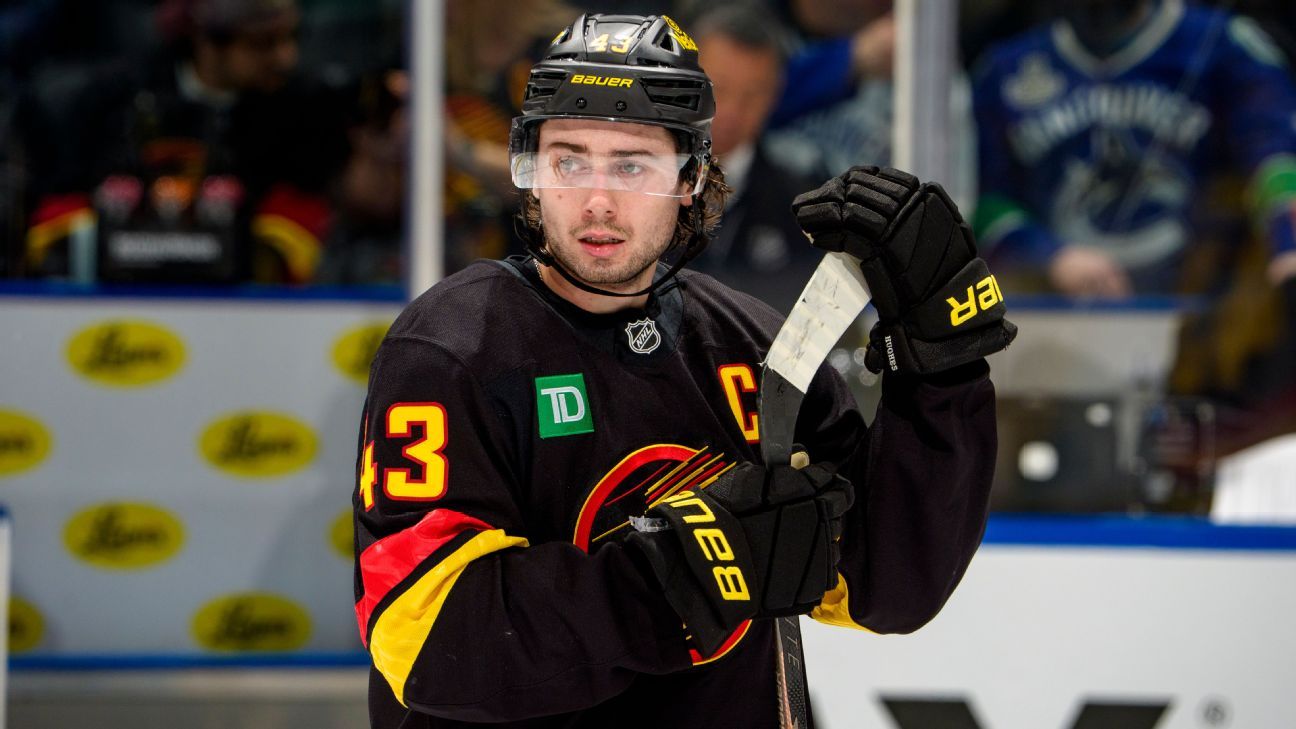
On Friday, the Vancouver Canucks traded Quinn Hughes to the Minnesota Wild, in exchange for Zeev Buium, Marco Rossi, Liam Ohgren and a 2026 first-round pick. Earlier in the day, the Pittsburgh Penguins sent goaltender Tristan Jarry and forward Sam Poulin to the Edmonton Oilers in exchange for goaltender Stuart Skinner, defenseman Brett Kulak and a 2029 second-round pick.
Throughout the season up until the March 6 deadline, ESPN reporters will be grading each side on all of the big swaps, with the latest deals highest up on this page.
Read on for more, and keep this page bookmarked as the trade volume rises throughout the campaign!
Jump ahead: Hughes to MIN
Jarry to EDM

Everything was quiet Friday … until it wasn’t. Because that’s when the first blockbuster trade of the season happened, with an expected name going to an unexpected place.
The Vancouver Canucks traded captain and star defenseman Quinn Hughes to the Minnesota Wild with defenseman Zeev Buium, forward Liam Ohgren, forward Marco Rossi and a 2026 first-round pick going in the other direction.
How did both general managers perform in what is easily the biggest trade of the season to this stage?

Wild grade: A-
In recent years, the Wild built one of the best farm systems in the NHL. Investing in their system and in player development gave them options … and they used three of those options to land one of the NHL’s best defensemen.
Hughes gives the Wild a Norris Trophy winner who can be used in every situation, starting with the offensive zone. Finding ways to consistently score goals has been a challenge for the Wild over the past few seasons.
Not that Hughes can single-handedly solve for that one problem. But he can definitely help, considering he has had four straight seasons of more than 60 assists and is projected to finish with 56 having missed a portion of this season with an injury.
How crucial is that for the Wild? Hughes’ 60 assists alone would have been tied for second on the team in points last season. His 76 total points also would have led the Wild outright in that category. The 21 assists that he has this season would already be the most if he played the whole season for the Wild, and his 23 points are tied for the third most on the roster.
Hughes also provides the Wild with another option — in addition to Brock Faber — who can be trusted to play in every key situation for long periods. The Wild could even pair them together if needed to form a combination that can defend and then quickly break out into transition.
The Wild’s top-four defensive unit also features Jonas Brodin, Jared Spurgeon and Faber, while Jake Middleton is logging more than 18 minutes per game.
Of course, adding Hughes came with a premium package going the other way. Buium was in his first full NHL season, having been a first-round pick in 2024. Ohgren was a first-round pick in 2022, and Rossi was a first-round pick in 2020.
The thought was that Buium would be part of the long-term plan, whereas Ohgren was a bit more of a work in progress given he had spent part of the season in the AHL. Rossi re-signed with the Wild having just spent the 2024-25 season and the early portion of the offseason as a possible trade target before agreeing to that new deal.
But there was also the matter of where those three fit into the Wild’s current lineup. Buium was on the third pairing, with the idea that he could be elevated into the top four at some point. Ohgren was playing amid the Wild’s injury crisis — Rossi and others had been on IR this season — but has zero points in 18 games.
Parlaying a sizable part of their future to get Hughes signals that the Wild are intent on breaking into that collection of teams that are in a championship window. Two of them — the Colorado Avalanche and the Dallas Stars — are ahead of the Wild in the Central Division standings right now.
Hughes has one more year left on his current contract at $7.85 million before hitting free agency in the summer of 2027, but he can sign an extension as of July 1, 2026. Whatever happens between now and then could play a role in defining one of the biggest trades in Wild franchise history.

Canucks grade: A
Going from being a game away from the Western Conference finals in 2024 to potentially winning the lottery over a two-year period prompted some difficult questions in Vancouver.
Figuring out whether the franchise needed to move on from Hughes might have been the most difficult.
Speculation about Hughes’ future ramped up significantly this offseason, when team president Jim Rutherford said that Hughes wanted to play with his brothers, Jack and Luke, who are on the New Jersey Devils.
Eventually, the Canucks were playing out two hypotheticals: one in which they kept Hughes, attempted to turn things around but ran the risk of losing him in free agency with nothing in return at the end of the 2026-27 season, and another in which they moved on from him at some point, commanding the sort of trade package that could help them now and in the future.
They went with the second option, which has a chance to potentially start paying dividends now for a franchise that entered Friday with the worst record in the NHL — but that is also the owner of two first-round picks in this summer’s draft.
0:49
Zeev Buium scores power-play goal vs. Predators
Zeev Buium scores power-play goal vs. Predators
Buium projects as a top-pairing, puck-moving defenseman who could be used in various situations. He joins a top four that includes Filip Hronek, Marcus Pettersson and Tyler Myers. He gives the Canucks another young defenseman for the future, in a young group that also includes Elias N. Pettersson and Tom Willander. He’s in the second year of his entry-level contract and will become a restricted free agent at the end of the 2026-27 season.
Ohgren is a potential top-nine option who has shown promise with what he has done at the AHL level. By skating more minutes with the Canucks, he could possibly find offensive consistency. He has two years remaining before becoming an RFA.
Rossi has a chance to establish himself as the Canucks’ second-line center upon his return from injury. Trading J.T. Miller last season created a void that was slated to be filled by a player who came over in that deal, Filip Chytil. Chytil had three goals through six games before sustaining an upper-body injury that has kept him out of the lineup since Oct. 19.
Rossi, who is in the first year of a three-year bridge deal, could return as soon as Sunday to provide the Canucks with another top-six option down the middle.
The Edmonton Oilers finally addressed their multiple-season problem in goal by acquiring Pittsburgh Penguins netminder Tristan Jarry.
The Oilers sent goalie Stuart Skinner, defenseman Brett Kulak and a 2029 second-round pick to Pittsburgh for Jarry and forward Sam Poulin.
How did both GMs do in this deal? Let’s dive in.

Penguins grade: B+
This trade is primarily about Jarry, of course. But it’s about someone else, too: Sergei Murashov.
The 21-year-old, who was a fourth-round pick by the Penguins in 2022, has grown into potentially their most promising prospect. He starred in the MHL, the premier Russian junior league, for two seasons after he was drafted. He also won four of his seven KHL games while posting a .928 save percentage in those stints.
Murashov came to North America last season where he posted a .922 save percentage over 26 ECHL games before a .913 mark in the AHL in 16 games. He has a .943 save percentage in 11 AHL games this season, while having a .912 save percentage and a 1.90 goals-against average in four games with the Penguins.
It’s the sort of trajectory that makes it evident that the Penguins have found their goalie of the future — who could be playing right now. Even more so given Murashov has a chance to be the latest Russian goalie to make an impact in what has been a golden age for Russian netminders.
Murashov has one more year left on his contract at a team-friendly $861,000. Arturs Silovs and Skinner, who are both on the NHL roster, are in the final years of their deals. Together, they cost the Pens a combined $3.45 million in cap space, with Silovs set to become a restricted free agent this coming offseason.
Skinner does provide them with an experienced option in net, given that Murashov is in just his second season of North American hockey while Silovs has only 32 games, with a career-high 13 of those performances coming this season.
It creates the sort of environment that allows the Penguins to continue developing Murashov with the idea that they can give him the necessary minutes, rather than trying to juggle his workload versus that of a goalie such as Jarry, who was a significant financial investment with two more years left on his contract at north of $5 million annually.
Getting Jarry’s contract off the books means the Penguins can now pave the way for Murashov to receive more playing time. They are now also armed with the sort of cap space that will allow them make other moves in their bid to reach the playoffs for the first time in three years.
PuckPedia projects that the Penguins have $9.164 million in salary cap space after the trade, which could give the Penguins an advantage entering the trade deadline. They entered Friday in the second Eastern Conference wild-card spot in a race that has 10 teams separated by six points.
Adding Kulak in the deal gives the Penguins an experienced top-six defenseman and someone who could anchor their bottom pairing. The Penguins have a clearly established top four, but have shuffled through their bottom-pairing options; they’ve had five defensemen who have played more than nine games and who have logged close to or more than 15 minutes per game. Kulak is averaging 17:42 in ice time per game this season.
Kulak can also provide the Penguins with another option on their penalty kill, as he has logged more than 100 short-handed minutes in two of his three most recent seasons.
0:16
Tristan Jarry makes big-time save vs. Stars
Tristan Jarry makes big-time save vs. Stars

Oilers grade: B
Any personnel decision the Oilers make is going to be viewed through the prism of whether it can help them win the Stanley Cup now. Trading for Jarry — or any goaltender — while moving away from Skinner reflects that reality.
There had been more than enough evidence in place to suggest that the Oilers needed a change in net. Advancing to the Stanley Cup Final in consecutive seasons made it extremely clear that the Oilers are in a championship window. Constantly having to press the proverbial reset button on Skinner in both of those runs to the Cup Final, however, played a significant role in what made their chances of winning a title rather murky by comparison.
Skinner recovered the first time the Oilers pulled him and brought him back during the 2024 playoffs. He finished with a save percentage greater than .900 in eight combined Stanley Cup Final and Western Conference playoff games. Last postseason, Skinner had four games with a save percentage greater than .900 in the Cup Final and conference finals — with three of those games coming in the conference finals.
It’s an even more damning reality with the consideration that the Oilers have possessed one of the strongest defensive structures in the NHL since hiring Kris Knoblauch in November 2024. The last two years have seen the Oilers rank in the top eight in allowing the fewest shots per 60 minutes, the fewest scoring chances per 60 and the fewest high-danger scoring chances allowed per 60, according to Natural Stat Trick.
Only to then have the ninth-lowest team save percentage in 5-on-5 play over that same span.
This season has been no different. The Oilers are a top-10 team in terms of the fewest shots allowed per 60 and the fewest high-danger scoring chances allowed per 60. That’s why they entered Friday in the first of the two Western Conference wild-card spots.
But despite that strong defensive structure, they are last in team save percentage in 5-on-5 play. That’s also why they entered Friday in a wild-card spot instead of sitting atop the Pacific Division — granted, they’re just five points behind first place.
Another item that hinted that a change could be coming was the fact that Skinner and Calvin Pickard are in the final season of their respective contracts, at figures that could be moved. Skinner is earning $2.60 million this season, while Pickard is at $1 million.
Jarry provides the Oilers with a two-time All-Star goalie who they believe can give them the consistency that’s been missing. Five of his six most recent campaigns have seen Jarry finish with a save percentage of more than .900.
He will also be under contract for two more years after this one, at $5.38 million annually. That means he’ll come off the books after the 2027-28 season — the same time that superstar captain Connor McDavid‘s two-year extension will be over and could potentially see him hit free agency for the first time.
Will the Oilers have won a Cup by then? Or will the next two years see them get close only to fall short again? — Ryan S. Clark
-
 Sports2 years ago
Story injured on diving stop, exits Red Sox game
-
 Sports3 years ago
‘Storybook stuff’: Inside the night Bryce Harper sent the Phillies to the World Series
-
 Sports2 years ago
Game 1 of WS least-watched in recorded history
-
 Sports3 years ago
Button battles heat exhaustion in NASCAR debut
-
 Sports3 years ago
MLB Rank 2023: Ranking baseball’s top 100 players
-
Sports4 years ago
Team Europe easily wins 4th straight Laver Cup
-
 Environment3 years ago
Japan and South Korea have a lot at stake in a free and open South China Sea
-
 Environment1 year ago
Here are the best electric bikes you can buy at every price level in October 2024