
Microsoft set to report earnings after market close

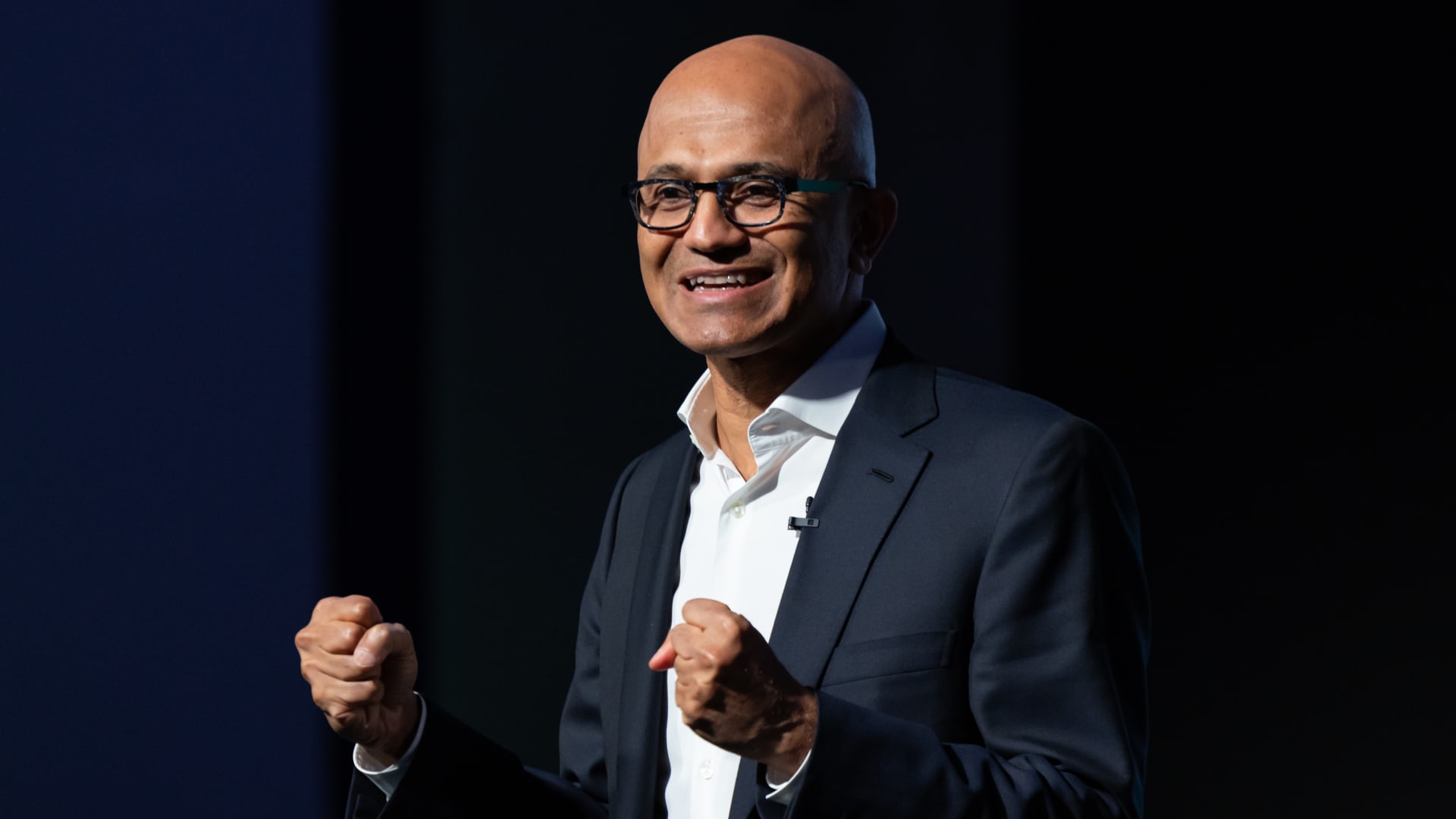
Microsoft CEO Satya Nadella speaks at the company’s Ignite Spotlight event in Seoul on Nov. 15, 2022. Nadella gave a keynote speech at an event hosted by the company’s Korean unit.
SeongJoon Cho | Bloomberg | Getty Images
Microsoft will report fiscal second-quarter results after the close of regular trading Tuesday.
Here’s what analysts are expecting:
- Earnings: $2.29 per share, adjusted, according to Refinitiv.
- Revenue: $52.94 billion, according to Refinitiv.
Sales growth is expected to come in at just 2.3% year over year, which would be the weakest expansion for Microsoft in any period since 2016.
The company faces concerns across the board. When CEO Satya Nadella announced 10,000 job cuts last week, he noted that clients in every industry around the world have taken a more cautious approach because of recession concerns.
As of Monday’s close, Microsoft shares were down 18% over the past year, slightly underperforming the Nasdaq.
The growth engine of Microsoft’s Intelligent Cloud unit is the Azure public cloud. In October, executives said the company’s engineers were busy helping customers be more efficient with their Azure infrastructure services. Last week Nadella wrote that “we’re now seeing them optimize their digital spend to do more with less.”
Analysts polled by CNBC and StreetAccount are expecting revenue growth for the Azure and other cloud services category of close to 31%. In the previous quarter, the business grew 35%.
Microsoft’s Windows business, housed inside the More Personal Computing unit, is reckoning with a pullback in the PC market. Technology industry researcher Gartner estimated that during the fourth quarter of 2022 the PC business had its slowest growth since the company started keeping track of the market in the mid-1990s.
The third unit, Productivity and Business Processes, contains the Microsoft 365 productivity suite formerly known as Office. In recent days some analysts have said they expect slower growth in seats purchased by business customers.
The decision to reduce head count “shows a commitment to margin defense despite top-line shakiness,” analysts at Raymond James wrote in a note to clients Monday. They recommend buying Microsoft shares.
Microsoft said the layoffs, along with hardware lineup changes and lease consolidation fees, will result in a $1.2 billion charge and a negative impact on earnings of 12 cents per share.
In the quarter the U.S. Federal Trade Commission sued Microsoft to block its pending $69 billion acquisition of game publisher Activision Blizzard, while the U.S. Defense Department awarded Microsoft and three other companies a cloud contract worth up to $9 billion combined. Also, Microsoft introduced Designer, an application in which people can craft documents such as social media posts and event invitations.
Executives will discuss its quarterly results with analysts on a conference call Tuesday starting at 5:30 p.m. ET.
Correction: This story has been updated to reflect that Microsoft’s conference call with analysts will start Tuesday at 5:30 p.m. ET. A previous version gave an incorrect time.
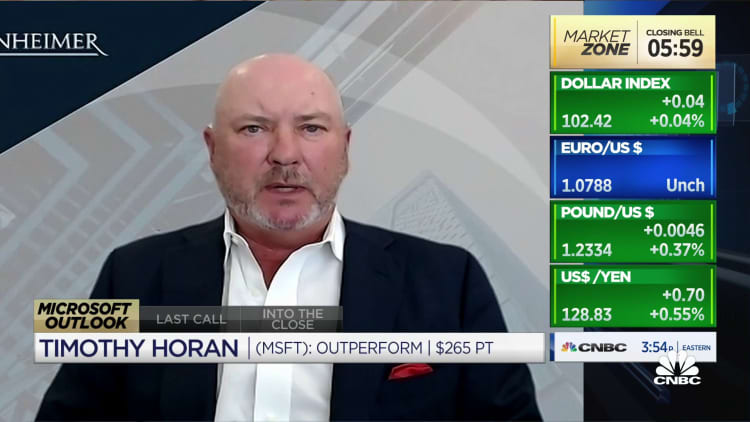
WATCH: Longer term, Microsoft has a massive secular growth story, says Oppenheimer’s Horan


CEO of Palantir Technologies Alex Karp attends the Pennsylvania Energy and Innovation Summit, at Carnegie Mellon University in Pittsburgh, Pennsylvania, U.S., July 15, 2025.
Nathan Howard | Reuters
It’s been a tough November for Palantir.
Shares of the software analytics provider dropped 16% for their worst month since August 2023 as investors dumped AI stocks due to valuation fears. Meanwhile, famed investor Michael Burry doubled down on the artificial intelligence trade and bet against the company.
Palantir started November off on a high note.
The Denver-based company topped Wall Street’s third-quarter earnings and revenue expectations. Palantir also posted its second-straight $1 billion revenue quarter, but high valuation concerns contributed to a post-print selloff.
In a note to clients, Jefferies analysts called Palantir’s valuation “extreme” and argued investors would find better risk-reward in AI names such as Microsoft and Snowflake. Analysts at RBC Capital Markets raised concerns about the company’s “increasingly concentrated growth profile,” while Deutsche Bank called the valuation “very difficult to wrap our heads around.”
Adding fuel to the post-earnings selloff was the revelation that Burry is betting against Palantir and AI chipmaker Nvidia. Burry, who is widely known for predicting the housing crisis that occurred in 2008 and the portrayal of him in the film “The Big Short,” later accused hyperscalers of artificially boosting earnings.
Palantir CEO Alex Karp vocally hit the front lines, appearing twice in one week on CNBC, where he accused Burry of “market manipulation” and called the investor’s actions “egregious.”
“The idea that chips and ontology is what you want to short is bats— crazy,” Karp told CNBC’s “Squawk Box.”
Despite the vicious selloff, Palantir has notched some deal wins this month. That included a multiyear contract with consulting firm PwC to speed up AI adoption in the U.K. and a deal with aircraft engine maintenance company FTAI.
But those announcements did little to shake off valuation worries that have haunted all AI-tied companies in November.
Across the board, investors have viciously ditched the high-priced group, citing fears of stretched valuations and a bubble.
In November, Nvidia pulled back more than 12%, while Microsoft and Amazon dropped about 5% each. Quantum computing names such as Rigetti Computing and D-Wave Quantum have shed more than a third of their value.
Apple and Alphabet were the only Magnificent 7 stocks to end the month with gains.
Sill, questions linger over Palantir’s valuation, and those worries aren’t a new concern.
Even after its steep price drop, the company’s stock trades at 233 times forward earnings. By comparison, Nvidia and Alphabet traded at about 38 times and 30 times, respectively, at Friday’s close.
Karp, who has long defended the company, didn’t miss an opportunity to clap back at his critics, arguing in a letter to shareholders that the company is making it feasible for everyday investors to attain rates of return once “limited to the most successful venture capitalists in Palo Alto.”
“Please turn on the conventional television and see how unhappy those that didn’t invest in us are,” Karp said during an earnings call. “Enjoy, get some popcorn. They’re crying. We are every day making this company better, and we’re doing it for this nation, for allied countries.”
Palantir declined to comment for this story.
WATCH: Palantir CEO Alex Karp: We’ve printed venture results for the average American
-
 Sports2 years ago
Story injured on diving stop, exits Red Sox game
-
 Sports3 years ago
‘Storybook stuff’: Inside the night Bryce Harper sent the Phillies to the World Series
-
 Sports2 years ago
Game 1 of WS least-watched in recorded history
-
 Sports3 years ago
Button battles heat exhaustion in NASCAR debut
-
 Sports3 years ago
MLB Rank 2023: Ranking baseball’s top 100 players
-
Sports4 years ago
Team Europe easily wins 4th straight Laver Cup
-
 Environment3 years ago
Japan and South Korea have a lot at stake in a free and open South China Sea
-
 Environment1 year ago
Here are the best electric bikes you can buy at every price level in October 2024