
Google job cuts hit 1,800 employees in California, including 27 massage therapists

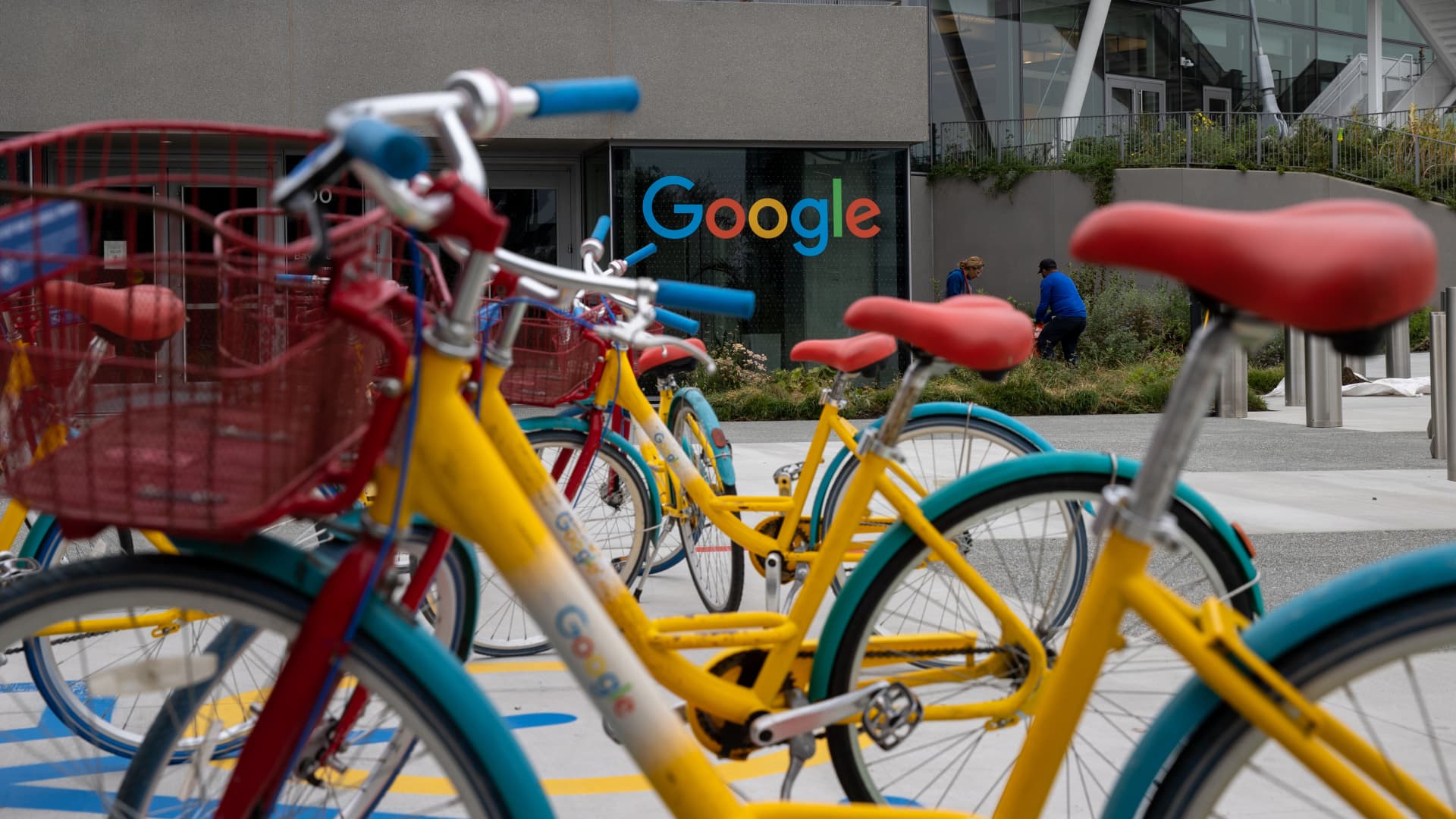
Google headquarters is seen in Mountain View, California, United States on September 26, 2022. (Photo by Tayfun Coskun/Anadolu Agency via Getty Images)
Anadolu Agency | Anadolu Agency | Getty Images
Google eliminated over 1,800 jobs in its home state California as part of the biggest round of layoffs in company history.
On Friday, Alphabet-owned Google announced it was cutting 12,000 employees, roughly 6% of the full-time workforce. According to filings released by the state and viewed by CNBC, 1,845 positions, or 15% of the cuts, were in California.
Most of the headcount reduction in the state occurred in and around the company’s Silicon Valley headquarters. Some 1,436 jobs were cut in Mountain View, where Google is based, while 119 were in San Bruno, home to YouTube. Palo Alto saw 53 cuts.
“Employee separations at the Facilities resulting from this action are expected to commence March 31, 2023,” read the filings, which were dated Jan. 20.
A Google spokesperson told CNBC that the March date is due to a notification period required in California. WARN (Worker Adjustment and Retraining Notification Act) forces employers to give impacted employees as well as state and local representatives at least 60 days written advance notice “of any plant closing or mass layoff.”
Google’s initial announcement said the company would pay U.S. employees “during the full notification period (minimum 60 days).”
More than a quarter of the Bay Area roles affected had “director” or “senior” in the titles. The cuts also included 27 in-house massage therapists, with 24 in Mountain View and three in the Southern California markets of Los Angeles and Irvine.
In total, 177 cuts took place in L.A., mostly from the company’s Playa Vista campus. There were 60 cuts in Irvine.
Alphabet is reckoning with slowing growth and recession risks as the tech market adjusts to the end of an extended bull market. At a companywide meeting on Monday, CEO Sundar Pichai addressed the layoffs while taking questions from employees, who expressed concerns about the future.
“I understand you are worried about what comes next for your work,” Pichai said at the meeting. “Also very sad for the loss of some really good colleagues across the company.”


Oracle CEO Clay Magouyrk appears on a media tour of the Stargate AI data center in Abilene, Texas, on Sept. 23, 2025.
Kyle Grillot | Bloomberg | Getty Images
Oracle on Friday pushed back against a report that said the company will complete data centers for OpenAI, one of its major customers, in 2028, rather than 2027.
The delay is due to a shortage of labor and materials, according to the Friday report from Bloomberg, which cited unnamed people. Oracle shares fell to a session low of $185.98, down 6.5% from Thursday’s close.
“Site selection and delivery timelines were established in close coordination with OpenAI following execution of the agreement and were jointly agreed,” an Oracle spokesperson said in an email to CNBC. “There have been no delays to any sites required to meet our contractual commitments, and all milestones remain on track.”
The Oracle spokesperson did not specify a timeline for turning on cloud computing infrastructure for OpenAI. In September, OpenAI said it had a partnership with Oracle worth more than $300 billion over the next five years.
“We have a good relationship with OpenAI,” Clay Magouyrk, one of Oracle’s two newly appointed CEOs, said at an October analyst meeting.
Doing business with OpenAI is relatively new to 48-year-old Oracle. Historically, Oracle grew through sales of its database software and business applications. Its cloud infrastructure business now contributes over one-fourth of revenue, although Oracle remains a smaller hyperscaler than Amazon, Microsoft and Google.
OpenAI has also made commitments to other companies as it looks to meet expected capacity needs.
In September, Nvidia said it had signed a letter of intent with OpenAI to deploy at least 10 gigawatts of Nvidia equipment for the San Francisco artificial intelligence startup. The first phase of that project is expected in the second half of 2026.
Nvidia and OpenAI said in a September statement that they “look forward to finalizing the details of this new phase of strategic partnership in the coming weeks.”
But no announcement has come yet.
In a November filing, Nvidia said “there is no assurance that we will enter into definitive agreements with respect to the OpenAI opportunity.”
OpenAI has historically relied on Nvidia graphics processing units to operate ChatGPT and other products, and now it’s also looking at designing custom chips in a collaboration with Broadcom.
On Thursday, Broadcom CEO Hock Tan laid out a timeline for the OpenAI work, which was announced in October. Broadcom and OpenAI said they had signed a term sheet.
“It’s more like 2027, 2028, 2029, 10 gigawatts, that was the OpenAI discussion,” Tan said on Broadcom’s earnings call. “And that’s, I call it, an agreement, an alignment of where we’re headed with respect to a very respected and valued customer, OpenAI. But we do not expect much in 2026.”
OpenAI declined to comment.
WATCH: Oracle says there have been ‘no delays’ in OpenAI arrangement after stock slide


-
 Sports2 years ago
Story injured on diving stop, exits Red Sox game
-
 Sports3 years ago
‘Storybook stuff’: Inside the night Bryce Harper sent the Phillies to the World Series
-
 Sports2 years ago
Game 1 of WS least-watched in recorded history
-
 Sports3 years ago
Button battles heat exhaustion in NASCAR debut
-
 Sports3 years ago
MLB Rank 2023: Ranking baseball’s top 100 players
-
Sports4 years ago
Team Europe easily wins 4th straight Laver Cup
-
 Environment3 years ago
Japan and South Korea have a lot at stake in a free and open South China Sea
-
 Environment1 year ago
Here are the best electric bikes you can buy at every price level in October 2024