
Amazon’s Zoox robotaxi now giving rides to employees on public roads in California

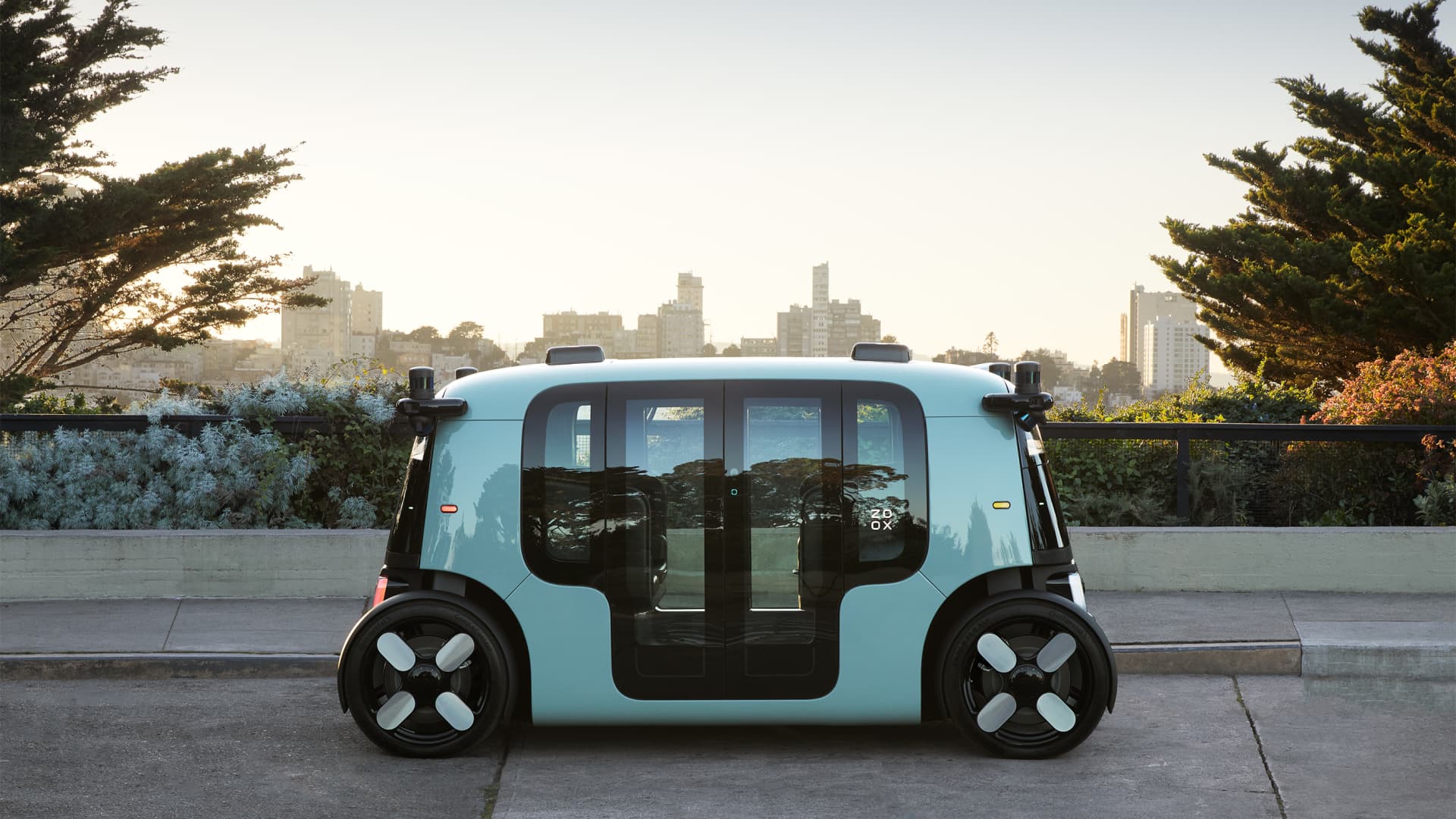
Amazon’s self-driving company Zoox unveiled its autonomous robotaxi on Monday.
Zoox
Amazon-owned autonomous vehicle venture Zoox said on Monday that it is now testing its self-driving robotaxis on public roads in California with passengers on board.
The vehicles have no steering wheel or pedals, and they have bidirectional driving capabilities and four-wheel steering, enabling them to change directions without the need to reverse.
Zoox executives said the company began the tests after it received approval from the California Department of Motor Vehicles last week.
The permit is not for all public roads in the state. The tests are currently limited to shuttling Zoox employees on a one-mile public route between two office buildings at the company’s headquarters in Foster City, California, at speeds up to 35 miles an hour. The company hasn’t said how big its test fleet is, but executives have said they have built “dozens” of vehicles, although fewer than 100.
Zoox said one of its vehicles completed a test run with employees on board over the weekend.
Amazon acquired the 9-year-old startup in 2020 and, at the time, shared few details about how it planned to use the company’s technology. Zoox unveiled its custom-built, electric robotaxi in 2020, with an eye on offering on-demand autonomous transportation in urban settings.
On a call with reporters, Zoox executives declined to say when the company will launch a commercial robotaxi service or open up testing beyond the limited route and employee participants. It will continue to test the vehicle with employees and expects to launch a shuttle service for staffers this spring.
GM‘s driverless unit, Cruise, has also developed an autonomous shuttle called Origin which does not have manual controls. Cruise and Alphabet‘s Waymo last year received approval to roll out their driverless taxi services in California and charge passengers for the rides.
Unlike Cruise, Zoox says its driverless vehicles — which do not have a steering wheel or other manual controls — meet Federal Motor Vehicle Safety Standards, and so the company is not seeking any waiver to put them into use on public roads.
All companies testing their vehicles on public roads in the state of California are required to report every time their system disengages or whenever a human driver has to take over for the autonomous system while driving, usually due to safety concerns or software issues.
Zoox doesn’t even refer to these incidents as disengagements, but rather as cases where the vehicle needs support or guidance, so does not report them to the state.
“If the vehicle is in a situation where it needs help because either it needs to do something it’s not normally allowed to do, or because it doesn’t know how to handle a situation, we have what’s called a ‘fusion center,’ with trained guidance operators monitoring the output of the scene and then will give guidance to the vehicle and either give it permission to do something — but the vehicle is still in charge and does all the driving — or drop breadcrumbs on alternative trajectory, or in the worst-case scenario pull over,” Zoox CEO Aicha Evans told reporters.
— CNBC’s Lora Kolodny contributed reporting to this article.
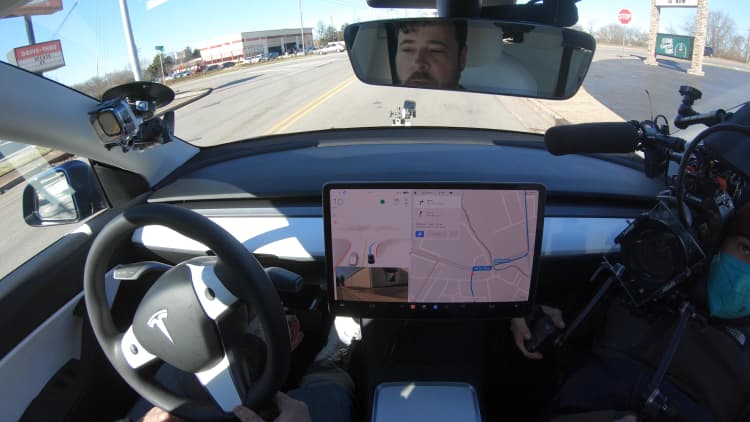
WATCH: Tesla FSD Beta users show how the system works — and doesn’t


Beta Technologies shares surged more than 9% after air taxi maker Eve Air Mobility announced an up to $1 billion deal to buy motors from the Vermont-based company.
Eve, which was started by Brazilian airplane maker Embraer and is now under Eve Holding, said the manufacturing deal could equal as much as $1 billion over 10 years. The Florida-based company said it has a backlog of 2,800 vehicles.
Shares of Eve Holding gained 14%.
Eve CEO Johann Bordais called the deal a “pivotal milestone” in the advancement of the company’s electric vertical takeoff and landing, or eVTOL, technology.
“Their electric motor technology will play a critical role in powering our aircraft during cruise, supporting the maturity of our propulsion architecture as we progress toward entry into service,” he said in a release.


Mateusz Slodkowski | SOPA Images | Lightrocket | Getty Images
Amazon’s cloud unit on Tuesday announced AI-enabled software designed to help clients better understand and recover from outages.
DevOps Agent, as the artificial intelligence tool from Amazon Web Services is called, predicts the cause of technical hiccups using input from third-party tools such as Datadog and Dynatrace. AWS said customers can sign up to use the tool Tuesday in a preview, before Amazon starts charging for the service.
The AI outage tool from AWS is intended to help companies more quickly figure out what caused an outage and implement fixes, Swami Sivasubramanian, vice president of agentic AI at AWS, told CNBC. It’s what site reliability engineers, or SREs, do at many companies that provide online services.
SREs try to prevent downtime and jump into action during live incidents. Startups such as Resolve and Traversal have started marketing AI assistants for these experts. Microsoft’s Azure cloud group introduced an SRE Agent in May.
Rather than waiting for on-call staff members to figure out what happened, the AWS DevOps Agent automatically assigns work to agents that look into different hypotheses, Sivasubramanian said.
“By the time the on-call ops team member dials in, they have an incident report with preliminary investigation of what could be the likely outcome, and then suggest what could be the remediation as well,” Sivasubramanian told CNBC ahead of AWS’ Reinvent conference in Las Vegas this week.
Commonwealth Bank of Australia has tested the AWS DevOps Agent. In under 15 minutes, the software found the root cause of an issue that would have taken a veteran engineer hours, AWS said in a statement.
The tool relies on Amazon’s in-house AI models and those from other providers, a spokesperson said.
AWS has been selling software in addition to raw infrastructure for many years. Amazon was early to start renting out server space and storage to developers since the mid-2000s, and technology companies such as Google, Microsoft and Oracle have followed.
Since the launch of ChatGPT in 2022, these cloud infrastructure providers have been trying to demonstrate how generative AI models, which are often training in large cloud computing data centers, can speed up work for software developers.
Over the summer, Amazon announced Kiro, a so-called vibe coding tool that produces and modifies source code based on user text prompts. In November, Google debuted similar software for individual software developers called Antigravity, and Microsoft sells subscriptions to GitHub Copilot.
WATCH: Amazon rolls out AI-powered tools to help big AWS customers update old software
Technology
Amazon to let cloud clients customize AI models midway through training for $100,000 a year


Attendees pass an Amazon Web Services logo during AWS re:Invent 2024, a conference hosted by Amazon Web Services, at The Venetian hotel in Las Vegas on Dec. 3, 2024.
Noah Berger | Getty Images
Amazon has found a way to let cloud clients extensively customize generative AI models. The catch is that the system costs $100,000 per year.
The Nova Forge offering from Amazon Web Services gives organizations access to Amazon’s AI models in various stages of training so they can incorporate their own data earlier in the process.
Already, companies can fine-tune large language models after they’ve been trained. The results with Nova Forge will lean more heavily on the data that customers supply. Nova Forge customers will also have the option to refine open-weight models, but training data and computing infrastructure are not included.
Organizations that assemble their own models might end up spending hundreds of millions or billions of dollars, which means using Nova Forge is more affordable, Amazon said.
AWS released its own models under the Nova brand in 2024, but they aren’t the first choice for most software developers. A July survey from Menlo Ventures said that by the middle of this year, Amazon-backed Anthropic controlled 32% of the market for enterprise LLMs, followed by OpenAI with 25%, Google with 20% and Meta with 9% — Amazon Nova had a less than 5% share, a Menlo spokesperson said.
The Nova models are available through AWS’ Bedrock service for running models on Amazon cloud infrastructure, as are Anthropic’s Claude 4.5 models.
“We are a frontier lab that has focused on customers,” Rohit Prasad, Amazon head scientist for artificial general intelligence, told CNBC in an interview. “Our customers wanted it. We have invented on their behalf to make this happen.”
Nova Forge is also in use by internal Amazon customers, including teams that work on the company’s stores and the Alexa AI assistant, Prasad said.
Reddit needed an AI model for moderating content that would be sophisticated about the many subjects people discuss on the social network. Engineers found that a Nova model enhanced with Reddit data through Forge performed better than commercially available large-scale models, Prasad said. Booking.com, Nimbus Therapeutics, the Nomura Research Institute and Sony are also building models with Forge, Amazon said.
Organizations can request that Amazon engineers help them build their Forge models, but that assistance is not included in the new service’s $100,000 annual fee.
AWS is also introducing new models for developers at its Reinvent conference in Las Vegas this week.
Nova 2 Pro is a reasoning model whose tests show it performs at least as well as Anthropic’s Claude Sonnet 4.5, OpenAI’s GPT-5 and GPT-5.1, and Google’s Gemini 3.0 Pro Preview, Amazon said. Reasoning involves running a series of computations that might take extra time in response to requests to produce better answers. Nova 2 Pro will be available in early access to AWS customers with Forge subscriptions, Prasad said. That means Forge customers and Amazon engineers will be able to try Nova 2 Pro at the same time.
Nova 2 Omni is another reasoning model that can process incoming images, speech, text and videos, and it generates images and text. It’s the first reasoning model with that range of capability, Amazon said. Amazon hopes that, by delivering a multifaceted model, it can lower the cost and complexity of incorporating AI models into applications.
Tens of thousands of organizations are using Nova models each week, Prasad said. AWS has said it has millions of customers. Nova is the second-most popular family of models in Bedrock, Prasad said. The top group of models are from Anthropic.
WATCH: Amazon set to kick off AI conference next week: Maxim’s Tom Forte on what to expect
-
 Sports2 years ago
Story injured on diving stop, exits Red Sox game
-
 Sports3 years ago
‘Storybook stuff’: Inside the night Bryce Harper sent the Phillies to the World Series
-
 Sports2 years ago
Game 1 of WS least-watched in recorded history
-
 Sports3 years ago
Button battles heat exhaustion in NASCAR debut
-
 Sports3 years ago
MLB Rank 2023: Ranking baseball’s top 100 players
-
Sports4 years ago
Team Europe easily wins 4th straight Laver Cup
-
 Environment3 years ago
Japan and South Korea have a lot at stake in a free and open South China Sea
-
 Environment1 year ago
Here are the best electric bikes you can buy at every price level in October 2024