
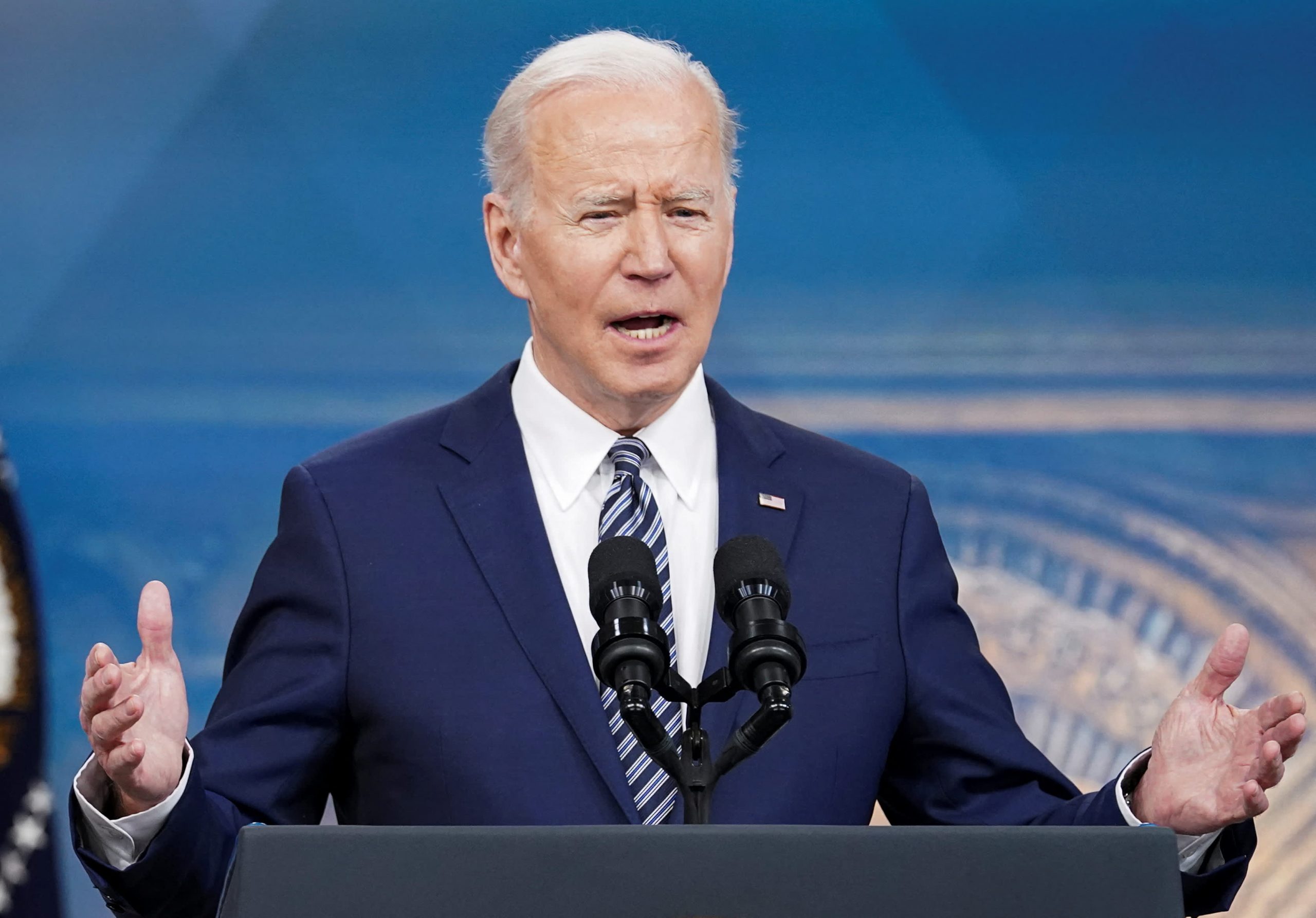


Frederic J. Brown | Afp | Getty Images
DETROIT – The U.S. automotive industry has entered a new phase for all-electric vehicles: realism.
The industry was euphoric about the EV segment in the early 2020s, but consumer demand never took off as much as expected and, as it fizzled, automakers monitored and planned how to react. Now, they’re pivoting, as companies have wasted billions of dollars in capital, Detroit automakers are refocusing on large gas-guzzling trucks and SUVs, and many have admitted that policies, not consumers, were driving the charge for EVs.
“We have to make the investments to get to … the regulatory environment they set. We’ve seen a complete change in that. One way, 180 degrees. One way, 180 degrees back. That’s the world CEOs of automakers are living in,” GM CEO and Chair Mary Barra said earlier this month during The New York Times’ DealBook conference.
How automakers like GM that invested heavily in EVs will respond over the next year will be telling for the future of the vehicles in the U.S., according to industry insiders and experts.
Barra said “it’s too early to tell” what true demand for EVs is following the end of up to $7,500 in federal incentives in September to purchase an electric vehicle. She said the industry will likely find its natural demand over the next six months.
In the meantime, GM continues to reassess its EV plans after disclosing a $1.6 billion impact from its pullback in those investments, with more write-downs expected in the future. Ford Motor last week said it expects to record about $19.5 billion in special items related to a restructuring of its business priorities and a pullback in its all-electric vehicle investments.
“We evaluated the market, and we made the call. We’re following customers to where the market is, not where people thought it was going to be,” Ford CEO Jim Farley told CNBC last week.
U.S. EV sales peaked in September, ahead of the federal incentives ending, at 10.3% of the new vehicle market, according to Cox Automotive. That demand plummeted to preliminary estimates of 5.2% during the fourth quarter.
“The long-term direction toward electrification remains clear: The future is electric. However, the timeline is being recalibrated,” said Stephanie Valdez Streaty, Cox director of industry insights. “In the near term, automakers will continue to adjust their strategies and significantly expand hybrid offerings to meet consumers where they are today.”
Most industry experts, including those at consulting firm PwC, don’t believe it’s the end days for EVs, but rather that expectations are more realistic now. PwC expects the EV industry to pick up toward the end of this decade, with EVs forecast to make up 19% of the U.S. industry by 2030.
“As several of the U.S. [automakers] have announced, there’s some level of charges, and we got out in front of the customer demand and likely the infrastructure that’s otherwise available here in the U.S.,” C.J. Finn, U.S. automotive industry leader for PwC, told CNBC.
‘What is the normal state of EVs?’
That projected EV market share doesn’t justify the billions of dollars companies have spent on the research, development and production of the vehicles, so automakers are significantly altering their plans to allow customers more choice of all-electric vehicles, hybrids and traditional internal combustion engines.
“If you think back a few years ago, it was like, ‘If you’re not all-in on EV, you’re going to eventually go out of business. Your terminal value is zero,'” KPMG partner and U.S. automotive leader Lenny LaRocca told CNBC. “Now I think that multi-propulsion technology approach is what’s panning out to work out well. We used to call it the ‘mosaic of powertrains.'”
A NYC charging station seen in the Yorkville neighborhood of New York City.
Adam Jeffery | CNBC
The changes have taken different forms for companies that have already heavily invested in EVs.
GM, which was by far leading in such investments in the U.S., will continue to offer its current models but has little to no plans of expanding in the future, according to Barra. Instead, it will use some of its planned capacity for increased production of large trucks and SUVs. The automaker also has said it plans to offer plug-in hybrid vehicles in the years ahead, but it hasn’t disclosed many other details.
Ford has said it will refocus investments on hybrid vehicles, including plug-in models rather than pure EVs; cancel a next generation of large all-electric trucks in exchange for smaller, more affordable EVs; and rebalance its investments in core products such as trucks and SUVs.
And Stellantis is deprioritizing EVs, including for its coveted Jeep brand, as it attempts to revive its U.S. sales.
“All of us are waiting to see what the demand is, how it’s going to continue to shake out,” Jeep CEO Bob Broderdorf told CNBC. “The [EV] industry will slide. It’s going to slow down. And then what is the normal state of EVs?”
Hyundai, which also invested billions in EVs, is taking a mixed approach compared with its peers. Like GM, it plans to continue offering its current models but it is also expected to have new models coming. On the other hand, like Ford, it’s decided to more heavily emphasize hybrids and allocated production at a new $7.6 billion plant for Hyundai and Kia vehicles in Georgia.
Others such as Honda, Nissan, Porsche, Volvo and Jaguar that announced ambitious plans for EVs have canceled or significantly scaled back those goals. GM also has backtracked on its pledge to exclusively offer EVs by 2035, including several of its brands before that time frame.
The Tesla effect
A litany of factors played into the current EV marketplace, including industry dynamics and external factors such as pressure from Wall Street and political whiplash from the Trump and Biden administrations.
“No doubt the policy had a big impact on customer demand. The net-net is the market’s changed,” Farley told CNBC last Monday.
The bullishness around EVs began with the rise of Tesla. The company, which remains the U.S. leader in EV sales by a wide margin, was able to significantly boost sales and its market valuation from Wall Street analysts at the beginning of this decade.
That led other automakers to take notice and, as the industry does, attempt to replicate Tesla’s success, according to officials. But what executives didn’t realize was consumers were buying Teslas — not just any EV.
“Tesla wasn’t creating a battery-electric vehicle market. They created a market for the Tesla brand.” said Stephanie Brinley, associate director in AutoIntelligence at S&P Global Mobility.
Tesla vehicles were, and continue to be, a “tech-buy” of software-first products that just happened to be EVs, Brinley said. The company also set up its own charging network and created a tech-savvy customer base of loyalists who looked past many quality and growing pain issues.
A Tesla Cybertruck near General Motors’ Renaissance Center world headquarters in Detroit.
Michael Wayland / CNBC
That success led Wall Street to seek out the “next Tesla,” ushering in an unsustainable amount of new companies. From 2019 to 2022, nearly a dozen EV carmakers went public as well as a litany of related ones. Most of those have gone bankrupt amid federal investigations, scandals and executive upheaval.
“The attention that Tesla got woke everyone else up. But now there’s competition, and there’s competition from trusted, known and respected brands,” Brinley said.
The euphoria surrounding EVs started waning as companies kept spending with little to no success and “legacy” automakers entered the market, investing big sums to bring unprofitable vehicles to market.
Hopes for profitable EVs further eroded with the second inauguration of President Donald Trump this year. Trump has killed or rolled back many of the Biden administration’s support and funding for the sale and production of EVs.
The biggest blow was in September with the end of up to $7,500 federal incentives for the purchase of an EV.
“The end of federal incentives came to an abrupt stop at the end of Q3, driving a lot of demand and sales for the new and used market,” Jeremy Robb, Cox interim chief economist, said last week. “Since then, we’ve seen the slowdown in both the pace of sales as well as the growth of new vehicle production. Next year will be pivotal for EVs.”

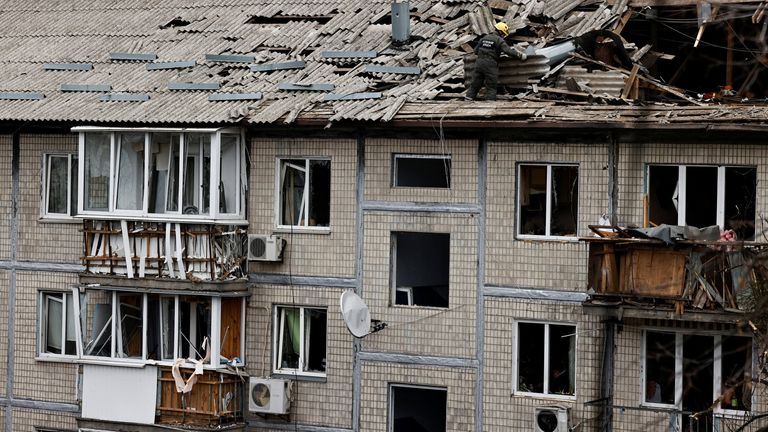
Russia launched a major overnight missile and drone attack on Ukraine that killed at least three people – including a four-year-old child.
Officials say Russia fired more than 650 drones and three dozen missiles in an assault that began during the night and stretched into daylight hours Tuesday.
Ukrainian President Volodymyr Zelenskyy said the barrage struck homes and the power grid in 13 regions across Ukraine, causing widespread outages in bitter temperatures.
It comes a day after he described recent progress towards a peace deal as “quite solid”.
The bombardment demonstrated Russian President Vladimir Putin’s intention of pursuing the invasion of Ukraine, Mr Zelenskyy said in an online post.
A damaged apartment building in Kyiv. Pic: Reuters
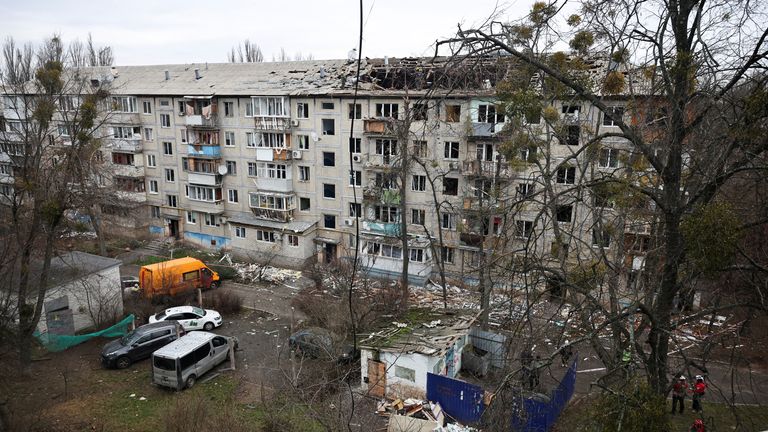
A damaged apartment building in Kyiv. Pic: Reuters
Ukrainian and European officials have said Putin is not sincerely engaging with US-led peace efforts.
The attack “is an extremely clear signal of Russian priorities,” Mr Zelenskyy said.
“A strike before Christmas, when people want to be with their families, at home, in safety. A strike, in fact, in the midst of negotiations that are being conducted to end this war. Putin cannot accept the fact that we must stop killing.”
US President Donald Trump has for months been pressing for a peace agreement, but the negotiations have become entangled in the very different demands from Moscow and Kyiv.
US envoy Steve Witkoff described talks in Florida with Ukrainian and European representatives as “productive and constructive”.

A drone explodes during a Russian missile and drone strike, in Kyiv. Pic: Reuters
Trump was less effusive on Monday, saying, “The talks are going along.”
Initial reports from Ukrainian emergency services said the child died in Ukraine’s northwestern Zhytomyr region, while a drone killed a woman in the Kyiv region, and another civilian death was recorded in the western Khmelnytskyi region, according to Mr Zelenskyy.
Russia launched 635 drones of various types and 38 missiles, Ukraine’s air force said. Air defences stopped 587 drones and 34 missiles, it said.
Read more
Russian general killed by car bomb and Moscow blames Ukraine
Putin didn’t sound like he will alter his course anytime soon
Polish and allied fighter jets were deployed after the Russian airstrikes towards western Ukraine, near Poland’s border.
“Fighter jets were scrambled, and ground-based air-defence and radar reconnaissance systems were put on heightened readiness,” the operational command of Poland’s armed forces said.
It was the ninth large-scale Russian attack on Ukraine’s energy system this year and left multiple regions in the west without power, while emergency power outages were in place across the country, acting Energy Minister Artem Nekraso said. Work to restore power would begin as soon as the security situation permitted, he said.
Ukraine’s largest private energy supplier, DTEK, said the attack targeted thermal power stations in what it said was the seventh major strike on the company’s facilities since October.
DTEK’s thermal power plants have been hit more than 220 times since Russia’s full-scale invasion began in February 2022. Those attacks have killed four workers and wounded 59.
Authorities in the western regions of Rivne, Ternopil and Lviv, as well as the northern Sumy region, reported damage to energy infrastructure or power outages after the attack.
In the southern Odesa region, Russia struck energy, port, transport, industrial and residential infrastructure, according to regional head Oleh Kiper.
A merchant ship and over 120 homes were damaged, he said.

-
David Hale
Upon his retreat from Moscow, Napoleon reportedly quipped of his army’s harrowing defeat that the margin between “the ridiculous and the sublime was but a step.”
He could just as easily have been talking about college football.
Fall Saturdays offer a wealth of the sublime: dramatic games, brilliant plays, awe-inspiring athleticism. But what truly sets college football apart is that after all the on-field heroics, the sport slips so easily into pure chaos.
For all the highlights, what often binds us most closely to college football are all those other moments, storylines, sound bites and memes so ludicrous, so stupefying, so perfectly … college football.
So, as the end of 2025 nears, it seemed a good time to consider the things that felt the most unique to college football, a celebration not of the sublime but of the ridiculous.
What exactly makes for a true “college football” moment? It has to be a little bit weird, colorful or unexpected. It can be something that theoretically could happen in another sport, but feels about a thousand times more likely to happen in this one. It can be something charmingly fun or something shockingly bad, but ideally, it perfectly straddles the line between comedy and tragedy. It should have a certain je ne sais quoi, which is French for “things Lane Kiffin would do.”
Let’s lay out a few ground rules.
To make the list, the college football moment cannot have happened during the course of game action (no Bush Push or Kick Six), but it can be something that happened on the field of play (like, say, throwing someone’s shoe).
The list can include some bad moments, but not something that involves an actual law being broken (so no crab legs).
And while, in retrospect, all of these moments probably feel like they were inevitable, they should have felt entirely unexpected in the moment.
Ultimately though, a great college football moment is determined by the same metric used by former Supreme Court Justice Potter Stewart to define another rather unrefined industry: You know it when you see it.
Like college football itself, its most absurd moments defy explanation.
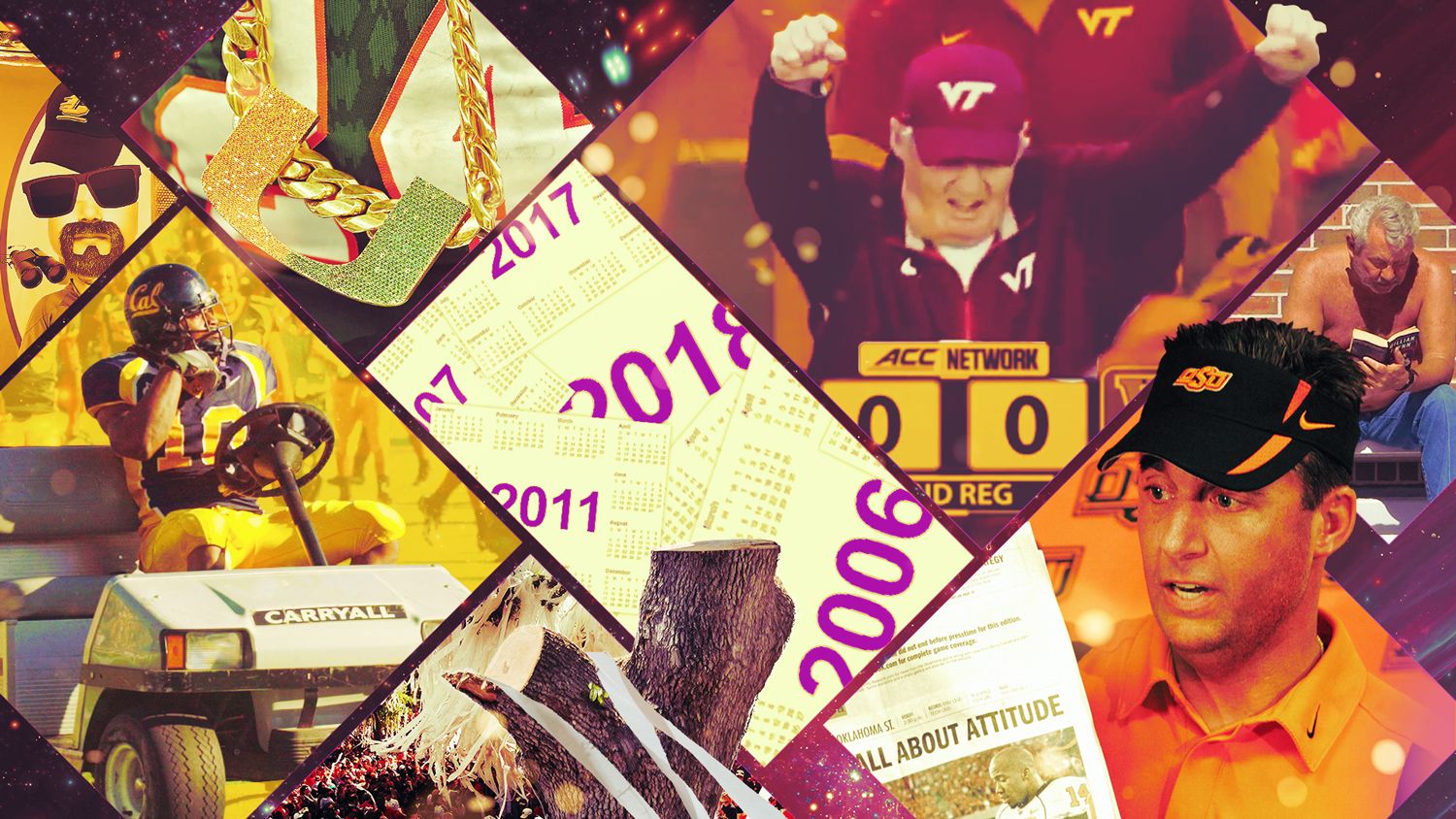
With that, these are the 25 most college football moments of the past 25 years.

Others receiving votes
Narrowing this list down to 25 was an impossible task. Indeed, we’ve likely forgotten a few moments that would’ve easily cracked the top 10. Here are a few favorites that didn’t quite make the cut.
25. Clemsoning
The best college football moments are appreciated in vastly different ways depending on whether you’re making the joke or are the butt of it, and the term “Clemsoning” captured that duality perfectly.
It started as a joke between podcast hosts Dan Rubenstein and Ty Hildenbrandt long before Clemson became a national power. The idea was simple: From the early 2000s through Dabo Swinney’s early years, Clemson had a tendency to start a season hot then run headlong into a pratfall against a lesser opponent. “Clemsoning” became shorthand for any team that torpedoed its season in the dumbest ways possible.
As Swinney built Clemson into a national power in the early 2010s, however, Clemson outgrew the moniker, but those outside Death Valley were eager to keep making the joke. It all came to a head in 2015, after Clemson beat Notre Dame in one of Swinney’s signature career wins. The national media continually referred to the next week’s contest against Georgia Tech as a prime opportunity for Clemson to, well, Clemson, and Swinney seethed the whole week.
2:08
Dabo Swinney sounds off on ‘Clemsoning’ jabs
Clemson coach Dabo Swinney goes on a tirade about the Tigers’ critics and the term “Clemsoning,” in reference to the team’s reputation for letdowns.
The Tigers then walloped Georgia Tech, and the game had the feel of a turning point — the moment when Clemsoning officially died. Only, Swinney wasn’t eager to offer its eulogy.
Clemsoning has occasionally wormed its way back into the vernacular since — sometimes for Clemson itself but often for another team that has fumbled away lofty expectations against a lesser foe. But after Swinney’s “it’s bull crap” outburst, the term lost much of its luster.
24. Manziel parties with the enemy
By July 2013, Johnny Manziel had already established two things: He was one of the most electric players in recent college football history on the field, and he was the sport’s biggest agent of chaos off the field.
There are myriad Manziel moments that could’ve made this list, but let’s go with this as the favorite: He went to a frat party at Texas, the hated rival of his Texas A&M Aggies. He was 20. He was asked to leave. He did.
And then, according to photos shared on social media the next day, he ended up at a completely different Texas party, this time sporting a Tim Tebow New York Jets jersey.
Manziel. Frat parties. The Jets. What could go wrong?
23. Shirtless dudes
The first recorded incident of a shirtless dude outbreak occurred in 2021, amid a traditionally woeful Indiana season, during a loss to equally woeful Rutgers. A handful of Hoosiers fans in an otherwise vacant section of the stadium took off their shirts. Soon, more fans joined. And more. And more. Until, without planning or intent, a party had broken out. And for four years, Indiana’s shirtless celebration of misery remained a beautiful one-off.
Then Oklahoma State fired Mike Gundy, and its fan base had no choice but to honor the departed coach by doing something entirely within the wheelhouse of a man whose hair inspired millions to find just the right balance between business and party.
From Stillwater grew a national craze. Fans everywhere were losing their shirts, rollicking in stadiums both big and small, packed and empty. While shirtless dudes in the stands may never feel as organic as it did way back in 2021, this year’s trend was a perfect reminder that passion, dedication and, occasionally, a lack of scruples by fans, are the foundation of college football’s greatness.
22. The commitment hoax
College football commitment ceremonies became their own cottage industry in the 2000s, with dramatic reveals, angry parents and the occasional dog.
So, it was perhaps inevitable that someone without the necessary pedigree for a blockbuster announcement would manage to seize the spotlight like college football’s version of the balloon boy.
In 2008, Kevin Hart, an offensive lineman from Fernley High School in Nevada, took to the stage in front of TV cameras and a sizable audience, two hats resting in front of him as he was set to announce whether he’d be playing for Cal or Oregon. Hart reached out, snatched the Cal hat, and the crowd applauded.
The only problem? No one at Cal had heard of the guy.
In the aftermath, Hart’s high school coach was fired for, ostensibly, not uncovering the ruse in advance, but Hart did eventually live out his dream — albeit on a smaller stage — playing Division II ball after a stint in junior college.
21. Red Lightning
Florida State‘s 2013 national championship team was jam-packed with stars: Jameis Winston, Kelvin Benjamin, Jalen Ramsey, even Jack Nicklaus’ grandson Nick O’Leary. Yet, no one had the star power of Frankie Grizzle-Malgrat, the team’s ball boy.
Blessed with luscious red curls, a full Viking beard and enough energy to power a midsize city, Grizzle-Malgrat became a social media sensation nicknamed “Red Lightning” after TV cameras caught him sprinting down the sideline alongside an FSU player en route to the end zone. His rise to fame coincided with the Seminoles’ rise in the polls.
That his 15 minutes of fame was bound to end with the Seminoles’ national championship was inevitable, though Grizzle-Malgrat did later work with the Atlanta Falcons. He is currently the head equipment manager for Florida State’s women’s soccer team, which has won a couple of national titles with him, the most recent being this past season.
20. The Alliance
As the most recent realignment roller coaster started in 2021, the commissioners of three leagues banded together in hopes of putting on the brakes. The ACC’s Jim Phillips, the Big Ten’s Kevin Warren and the Pac-12’s George Kliavkoff held a joint news conference via video conference to announce the formation of “The Alliance.”
The idea behind the partnership was to counter the seemingly outsize influence of the SEC — which had just nabbed Texas and Oklahoma from the Big 12 — by working together toward an agenda that wouldn’t just benefit one league.
It was a seemingly smart move for the ACC and Pac-12, whose influence in the sport had waned. For Warren and the Big Ten, however, it was perhaps more an act of sabotage from within.
The Alliance was, as the commissioners freely admitted at the time, little more than a “handshake agreement,” and Warren and the Big Ten quickly proved that a handshake will hold up in court about as well as calling “shotgun.” Before the Alliance had a chance to do, well, anything, the Big Ten lured USC and UCLA away from the Pac-12. That was the first domino in the destruction of the Pac-12 as a power conference and offered a reminder that, ultimately, it’s an every-man-for-himself sport.
19. Boise State‘s Cinderella story
The 2007 Fiesta Bowl would rank on any list of the best games of the past 25 years, and Boise State’s iconic “Statue of Liberty” play to beat Oklahoma in overtime would rank among the greatest plays. But for these purposes, what matters is what came after that 43-42 Broncos win.
Amid the raucous celebration, running back Ian Johnson found his girlfriend, cheerleader Chrissy Popadics, on the sideline and proposed.
1:53
Ian Johnson celebrates 10 year anniversary of Boise State trick play, proposal
Ian Johnson reflects on the glorious moment when he successfully pulled off the “Statue of Liberty” trick play for Boise State in the Fiesta Bowl followed by a spur of the moment proposal to girlfriend Chrissy Popadics.
No one does romance quite like college football — well, OK, maybe a Coldplay concert — and the 2007 Fiesta Bowl was the moment when the world learned that true love and a team that plays home games on blue turf can conquer all.
18. Bevo vs. Uga
Mascots are one of the best parts of college football, from Stanford‘s tree to Syracuse‘s orange to Western Kentucky‘s — well, we’re still not sure. But what’s even better than a costume with a sweaty-but-jubilant student inside is when schools feature the real deal.
Only a handful of schools have live mascots, and they are as iconic as the programs themselves — from Colorado‘s Ralphie to Auburn‘s War Eagle to SMU‘s tiny-but-fearsome Peruna.
At the 2019 Sugar Bowl between Georgia and Texas, two of the most beloved live mascots were set to meet. TV producers decided it’d be fun to bring Georgia’s bulldog Uga over to the gated area where Texas’ longhorn steer Bevo was preparing for game day. It didn’t go well.
Ultimately, no real harm was done, though the Sugar Bowl learned the lesson that variety show hosts have understood for decades: With animal acts, anything can happen.
17. #Pac12AfterDark
Sure, I said all entries on this list had to be outside the action of the games, and this one toes the line. To watch a #Pac12AfterDark game was to witness some of the wildest action college football could provide, from Cal’s 60-59 win over Washington State in 2014 to UCLA’s 67-63 come-from-behind win over Washington State in 2019 to a few dozen other epics.
We’re not discussing any individual games, but rather the ethos of #Pac12AfterDark. It’s a vibe. It’s a lifestyle. It’s something beyond the game, a metaphysical anomaly that impacted the West Coast every Saturday around 11 p.m. on the East Coast and delivered pure magic. Other leagues have had their fun, too. #MACtion has taken over Tuesday nights, and #goacc has defined a generation of hardened ACC fans who’ve come to expect the worst possible outcome at all times. But #Pac12AfterDark was a harbinger that, long after the lightweights had gone to bed and the important games had all been settled, the real action was on deck.
When the Pac-12 fell apart amid realignment, college football didn’t just lose a historic conference and the fifth member of the Power 5. It lost a reason to stay up until 2 a.m., bleary-eyed and confused, secure in the knowledge that something wild was about to happen in Tucson, and we’d all be better for having stayed up to witness it.
16. Mayfield plants the flag
On Sept. 9, 2017, a brash QB and a first-time head coach arrived at the Horseshoe looking to make a statement.
Oklahoma was looking for revenge after a home loss to Ohio State a year earlier, and Baker Mayfield and Lincoln Riley delivered. Mayfield threw for 386 yards and three touchdowns in a 31-16 win over the Buckeyes that officially kicked off the Riley era for Oklahoma. But it wasn’t so much the score of the game or Mayfield’s gaudy stats that made the most impact.
Mayfield, the often controversial and outspoken former walk-on, grabbed an Oklahoma flag from along the sideline and ran to midfield, where he planted it right in the middle of the “O.” Ohio State’s band nearly attacked him in defense of their home turf, and Buckeyes fans were outraged. The whole thing played like a scandal around Columbus, but it proved to be an omen of even bigger things for Mayfield, who’d go on to win the Heisman.
Other such acts of vandalism have garnered their own headlines over the past 25 years, but none seemed so significant, so cocky and so memorable as Mayfield’s. And to do it at Ohio State, a place where the Buckeyes have lost just 15 times total in the past 25 years, was a statement that echoed throughout the college football world.
15. Lynch goes for a ride
It would be years before the rest of the world understood what a treasure Marshawn Lynch is, but college football fans understood this implicitly when the Cal star stole an injury cart and drove it around the field in 2006 after a game against Washington.
1:30
Marshawn Lynch takes a ride down memory lane… in a cart
Before the start of the Washington-Cal game, former Golden Bear Marshawn Lynch makes his entrance by driving on the field in an injury cart, a moment that will go down in Cal history when he drove a cart 10 years ago after team win.
Where’s the golf cart now? The folks at Cal said their best guess was that it’s probably parked in Lynch’s living room.
14. Wedding advice from Leach
It would be impossible to boil down all of Mike Leach’s great insights, witticisms and outrageous claims into one moment, but if we’re forced to pick, it’s his wedding advice.
“Stay out of the way,” Leach advised a reporter. It’s good advice on most things, honestly.
13. The 2017 Tennessee coaching search
There have been many coaching searches that have run aground in the most embarrassing of ways. But of all the wild attempts to hire a coach, it’d be nearly impossible to top Tennessee’s efforts after firing Butch Jones in 2017.
An incomplete rundown of all that transpired: Jones used a plastic garbage can as a sideline prop and pronounced his players “champions of life,” but somehow that didn’t save his job. A bevy of big names were mentioned as possible replacements, but the school zeroed in on Greg Schiano, then the defensive coordinator at Ohio State. That didn’t sit well with fans, however. The Vols faithful united in an online chorus so loudly and vehemently upset with the hire that the school was forced to backtrack, and AD John Currie was ultimately fired for mishandling the process. In stepped former coach Philip Fulmer — a man who for several years had to skip SEC media days in Hoover, Alabama, because of a subpoena he was trying to avoid — to handle the proceedings. Mike Gundy was a hot name for the job. So, too, was Dave Doeren. Les Miles was considered. Mike Leach threw his name into the mix. And, of course, Lane Kiffin. Oh, and this hiring cycle marked the apex of “Grumors” — a roughly decadelong stretch of reports that Tennessee was on the brink of hiring Jon Gruden to coach the team. Finally, Fulmer and Tennessee landed on the right guy for the job: Alabama defensive coordinator Jeremy Pruitt. And it all worked out perfectly, and no one ever questioned the plan again.
Oh, no, sorry, we’re being told Pruitt was fired three years later in spectacular fashion for recruiting violations that may or may not have involved fast food bags filled with cash.
Somehow Tennessee now has a completely reasonable coach in Josh Heupel who consistently wins games without creating a massive circus in the process.
Halftime
The five most memorable coach departures of the past 25 years (non-Kiffin edition)
-
Petrino’s motorcycle accident
Even without his infamous exit at Arkansas in the spring of 2012, Bobby Petrino would have ranked among the most controversial and reviled coaches in recent college football history. There was, of course, the scandal in which he tried to steal Tommy Tuberville’s job at Auburn, his ghost-in-the-night exit from the Atlanta Falcons and the tumultuous ending of his second tenure at Louisville in 2018 when players said the staff had effectively quit on them a month into the season.
Yet, a simple Google image search for “Bobby Petrino” makes it clear the end of his time at Arkansas is in a league of its own. Petrino’s motorcycle accident with an Arkansas staffer that resulted in a news conference in which he was in a neck brace and his face was covered in road rash might be the most absurd image of the past 25 years in the sport. -
Freeze ousted at Ole Miss
Hugh Freeze’s departure is too complex to fully reassemble here, but suffice it to say it involved impermissible benefits, a lawsuit filed by Houston Nutt, and an escort service that may or may not have been “misdialed.” -
Graham goes thirsty at Hawai’i
That Todd Graham’s tenure at Pitt — which began after Mike Haywood was fired without ever coaching a game and ended less than a year later when he quit to take the Arizona State job and informed his team via a forwarded text message — isn’t the most dramatic of his career speaks volumes to the true absurdity of the coaching carousel in college football. His Hawai’i tenure ended amid dust-ups at a board meeting, allegations of player mistreatment and a host of players, including his own son, opting to transfer. But perhaps the most eye-opening reason Graham ultimately resigned from the job: He couldn’t find anywhere to buy a cold Dr Pepper. -
Price never coaches at Alabama
This may seem wild now, but there was a time when it was hard for Alabama to find a good football coach. After Dennis Franchione voluntarily left for Texas A&M in December 2002, the Tide turned to Mike Price, who had just gone 10-3 at Washington State. After coaching the team through spring practice, however, reports surfaced that he had been at a strip club during a golf trip in Pensacola, Florida, and that a woman had charged more than $1,000 to his hotel room. Price explained that he was “too drunk” to remember what happened, but Alabama fired him anyway. -
O’Leary updates his LinkedIn
After a solid run at Georgia Tech, George O’Leary seemed an ideal hire by Notre Dame, as the Irish looked to replace Bob Davie in December 2001. Unfortunately, O’Leary’s biography had some … typos. His bio, which he had used for nearly 20 years at the time, suggested he had lettered in football at University of New Hampshire, which wasn’t true, and that he had gotten a master’s degree from NYU-Stony Brook, a school that doesn’t exist. Ultimately, O’Leary resigned from his post after five days.
12. Bowls get creative
In the playoff era, when the import of other bowl games has been severely diminished and big stars opt out routinely, how do those lower-tier games stay in business? It sure helps if there’s food involved.
In Boise, the Famous Idaho Potato Bowl dumps french fries on the winning coach. In Charlotte, the Dukes Mayo Bowl winning coach gets a mayonnaise bath.
And, in the coup de gras of bowl delicacies, the Pop-Tarts Bowl in Orlando actually serves up the game’s mascot for consumption — fresh and warm from the oversize toaster.
0:45
Edible Pop-Tart served to bowl winner Kansas State
Kansas State’s head coach and quarterback enjoy a huge Pop-Tart after winning the inaugural Pop-Tarts Bowl.
The success of the edible props in marketing the bowl games has been a perfect reminder of how much college football can survive on the zany and colorful — even if the quality of the game isn’t exactly playoff-caliber. So, expect more of the same as bowls continue to grasp for eyeballs — be it celebratory lattes at the Scooter’s Coffee Frisco Bowl or frolicking in Frosted Flakes at the Tony the Tiger Sun Bowl. Food and college football are a perfect pair, after all. Bowl Appétit!
11. Wakeyleaks
Dave Clawson insists if it had happened to Alabama or Ohio State, it would’ve been the biggest story in sports. Instead, it was Wake Forest — a team coming off back-to-back 3-9 campaigns — that had its playbook stolen and handed over to the competition by a mole within the program in 2016. The timing of the scandal overlapped with another major national news story — Wikileaks — to set up an easy joke, so instead of a scandal, it became more of a punchline.
The details, however, are astonishing. A former Wake assistant, Tommy Elrod, was working on the radio broadcast for games, and thus had access to practices. He scouted the team, then sent the plays to people he knew at other programs, including Virginia Tech, Army and Louisville. After a walk-through ahead of a Wake-Cardinals game in 2016, Deacons coaches found their playbook left among Louisville’s things, and the secret was out.
Ultimately, a handful of assistant coaches were handed suspensions or fines for accepting the plays, Elrod was fired, and Wake moved on — becoming one of the ACC’s most consistent winners in the years that followed.
10. Down come the goalposts
It’s not really an epic upset until the fans have stormed the field and made off with the goalposts.
Technically, it’s frowned upon by the schools and conferences, but try telling that to the hundreds of students intent on bringing a 35-foot memento of the game to that night’s frat party.
Absconding with goalposts is almost always a euphoric celebration, from Vanderbilt dumping theirs into the Tennessee River after shocking Alabama in 2024 to Georgia Tech dumping its post into the president’s pool after beating Clemson this year. SMU actually figured it could make some cash on the idea, selling pieces of its broken goal post to fans after upsetting Miami.
Of course, there is one exception to the rule, and it came in Lexington, Kentucky, on Nov. 9, 2002.
Kentucky took a 30-27 lead over No. 16 LSU on a touchdown with 11 seconds to play. The Wildcats pinned LSU deep with the ensuing kickoff, and with two seconds to go, LSU needed a Hail Mary. Tigers QB Marcus Randall heaved a pass from his own 18-yard line, but it came down nearly 30 yards shy of the goal line, deflecting off the hands of a Wildcats defender. Kentucky fans stormed the field in celebration and tried to tear down the goalpost. Only LSU’s Devery Henderson had caught the deflection at the 15, and he dashed past fans and into the end zone for the winning touchdown.
Kentucky got its revenge five years later, stunning eventual national champion LSU 43-37 in triple overtime and pulled down the goalposts for real.
9. Fisher burns bridges
Coaches say wild things from time to time, but rarely do they turn their ire — at least publicly — on each other. Moreover, no coach in the country benefited from more respect — perhaps even awe — among his peers than Nick Saban did. And to make the setup for Jimbo Fisher’s rant even more incredible, the two had a long and successful history together, with Fisher coming up as Saban’s offensive coordinator at LSU.
Still, when Saban quipped that Texas A&M had “bought every player” on its roster, Fisher went scorched-earth in response.
Jimbo Fisher on Nick Saban: pic.twitter.com/qYl3voe8AX
— Adam Schefter (@AdamSchefter) May 19, 2022
Fisher said Saban’s comments were “despicable” and called Saban a “narcissist,” then suggested Saban had been cheating to maintain Alabama’s edge.
“Some people think they’re God,” Fisher said. “Go dig into how God did his deal. You may find out about a guy — a lot of things you don’t want to know.”
Fisher’s rant, which extended for the better part of nine minutes with a few interruptions for follow-up questions, was a stream-of-consciousness soliloquy that ranged from protecting the “kids” to assurances that A&M did things “the right way” to Fisher quoting his dad’s advice.
That all of this came over allegations A&M paid players during an era in which everyone was paying players only makes the rant funnier. But the coup de gras came a year later.
After Fisher had defended his program during his speech — “We’re always going to be here. We’ve done a heck of a job.” — he lost a home game to App State in 2022, went 7-5 in 2023 and was fired at season’s end.
All we got from the experience was one epic rant about the sport’s greatest coach, and all Fisher got was $78 million to go away.
Commercial break
Fisher’s tirade against Saban was an all-timer, but college coaches have delivered their share of iconic quotables when presented with a microphone. Here are five favorites that didn’t make the cut.
-
Swinney coins a phrase.
-
John L. Smith wants more smiles.
-
David Bennett needs more dogs.
-
Saban enjoys rat poison.
-
Bill O’Brien says hi to Trevor.
8. Tebow’s promise
College football’s history is littered with epic speeches often immortalized in films such as “Rudy” and “Knute Rockne, All American,” but their veracity was always considered questionable, at best. Fans remember the dramatized versions, not the real thing.
In 2008, Tim Tebow delivered the real thing.
Florida was a three-touchdown favorite against Ole Miss in late September, but the Rebels pulled off the upset 31-30. Afterward, Tebow, who had thrown for 319 yards and accounted for three touchdowns in the game, apologized for the performance and made a promise to the fans that no one would play harder, push harder or drive a team harder than he would the rest of the way.
True to his word, Tebow led Florida to 10 straight wins — all by double digits — including a BCS national championship following the speech, which is now immortalized on a statue outside Ben Hill Griffin Stadium.
If you weren’t a Florida fan, Tebow’s all-American kid approach could be grating. For Gators fans who celebrated that 2008 title, there may have been no more compelling moment in college football history.
7. Surrender Cobra
The game remains infamous in Michigan lore. In 2015, the Wolverines led rival Michigan State 23-21 with nine seconds left. But the Michigan punter fumbled the snap, Michigan State recovered, and the Spartans went on to win the game 24-23. The reaction from Michigan fan Chris Baldwin was unforgettable.
3:22
How agonizing defeat can lead to viral fame
College GameDay explores the connection between fans dealing with the agony of defeat and one of the world’s most feared and dangerous creatures.
The look — shocked and distraught, arms raised, elbows kinked, hands on head — earned icon status and was dubbed the Surrender Cobra for its similarities to the hood of the snake. But unlike a cobra, the folks in the crowd in that game and dozens since are not signaling an impending attack but, rather, an unexpected defeat.
The Surrender Cobra is perhaps the pinnacle of all fan shots, but the folks who produce and direct college football games are always on the lookout for fans whose body language can tell the story of a game far better than any play-by-play broadcaster could — and more often than not, they find them.
So many great looks that have followed the Surrender Cobra, from the FSU book guy to the annoyed LSU girl to the sad Kansas fan. More fans become memes each year.
But none have spawned such an important sports tradition as Baldwin, whose Surrender Cobra became college football’s ultimate mark of defeat.
6. The Turnover Chain
In 2017, then-Miami defensive coordinator Manny Diaz was looking for ways to inspire his team to create more takeaways. A few other schools had used sideline props, and so the coaching staff brainstormed a prop that felt true to Miami. Someone mentioned a “Cuban link.”
“Half the guys on the staff probably thought it was a type of sausage,” Diaz said.
It was a giant gold chain, and Miami affixed a bejeweled logo and dubbed it, “The Turnover Chain.”
“When we first showed it to the team, it was like the scene in ‘Pulp Fiction,’ where they open the briefcase, and it just glows,” Diaz said.
The chain had an instant impact. Miami’s defense was exceptional, the Canes were among the national leaders in takeaways, as the team rose all the way to No. 2 in the AP poll in late November. Moreover, the turnover chain was a national sensation.
College football is never shy about stealing a good idea, so soon enough, other teams had their own version of the turnover chain.
SMU had a turnover chalice and crown.
UNLV had a turnover slot machine.
Oregon State had a turnover chainsaw.
Although no one likes to think much about it now, Florida State’s turnover backpack proved one of the most embarrassing points of the past 25 years for the Seminoles.
But, like all fads, the magic faded. Miami’s 2017 season ended in heartbreak with a loss to Pitt and then Clemson in the ACC championship. The chain returned for a few more years, but when Diaz was fired after the 2021 season, Mario Cristobal retired it.
Still, we’ll always have 2017, the year anyone with fashion sense embraced the male romper (or “romp-him”), solar eclipse glasses and some bedazzled neckwear courtesy of the most fashion-forward coordinator in the country.
5. Stalions steals the show
Stealing signs to get an advantage is certainly not unique to college football, but Michigan took it to new levels by putting Connor Stalions at the center. Stalions, a Marine-turned-defensive-analyst, made the folks involved in Watergate look like master spies. He had purchased tickets in his own name to more than 30 games for Big Ten opponents in an effort to decipher their signals. He reportedly referred to the group running this operation as “the KGB” and left a long trail of evidence including video of signals, expense reports detailing his spending and, most notably, video of him on the sideline of a Central Michigan game dressed in Chippewas gear while scouting Michigan State.
Central Michigan is investigating photos that show a man resembling Michigan’s Connor Stalions on its sideline for the Sept. 1 game at Michigan State.
More ⤵️ https://t.co/cPhBOVsW4c
— ESPN College Football (@ESPNCFB) October 31, 2023
Investigations resulted in Stalions’ dismissal and suspensions for Michigan coach Jim Harbaugh and, later, his successor, Sherrone Moore.
In all, the scandal did little to damage Harbaugh, who landed an NFL job with the Chargers, or Michigan, which won the 2023-24 national championship.
Stalions, on the other hand, landed in the high school ranks, became one of the more popular Halloween costumes of 2023 and will still happily record a Cameo for you for the low price of just $75.
4. I’m a man. I’m 40.
Mike Gundy’s tenure at Oklahoma State will be remembered for many things: a gorgeous mullet, a high-flying offense, a host of tremendous players and the school’s best run of success outside Barry Sanders and, of course, his choice in news networks. But above all, Gundy’s crowning achievement will be this: On one special day in 2007, he was a man, and he was 40.
Certainly few remember the reason for the rant. Gundy was defending his QB, Bobby Reid, from a reporter who had questioned Reid’s performance. That Reid’s time in Stillwater didn’t exactly age as amazingly as Gundy’s viral moment is effectively lost to history. It’s a reminder that, behind many of the most ridiculous moments in college football, there are real people living real lives and, at least for some, it’s not all that funny.
3. The Lane Kiffin Experience
Broken down individually, it’s entirely reasonable to assume Kiffin could hold at least half the spots on this list. His career is a shrine to poor decisions, public humiliations, ludicrous situations and meme gold. He is the Mozart of college football controversy, and love him or hate him, he has made the sport markedly more interesting over the past 25 years.
There are his famous exits — Tennessee, USC and, most recently, Ole Miss. There’s the trolling of Saban on social media. There’s the throwing of clipboards and golf balls. There’s his outlandish recruiting strategies. (Remember when he offered a scholarship to a seventh grader from Delaware, who eventually became a star receiver at West Virginia?) and confrontations with opposing coaches (like accusing Urban Meyer of cheating). He promised recruits who chose South Carolina they would end up pumping gas, and he changed the market for transfers at Ole Miss. There’s the string of spurned fans at his former haunts and the host of other fans who’d love to hire him. Honestly, there’s virtually no level of ridiculousness Kiffin hasn’t dabbled in during his time as a coach.
We can’t wait to find out what happens next at LSU.
Two-minute timeout
If Kiffin is leaving a job, it’s a safe bet there’s a trail of wreckage in his wake, so let’s rank his exits.
-
The USC tarmac firing
It’s the greatest firing in coaching history, and it will never be topped. -
Al Davis’ overhead projector
Where the former Raiders owner found an overhead projector is a mystery, but his old-school PowerPoint presentation on Kiffin’s failures remains timeless. -
So long, Ole Miss
Kiffin’s latest exit, in which he insisted he wanted to coach in the CFP, flirted with a bevy of suitors, and ultimately left for LSU after weeks of buildup had all the backstabbing, bruised egos and soap opera drama we’ve come to love about Kiffin. -
The Tennessee news conference
Perhaps the strangest news conference in history. -
Shoved out mid-playoff by Alabama
Kiffin had taken the FAU job but planned to stay with Alabama through the 2017 postseason. Saban had other ideas. -
Leaving FAU
The only normal exit of Kiffin’s career. But at least we’ll always have the awkward, sun-splashed introductory video from his time in Boca Raton.
2. Poisoning at Toomer’s Corner
The SEC’s “it just means more” slogan is ubiquitous around college football, used both as a sign of respect and derision. To truly understand why the slogan can so easily fit into both categories, however, look no further than Alabama fan Harvey Updyke.
In 2011, Updyke — using the name “Al from Dadeville” — called in to Paul Finebaum’s radio show to announce he had gotten some revenge on his arch nemesis, Auburn.
This was just days after the Tigers had won a national championship behind star QB Cam Newton, and Updyke — a rabid Alabama fan who had named two of his kids Bear Bryant Updyke and Crimson Tyde Updyke and was prevented from naming a third “Ally Bama” — was angry. So, he told Finebaum, after his beloved Tide had lost to the Tigers in that year’s Iron Bowl, he had driven to Auburn to commit a murder.
Updyke’s weapon of choice: Spike 80DF, an herbicide used for vegetation control. He doused the famed oak trees at Auburn’s Toomer’s Corner with the poison, setting up a slow death for the school’s iconic trees.
Auburn tried to save the trees, but they were ultimately removed and replaced two years later. Updyke was sentenced to three years in prison for criminal mischief in 2012, though he served only a few months before being released to serve out his term under house arrest due to failing health. He was also supposed to pay $800,000 in restitution, but he turned over just a small fraction of that amount.
Updyke died in 2020 at the age of 71, but his legacy — for better or worse — lives on in the SEC.
1. Moore lifts his leg
The Egg Bowl is ground zero for college football wildness, and its apex came in 2019 when Elijah Moore upended what might’ve been an epic comeback by delivering something even more astounding.
Moore scored with four seconds left in the game to pull Ole Miss to within one. Following the touchdown, however, Moore crawled on his hands and knees along the back of the end zone, then lifted his leg and mimed urinating like a dog.
The move was actually an ode to former teammate DK Metcalf, who had done something similar in the 2017 Egg Bowl, though with far lower stakes.
Moore’s “celebration” drew a flag for unsportsmanlike conduct, pushing the extra point attempt back by 15 yards. Ole Miss kicker Luke Logan promptly missed the kick, and Mississippi State won the game 21-20.
That the game happened on Thanksgiving made the moment an instant hit, with dozens of memes and alternate versions quickly making the rounds on social media. But the ripple effects of the “pee seen ’round the world” hardly stopped there.
With the loss, Ole Miss fell to 4-8, and head coach Matt Luke was fired soon after. That led to Ole Miss hiring Lane Kiffin.
Mississippi State fired its head coach, Joe Moorhead, too, and brought Mike Leach to Starkville.
Those two firings and hirings led to a chain reaction that, in 2021, The Athletic reported ultimately resulted in 52 FBS schools hiring or losing a coach or assistant, along with dozens more at lower levels and even six NFL teams were impacted.
Among the coaches who changed jobs in the aftermath were Alex Golesh, Jeff Lebby and Jake Dickert — all then lesser-known assistants who’ve since landed head coaching gigs — along with more prominent coaches such as Rich Rodriguez, Willie Taggart and Steve Spurrier Jr.
It even influenced another note on this list. When Leach left Washington State, the Cougars hired Nick Rolovich to replace him. Rolovich left Hawai’i to take that job, and the Rainbow Warriors brought in Todd Graham. Rolovich’s tenure at Washington State also turned out to be a carnival after he refused a COVID-19 vaccine mandate and was fired.
Moore’s mime act stands out among all the wildness for its immediate impact on the game, its hilarious iterations on social media and its lasting legacy in the sport. Even in college football, which produces dark comedy on a weekly basis, Moore’s moment of infamy stands out as the most sublimely ridiculous of the past quarter-century.
-
 Sports2 years ago
Story injured on diving stop, exits Red Sox game
-
 Sports3 years ago
‘Storybook stuff’: Inside the night Bryce Harper sent the Phillies to the World Series
-
 Sports2 years ago
Game 1 of WS least-watched in recorded history
-
 Sports3 years ago
Button battles heat exhaustion in NASCAR debut
-
 Sports3 years ago
MLB Rank 2023: Ranking baseball’s top 100 players
-
Sports4 years ago
Team Europe easily wins 4th straight Laver Cup
-
 Environment3 years ago
Japan and South Korea have a lot at stake in a free and open South China Sea
-
 Environment1 year ago
Here are the best electric bikes you can buy at every price level in October 2024