
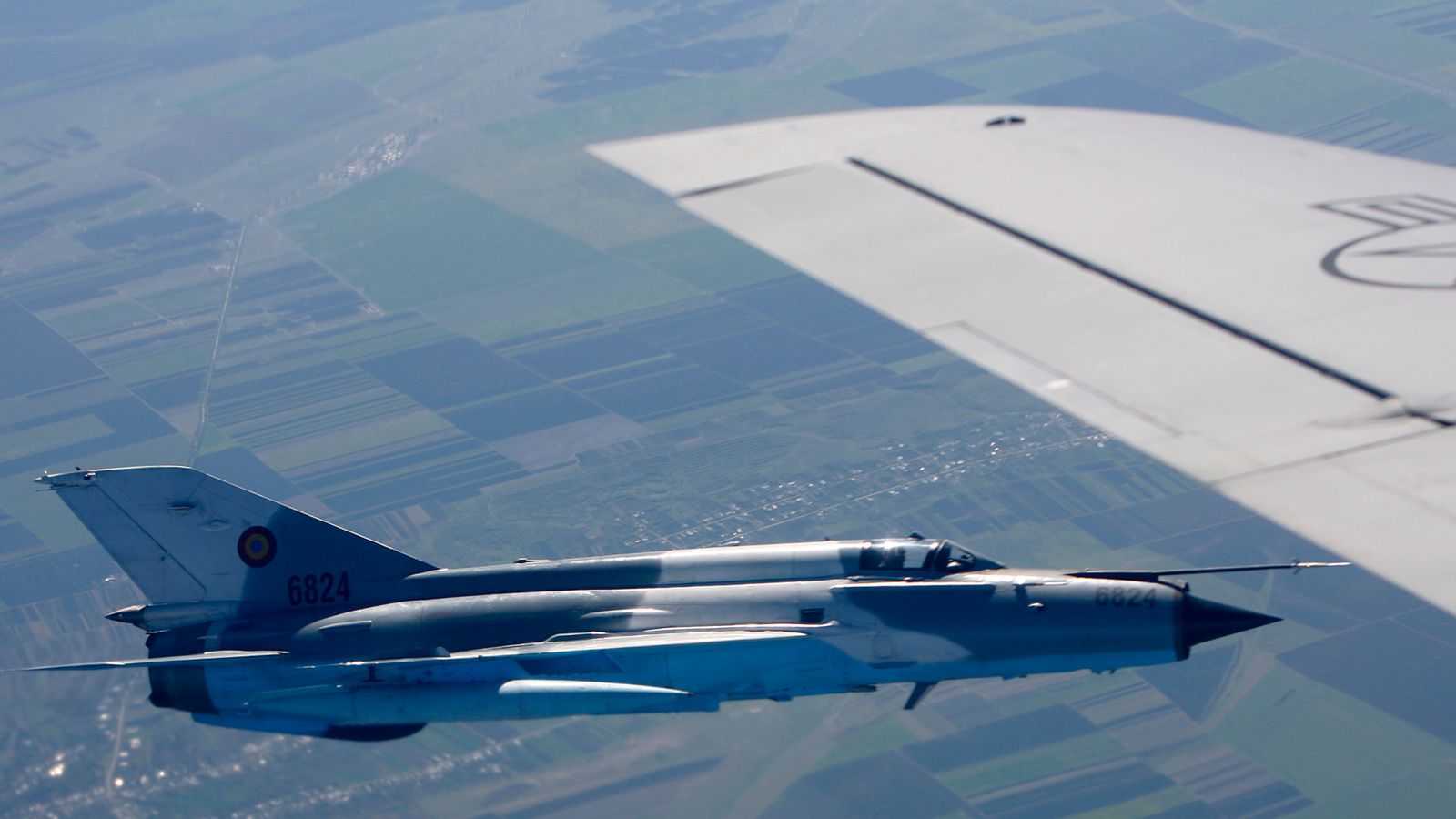
Romania scrambles fighter jets after detecting suspicious ‘weather balloon’ in its airspace


A suspicious aerial object looking like a weather balloon has been spotted flying in Romania’s airspace.
The country’s air force scrambled two MiG 21 LanceR jets to the area in the southeast 10 minutes after its surveillance system detected the object, but they were unable to confirm its presence, the defence ministry said.
The planes stayed in the vicinity for 30 minutes before returning to base after not getting visual or radar confirmation of the target.
The ministry said the balloon was flying at an altitude of 11,000m.
It comes amid heightened tensions between the US and China after Washington shot down a suspected Chinese spy balloon earlier this month.
Read more on spy balloons:
Timeline of unidentified objects shot down
White House: China has balloon programme linked to army
The US says it has recovered key sensors from the object, which spent around a week flying over the US and Canada before President Joe Biden ordered it to be downed off the South Carolina coast.
The sighting in Romania occurred the same day that Moldova, which borders Romania and Ukraine, briefly closed its air space for undisclosed security reasons – though the Romanian ministry did not link the two events.
US denies flying balloons over China
US says other objects shot down could be ‘tied to some commercial or benign purpose’
Since the South Carolina incident, the US military has shot down three more objects, but the White House has said there were no indications they were part of China’s spy programme.
White House spokesman John Kirby said no group or individual has claimed the objects and the US intelligence community believes they could be “tied to some commercial or benign purpose”.
The White House has said the objects’ altitude was low enough to pose a risk to civilian air space.
One of the objects was downed over sea ice near Deadhorse, Alaska, another was brought down over Canada’s Yukon territory and the third was shot down over Lake Huron.
The US military is yet to recover debris from the three objects, with tough weather conditions hampering recovery operations.

‘There’s no indication of aliens’
First missile strike missed
The first US missile fired at the unidentified object over Lake Huron missed its target and “landed harmlessly” in the water before a second one successfully hit, the chair of the Joint Chiefs of Staff said.
General Mark Milley said the military went to “great lengths” to make sure the strikes did not put civilians at risk, including identifying how large the debris field was likely to be and the maximum effective range of the missiles used.
World
‘No one is here to help us’: Palestinians watch as Israeli diggers tear down homes in East Jerusalem

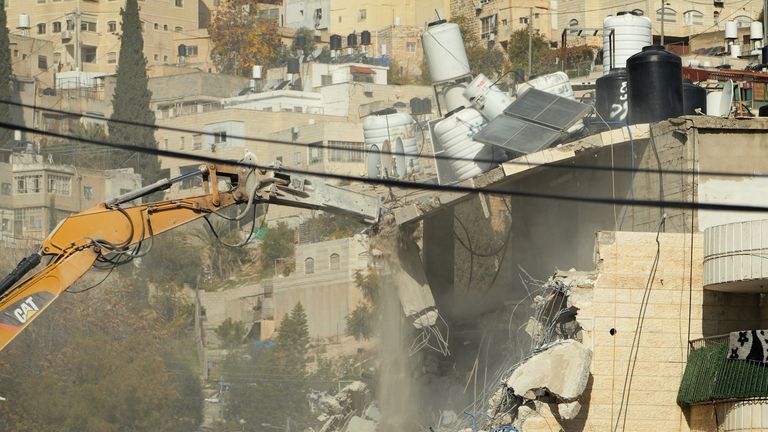
A balcony of onlookers stare as three diggers gnaw at the four-storey building that was a fixture of their daily view.
The roads of Silwan’s Wadi Qaddom neighbourhood are blocked off by Israeli police as residents watch the demolition in the valley from every vantage point. The block of flats was home to around 100 of their neighbours – many of them are now homeless.
An elderly woman sits at the bus stop near the police checkpoint closest to the demolition site. As she walks back down the hill, she looks back at the destruction. Her cheeks are red with anger when she hails that God is their only protection.
“Where are the Arab countries? No one is here to help us,” she exclaims.
Of the 230 buildings demolished in East Jerusalem’s Palestinian neighbourhoods in 2025, the block of roughly 13 flats is considered to be the largest and took 12 hours to completely demolish.
The demolition of a building in Silwan’s Wadi Qaddom neighbourhood
The building was without a permit, like many in Silwan, and stood on land that was not licensed for residential use. The residents were challenging long-standing demolition orders and applying for licensing when diggers arrived at dawn.
The Jerusalem Municipality said the demolition of the building in Silwan was based on a 2014 court order, and that residents were granted extensions for the execution of the order and were offered various options in order to find a solution, but they declined to do so.
But an architect and urban planner from the Israeli NGO Bimkom (Planners for Planning Rights) – which is supporting the families in their bid to license the land of the building – says their time to act was cut short.
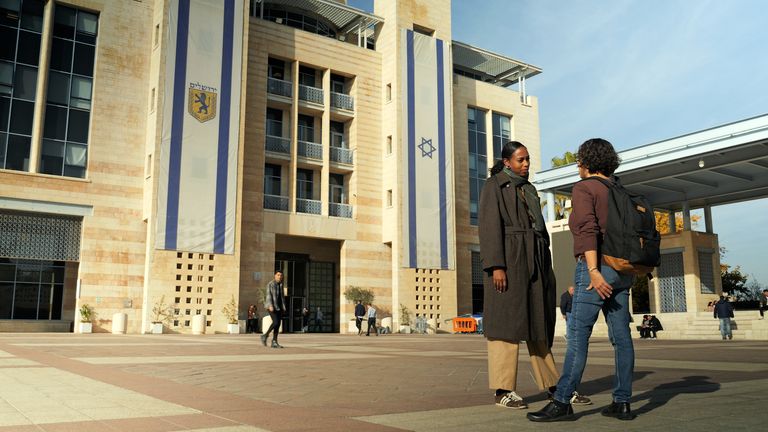
Architect Sari Kornish speaks to Sky’s Yousra Elbagir
“They were told that the demolition order would be implemented, and then they would get another six months’ recourse to try to continue with their planning. Six months is not enough for these planning processes. They take a long time,” Sari Kornish tells us in front of the Jerusalem Municipality after meeting with the building residents’ lawyer there.
Are permits granted for Palestinians in East Jerusalem?
“Very, very few, and in recent years, since October 7, less and less,” says Sari.
“It has always been discrimination. It has always been not enough.”
Far-right minister of national security Itamar Ben-Gvir posted on X about the building’s demolition.
He said: “Proud to lead the policy of demolishing illegal buildings – not only in the Negev, this morning in East Jerusalem (Silwan neighbourhood) a building that was built illegally and 100 people lived in it – was demolished! Strengthens the police and the district commander.”
Israel’s annexation of East Jerusalem and parts of the West Bank is illegal under international law.
Read more from Sky News:
Is Israel building a wall on Lebanese land?
Mother of last hostage in Gaza speaks to Sky News
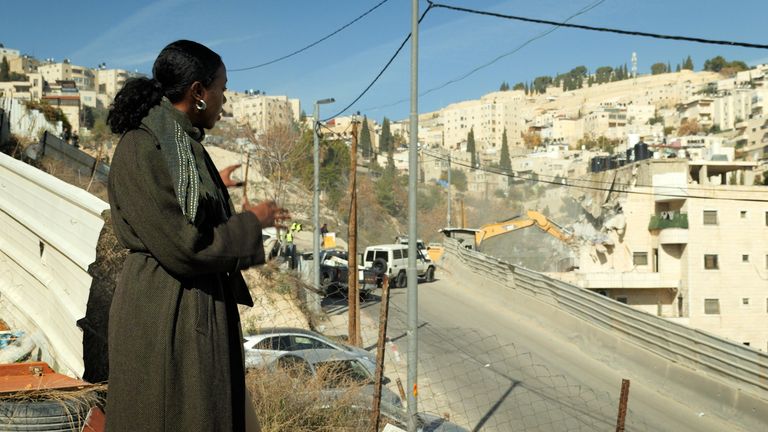
Sky’s Yousra Elbagir watches the demolition in Silwan
On Sunday, Israel’s far-right finance minister Bezalel Smotrich announced that the security cabinet approved 19 new Jewish settlements in the occupied West Bank.
Half a million Israeli settlers currently live in the West Bank, and over 230,000 live in East Jerusalem, where some are taking over homes instead of seizing land.
At least 500 Palestinians have lost their homes to lack-of-permit demolitions in East Jerusalem, and at least 1,000 people, including 460 children, are at risk of forced displacement from eviction cases filed against them in Israeli courts by settler organisations.
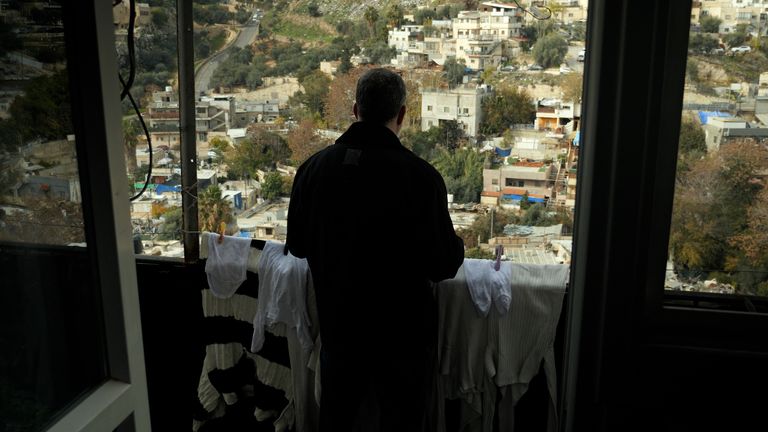
Zuhair al Rajabbi looks out at the homes of his neighbours now marked by demolition sites
In the East Jerusalem neighbourhood of Batn al Hawa in Silwan, Zuhair al Rajabbi looks out from his balcony at the homes of his neighbours.
The landscape is marked by demolition sites, and former homes of his neighbours are marked by Israeli flags. Settlers are busy renovating the rooftops to make their own.
“They have five children, and a grandmother was in one room. Downstairs, there was a family of seven children, with the wife and mother, in that one,” he says, pointing at the roof of his neighbours.
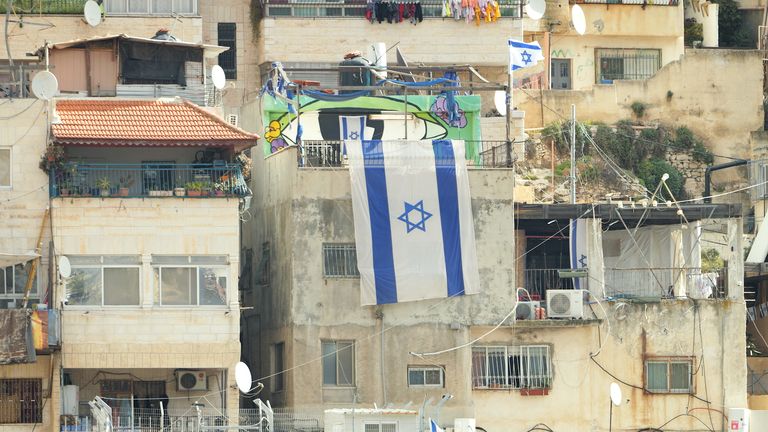
Israeli settler flags on a building in Silwan, a Palestinian neighbourhood in East Jerusalem
As we watch, a woman quietly mops the dirty water into a hole in the fence and onto the roof of the house next door.
“Look, they are even putting the dirty water on our neighbour’s roof,” Zuhair says with a sad bitterness.
“We used to live together like we live here at home – eating and drinking with them. It makes me sad when I see their home disappearing.”

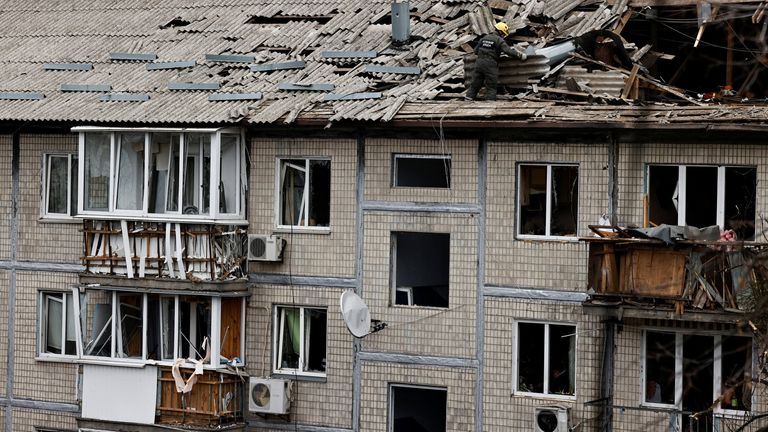
Russia launched a major overnight missile and drone attack on Ukraine that killed at least three people – including a four-year-old child.
Officials say Russia fired more than 650 drones and three dozen missiles in an assault that began during the night and stretched into daylight hours Tuesday.
Ukrainian President Volodymyr Zelenskyy said the barrage struck homes and the power grid in 13 regions across Ukraine, causing widespread outages in bitter temperatures.
It comes a day after he described recent progress towards a peace deal as “quite solid”.
The bombardment demonstrated Russian President Vladimir Putin’s intention of pursuing the invasion of Ukraine, Mr Zelenskyy said in an online post.
A damaged apartment building in Kyiv. Pic: Reuters
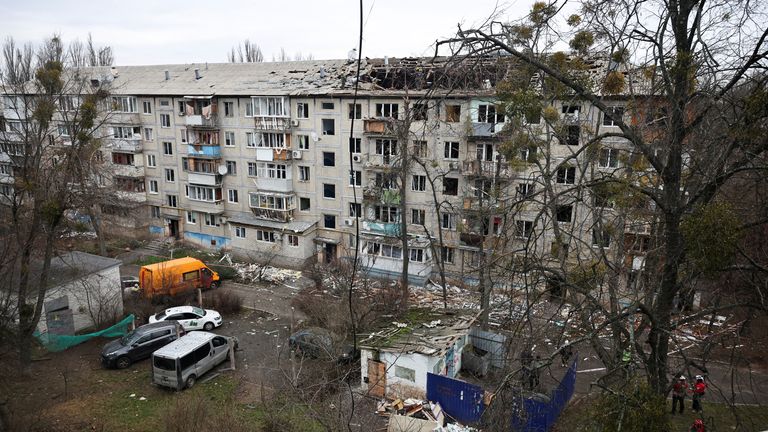
A damaged apartment building in Kyiv. Pic: Reuters
Ukrainian and European officials have said Putin is not sincerely engaging with US-led peace efforts.
The attack “is an extremely clear signal of Russian priorities,” Mr Zelenskyy said.
“A strike before Christmas, when people want to be with their families, at home, in safety. A strike, in fact, in the midst of negotiations that are being conducted to end this war. Putin cannot accept the fact that we must stop killing.”
US President Donald Trump has for months been pressing for a peace agreement, but the negotiations have become entangled in the very different demands from Moscow and Kyiv.
US envoy Steve Witkoff described talks in Florida with Ukrainian and European representatives as “productive and constructive”.

A drone explodes during a Russian missile and drone strike, in Kyiv. Pic: Reuters
Trump was less effusive on Monday, saying, “The talks are going along.”
Initial reports from Ukrainian emergency services said the child died in Ukraine’s northwestern Zhytomyr region, while a drone killed a woman in the Kyiv region, and another civilian death was recorded in the western Khmelnytskyi region, according to Mr Zelenskyy.
Russia launched 635 drones of various types and 38 missiles, Ukraine’s air force said. Air defences stopped 587 drones and 34 missiles, it said.
Read more
Russian general killed by car bomb and Moscow blames Ukraine
Putin didn’t sound like he will alter his course anytime soon
Polish and allied fighter jets were deployed after the Russian airstrikes towards western Ukraine, near Poland’s border.
“Fighter jets were scrambled, and ground-based air-defence and radar reconnaissance systems were put on heightened readiness,” the operational command of Poland’s armed forces said.
It was the ninth large-scale Russian attack on Ukraine’s energy system this year and left multiple regions in the west without power, while emergency power outages were in place across the country, acting Energy Minister Artem Nekraso said. Work to restore power would begin as soon as the security situation permitted, he said.
Ukraine’s largest private energy supplier, DTEK, said the attack targeted thermal power stations in what it said was the seventh major strike on the company’s facilities since October.
DTEK’s thermal power plants have been hit more than 220 times since Russia’s full-scale invasion began in February 2022. Those attacks have killed four workers and wounded 59.
Authorities in the western regions of Rivne, Ternopil and Lviv, as well as the northern Sumy region, reported damage to energy infrastructure or power outages after the attack.
In the southern Odesa region, Russia struck energy, port, transport, industrial and residential infrastructure, according to regional head Oleh Kiper.
A merchant ship and over 120 homes were damaged, he said.
World
‘No one is here to help us’: Palestinians watch on as Israeli diggers tear down their homes in East Jerusalem
A balcony of onlookers stare as three diggers gnaw at the four-storey building that was a fixture of their daily view.
The roads of Silwan’s Wadi Qaddom neighbourhood are blocked off by Israeli police as residents watch the demolition in the valley from every vantage point. The block of flats was home to around 100 of their neighbours – many of them are now homeless.
An elderly woman sits at the bus stop near the police checkpoint closest to the demolition site. As she walks back down the hill, she looks back at the destruction. Her cheeks are red with anger when she hails that God is their only protection.
“Where are the Arab countries? No one is here to help us,” she exclaims.
Of the 230 buildings demolished in East Jerusalem’s Palestinian neighbourhoods in 2025, the block of roughly 13 flats is considered to be the largest and took 12 hours to completely demolish.
The demolition of a building in Silwan’s Wadi Qaddom neighbourhood
The building was without a permit, like many in Silwan, and stood on land that was not licensed for residential use. The residents were challenging long-standing demolition orders and applying for licensing when diggers arrived at dawn.
The Jerusalem Municipality said the demolition of the building in Silwan was based on a 2014 court order, and that residents were granted extensions for the execution of the order and were offered various options in order to find a solution, but they declined to do so.
But an architect and urban planner from the Israeli NGO Bimkom (Planners for Planning Rights) – which is supporting the families in their bid to license the land of the building – says their time to act was cut short.
Architect Sari Kornish speaks to Sky’s Yousra Elbagir
“They were told that the demolition order would be implemented, and then they would get another six months’ recourse to try to continue with their planning. Six months is not enough for these planning processes. They take a long time,” Sari Kornish tells us in front of the Jerusalem Municipality after meeting with the building residents’ lawyer there.
Are permits granted for Palestinians in East Jerusalem?
“Very, very few, and in recent years, since October 7, less and less,” says Sari.
“It has always been discrimination. It has always been not enough.”
Far-right minister of national security Itamar Ben-Gvir posted on X about the building’s demolition.
He said: “Proud to lead the policy of demolishing illegal buildings – not only in the Negev, this morning in East Jerusalem (Silwan neighbourhood) a building that was built illegally and 100 people lived in it – was demolished! Strengthens the police and the district commander.”
Israel’s annexation of East Jerusalem and parts of the West Bank is illegal under international law.
Read more from Sky News:
Is Israel building a wall on Lebanese land?
Mother of last hostage in Gaza speaks to Sky News
Sky’s Yousra Elbagir watches the demolition in Silwan
On Sunday, Israel’s far-right finance minister Bezalel Smotrich announced that the security cabinet approved 19 new Jewish settlements in the occupied West Bank.
Half a million Israeli settlers currently live in the West Bank, and over 230,000 live in East Jerusalem, where some are taking over homes instead of seizing land.
At least 500 Palestinians have lost their homes to lack-of-permit demolitions in East Jerusalem, and at least 1,000 people, including 460 children, are at risk of forced displacement from eviction cases filed against them in Israeli courts by settler organisations.
Zuhair al Rajabbi looks out at the homes of his neighbours now marked by demolition sites
In the East Jerusalem neighbourhood of Batn al Hawa in Silwan, Zuhair al Rajabbi looks out from his balcony at the homes of his neighbours.
The landscape is marked by demolition sites, and former homes of his neighbours are marked by Israeli flags. Settlers are busy renovating the rooftops to make their own.
“They have five children, and a grandmother was in one room. Downstairs, there was a family of seven children, with the wife and mother, in that one,” he says, pointing at the roof of his neighbours.
Israeli settler flags on a building in Silwan, a Palestinian neighbourhood in East Jerusalem
As we watch, a woman quietly mops the dirty water into a hole in the fence and onto the roof of the house next door.
“Look, they are even putting the dirty water on our neighbour’s roof,” Zuhair says with a sad bitterness.
“We used to live together like we live here at home – eating and drinking with them. It makes me sad when I see their home disappearing.”
-
 Sports2 years ago
Story injured on diving stop, exits Red Sox game
-
 Sports3 years ago
‘Storybook stuff’: Inside the night Bryce Harper sent the Phillies to the World Series
-
 Sports2 years ago
Game 1 of WS least-watched in recorded history
-
 Sports3 years ago
Button battles heat exhaustion in NASCAR debut
-
 Sports3 years ago
MLB Rank 2023: Ranking baseball’s top 100 players
-
Sports4 years ago
Team Europe easily wins 4th straight Laver Cup
-
 Environment3 years ago
Japan and South Korea have a lot at stake in a free and open South China Sea
-
 Environment1 year ago
Here are the best electric bikes you can buy at every price level in October 2024