

Connect with us

Published

on

Republican lawmakers are wary of their party’s propensity for self-inflicted wounds and are hoping for more discipline heading into the next election cycle.  

Leading Republicans think that the House GOP’s raucous reception of President Biden at last week’s State of the Union played into the president’s hands and that the proposal by Sen. Rick Scott (R-Fla.) to sunset all federal legislation after five years is a political gift to Democrats.  

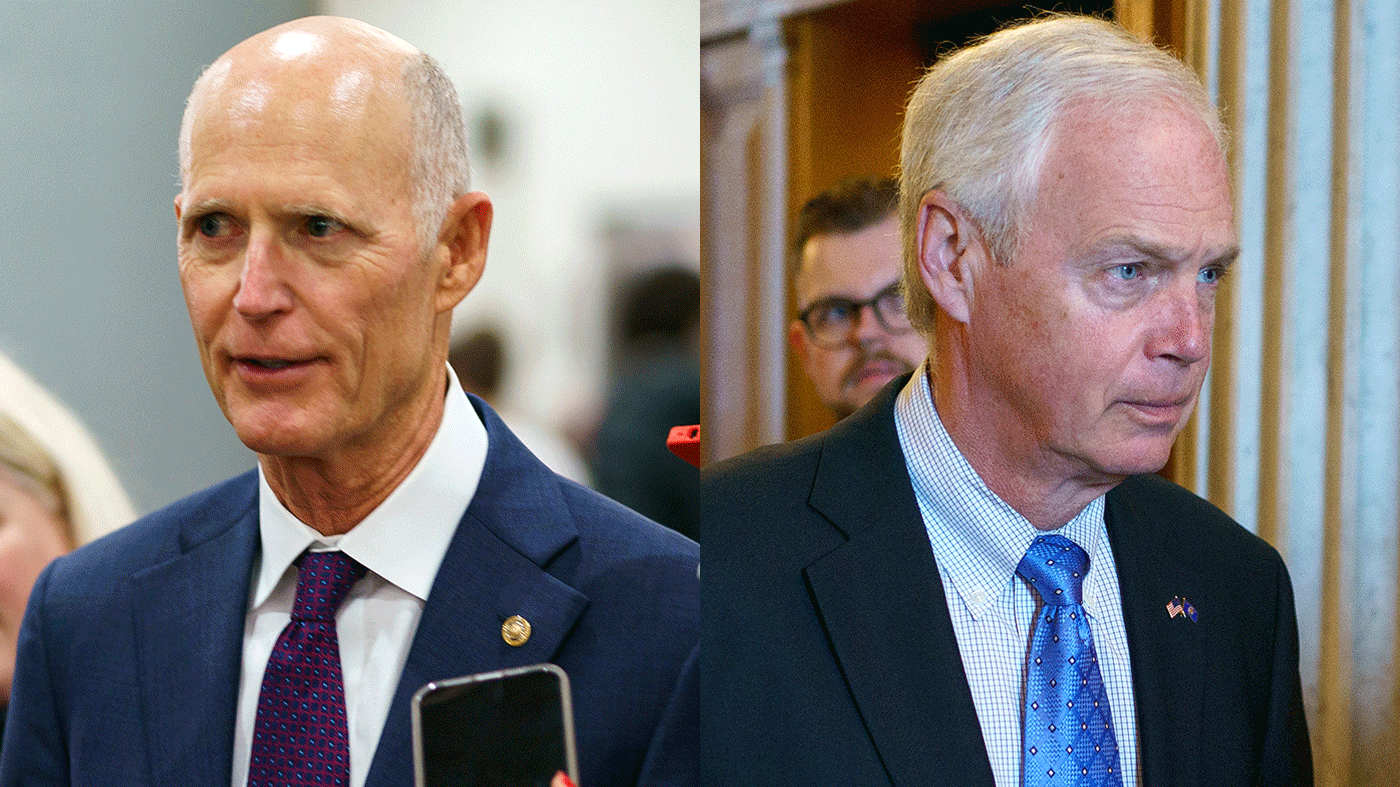
Some Republicans on Capitol Hill are dismayed that Scott hasn’t disavowed his 12-point plan to “Rescue America,” despite repeated Democratic attacks, and they are disappointed by lapses in message discipline, such as Sen. Ron Johnson’s (R-Wis.) call for annual votes on Medicare and Social Security, which he described as “a legal Ponzi scheme.”  

Johnson says that doesn’t mean he wants to cut Social Security, but some of his colleagues worry that Republicans are already giving Democrats too much ammo heading into the 2024 election.  

“I think Republicans have got to be wise in how we talk about these issues,” said Senate Minority Whip John Thune (R-S.D.).

Some Republicans, like Sen. John Thune (R-S.D.), have urged other members of their party to be cautious in how they approach the issue of Social Security. (Greg Nash)

Biden’s job approval rating has been mired in the low 40s for much of his first term in office, but Democrats still managed to expand their Senate majority and exceed expectations in the battle for the House last year.  

Many Republicans believe the Democrats’ strong showing in the midterms had more to do with their own party’s mistakes than the popularity of Biden’s agenda.  

Biden seized on Scott’s 12-point plan at his State of the Union speech, telling the nation that “some Republicans want Medicare and Social Security to sunset every five years.”   

And Senate Majority Leader Charles Schumer (D-N.Y.) on Monday pointed to Johnson’s recent comments to advance Biden’s claim.   

“Almost as if to prove President Biden correct, Sen. Johnson of Wisconsin reacted to the State of the Union by going on radio and calling for annual votes on Social Security, calling it a ‘Ponzi scheme,’” Schumer said on the Senate floor.  

Schumer also pointed out that the House Republican Study Committee released a budget proposal last year that raised the Social Security retirement age and cut some benefits to certain recipients.  

Sen. Chuck Schumer (D-N.Y.) slammed Sen. Ron Johnson (R-Wis.) for describing Social Security as a “Ponzi scheme.” (AP Photo/Jose Luis Magana)

Johnson on Wednesday defended his comments by arguing that future Social Security recipients aren’t going to get what they put into the trust fund given the nation’s mounting debt.  

“It’s not a sustainable system,” he said of Social Security, noting that the number of workers paying into the system to support retirees has dwindled. “A Ponzi scheme is you take from investors. You don’t invest it. You spend it. And you pay off early investors. The later investors get hosed.” 

But members of the Senate Republican leadership team don’t see any point in talking about Medicare and Social Security reforms when they don’t think Democrats have any good-faith desire to reform those programs and instead will just use GOP proposals to play offense in next year’s election.  

Sen. John Cornyn (R-Texas) said Biden “loves that, doesn’t he?” referring to Biden hammering Republicans over Scott’s plan.  

“What it’s showing is that Biden has no interest in saving Social Security or Medicare from insolvency,” he said. “He’s just going to use it purely as a political pinata.” 

Cornyn later said Democrats are using Scott’s plan as “a diversion” to shift public attention away from the nation’s serious debt problem.  

Sen. John Cornyn (R-Texas) is among the GOP members who do not see advantages to continuing to speak about Social Security and Medicare, noting that, Biden “loves that, doesn’t he?” (Greg Nash)

Senate Minority Leader Mitch McConnell (R-Ky.) on Tuesday tried to quash once and for all Democratic claims that Republicans want to use the expiring debt limit as leverage to cut benefits for seniors.  

“It continues to come up. The president was talking about it in the State of the Union,” McConnell told reporters this week. “So let me say it one more time. There is no agenda on the part of Senate Republicans to revisit Medicare or Social Security. Period.” 

Sen. Shelley Moore Capito (R-W.Va.) pointed out that Speaker Kevin McCarthy (R-Calif.) said last week that Medicare and Social Security cuts are “off the table” and fellow Republicans need to get the message.   

Capito, the chairwoman of the Senate Republican Policy Committee, said GOP senators discussed “trying to keep on [a] unified message as much as we can.” 

“With the Speaker and our leader, the two Republican leaders, being on the same page, that’s going to drive the message of the day,” she said, referring to McCarthy’s and McConnell’s pledges not to cut Medicare or Social Security.  

“Members are going to disagree,” she said, acknowledging differing views on strategy within the GOP conference.  

But she argued that party leaders are smart to stay away from what has become the “third rail” of politics — specifically Medicare and Social Security cuts — in the debt limit discussions with the White House.  

“I’m unified with the message that we need to stay away from these things to solve some fiscal problems,” she said.  

Some Republican senators say they weren’t thrilled with the jeering and raucous reception Biden received from House Republicans at last week’s State of the Union address, which appeared to play into the president’s hands in front of a national television audience.  

Some Republicans have expressed dismay over the raucous response Biden received at his State of the Union address, where he addressed Republicans’ reported plans for Social Security and Medicare. (Greg Nash)

Schumer said the contrast between Biden and “these guys screaming and yelling” and “just calling names” is “going to serve the president so well.” 

Veteran journalist Chris Wallace said GOP lawmakers who heckled Biden “literally played into his hands.” 

Later, when he was asked about Wallace’s observation that Republicans might have unwittingly made the president look good, Sen. Thom Tillis (R-N.C.) replied, “That may be fair.”  

He said that Republicans should stick to “reasonable and enduring policy” proposals instead of made-for-television antics that give Democrats a chance to change to subject to the behavior of Republican personalities.  

“I think we’re missing an opportunity to differentiate,” he said. “Focus on policy. If you get that done, it will age well.” 

Another Republican senator who requested anonymity to comment on House colleagues said that decorum is good for the party’s brand.  

“We ought to be polite and respectful to each other. This is not theater. It’s governing,” the senator said, commenting on the unruly reactions to Biden’s speech last week. “It’s damaging to the politics. It appeals to a handful of people and turns off a whole bunch more.”  

Looking ahead to next year’s election, Senate Republicans say they need to do a better job of helping ensure the most electable candidates advance to the general election, something they believe did not happen last year in Arizona, Georgia, New Hampshire and Pennsylvania, where Democrats won.  

At a one-day retreat last week, GOP lawmakers discussed the need for the National Republican Senatorial Committee to get more involved in the candidate vetting and selection process in 2024.  Trump warns Scott on Social Security, Medicare: ‘THERE WILL BE NO CUTS’ Haley calls for generational change when asked about differences with Trump

“I think it’s more a matter of interacting with the states to make sure that they understand this is all about winning the finals, not the semifinals,” Tillis said.  

Capito said the retreat was “forward thinking.”  

“Candidate recruitment is a repeating message, making sure we get candidates that win the primary that can win the general,” she said. 

Continue Reading

Business

Bank of England warns of heightened risks but trims banks’ reserve requirements

Published

on

By

Bank of England warns of heightened risks but trims banks' reserve requirements

The Bank of England has warned of heightened risks to the UK’s financial system but cut the amount of money that banks need to hold in reserve in case of shock.

The twice-yearly financial stability report highlights a series of pressures, from higher government borrowing costs to risks around lending to major tech firms and record stock market valuations – particularly in areas exposed to artificial intelligence (AI).

“Risks to financial stability have increased during 2025,” the Bank‘s financial policy committee (FPC) said.

“Global risks remain elevated and material uncertainty in the global macroeconomic outlook persists. Key sources of risk include geopolitical tensions, fragmentation of trade and financial markets, and pressures on sovereign debt markets.

Money latest: My supermarket delivery row

“Elevated geopolitical tensions increase the likelihood of cyberattacks and other operational disruptions.

“In the FPC’s judgement, many risky asset valuations remain materially stretched, particularly for technology companies focused on AI.

More from Money

“Equity valuations in the US are close to the most stretched they have been since the dot-com bubble, and in the UK since the global financial crisis (GFC). This heightens the risk of a sharp correction.”

Its concern extended to the growing trend of tech firms using debt finance to fund investment.

Please use Chrome browser for a more accessible video player

Could the AI bubble burst?

The Bank, which joined the International Monetary Fund in warning over an AI-led bubble in October, delivered its verdict at a time when UK regulators are under pressure from the government to place a greater focus on supporting economic growth.

It is understood, for example, the UK’s ringfencing regime – that sees retail banking separated from more risky investment banking operations within major lenders – is the subject of a review between the Bank and government.

Efforts by the chancellor to grow the economy will be potentially helped by the Bank’s decision today to lower capital requirements – the reserves banks must hold to help them withstand shocks in the financial system such as the global crisis of 2008/9.

The sector’s main capital requirement was cut by the Bank from 14% to 13%.

The Bank said that almost four million households face higher mortgage costs as fixed-term deals end. Pic: iStock
Image:
The Bank said that almost four million households face higher mortgage costs as fixed-term deals end. Pic: iStock

Such a move was urged, not only by the government, but by businesses to bolster UK lending and competitiveness.

The relaxation of the buffer does not take effect until 2027.

It was announced alongside confirmation that the country’s biggest lenders – Barclays, HSBC, Lloyds, NatWest, Santander UK, Standard Chartered and Nationwide building society – had passed the Bank’s latest stress tests.

The shocks each was exposed to included a 5% contraction in UK economic output, a 28% drop in house prices and Bank rate at 8%.

Despite the growing risks identified by the FPC, the Bank said that each was strong enough to support households and businesses even in the event of such scenarios, given the healthy state of their reserves.

It is widely expected that the gradual reduction in Bank rate will continue next year, assuming the outlook for inflation remains on a downwards trajectory, helping wider borrowing costs – a source of record bank profitability – decline.

The Bank said that three million households were expected to see their mortgage payments decrease in the next three years but that 3.9 million were forecast to refinance onto higher rates.

As such, it projected a £64 (8%) rise in costs for a typical owner-occupier mortgage customer rolling off a fixed rate deal in the next two years.

Banking stocks, which have enjoyed strong gains this year, were up when the FTSE 100 opened for business despite wider market caution globally which is aligned with the risks spoken of in the financial stability report.

Matt Britzman, senior equity analyst at Hargreaves Lansdown, said: “UK banks are offering a dose of optimism this morning in what’s turning out to be a good couple of weeks for the major lenders.

“The UK’s seven biggest banks sailed through the latest stress test, reaffirming their resilience and earning a regulatory nod to ease capital buffers.

“Most banks already hold capital well above the minimum by choice, so any shift in strategy may take time – but in theory, it frees up extra capital for lending or capital returns.

“However they use the new freedom, this is another clear signal that the UK banking sector is in robust health. This was largely expected, but the confirmation should still be taken well, especially after dodging tax hikes in last week’s budget.”

Continue Reading

World

More than 800,000 young children seeing social media content ‘designed to hook adults’, figures show


Published

on

By

More than 800,000 young children seeing social media content 'designed to hook adults', figures show

Children as young as three are “being fed content and algorithms designed to hook adults” on social media, a former education minister has warned.

Lord John Nash said analysis by the Centre for Social Justice (CSJ) suggesting more than 800,000 UK children aged between three and five were already engaging with social media was “deeply alarming”.

The peer, who served as minister for the school system between 2013 and 2017, said that “children who haven’t yet learned to read [are] being fed content and algorithms designed to hook adults”, which, he said, “should concern us all”.

He called for “a major public health campaign so parents better understand the damage being done, and legislation that raises the age limit for social media to 16 whilst holding tech giants to account when they fail to keep children off their platforms”.

The CSJ reached the figure by applying the latest population data to previous research by Ofcom.

The internet and communications watchdog found that almost four in 10 parents of a three to five year-old reported that their child uses at least one social media app or site.

With roughly 2.2 million children in this age group as of 2024, the CSJ said this suggests there could be 814,000 users of social media between three and five years old, a rise of around 220,000 users from the year before.

More on Australia

Lord Nash is among those who have demanded the Children’s Wellbeing and Schools Bill ban under-16s from having access to social media, something that will become law in Australia next month.

From 10 December, social media platforms will have to take reasonable steps to prevent under-16s from having a social media account, in effect blocking them from platforms such as Meta’s Instagram, TikTok and Snap’s Snapchat.

Ministers hope it will protect children from harmful content and online predators.

But one teenager who is against the idea is suing the Australian government as, he says, the measure would make the internet more dangerous for young people, many of whom would ignore the ban.

Read more on Sky News:
Call to trial four-day week for teachers
Primary school tests ‘devastating’
AI to tackle truancy

Noah Jones, 15, co-plaintiff in a High Court case said a better plan would be “cutting off the bad things about social media”, adding, “I most likely will get around the ban. I know a lot of my mates will”.

UK campaigners have called for stronger policies to stop students using phones in schools, which already have the power to ban phones.

The CSJ wants to see smartphones banned in all schools “to break the 24-hour cycle of phone use”, and said a public health campaign is needed “to highlight the harms of social media”.

Last week Health Secretary Wes Streeting said he worries “about the mind-numbing impact of doomscrolling on social media on young minds and our neurodevelopment”.

Continue Reading

World

Sudan’s RSF says it has captured Babanusa in West Kordofan

Published

on

By

Sudan's RSF says it has captured Babanusa in West Kordofan

Sudan’s paramilitary Rapid Support Forces says it has captured Babanusa, a transport junction in the south of the country, just a month after the fall of Al Fashir to the same group.

The RSF said in a statement the seizure of the city in West Kordofan state came as it repelled “a surprise attack” by the Sudanese army in what it called “a clear violation of the humanitarian truce”.

The paramilitary group added it had “liberated” the city in the state, which has become the latest frontline in the war in Sudan.

Please use Chrome browser for a more accessible video player

Sky’s Yousra Elbagir explains the unfolding humanitarian crisis

It comes just over a month after the Sudanese Armed Forces (SAF) withdrew from military positions in the heart of Al Fashir, the capital of North Darfur, and the symbolic site was captured by the RSF with no resistance.

The RSF claimed at the time it had taken over the city and completed its military control of the Darfur region, where the administration of former US president Joe Biden has accused the group of committing genocide.

Please use Chrome browser for a more accessible video player

Sky’s Africa correspondent Yousra Elbagir on why evidence suggests there is a genocide in Sudan.

The war between the Sudanese army and the RSF – who were once allies – started in Khartoum in April 2023 but has spread across the country.

About 12 million people are believed to have been displaced and at least 40,000 killed in the civil war, according to the World Health Organization (WHO) – but aid groups say the true death toll could be far greater.

More on Sudan

Tom Fletcher, the UN’s under-secretary-general for humanitarian affairs, recently told Sky’s The World With Yalda Hakim the situation was “horrifying”.

“It’s utterly grim right now – it’s the epicentre of suffering in the world,” he said of Sudan.

Read more:
Tens of thousands killed in two days in Sudan city

Sudan’s war: Is it a genocide?

The United States, the United Arab Emirates, Egypt and Saudi Arabia – known as the Quad – earlier in November proposed a plan for a three-month truce followed by peace talks.

The RSF responded by saying it had accepted the plan, but soon after attacked army territory with a barrage of drone strikes.

Continue Reading

Trending