
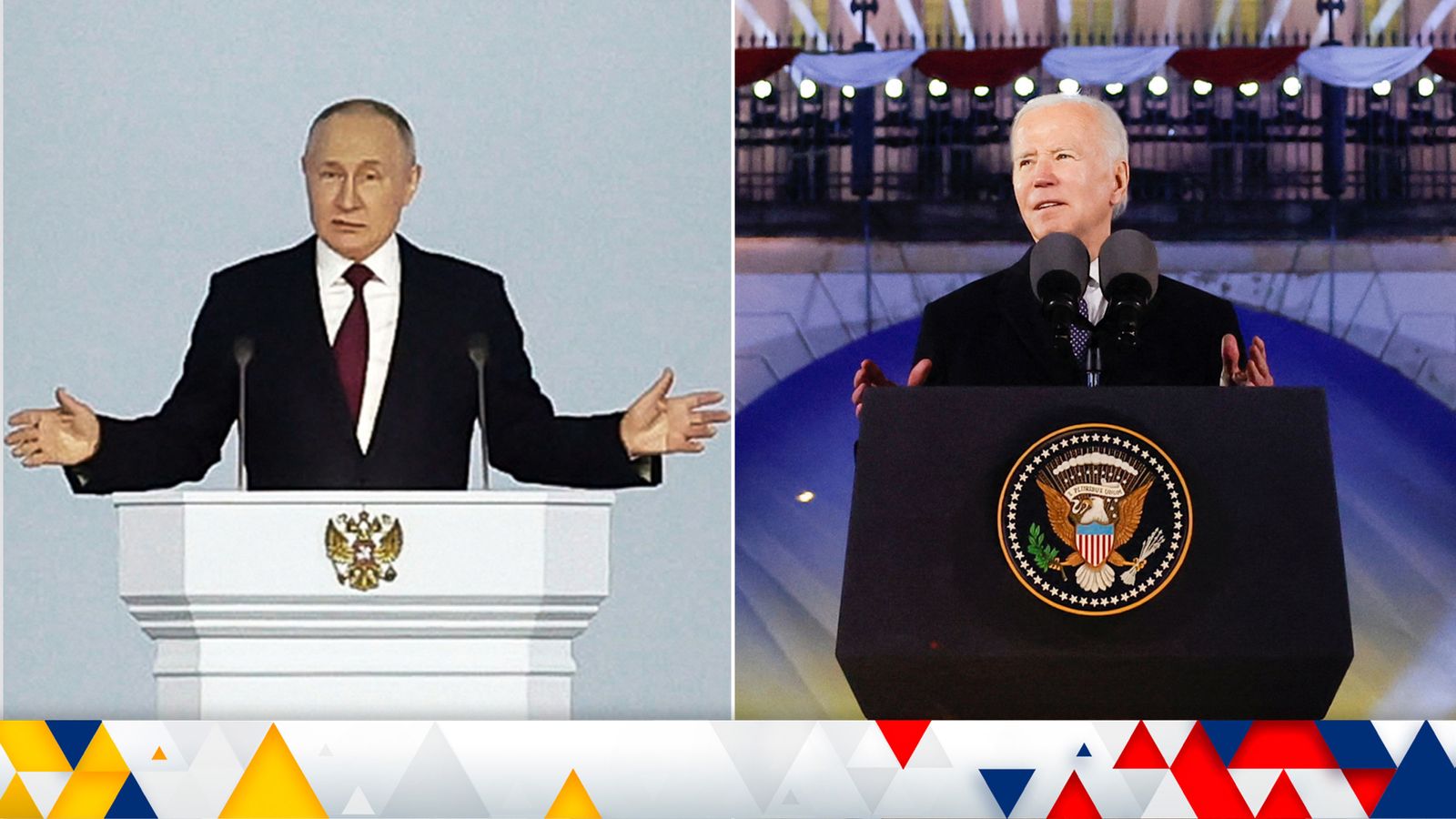
Ukraine war: Biden says Kyiv’s allies have ‘iron will’ as Putin suspends key nuclear treaty

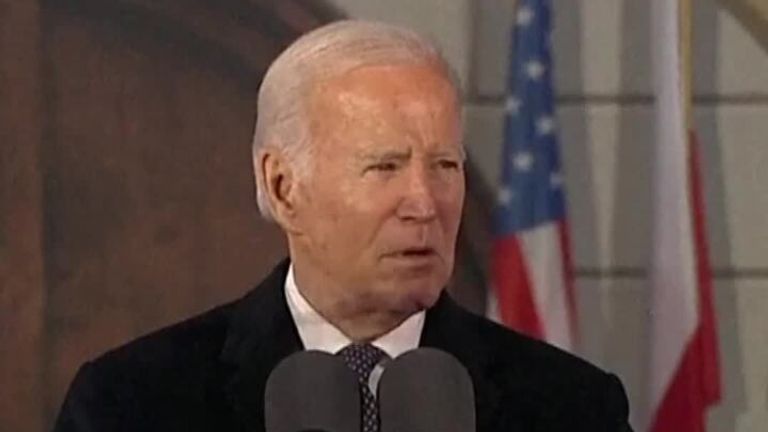
Joe Biden has said Vladimir Putin expected his enemies to “roll over” when he invaded Ukraine but was met with the “iron will” of its allies – as the Russian president suspended a key nuclear treaty with the US after accusing the West of starting the war.
The American president gave a historic speech from the gardens of Warsaw’s Royal Castle just hours after Mr Putin delivered a state of the nation address in Russia.
Mr Biden was speaking in the Polish capital a day after he made his highly-secretive and historic visit to Kyiv in Ukraine.
“I can report: Kyiv stands strong, Kyiv stands proud, it stands tall and, most important, it stands free,” Mr Biden said on Tuesday evening.
‘Freedom, there is no sweeter word’
Ukraine war latest: Biden comes out dancing and declares ‘NATO is stronger than ever’
Mr Putin had earlier blamed the West for starting the war in Ukraine and claimed his country responded with force “in order to stop it”.
He added that Ukraine was in talks with the West about weapons supplies before Russia invaded its neighbour on 24 February last year.
“I would like to emphasise when Russia tried to find a peaceful solution they were playing with the lives of people and they were playing a dirty game,” Mr Putin said.
Biden says ‘democracy was too strong’
Both leaders gave speeches presenting starkly contrasting views of the war as the one-year anniversary of Russia’s invasion approaches.
Mr Biden used his address to repeatedly accuse Mr Putin of underestimating Ukraine and the strength of NATO before ordering the full-scale offensive.
The US president said: “When Russia invaded it wasn’t just Ukraine being tested, the whole world faced a test for the ages… all democracies were being tested.
“The questions we faced were as simple as they were profound. Would we respond or would we look the other way?
“Would we be strong or would we be weak?”
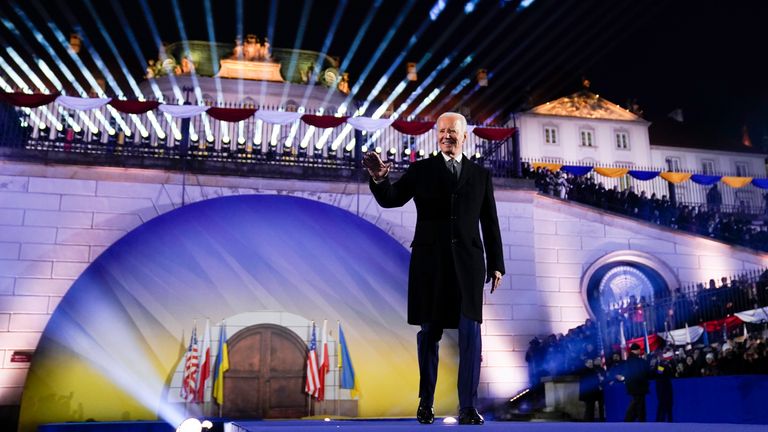
Pic: AP
Mr Biden continued: “One year later we know the answer.
“We did respond, we would be strong, we would be united, and the world would not look the other way.”
Mr Biden said: “President Putin ordered his tanks to roll into Ukraine, he thought we would roll over. He was wrong.
“The Ukrainian people were too brave. America, Europe, a coalition of nations from the Atlantic to the Pacific, we were too unified.
“Democracy was too strong. Instead of the easy victory he perceived and predicted, Putin left with burnt-out tanks and Russia’s forces in disarray.
“He thought he would get the Finlandization of NATO, instead he got the NATO-isation of Finland and Sweden.”
The term Finlandization has been used to refer to the decision of a country not to challenge a more powerful neighbour in foreign politics while maintaining national sovereignty.
‘Autocrats have grown weaker’
“He thought NATO would fracture and divide. Instead, NATO was more united and more unified than ever before,” Mr Biden continued.
“He thought autocrats like himself were tough and leaders of democracies were soft, and then he met the iron will of America and nations everywhere who refused to accept a world governed by fear and force.”
Mr Biden added: “President Putin is confronted with something today that he didn’t think was possible a year ago.
“The democracies of the world have grown stronger not weaker, but the autocrats of the world have grown weaker not stronger.”
Mr Biden also said Russia had committed “abhorrent” crimes in Ukraine by targeting civilians with “death and destruction” and had used rape as a “weapon of war”.
He also accused Russian forces of stealing Ukrainian children and bombing maternity hospitals and orphanages.
Mr Biden insisted the US support for Ukraine will never waiver.
Biden the Cold War warrior is on a mission to build on the success of his visit to Kyiv

As billed by White House officials, this speech in Warsaw was about Ukraine but also “the larger contest at stake between those aggressors who are trying to destroy fundamental principles and those democracies who are pulling together to try to uphold it”.
This was Joe Biden the Cold War warrior and statesman whose lifelong belief in those principles of freedom and democracy took him all the way to war-torn Kyiv this week.
He recalled the World War Two struggles for freedom in this city and vowed its example would inspire the West’s battles today.
“The appetites of autocrats must not be appeased. They must be opposed.”
His mission now is building on that stunning surprise visit and to rally allies and maintain solidarity and unity as we pass the grim milestone of the first anniversary of Russia’s unprovoked invasion.
Russia says the West ‘released the genie from the bottle’
In his address hours before Mr Biden’s, Mr Putin said Russia decided to “protect its people and history” by conducting a “special military operation step-by-step” – as he warned that Moscow will “continue to resolve the objectives that are before us”.
The Russian president has always referred to the invasion as a “special military operation” since it began last year.
“I would like to repeat, they started the war and we used force in order to stop it,” he said.
Read more:
Biden’s secretive trip to Kyiv was disguised as a ‘golf tourney’ – here’s how it unfolded
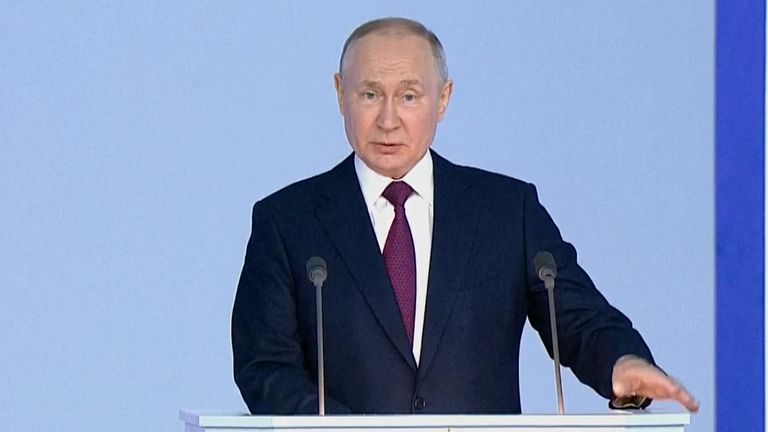
Putin’s state of the nation address
Mr Putin also announced that Russia was suspending its participation in a key nuclear treaty with the US which limits the two sides’ strategic nuclear arsenals.
The New START treaty caps the number of strategic nuclear warheads that the US and Russia can deploy.
Mr Putin said Russia was not fully withdrawing from the treaty and said Moscow must stand ready to resume nuclear weapons tests if the US does so.
The Russian president took aim at the West and said they “released the genie from the bottle” in the 10 years prior to the war, by starting others.
He claimed Western countries were painting Russia as an enemy of the state to divert attention from the corruption and socio-economic problems in their own countries.
On weapons, Mr Putin also claimed the West was “in negotiations” over the “supply of heavy military equipment and planes and anti-aircraft missile systems” before the operation began.
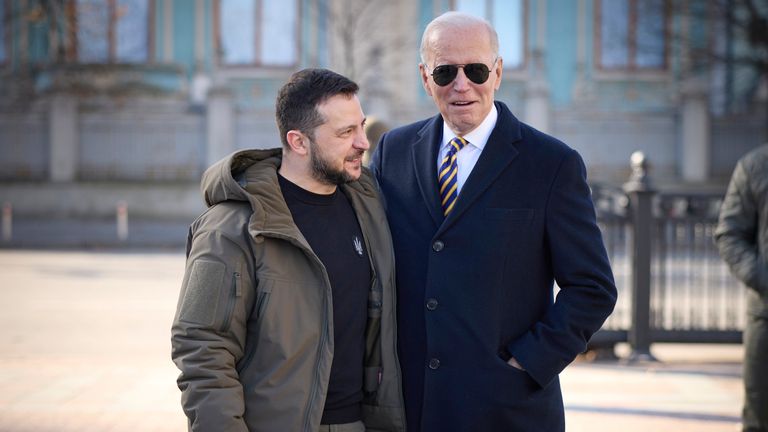
Joe Biden and Volodymyr Zelenskyy in Kyiv
While Russian forces have suffered three major battlefield reversals since the war began, it still controls around one-fifth of Ukraine.
In his wide-ranging speech, the Russian president also claimed millions of people in the West are being “led to a real spiritual catastrophe”, as he criticised the “Anglican Church’s plan to consider the idea of a gender-neutral God”.
Click to subscribe to Ukraine War Diaries wherever you get your podcasts
In his visit to the Ukrainian capital on Monday, Mr Biden said Washington would provide Kyiv with a new military aid package worth $500m (£413m) as he was pictured walking in the city with Ukraine’s President Volodymyr Zelenskyy.
Mr Biden said Mr Putin had believed Ukraine was “weak and the West was divided” and “thought he could outlast us” but added – “he was dead wrong”.
Mr Zelenskyy said he discussed long-range weapons with Mr Biden and described negotiations as “very fruitful”.
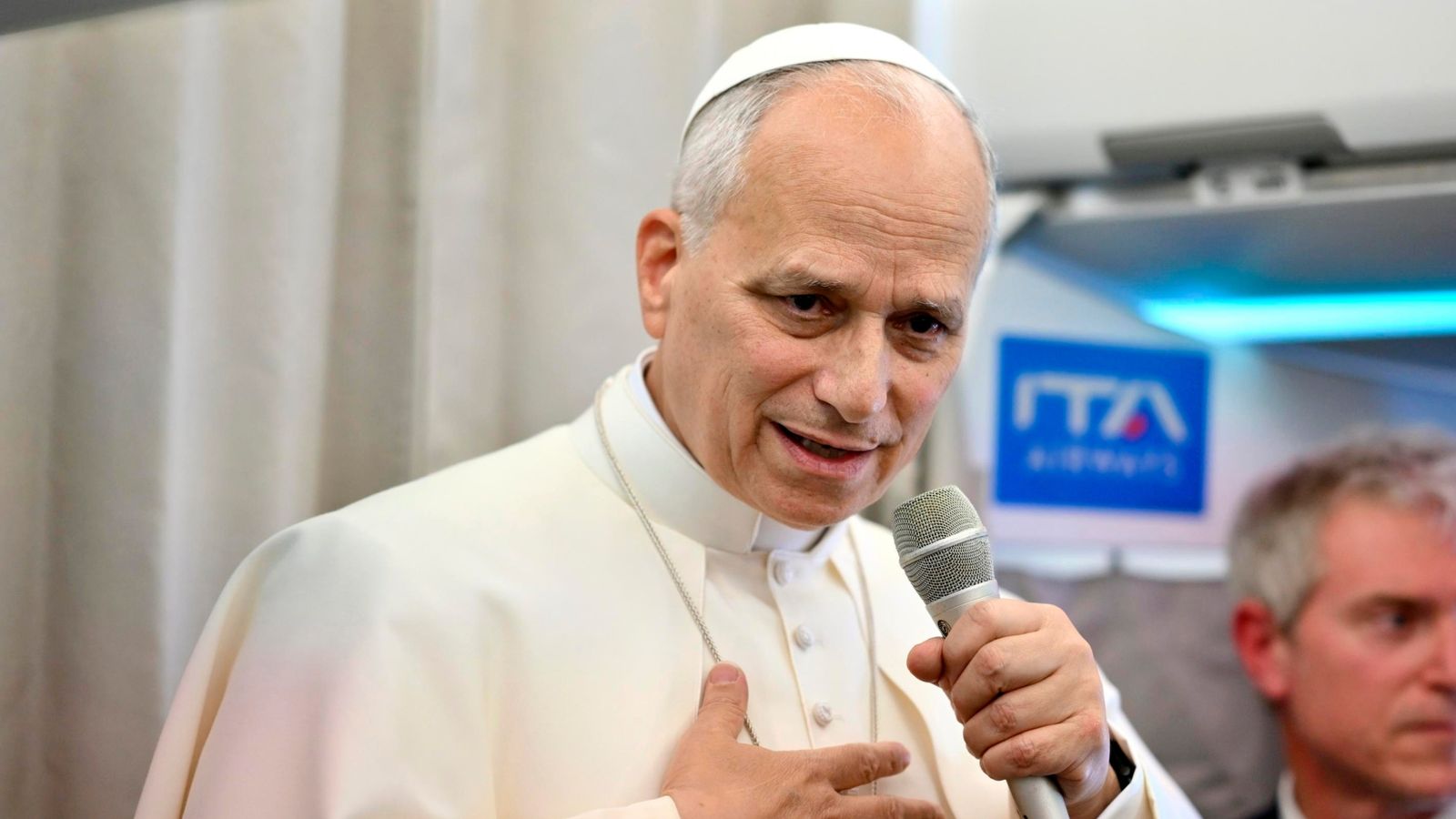
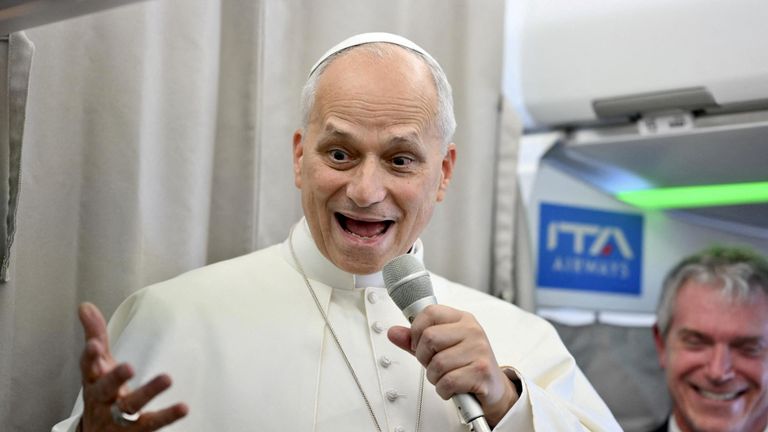
The Pope has urged Donald Trump not to try to oust Venezuelan President Nicolas Maduro using military force.
Leo, the first American pontiff, said it would be better to attempt dialogue or impose economic pressure on Venezuela if Washington wants to pursue change there.
The Trump administration has been weighing options to combat what it has portrayed as Mr Maduro’s role in supplying illegal drugs that have killed Americans.
The socialist Venezuelan president has denied having any links to the illegal drug trade.
Pope Leo XIV aboard a flight to Rome. Pic: Reuters
Asked during a news conference about President Trump’s threats to remove Mr Maduro by force, the Pope said: “It is better to search for ways of dialogue, or perhaps pressure, including economic pressure.”
He added that Washington should search for other ways to achieve change “if that is what they want to do in the United States”.
The Pope was speaking as he flew home from a visit to Turkey and Lebanon – his first overseas trip in the role.
Mr Maduro has said Venezuelans are ready to defend their country as the US considers a land attack.
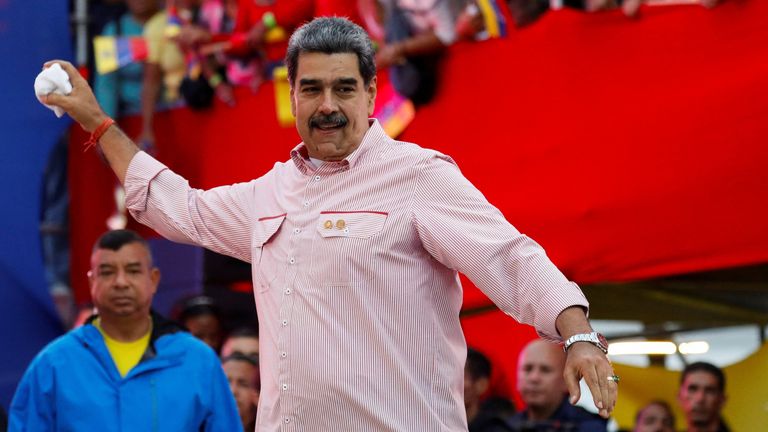
Venezuela’s President Nicolas Maduro in Caracas. Pic: Reuters
The president held a rally in Caracas amid heightened tensions with Mr Trump’s administration, which has been targeting what it says are boats carrying drug smugglers.
Mr Trump met his national security team on Monday evening, having warned last week that land strikes would start “very soon”.
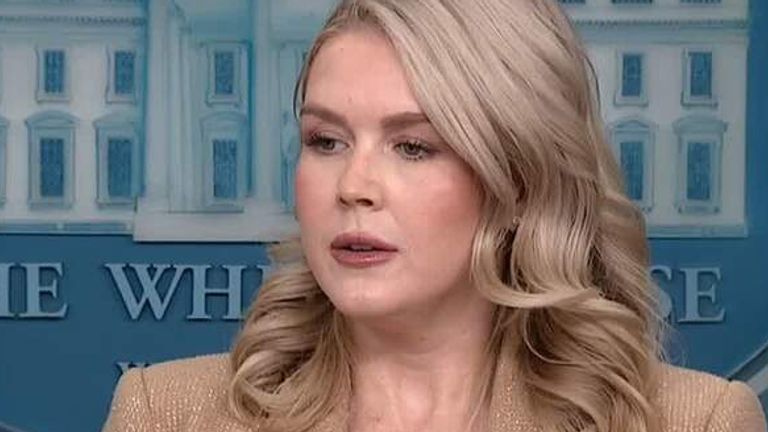
It’s not been confirmed what was discussed at the meeting, but White House press secretary Karoline Leavitt told reporters: “There’s many options at the president’s disposal that are on the table – and I’ll let him speak on those.”
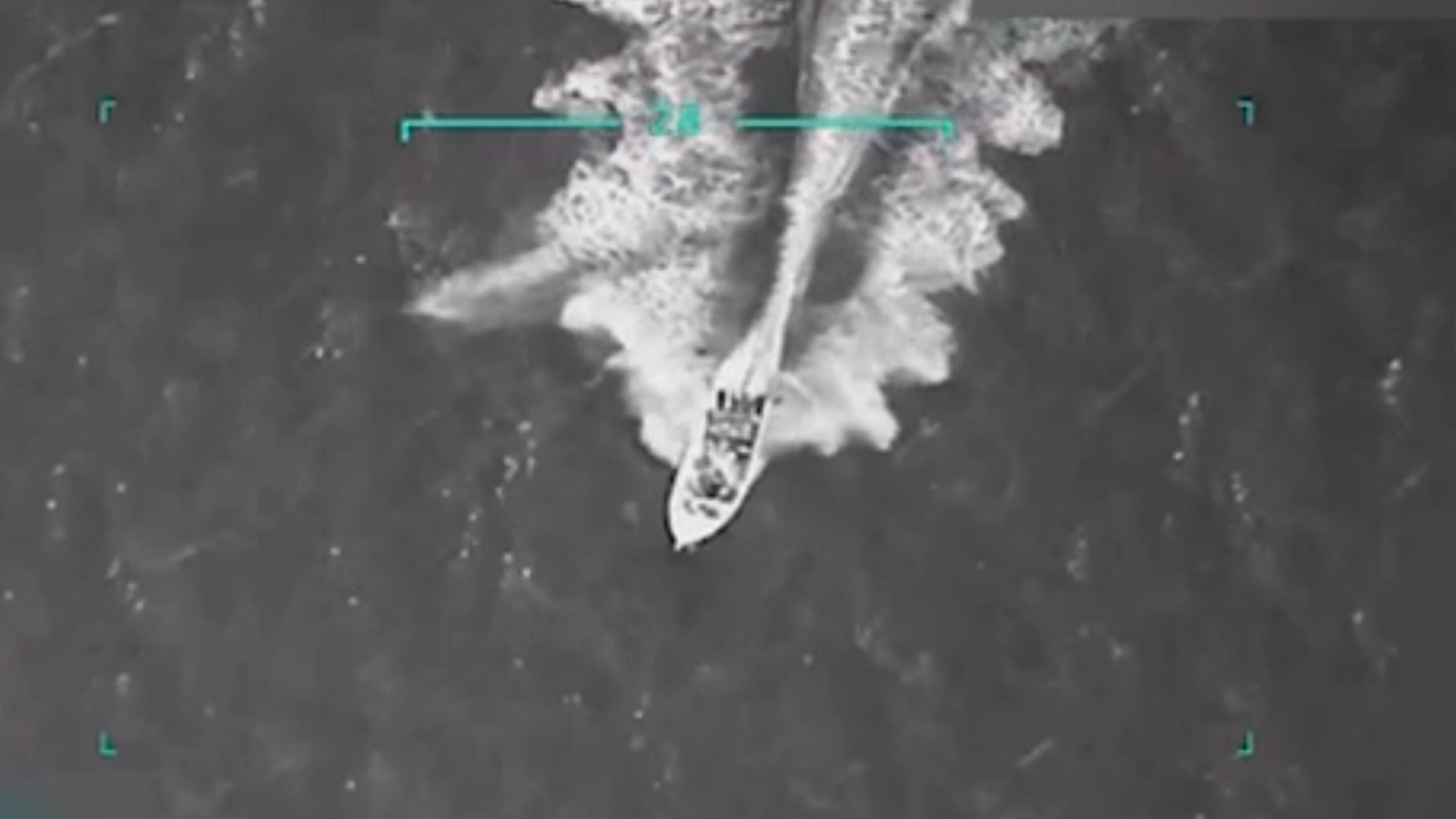
US forces have carried out at least 21 strikes on boats it claims were carrying narcotics to its shores over the last few months.
‘The president has a right to take them out’
Mr Maduro – widely considered a dictator by the West – said on Monday that Venezuelans are ready “to defend [the country] and lead it to the path of peace”.
“We have lived through 22 weeks of aggression that can only be described as psychological terrorism,” he said.
Venezuela has said the boat attacks, which have killed more than 80 people, amount to murder – and that Mr Trump’s true motivation is to oust Mr Maduro and access its oil.
This breaking news story is being updated and more details will be published shortly.
Please refresh the page for the latest version.
You can receive breaking news alerts on a smartphone or tablet via the Sky News app. You can also follow us on WhatsApp and subscribe to our YouTube channel to keep up with the latest news.

“Many options” are on the table to deal with Venezuelan drug gangs, the White House has said, as the US considers attacking on land.
President Trump is meeting his national security team on Monday and could discuss what would be a major escalation in strikes that have so far only targeted boats.
Karoline Leavitt, the president’s press secretary, did not detail what the meeting would focus on. However, Mr Trump said last week that land strikes would start “very soon”.
“There’s many options at the president’s disposal that are on the table – and I’ll let him speak on those,” Ms Leavitt told reporters.
Three killed as US strikes another alleged drug boat
American forces have carried out at least 21 strikes on boats it claims were carrying narcotics to its shores over the last few months.
The US has accused Venezuelan President Nicolas Maduro of being involved in the drugs trade – a claim he denies.
Venezuela has said the attacks, which have killed more than 80 people, amount to murder and that President Trump’s true motivation is to oust Mr Maduro and access its oil.
President Maduro – widely considered a dictator by the West – said on Monday that Venezuelans are ready “to defend [the country] and lead it to the path of peace”.
“We have lived through 22 weeks of aggression that can only be described as psychological terrorism,” he said.
Concerns have been raised over the legality of the US attacks, which the Pentagon has sought to justify by designating the gangs as foreign terror organisations.
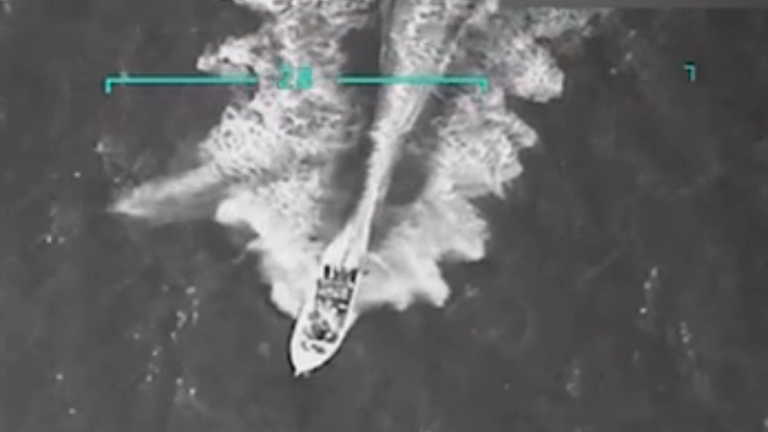
Image of an alleged drug boat being targeted by the US military. Pic: Truth Social
Tensions remain high over America’s large deployment in the Caribbean Sea and eastern Pacific, which includes its flagship aircraft carrier and thousands of troops.
The US has released videos of boats being blown up but has not provided evidence – such as photos of drugs – to support the smuggling claims.
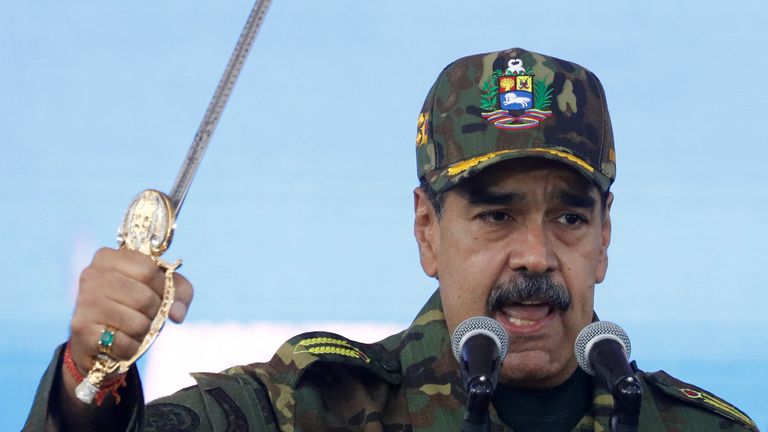
President Maduro is widely considered a dictator by the West. Pic: Reuters
Controversy also surrounds the first incident, on 2 September, in which 11 people were killed – with a follow-up strike targeting the boat after the first attack left two survivors in the water.
US media reported defence secretary Pete Hegseth gave an order beforehand that everyone on board should be killed.
However, there are concerns about the legality of the second strike if the survivors posed no threat.
Mr Hegseth dismissed the reporting as “fake news” and insisted all actions in the region are compliant with US and international law.
“Every trafficker we kill is affiliated with a Designated Terrorist Organization,” he said on X.
President Trump said on Sunday he would not have wanted a second strike and that Mr Hegseth had denied giving such an order.
Read more from Sky News:
Hong Kong fire: 13 arrested as death toll hits 151
More than 1,100 confirmed dead in Asia floods
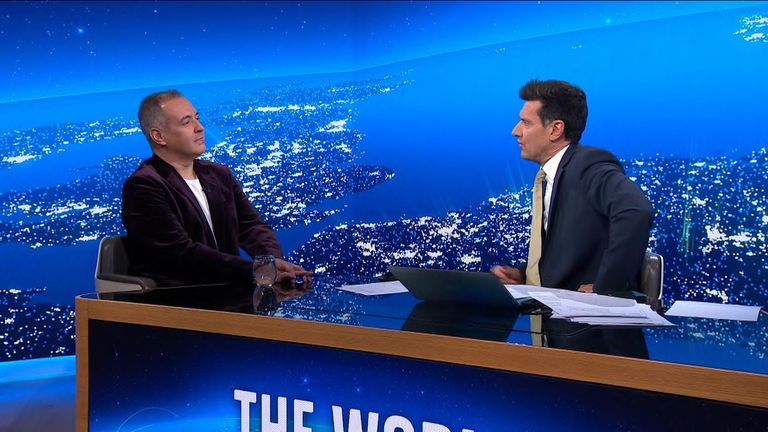
Is US about to go to war with Venezuela?
Ms Leavitt confirmed on Monday that the boat had been hit by a second strike – but denied Mr Hegseth gave the order for the follow-up.
Instead, she said he had authorised US navy vice admiral Frank Bradley to attack and the admiral acted “well within his authority and the law, directing the engagement to ensure the boat was destroyed and the threat to the US was eliminated”.
As the US weighs its next steps, Mr Trump said on Sunday he had spoken to President Maduro by phone and that the conversation went neither “well or badly”.
In recent days, he also stated that Venezuela’s airspace should be considered closed – with the South American nation calling it a “colonial threat” and “illegal, and unjustified aggression”.
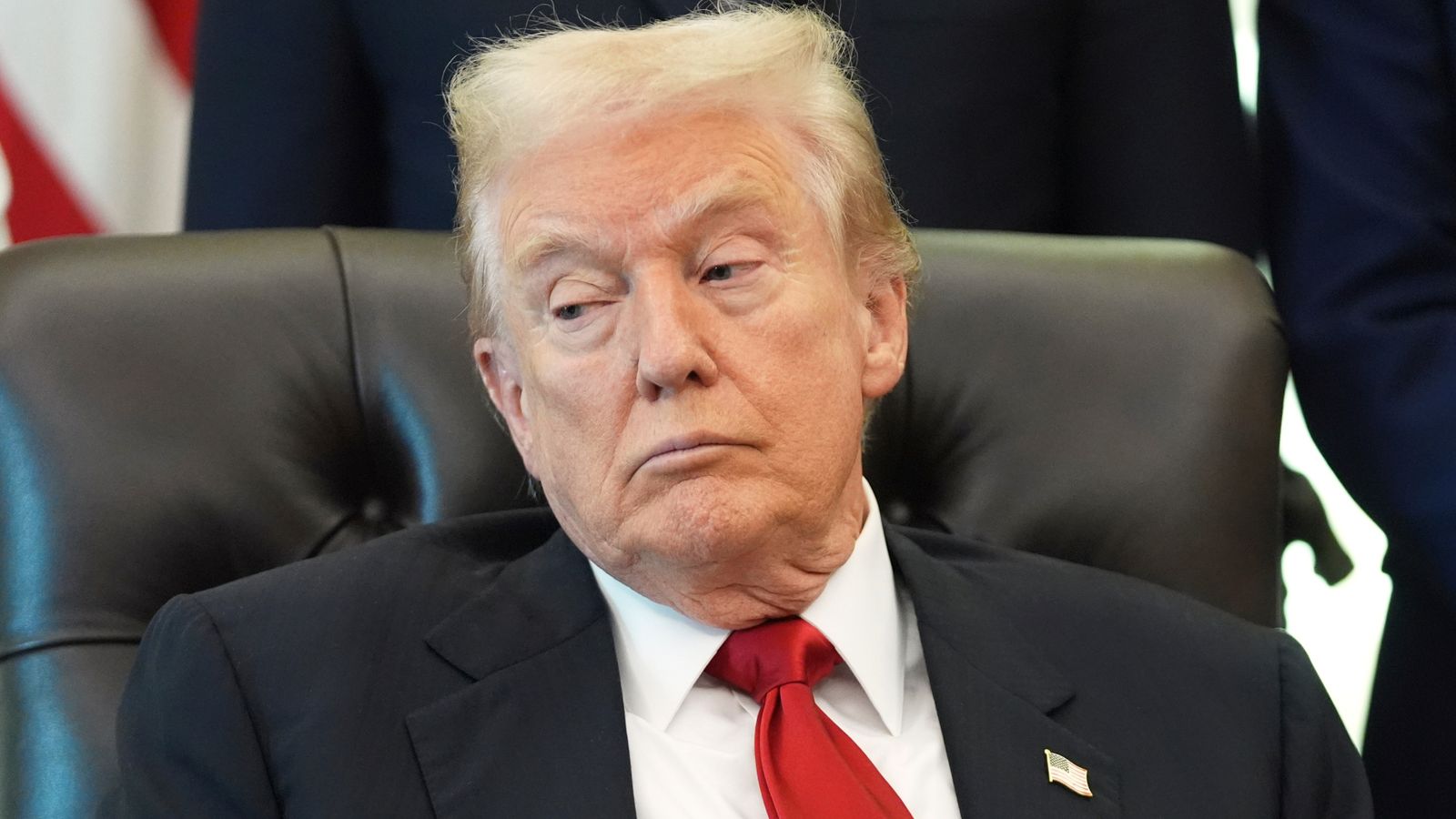

The White House has revealed details of Donald Trump’s recent medical evaluation involving a scan of his cardiovascular system and abdomen.
The US president, 79, underwent a magnetic resonance imaging (MRI) scan in October, which was confirmed in a memo from his doctor, Sean P Barbabella.
The White House physician wrote that the cardiovascular and abdominal imaging was “perfectly normal”.
“The purpose of this imaging is preventive: to identify issues early, confirm overall health, and ensure he maintains long-term vitality and function,” said Dr Barbabella.
He added that there was “no evidence of arterial narrowing impairing blood flow or abnormalities in the heart or major vessels”.
“The heart chambers are normal in size, the vessel walls appear smooth and health, and there are no signs of inflammation, or clotting.”
As for the abdominal imaging, he wrote that “all major organs appear very healthy and well-perfused”.
“Everything evaluated is functioning within normal limits with no acute or chronic concerns.”
He said the imaging was done “because men in his age group benefit from a thorough evaluation of cardiovascular and abdominal health”.
While speaking to reporters on Sunday, the US president said he didn’t know what part of his body was examined but added: “It wasn’t the brain because I took a cognitive test and I aced it.”
He described the results of the MRI as “perfect”.
Read more from Sky News:
Trump targets ‘third world’ immigrants
Venezuela accuses Trump of ‘colonial threat
Trump to cancel all Biden executive orders
Donald Trump in July with a swollen ankle. File pic: AP
In 2022, Donald Trump described himself as “the healthiest president that’s ever lived” but in July was diagnosed with chronic venous insufficiency (CVI) after noticing “mild swelling” in his lower legs.
Dr Barbabella said CVI, which causes blood to pool in the veins, was a “benign and common condition, particularly in individuals over the age of 70”.
Concerns were also raised in July about photos which showed bruising on the back of Mr Trump’s hand that had been covered with make-up.
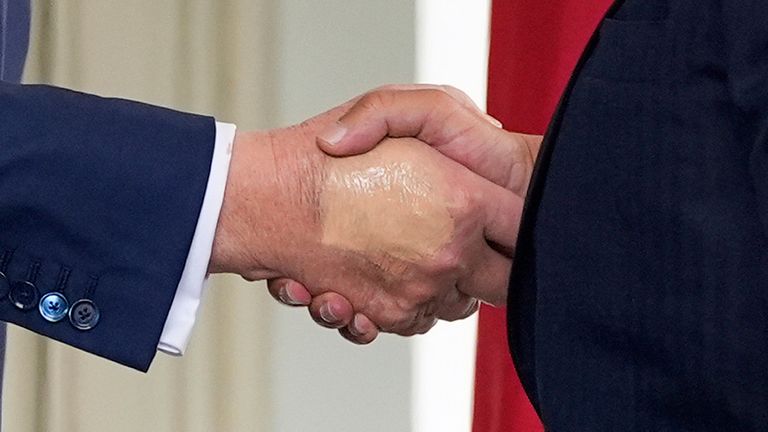
Make-up covering bruising on Mr Trump’s hand. File pic: AP
White House press secretary Karoline Leavitt clarified this was “minor soft tissue irritation from frequent handshaking and the use of aspirin” to reduce the risk of heart attack and stroke.
-
 Sports2 years ago
Story injured on diving stop, exits Red Sox game
-
 Sports3 years ago
‘Storybook stuff’: Inside the night Bryce Harper sent the Phillies to the World Series
-
 Sports2 years ago
Game 1 of WS least-watched in recorded history
-
 Sports3 years ago
Button battles heat exhaustion in NASCAR debut
-
 Sports3 years ago
MLB Rank 2023: Ranking baseball’s top 100 players
-
Sports4 years ago
Team Europe easily wins 4th straight Laver Cup
-
 Environment3 years ago
Japan and South Korea have a lot at stake in a free and open South China Sea
-
 Environment1 year ago
Here are the best electric bikes you can buy at every price level in October 2024