

Tesla has built its 4 millionth electric car

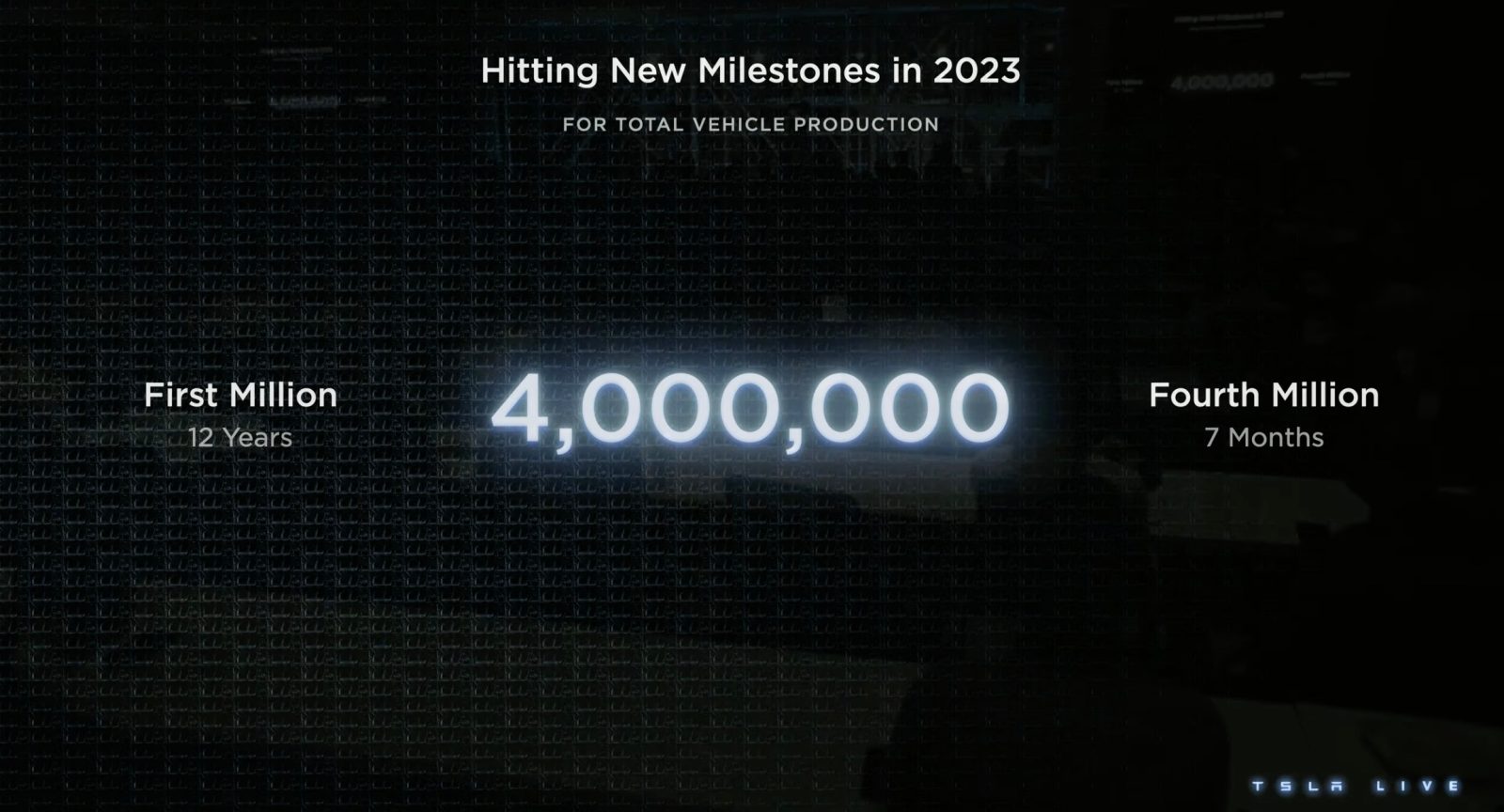
Tesla announced that it has built its 4 millionth electric car, and the rate of production is increasing at an impressive pace.
It took Tesla 12 years of operations in order to build its first million electric vehicles; the automaker achieved that milestone in early 2020.
Now just a few years later, Tesla has repeated the achievement several times as it managed to ramp up electric vehicle production better than any automaker to date.
At its Investor Day event yesterday, Tesla announced that it has now produced its 4 millionth electric car, and it took the automaker only seven months from its 3 millionth milestone:
The 4 millionth Tesla vehicle was produced at Gigafactory Texas in Austin. With new capacity being deployed at the factory and a Gigafactory Berlin, Tesla is now able to produce about two million vehicles per year.
Tesla has a goal to ramp up to produce 20 million electric vehicles per year.
It now has four Gigafactories in operation. It is also expanding Gigafactory Nevada to add Tesla Semi production at the location, and it recently announced Gigafactory Mexico.
Last year, CEO Elon Musk said that he believes Tesla will need about 12 Gigafactories in order to achieve a capacity of 20 million vehicles per year.
The automaker is expected to announce more locations for new gigafactories soon, since it takes a few years to bring each one to volume production and 2030 is coming fast.
FTC: We use income earning auto affiliate links. More.

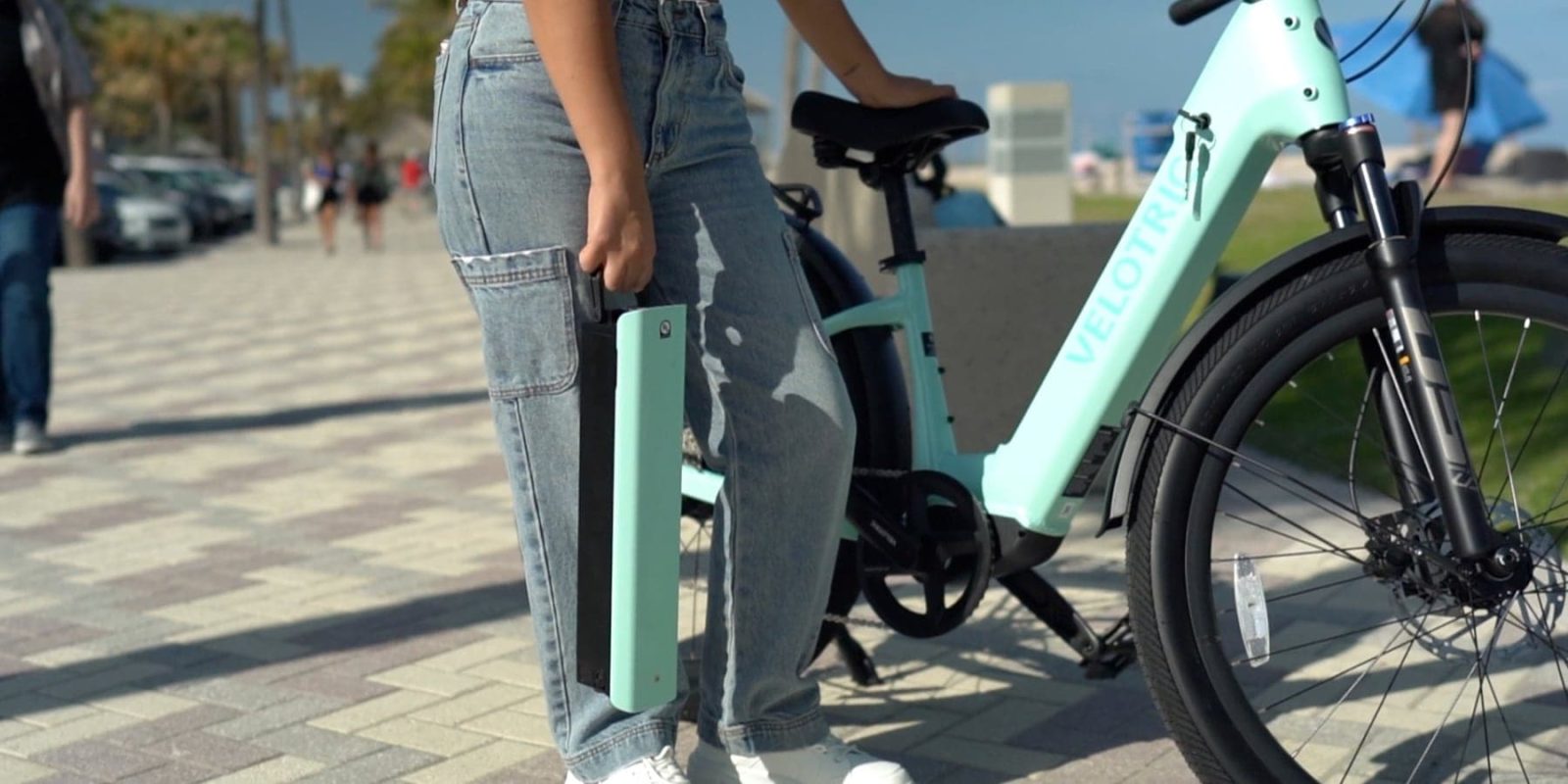
If you ask the average American which country is doing the most to improve e-bike battery safety, most people probably wouldn’t guess China. But that’s exactly where the world’s strongest, most comprehensive lithium-ion safety rules are coming from – and the latest round just went into effect today.
Beginning December 1, China has officially banned the sale of all e-bikes built to the older national standard, replacing them with a new, far stricter rule set known as GB 17761-2024. Under the announcement from the State Administration for Market Regulation, any e-bike sold in China from today forward must carry a valid CCC certification under this brand-new standard. Older certificates are now invalid, and retailers caught selling non-compliant bikes face enforcement from local regulators.
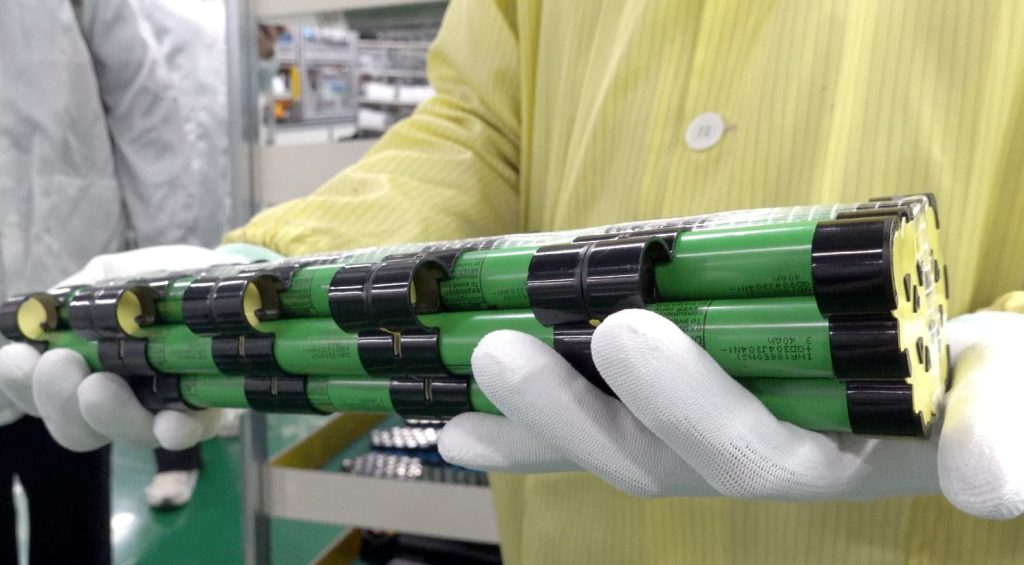
The new rules go far beyond what most countries require. They tighten fire-resistance requirements, restrict the amount of plastic allowed on an e-bike, cap total vehicle weight, and mandate improved electrical safety. The regulations also work hand-in-hand with a second standard, the already-implemented GB 43854-2024, which sets some of the toughest lithium-ion battery testing requirements in the world, including mandatory over-charge protection, thermal abuse tests, puncture tests, and a ban on repurposed or second-hand cells, a major cause of past fires.
Balancing safety and convenience for existing owners, Chinese regulators also built in consumer protections. Bikes that were already purchased and registered under the old rules won’t be forced off the road. And companies are required to support repairs and spare parts for at least the next five years. But unregistered “old-standard” bikes must have been formally plated already, or they’ll no longer be legal to operate.
For a country often stereotyped as producing unsafe batteries, the reality is almost the opposite. China is now setting the global pace on e-bike safety – aggressively tightening standards, sharply reducing fire risks, and pushing manufacturers to meet levels of testing that most of Europe and the US still haven’t matched.
via: ITHOME


FTC: We use income earning auto affiliate links. More.
Environment
Tesla Model 3/Y with Chinese LG batteries showing ‘catastrophic’ failure rates, repair shop warns

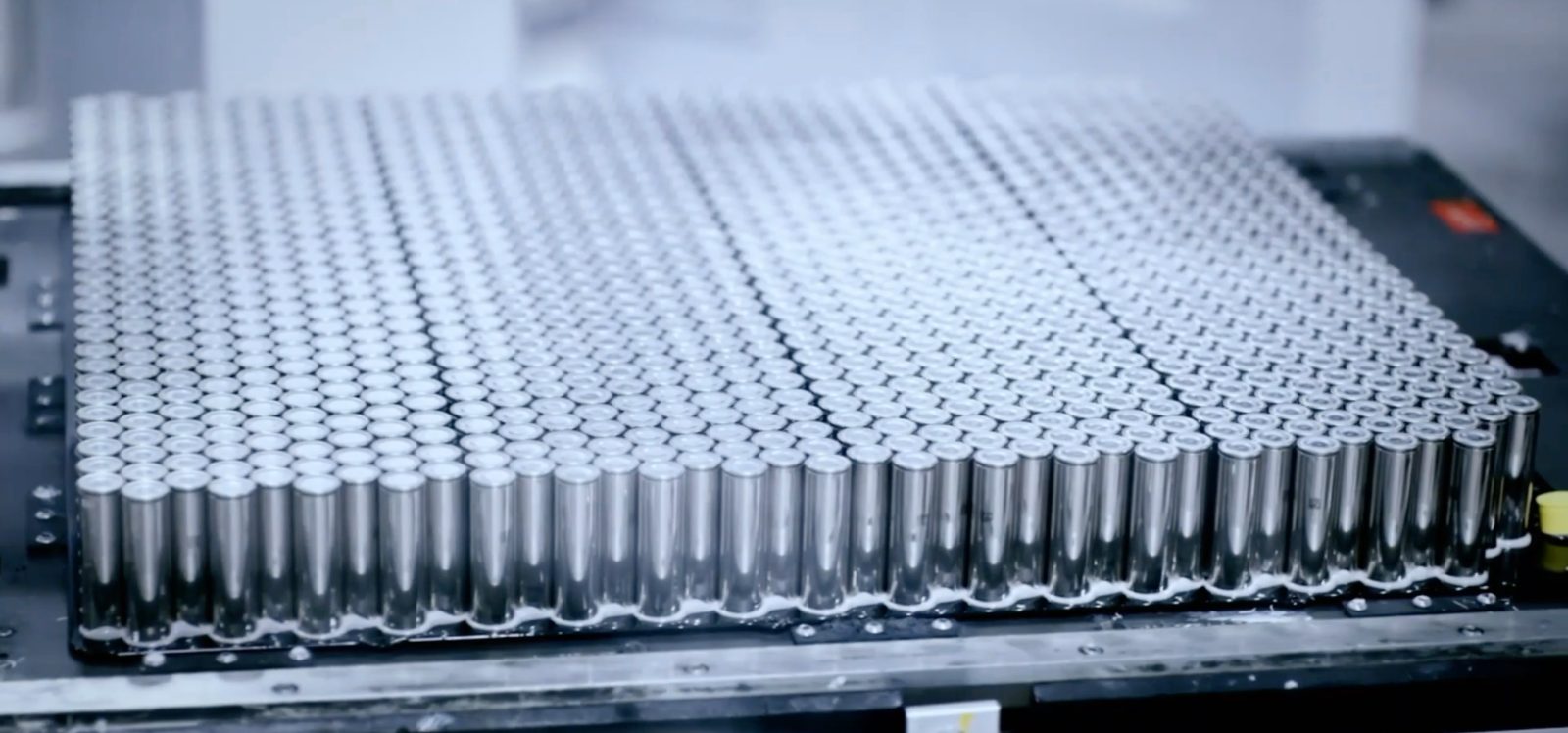
A prominent European EV repair specialist is sounding the alarm on Tesla Model 3 and Model Y vehicles equipped with LG battery cells manufactured in China, claiming they are seeing “catastrophic” failure rates and significantly shorter lifespans compared to Panasonic packs.
For years, the narrative around Tesla’s move to Chinese battery suppliers has been generally positive, with the LFP (Lithium Iron Phosphate) packs from CATL proving to be extremely durable.
However, Tesla also sources Nickel Manganese Cobalt (NMC) cells from LG Energy Solution’s Nanjing facility for its Long Range and Performance models in Europe and parts of Asia.
Now, EV Clinic, a Croatia-based independent research and repair facility known for diving deep into battery diagnostics, has issued a severe warning regarding these specific LG NCM811 packs.
According to the firm, data from its repair center suggests a stark difference in quality between Tesla’s two main higher-energy-density packs: the US-made Panasonic NCA packs and the Chinese-made LG NCM packs.
“We are raising serious concerns about Tesla Model 3/Y LG NCM811 battery packs (LGES Nanjing), which exhibit very high failure rates and significantly shorter lifespans compared to Panasonic NCA packs (Made in USA).”
The shop claims that while Panasonic packs are generally repairable and can last up to 250,000 miles before cell failure, the LG equivalents are approaching end-of-life at around 150,000 miles.
More concerning is the nature of the failure. EV Clinic states that in over 90% of the cases they see with LG packs, cell-level repair is “impossible.”
The issue appears to be widespread degradation across the modules rather than a single bad cell bringing down the pack. They found that LG cells often show extremely high internal resistance.
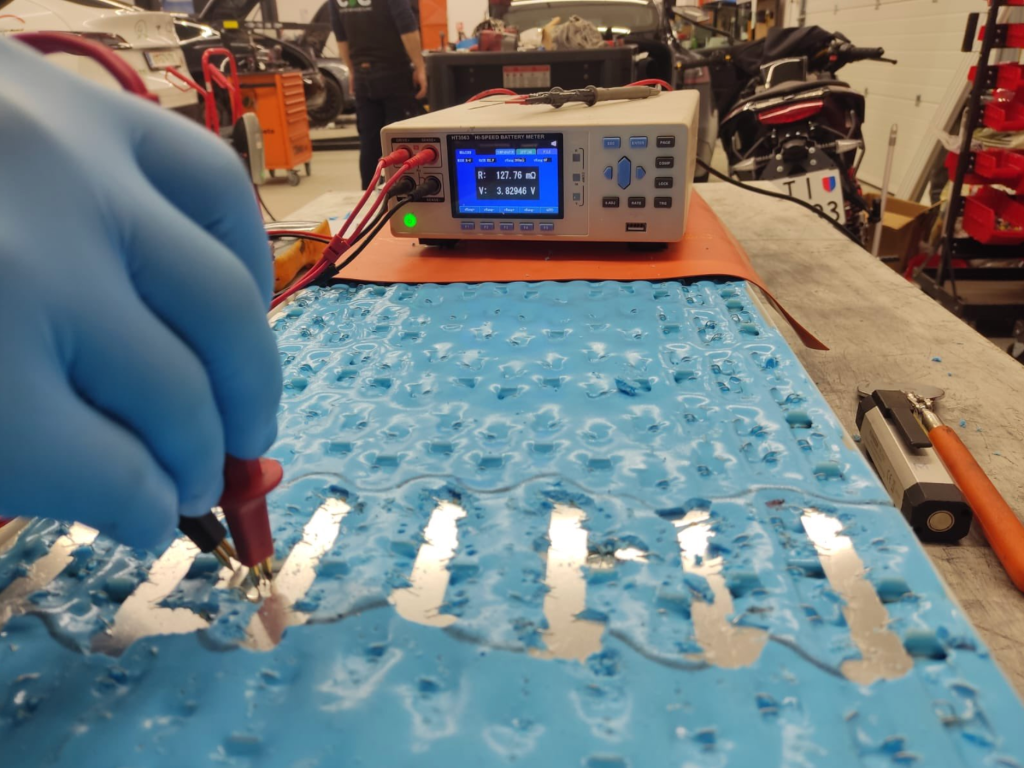
“A failing Panasonic cell hits roughly 28 mΩ, which is the measurement for LG cells when brand new… Out of 46 cells, it’s common to find 15 cells over 100 mΩ ACIR, and the remaining 30 cells above 50 mΩ ACIR.”
The lab shared an example from a Tesla battery module:
Because the degradation is so uniform and severe, replacing a single faulty module is described as “operationally unsustainable,” as the remaining weakened cells are likely to fail in a cascade shortly after.
The situation has become so problematic for the shop that they announced they are introducing a “feasibility fee” just to check if these specific packs can be repaired, noting that they are “losing over €20,000 each month” attempting to fix packs that are effectively dead.
At this moment, during ongoing experimental testing with real customers experiencing LG failures, we are losing over €20,000 per month in operational time while investigating whether LG’s Chinese NCM811 systems can be sustainably repaired. At this stage, we can confidently say: the cells are, to put it mildly, catastrophic. Panasonic has mostly single-cell failures at 250,000km, and it is repairable, whereas LG has multiple-cell failures.
Their advice to owners with failed LG packs? Swap it for a used Panasonic pack or go to Tesla for a full replacement.
Electrek’s Take
This is a pretty damning report from a shop that is well-respected in the aftermarket repair community for actually tearing these things apart and attempting to fix them rather than just swapping them out.
We know that Tesla has been diversifying its battery supply chain aggressively, and for the most part, it has worked out well. The CATL LFP packs are tanks, heavy, but durable. But the NCM chemistry is trickier, and if these findings from EV Clinic hold up across a larger sample size, it could be a headache for Tesla, especially in Europe, where many of the China-made NCM packs end up.
It’s worth noting that this applies specifically to the LG NCM811 packs from Nanjing. Many US Tesla owners have Panasonic packs, which this report actually praises as highly durable and repairable.
FTC: We use income earning auto affiliate links. More.


Thanksgiving may be over, and the official Black Friday date may have passed, but that doesn’t mean savings have slowed down any, with us now having shifted over into Cyber Monday sales. Many of the previous Black Friday Green Deals we spotted up until today are continuing – some ending tonight with the holiday, while others are continuing on through the rest of the week. If you didn’t jump on these deals last week, you still have time to score the best prices of the year across e-bikes, EVs, power stations, tools, eco-friendly appliances, and much more. We’ve thrown all the best deals into this one-stop shopping hub for all your greener needs and will continue updating it throughout the week. Head below to browse all the best Cyber Monday Green Deals while they last.
Cyber Monday Green Deals

Cyber Monday EV Green Deals
- Lectric’s Black Friday/Cyber Monday Sale offers up to $893 bundles with e-bikes starting from $999
- Lectric launches Black Friday accessory flash sale with up to 40% discounts for add-on gear starting from $14
- Cash in during Lectric’s Black Friday battery sale with up to 30% off new and legacy models starting from $250
- Lectric’s XP4 e-bikes get best bundles of up to $514 in FREE gear for Black Friday starting from $999
- Upgrade off-road commutes and adventures with Lectric’s XPeak 2.0 e-bikes and up to $583 in FREE gear from $1,499
- Score $518 in FREE gear and commute up to 60 miles on Lectric’s XPress 750 long-range e-bike at $1,299
- MOD Bikes offers rare Black Friday/Cyber Monday e-bike discounts to lows starting from $1,799 (Up to $400 off)
- Tesla’s Universal Wall Connector with dual NACS + J1772 connectors and customizable 48A speeds retains $50 cut to $600
- Segway’s official Black Friday sale now live: Best price of the year on latest e-scooters, e-bikes, more starting from $150
- Segway’s feature-packed E3 Pro electric scooter with Apple Find My hits new $500 Black Friday low (Save $200)
- Rad Power expands Black Friday e-bike lineup and increases savings to new lows starting from $999
- Autel’s MaxiCharger AC Lite level 2 EV charger grants up to 50A speeds at new $398 Black Friday low (Save $171)
- Schumacher’s 12A level 1 portable EV charger is perfect for stowing in trunks at a $110 Black Friday low (Save $50)
- Aventon takes up to $400 off new e-bikes: Security-packed Pace 4 smart cruiser at new $1,599 low (Reg. $1,799)
- Aventon’s Level 3 smart commuter e-bike gets a first-time early Black Friday discount to $1,699 (Reg. $1,899)
- Hop on Aventon’s latest Aventure 3 all-terrain smart e-bike with first-time savings to $1,799 (Reg. $1,999)
- Save up to 41% on Navee’s smart e-scooters, like the flagship ST3 Pro at its second-ever $660 low, more from $315
- Heybike’s new-gen Ranger 3.0 Pro folding commuter e-bike gets first post-launch cut to $1,399 low for Black Friday
- Heybike drops new Mars 3.0 folding e-bike back to its $1,199 low during Black Friday sale for first time since launch
- Heybike increases Black Friday savings on its Hero 750W mid-drive all-terrain e-bike to a new $2,099 low, more
- Get up to 85 miles of pedal-assisted cargo carrying on Heybike’s dual-battery Hauler e-bike at a new $1,099 low (Reg. $1,899)
- Heybike is clearing stock of its Tyson uni-body folding e-bike with an $800 price cut to a new $999 low
- Velotric’s Black Friday Sale switches gears with up to $750 increased savings and new lows starting from $999
- Score up to 47% Black Friday savings on NIU EVs, like the 2025 KQi 200F e-scooter at its $529 low (Reg. $799), more from $279
- Leviton’s 48A level 2 smart hardwired EV charger falls to new $479 Black Friday low (Save $270), more from $400
- Tenways launches new Wayfarer e-bike with 85-mile range, Apple Find My, and $577 savings at $1,899
- Ride1Up’s early Black Friday Sale gives us first savings on the latest TrailRush German mid-drive e-bike at $1,995
- Get up to 53% Black Friday savings + bonus discounts on Hiboy e-scooters and e-bikes at lows starting from $150
- Gift the kids Hover-1’s Neo I Foldable Electric Scooter this Christmas, it’s only $105 for Black Friday (Reg. $280)
Cyber Monday Power Station Green Deals
- EcoFlow launches next Black Friday Sale phase with up to 80% off expanded lineup – starts from $149
- Score up to $13,289 exclusive Cyber Monday savings on EcoFlow’s DELTA Pro Ultra X power station + bundles, more from $174
- Save up to 67% on 2x EcoFlow DELTA 2 power stations at $698 low + three accessory bundles from $799 for Cyber Monday
- EcoFlow launches DELTA 3 1000 Air power station and bundles with up to $640 early-bird savings starting from $299
- EcoFlow’s newest 10,000mAh to 27,650mAh RAPID power banks with up to 53% Black Friday savings at new lows from $66
- Anker’s extended SOLIX Black Friday Sale increases power station savings up to 70% with new lows starting from $150
- Anker’s SOLIX C300X 90,000mAh portable power station + solar bundle option at new Black Friday lows from $160
- Anker’s popular PowerCore Reserve 192Wh power station with a pop-up light drops to $80 for Black Friday (Save $70)
- Get up to 54% exclusive savings on these Anker SOLIX F3800 units + EverFrost 2 cooler at new lows starting from $699
- Jackery’s Explorer 1000, 2000, 3000 V2 + 5000 Plus power stations are all hitting new Black Friday lows from $332
- Get a 256Wh LiFePO4 capacity in a 6.9-pound unit with Jackery’s Explorer 240D power station at a new $132 low (Reg. $209)
- Jackery’s Black Friday power station sale offers up to 65% discounts with bonus 5% + 7% savings starting from $79
- Bluetti’s Black Friday Sale takes up to 55% off power stations with exclusive bonus savings to new lows from $209
- Bluetti launches new Elite 400 ‘luggage’ power station with up to 53% exclusive savings starting from $1,409
- Pick up Bluetti’s new Pioneer Na(Sodium) power station + bundles at lowest prices with exclusive savings from $735
- Mango Power’s Black Friday Sale takes up to 75% off its lineup of Power E station/bundles + bonus savings – all starting from $1,099
- DJI’s 2,048Wh modular power station hits new $699 Black Friday low ($600+ off) + gimbals, cameras, more from $55
- Take the two-pound ALLPOWERS SOLAX P100 mini power station anywhere at a new $55 low (Reg. $89)
- Save up to 34% on ALLPOWERS’ new Volix P300 256Wh power station and bundles starting from $132
Cyber Monday Appliance and Device Green Deals
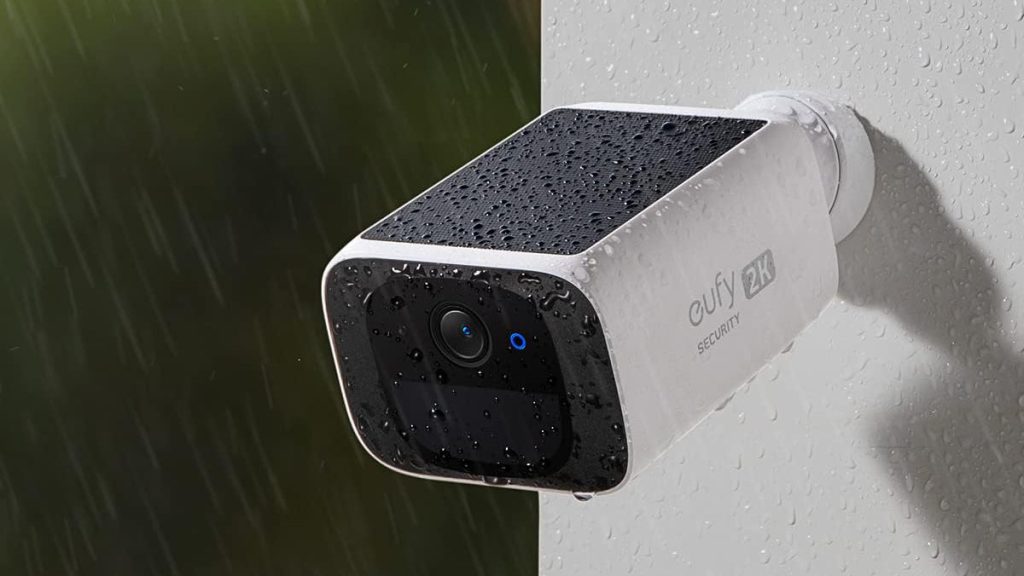
- Anker’s eufy solar security cameras, smart locks, more get up to 50% Black Friday savings to new lows starting from $50
- Autel’s new outdoor cams pack a punch with solar design, local storage, and HDMI with kits from $249 (Up to $245 off)
- Save thousands for Black Friday on Samsung smart washer/dryers, refrigerators, ovens, and more starting from $269
- GE’s 2-in-1 Profile smart ventless electric washer/dryer combo with heat pump at $2,000 (Reg. $2,700)
- Aiper’s Black Friday Sale offers up to 50% savings on robot pool cleaners, skimmers, monitors, more from $120
- AeroGarden’s 6-plant Harvest Elite 360 indoor hydroponic system hits new $62 Black Friday low, more from $29
- Jump car batteries with GOOLOO’s GP4000 or use as a 24,000mAh power bank with $60 Black Friday savings at a new $80 low
- Cross Whisker’s Litter-Robots off your shopping list with up to $152 Black Friday savings and lows from $599
- Govee’s indoor and outdoor ambient lighting devices hit new lows with up to 50% Black Friday savings from $24
- Save up to 49% on Govee’s smart appliances, like the electric kitchen composter at its $200 low ($103 off), more
FTC: We use income earning auto affiliate links. More.
-
 Sports2 years ago
Story injured on diving stop, exits Red Sox game
-
 Sports3 years ago
‘Storybook stuff’: Inside the night Bryce Harper sent the Phillies to the World Series
-
 Sports2 years ago
Game 1 of WS least-watched in recorded history
-
 Sports3 years ago
Button battles heat exhaustion in NASCAR debut
-
 Sports3 years ago
MLB Rank 2023: Ranking baseball’s top 100 players
-
Sports4 years ago
Team Europe easily wins 4th straight Laver Cup
-
 Environment3 years ago
Japan and South Korea have a lot at stake in a free and open South China Sea
-
 Environment1 year ago
Here are the best electric bikes you can buy at every price level in October 2024