
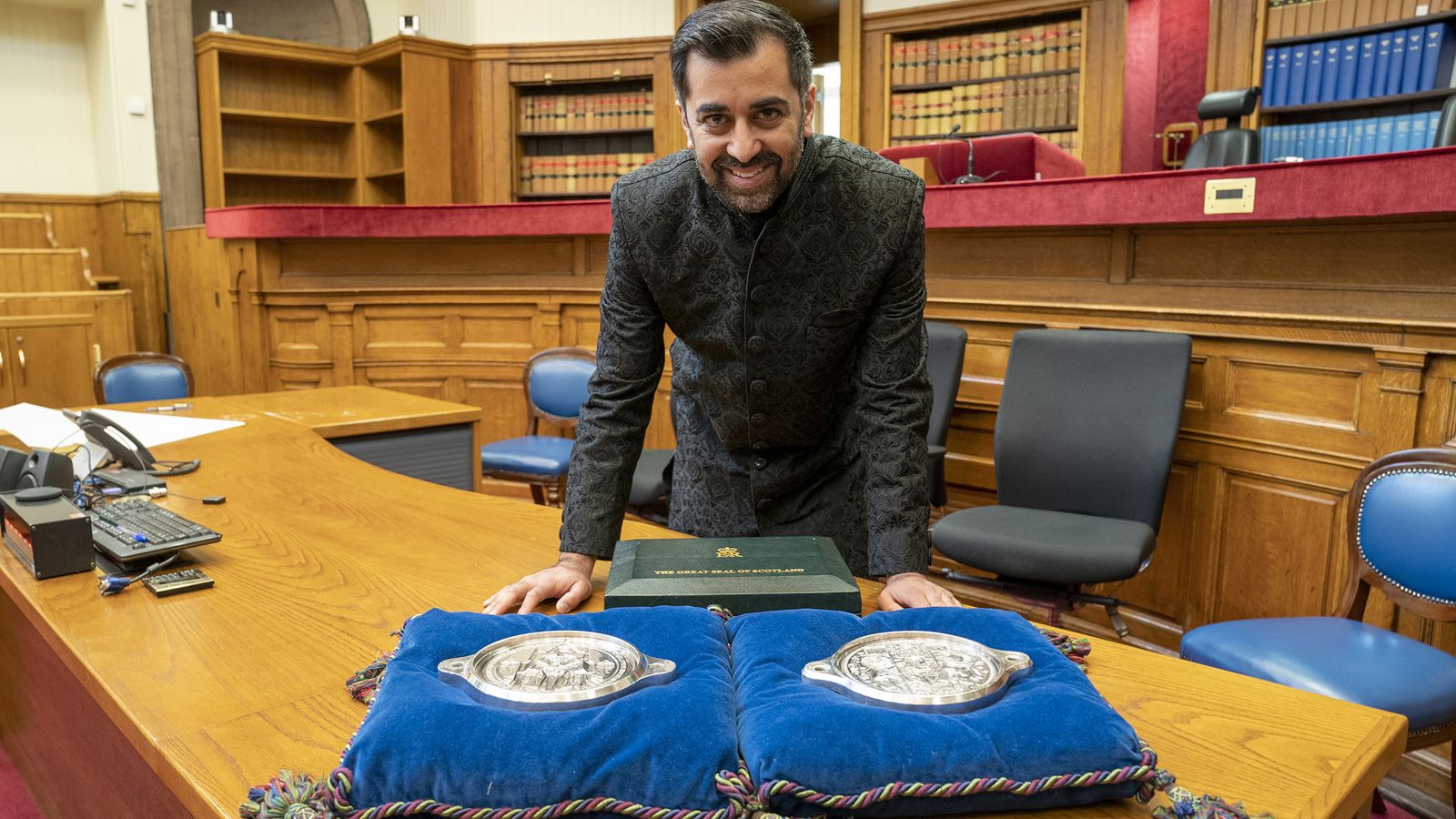
Humza Yousaf sworn in as Scotland’s first minister at Court of Session in Edinburgh


Humza Yousaf has been legally sworn in as Scotland’s sixth first minister.
The 37-year-old is now Keeper of the Scottish Seal after taking the oath of office and pledging his allegiance to the King.
The seal allows the monarch to authorise official documents without having to sign each one.
As Keeper of the Scottish Seal, Mr Yousaf now has the authority to make decisions on behalf of the crown, which effectively means he can lead the country with the support of the Scottish Parliament.
The ceremony took place at the Court of Session in Edinburgh on Wednesday morning.
Read more:
The life, political path and controversies of the new SNP leader
Yousaf promises independence: What can new SNP leader deliver?
Yousaf officially elected as first minister as Forbes leaves government
Mr Yousaf, who also replaced Nicola Sturgeon as SNP leader, is the youngest person to hold the post and has made history as the first from an ethnic minority background to be appointed to the position.
On Tuesday, Mr Yousaf insisted he would argue “vigorously for independence”, but also said he would work with the UK government “where I can, when I can, in the best interests of our nation”.
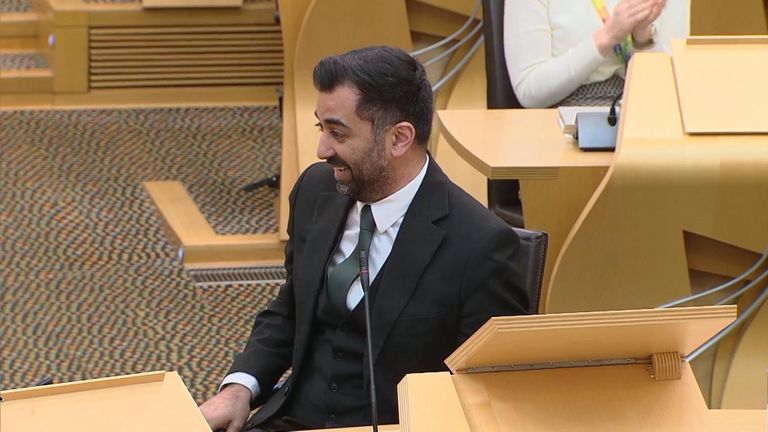
Humza Yousaf elected Scotland’s first minister
He said taking on the top job is the “honour and the privilege of my life”, adding: “I will strive every single minute of every day to be worthy of it.”
The first minister saw off competition from Kate Forbes and Ash Regan in what was an explosive election campaign.

Mr Yousaf saw off competition from Ash Regan and Kate Forbes
The leadership contest featured rows over religious beliefs, arguments about the recollection of past events, and widespread criticism of secrecy surrounding the vote.
The contest also led to a number of other resignations, including that of Ms Sturgeon’s husband Peter Murrell as SNP chief executive.

In full: Beth Rigby Interviews…
Mr Yousaf is now expected to announce his first ministerial appointments.
Shona Robison, a good friend of Ms Sturgeon, has already been named deputy first minister.
Ms Forbes, who served as finance secretary under Ms Sturgeon, is set to return to the backbenches after turning down the role of rural affairs secretary.
The 32-year-old tweeted: “To the great credit of Humza Yousaf the first official [conversation] he had after Monday’s result was with me. He has been respectful, supportive and warm throughout.
“In whatever capacity I serve, I’ll support him. Ps after five long weeks, I’ll be delighted to see more of my family.”
On Tuesday night, Mr Yousaf posted pictures online of his family at Bute House, the first minister’s official residence.
He tweeted: “My family and I spending our first night in Bute House after today’s parliamentary vote.
“A special moment leading my family in prayer in Bute House as is customary after breaking fast together.”
World
‘No one is here to help us’: Palestinians watch on as Israeli diggers tear down their homes in East Jerusalem

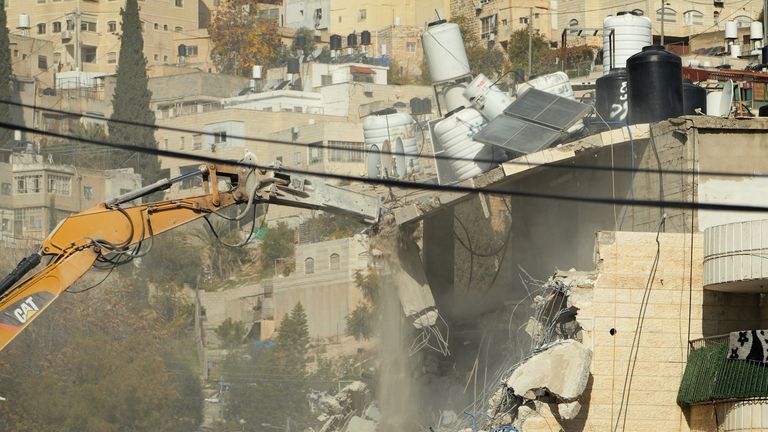
A balcony of onlookers stare as three diggers gnaw at the four-storey building that was a fixture of their daily view.
The roads of Silwan’s Wadi Qaddom neighbourhood are blocked off by Israeli police as residents watch the demolition in the valley from every vantage point. The block of flats was home to around 100 of their neighbours – many of them are now homeless.
An elderly woman sits at the bus stop near the police checkpoint closest to the demolition site. As she walks back down the hill, she looks back at the destruction. Her cheeks are red with anger when she hails that God is their only protection.
“Where are the Arab countries? No one is here to help us,” she exclaims.
Of the 230 buildings demolished in East Jerusalem’s Palestinian neighbourhoods in 2025, the block of roughly 13 flats is considered to be the largest and took 12 hours to completely demolish.
The demolition of a building in Silwan’s Wadi Qaddom neighbourhood
The building was without a permit, like many in Silwan, and stood on land that was not licensed for residential use. The residents were challenging long-standing demolition orders and applying for licensing when diggers arrived at dawn.
The Jerusalem Municipality said the demolition of the building in Silwan was based on a 2014 court order, and that residents were granted extensions for the execution of the order and were offered various options in order to find a solution, but they declined to do so.
But an architect and urban planner from the Israeli NGO Bimkom (Planners for Planning Rights) – which is supporting the families in their bid to license the land of the building – says their time to act was cut short.
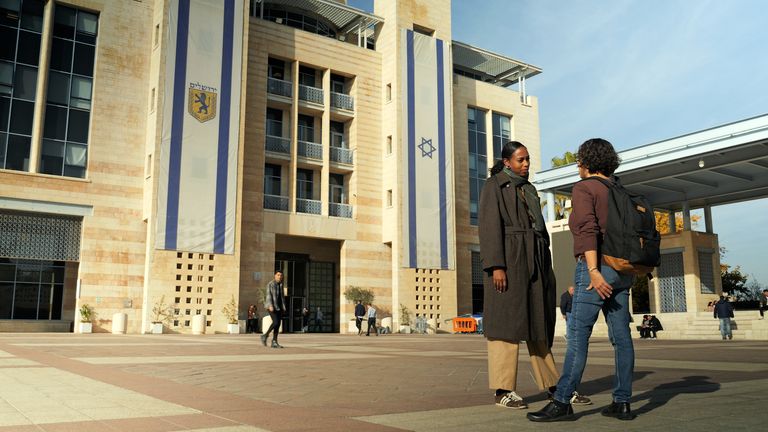
Architect Sari Kornish speaks to Sky’s Yousra Elbagir
“They were told that the demolition order would be implemented, and then they would get another six months’ recourse to try to continue with their planning. Six months is not enough for these planning processes. They take a long time,” Sari Kornish tells us in front of the Jerusalem Municipality after meeting with the building residents’ lawyer there.
Are permits granted for Palestinians in East Jerusalem?
“Very, very few, and in recent years, since October 7, less and less,” says Sari.
“It has always been discrimination. It has always been not enough.”
Far-right minister of national security Itamar Ben-Gvir posted on X about the building’s demolition.
He said: “Proud to lead the policy of demolishing illegal buildings – not only in the Negev, this morning in East Jerusalem (Silwan neighbourhood) a building that was built illegally and 100 people lived in it – was demolished! Strengthens the police and the district commander.”
Israel’s annexation of East Jerusalem and parts of the West Bank is illegal under international law.
Read more from Sky News:
Is Israel building a wall on Lebanese land?
Mother of last hostage in Gaza speaks to Sky News
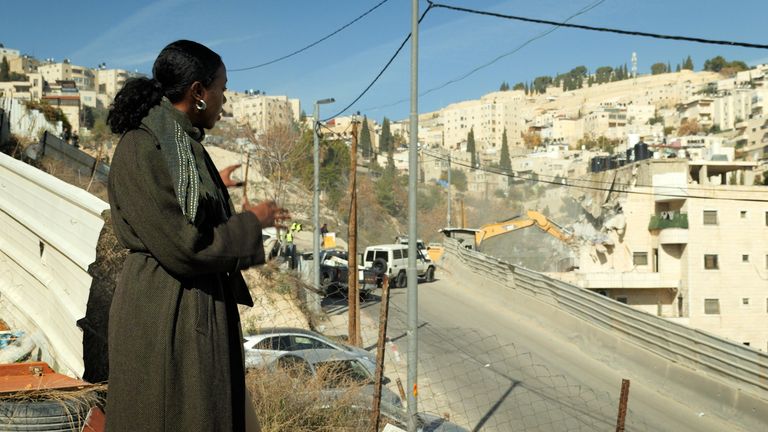
Sky’s Yousra Elbagir watches the demolition in Silwan
On Sunday, Israel’s far-right finance minister Bezalel Smotrich announced that the security cabinet approved 19 new Jewish settlements in the occupied West Bank.
Half a million Israeli settlers currently live in the West Bank, and over 230,000 live in East Jerusalem, where some are taking over homes instead of seizing land.
At least 500 Palestinians have lost their homes to lack-of-permit demolitions in East Jerusalem, and at least 1,000 people, including 460 children, are at risk of forced displacement from eviction cases filed against them in Israeli courts by settler organisations.
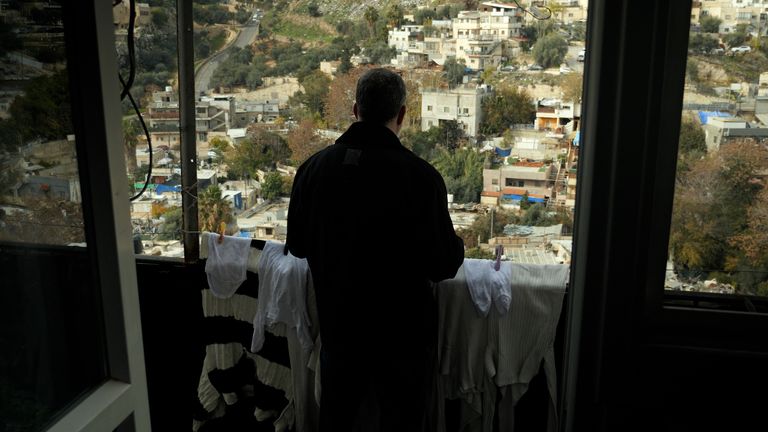
Zuhair al Rajabbi looks out at the homes of his neighbours now marked by demolition sites
In the East Jerusalem neighbourhood of Batn al Hawa in Silwan, Zuhair al Rajabbi looks out from his balcony at the homes of his neighbours.
The landscape is marked by demolition sites, and former homes of his neighbours are marked by Israeli flags. Settlers are busy renovating the rooftops to make their own.
“They have five children, and a grandmother was in one room. Downstairs, there was a family of seven children, with the wife and mother, in that one,” he says, pointing at the roof of his neighbours.
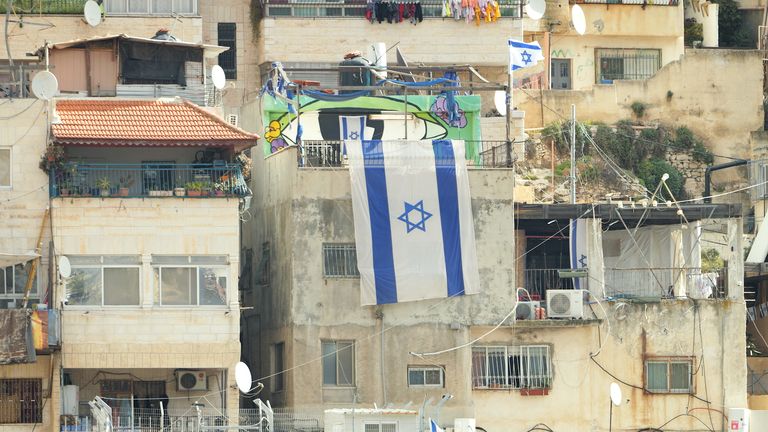
Israeli settler flags on a building in Silwan, a Palestinian neighbourhood in East Jerusalem
As we watch, a woman quietly mops the dirty water into a hole in the fence and onto the roof of the house next door.
“Look, they are even putting the dirty water on our neighbour’s roof,” Zuhair says with a sad bitterness.
“We used to live together like we live here at home – eating and drinking with them. It makes me sad when I see their home disappearing.”
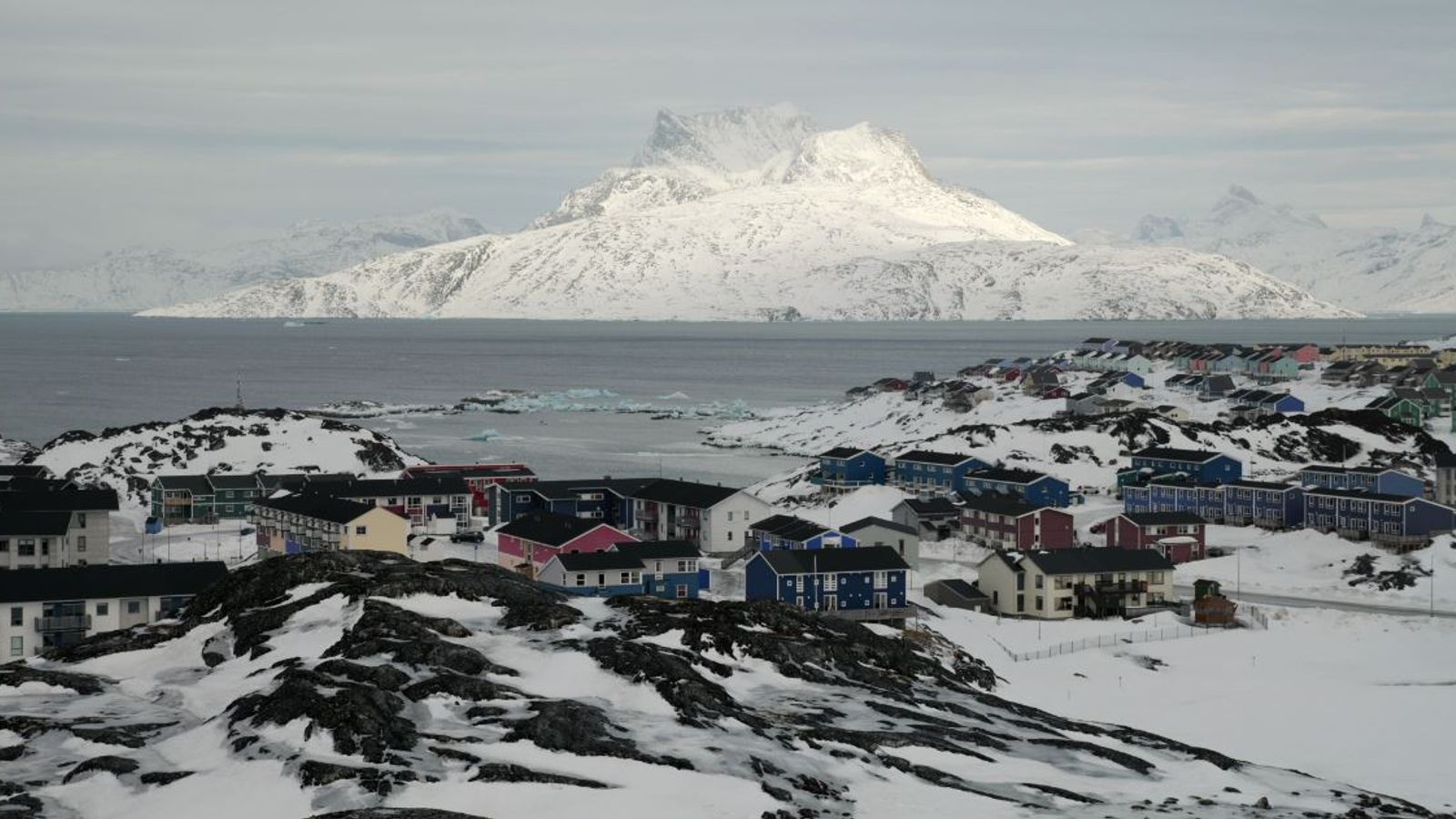
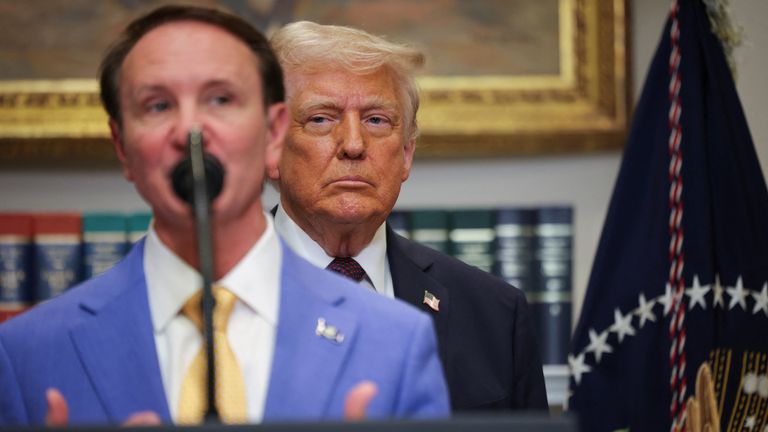
Donald Trump has said the US “has to have” Greenland, claiming it needs the territory for national security.
It comes after the US president appointed Louisiana’s governor Jeff Landry as special envoy to Greenland, saying he would “lead the charge” in advocating the semi-autonomous part of Denmark to become part of the United States.
“Jeff understands how essential Greenland is to our national security,” Mr Trump said.
Donald Trump has appointed Jeff Landry as special envoy to Greenland. Pic: Reuters
“We need Greenland for national security, not for minerals… If you take a look at Greenland, you look up and down the coast, you have Russian and Chinese ships all over the place.
“We need it for national security. We have to have it… Greenland is a big deal.”
Why does Trump want Greenland?
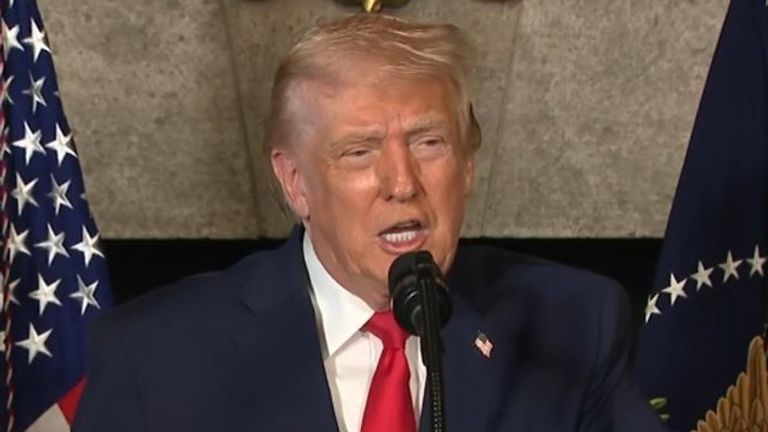
Trump said Greenland is a ‘big deal’. Pic: Reuters
Danish Prime Minister Mette Frederiksen and Greenland’s Prime Minister Jens-Frederik Nielsen said in a joint statement that Greenland belongs to Greenlanders, stressing the US will not take it over.
“You cannot annex another country. Not even with an argument about international security,” they said.
The country has already summoned the US ambassador in protest, with its foreign minister saying the move shows the US is still interested in the vast Danish territory.
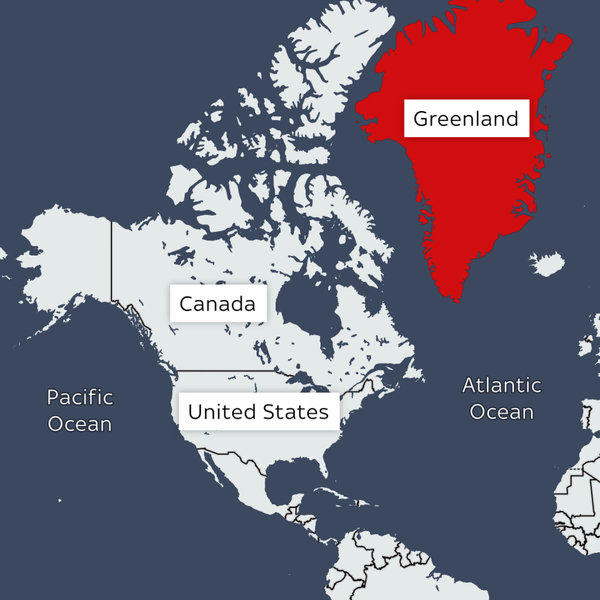
Mr Trump has repeatedly called for the US to take over the mineral rich and strategically located Arctic island, since winning his second term, and has not ruled out using military force to achieve it.
Denmark’s foreign minister Lars Løkke Rasmussen said everyone – including the US – must show respect for Denmark’s territorial integrity.

NATO allies Denmark, Norway, Sweden, Germany and France took part in military drills in Greenland, where the US has a military base, in September. Pic: Reuters
How did we get here?
In March, US Vice President JD Vance visited a remote American military base in Greenland and accused Denmark – a NATO ally of the US – of underinvesting there.
The issue then gradually drifted out of the headlines but, in August, Danish officials again summoned the US ambassador – following a report that at least three people with connections to Mr Trump had carried out covert influence operations in Greenland.
The territory’s strategic position between Europe and North America makes it a key site for the US ballistic missile defence system, while its mineral wealth has heightened US interest in reducing reliance on Chinese exports.
Earlier this month, the Danish Defence Intelligence Service said in an annual report that the US was using its economic power to “assert its will” and threaten military force against friend and foe alike.
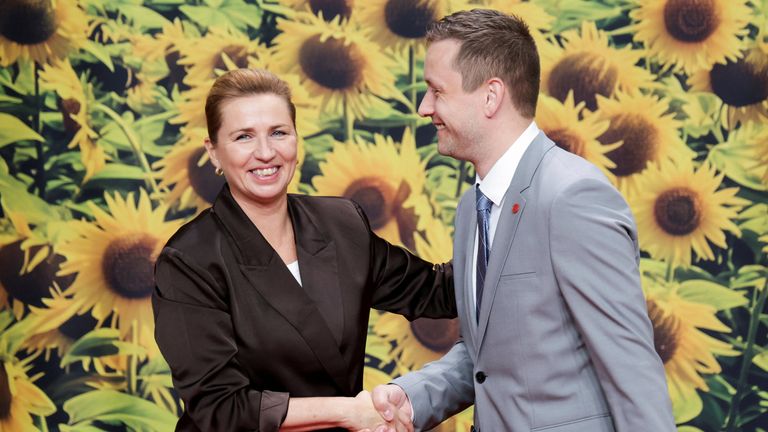
Denmark’s Prime Minister Mette Frederiksen (left) greets Greenland’s Prime Minister, Jens-Frederik Nielsen.
Read more:
Head of US Greenland base sacked after criticising JD Vance
Denmark’s PM says ‘you can’t spy against an ally’
The report also highlighted the rising strategic importance of the Arctic to great power countries as “conflict between Russia and the West intensifies.
It went on to say that the growing security and strategic focus on the Arctic by the US would “further accelerate these developments”.
Russian President Vladimir Putin has said Russia is worried about NATO’s activities in the Arctic and will respond by strengthening its military capability in the polar region.
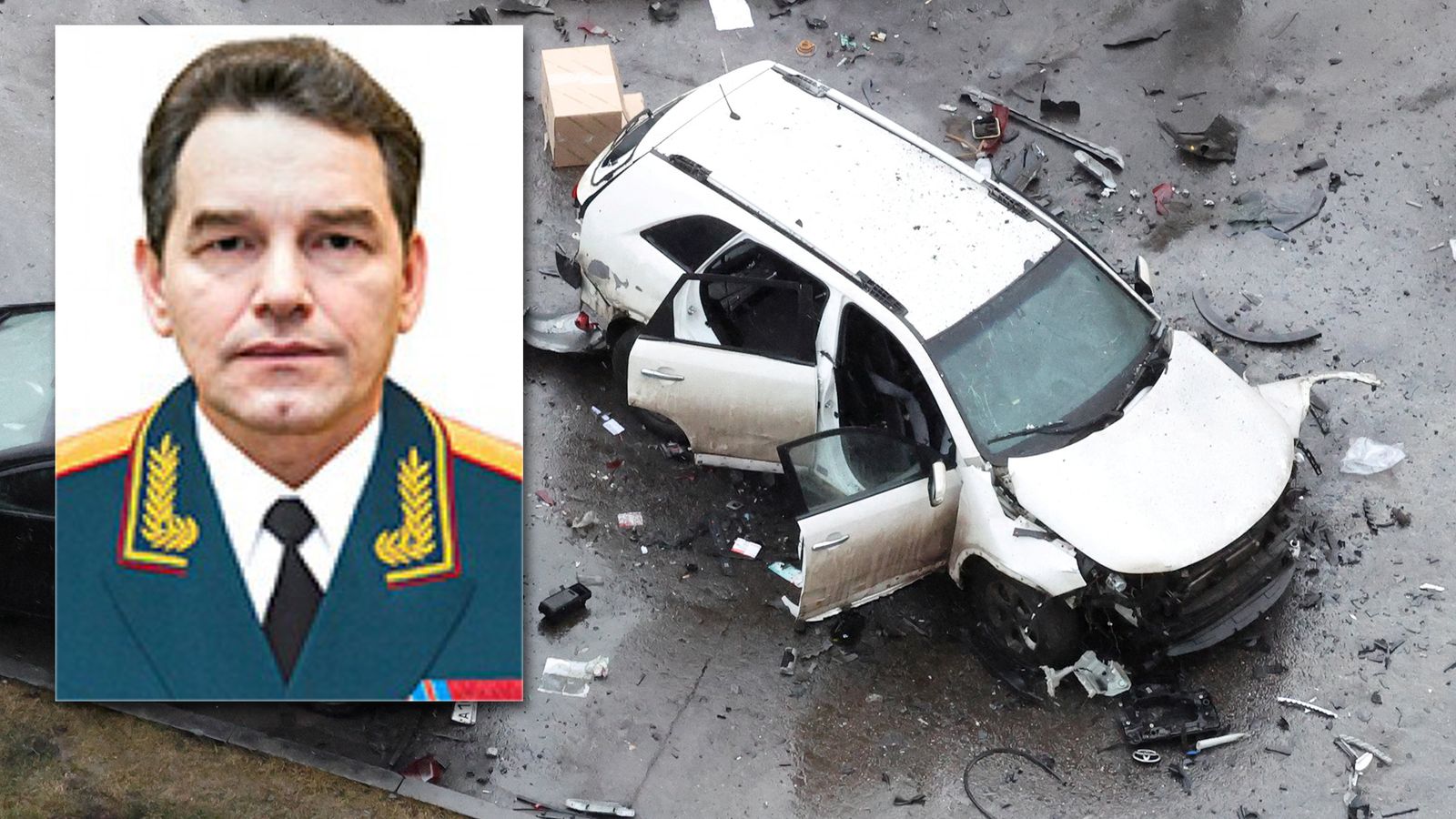

A Russian general being blown up on his own doorstep isn’t a good look for Moscow, and it seems it’s becoming increasingly common.
The latest high-profile figure to be assassinated since Russia‘s invasion of Ukraine is Lieutenant General Fanil Sarvarov.
He was killed by a car bomb that detonated outside a residential complex, little more than 10 miles from the Kremlin.
Ukraine war latest: Kremlin denies Putin plans to invade European countries
He was a senior figure. Head of the operational training directorate of the general staff, Sarvarov prepared forces for future deployment, having previously served in Chechnya and Syria.
There was no immediate claim of responsibility but Moscow believes Kyiv may have been behind it. No wonder – they’ve carried out similar attacks many times before.
This time last year, Ukraine took credit for the assassination of Lieutenant General Igor Kirillov, who Kyiv alleged had ordered chemical weapons to be used against its troops on the battlefield.
He was killed by a bomb hidden in a scooter outside his apartment block, which Vladimir Putin referred to as a “major blunder” by the security services.
Sarvarov was the least senior commander to be killed on Russia soil. Pic: Reuters

Pics: Reuters
But the attacks didn’t stop there.
In April, Lieutenant General Yaroslav Moskalik was killed after a car exploded in a town just outside Moscow. And two months ago another car bomb in Siberia killed a Russian commander accused of committing war crimes.
It’s unclear why Sarvarov was targeted – perhaps simply because his rank and apparent vulnerability.
The timing appears significant. It follows the latest peace talks between US and Russian officials in Miami over the weekend, where Kremlin envoy Kirill Dmitriev met with Steve Witkoff and Jared Kushner.
In the past, Ukraine has used these kinds of attacks to embarrass Moscow and to bring the war closer to home for Russians.
This time could be Kyiv’s way of undermining Moscow’s narrative in the negotiations.
Read more from Sky News:
Bondi suspect trained with father before attack, police say
Trump’s Greenland envoy intends to make territory ‘a part of US’
The Kremlin has been trying to persuade the White House that a Russian victory is inevitable, and that it’s futile to support Ukraine, in the hope of securing a more preferential settlement.
Ukraine has been trying to convince the Trump administration of the opposite – that it’s still full of fight – and taking out Russian generals in their own backyard is one way of doing that.
It shows Washington that the Kremlin is clearly not in total control.
-
 Sports2 years ago
Story injured on diving stop, exits Red Sox game
-
 Sports3 years ago
‘Storybook stuff’: Inside the night Bryce Harper sent the Phillies to the World Series
-
 Sports2 years ago
Game 1 of WS least-watched in recorded history
-
 Sports3 years ago
Button battles heat exhaustion in NASCAR debut
-
 Sports3 years ago
MLB Rank 2023: Ranking baseball’s top 100 players
-
Sports4 years ago
Team Europe easily wins 4th straight Laver Cup
-
 Environment3 years ago
Japan and South Korea have a lot at stake in a free and open South China Sea
-
 Environment1 year ago
Here are the best electric bikes you can buy at every price level in October 2024