Connect with us

Published

on

The overall supply of candidates for jobs has increased for the first time in more than two years, a survey of recruiters suggests.

While the rise in the availability of workers in March was “modest”, it marks the first such upturn in the UK since February 2021, a report from the Recruitment and Employment Confederation (REC) and KPMG said.

Researchers said the increase was driven by improvements in the availability of both permanent and temporary staff amid greater “confidence among job seekers” – alongside “signs of a relative improvement in hiring conditions”.

The rise suggests that the tide could slowly be beginning to turn on labour market tightness in the British economy which has prompted widespread concern in recent years.

REC chief executive Neil Carberry said that while staff shortages remained a major challenge for many firms, the overall increase in available candidates was “big news”.

“This suggests that, while the market is still tight, it should be getting gradually easier for firms to hire over the next few months,” he said.

“The continuing fast rate of pay growth is likely reflective of the impact of inflation on wage offers, as well as low labour supply. That means increasing pay is likely to persist, despite more people beginning to look for work.”

Mr Carberry added that it was “still a good time to be looking for work”, particularly in hospitality, healthcare, accountancy and financial roles.

However the report cautioned that redundancies amid economic uncertainty had also contributed to the numbers of fresh candidates looking for work – and that the jobs market was still lagging far behind pre-pandemic levels.

Mr Carberry warned that government and businesses still needed to do more to attract potential employees, arguing that the chancellor’s recent budget measures had not gone far enough.

He said: “This cautious optimism belies the scale of the challenge we face in tackling shortages and addressing economic inactivity.”

Read more from business:
World economy entering ‘perilous phase’, IMF says
CBI president McBride cast doubt on lobby group’s survival

The UK Report on Jobs, which is based on a survey of around 400 recruitment and employment consultancies, said the availability of staff to fill roles hit 51.4 on its index in March – the first time it has been in positive territory in 25 months.

Any figure above 50 on the seasonally-adjusted index indicates an improvement on the month before.

A ‘curate’s egg’ for jobs

Since 2019 the supply of workers had been rising sharply in the UK, according to the index, until it plunged as COVID-19 hit the economy. The previous increase, in February 2021, had only been a “fractional” rise following a spate of pandemic-related redundancies, with the next two years then continuing to see a decline in staff availability.

Today’s report also suggests that starting salaries and total vacancies are continuing on an upward trend, although growth in the number of jobs on offer was down slightly on February’s data.

Claire Warnes, a partner at KPMG, described March as being a “curate’s egg” for jobs.

“While the labour market continues to show resilience, it is nowhere near pre-pandemic levels of stability,” she said.

The report further found that growth in temp billings hit a six-month high in March, suggesting that uncertainty about the economy had prompted firms to opt for temporary hires over permanent placements, the latter of which saw a “marginal” decline.

Delivery giant Just Eat is among the companies to recently switch to a greater reliance on temporary workers. It announced plans last month to axe 1,700 jobs as part of moves to replace its hybrid system of employees and self-employed with gig economy workers.

Continue Reading

Business

Bank of England rate cut to 3.75% following fall in inflation

Published

on

By

Bank of England rate cut to 3.75% following fall in inflation

The Bank of England has cut interest rates from 4% to 3.75%, its sixth cut since last summer.

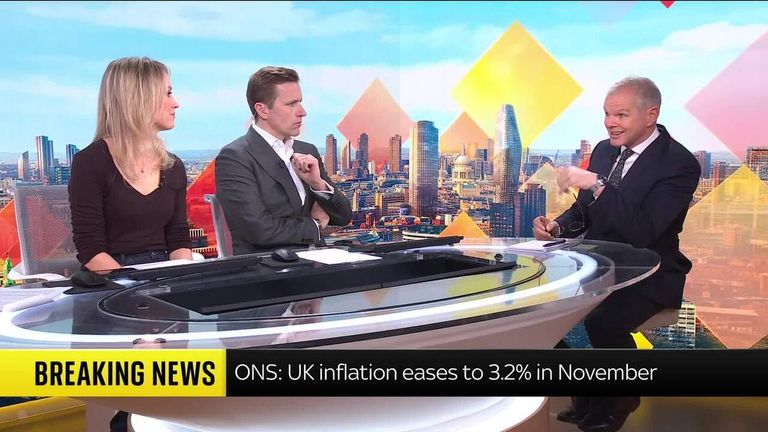
The decision follows a bigger-than-expected fall in the consumer price index rate of inflation in data released this week. While inflation is still above the Bank‘s 2% target, the fall to 3.2% helped swing today’s decision, with five of the Bank’s nine-member monetary policy committee (MPC) voting for a cut.

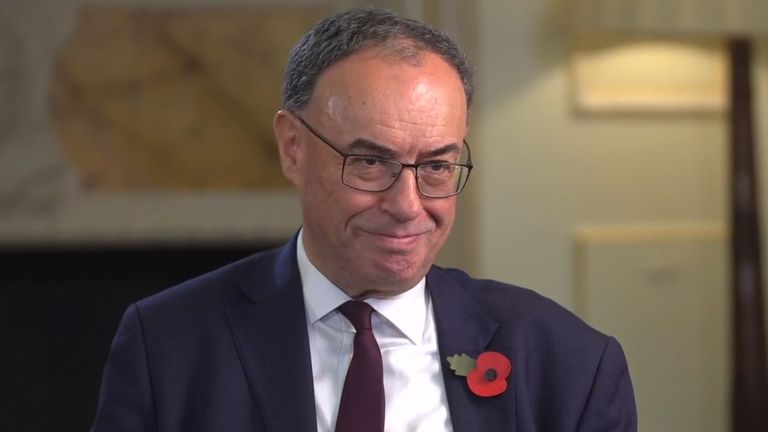
The governor, Andrew Bailey, who had voted to leave rates on hold in November pending more data on inflation, shifted his vote this time around.

Money latest: What interest rate decision means for you

“We’ve passed the recent peak in inflation and it has continued to fall,” he said, “so we have cut interest rates for the sixth time, to 3.75 per cent, today. We still think rates are on a gradual path downward. But with every cut we make, how much further we go becomes a closer call.”

The decision will mean those with floating rate mortgages should immediately see a reduction in their monthly repayments – and some lenders are now reducing fixed-rate deals to 3.5% or below.

The Bank also gave its first full assessment of the economic impact of last month’s budget. It said the budget, which included measures to reduce energy bills and freeze fuel duty, should help push inflation half a percentage point lower next year.

More on Bank Of England


Better news on cost of living

That would mean CPI inflation would drop to close to the Bank’s 2% target as soon as the second quarter of 2026, nearly a year earlier than it originally expected.

However, the Bank also warned that growth remained weak. It said it expected gross domestic product to flatline in the fourth quarter of the year.


UK economy shrinks again – was budget build-up partly to blame?

Since the decision was a narrow one, with four members of the MPC voting against the cut, some investors might judge that the Bank remains finely balanced on future decisions. Right now investors expect another cut by the end of next spring and, possibly, another one thereafter.

But whether rates eventually settle at 3.5% or 3.25% – or even lower – remains a matter of debate.

Continue Reading

Business

Interest rate cut brings Christmas cheer but there’s good reason for caution ahead

Published

on

By

Interest rate cut brings Christmas cheer but there's good reason for caution ahead

The economy may be stuttering, unemployment may be rising, inflation may be above target. But even so, the Bank of England delivered mortgage payers some welcome Christmas cheer on Thursday.

The quarter percentage point cut in interest rates was far from a surprise – the vast majority of economists and investors had expected the Bank to cut rates down from 4% to 3.75%. But even so, for those still struggling with the cost of living, the decision will help lighten the load through the winter months.

And, if the pricing in financial markets is anything to go by, there will be more cuts to come next year with one or maybe two more cuts priced in by investors.

Money latest: What interest rate decision means for you

There was Christmas cheer, too, for the chancellor, as the Bank revealed that it expected the measures in her budget to reduce inflation by half a percentage point next year, thanks largely to her measures to reduce energy bills and freeze fuel duty.

This is a hefty reduction – and means that far from having to wait until 2027 to see inflation come down to its 2% target, the Bank thinks the target will be hit as soon as next year. In short, the Bank has offered its seal of approval to Rachel Reeves, who said repeatedly that she was hoping to craft a non-inflationary budget.

However, deeper questions still remain. To what extent is Britain’s low inflation a good news story – the fruit of clever monetary and fiscal policy – or something else? For there are some who worry that instead it bears all the hallmarks of economic slowdown. The slower the economy is growing, the less people spend and the lower inflation goes. And the Bank said it expected economic growth to drop to zero in the final quarter of the year.

More from Money


November: Bank governor’s message on rates

There are also suspicions inside the Bank that one of the consequences of Donald Trump’s trade war is that cheap imports from China, that would previously have flowed into the US, might be diverted to Europe. That would, on the one hand, push down consumer prices. However, it also risks pushing European manufacturers into the red as they struggle to compete.

On the other hand, there’s a deeper worry that, having experienced high inflation for quite a few years, consumers are now so used to it that they might “bake” higher inflation into their personal mental maps. That could, in turn, mean they push for bigger annual wage increases, which in turn pushes inflation even higher. In short, the question as to whether the inflation genie is still out of the bottle remains.

Finally, there’s the question about whether the trade war is a signal of something bigger: the end of the decades-long period of uber-globalisation. If it becomes more expensive to transport goods around the world, that implies that everything could gradually become more expensive.

Still, for the time being, the Bank has delivered its last piece of analysis and policymaking before the end of the year. And, for the most part, it’s a set of measures and analysis that most people will be cheered by.

Continue Reading

Business

Vodafone sets date to meet MPs over franchisee scandal

Published

on

By

Vodafone sets date to meet MPs over franchisee scandal

Executives at Vodafone will next month meet parliamentarians amid growing scrutiny of its treatment of dozens of its retail franchisees, which a prominent MP said possessed “uncomfortable echoes of the Post Office [Horizon IT] scandal”.

Sky News understands that senior executives from the FTSE-100 telecoms giant will hold talks with MPs, including the Reform deputy leader Richard Tice, on 21 January to discuss the escalating row.

The meeting, which MPs had been pursuing for several weeks, will come weeks after ministers indicated they were prepared to review the legal structure of franchise agreements in Britain.

Money latest: How low could mortgage rates go?

A group of 62 Vodafone retail franchisees brought a High Court claim last year, alleging that the company had “unjustly enriched” itself by cutting sales commissions paid to the small business owners who ran its stores in 2020.

The Guardian reported allegations this week that a number of those affected had committed suicide or attempted to take their own lives.

In September, Vodafone began proposing financial settlements to some of the group of former franchisees.

More from Money

Mr Tice, whose engagement on the issue was triggered by the plight of one of his constituents, said in a statement on Thursday: “Vodafone’s behaviour in this case has uncomfortable echoes of the Post Office scandal, where a powerful organisation is avoiding accountability while ordinary people running our high streets are left to suffer.

“That is completely unacceptable.

“Vodafone must stop stonewalling, accept that serious failures in its franchising operation have caused real harm, and engage properly with Parliament to establish what went wrong and how this will be put right.

“I welcome the fact that a meeting is finally taking place, but it should not have taken this long.

He added: “This must now be a serious and transparent discussion.

“MPs need urgent answers about Vodafone’s conduct and meaningful engagement in response to the deeply troubling stories that continue to emerge.”

Vodafone rejected comparisons with the Horizon scandal.

In a statement, Vodafone said: “We have tried on multiple occasions to resolve this complex commercial dispute.

“We offered to make a significant payment which we believed would ensure no claimants had debts associated with their franchise.

“We were disappointed to learn that our financial offer was rejected by the company funding the claim, without having shared it with all claimants.

“We remain open to further talks and are sorry if any franchisee had difficulty in operating their business.

“We continue to run a successful franchise business in the UK, with many current franchisees keen to take on more stores.”

Continue Reading

Trending