
Top City investors throw weight behind Hammerson in stand-off with Lighthouse

A millionaires’ playground, Poole in Dorset boasts some of the most expensive properties in the UK, and has been called Britain’s Palm Beach.
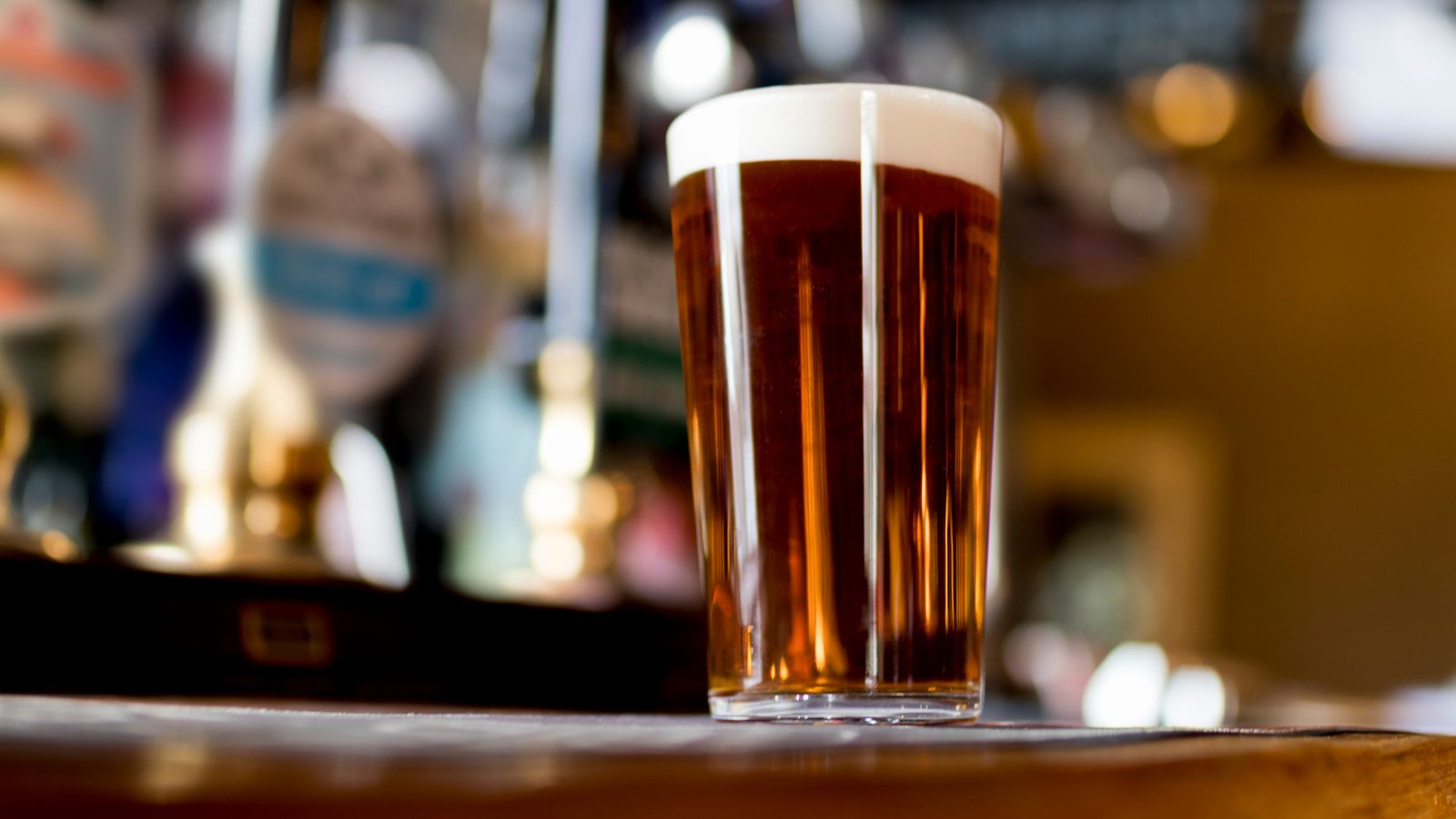
Away from the yachts and the mansions of Sandbanks, however, Poole is also a beer drinkers’ paradise, with 58 pubs in the parliamentary constituency alone.
But now many of Dorset’s pub landlords have joined a bitter backlash against rises in business rates of up to £30,000 in Rachel Reeves’s November budget.
Across the UK, it is claimed up to 1,000 publicans have even banned Labour MPs from their pubs, after the chancellor axed a 40% rates discount, introduced during COVID, from next April.
The row over the rises, brewing since the budget, came to a head in a clash between Kemi Badenoch and Sir Keir Starmer in the final Prime Minister’s Questions of 2025.
“He gave his word that he would help pubs,” said the Tory leader.
“Yet they face a 15% rise in business rates because of his budget. Will he be honest and admit that his taxes are forcing pubs to close?”
The PM replied that the temporary relief introduced during COVID – a scheme the Conservatives put in place and Labour supported, he said – had come to an end.
“But it was always a temporary scheme coming to an end,” he said.
“We have now put in place a £4bn transitional relief.”
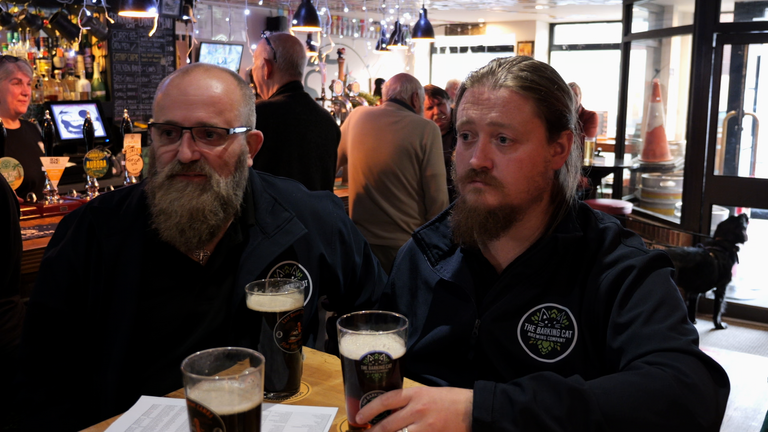
Mark and Michael Ambrose, father and son co-landlords of The Barking Cat, said the increases are a ‘pub destroyer’
But in the Barking Cat Ale House in Poole, facing an increase in business rates of nearly £9,000 a year, the father and son co-landlords fear the rises could mean last orders for many pubs.
“We’re sort of in the average area at 157%, but we’ve got a lot of local pubs that are increasing by 600%, and another one by 800%,” Ambrose senior, Mark, told Sky News.
“It’s a pub destroyer. Pubs can’t survive these kinds of increases. It’s not viable. Most pubs are just about scraping by anyway. If you add these massive increases your profit margins are wiped out.
“We struggle as it is. You can’t have that kind of increase and expect businesses to succeed.
“Fortunately, the customers understand. But they still don’t want to have to spend an extra 30 or 50 pence a pint.”
Son Michael added: “It’s all back to front. It’s really these bigger pub companies and supermarkets that need to be facing increased taxes. We can’t handle them. They can.”
Michelle Smith, landlady of the Poole Arms, the oldest pub on the town’s quay, dating back to 1635, said: “Our rates per value is due to go up £9,000 in April, so it’s quite a deal.”
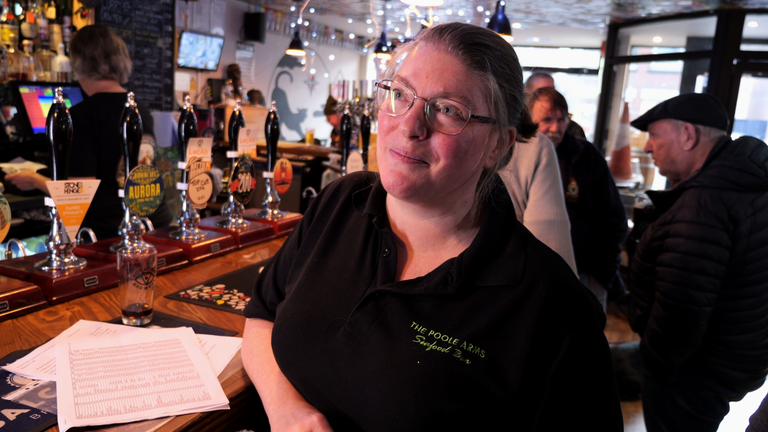
Michelle Smith, landlady of The Poole Arms, said all her prices are going up
“And we had a rates increase just gone as well,” she added. “So our rates had already increased over £1,000 a month last April. So another hit is quite considerable really.
“Prices definitely have to go up with all the different price increases that we’ve got throughout: business rates, wage increases, the beer goes up from the breweries. Everything is going up.”
Backing the publicans, Neil Duncan-Jordan, who became Poole’s first ever Labour MP last year, has written to the chancellor demanding a rethink. He said he is prepared to vote against the tax rise in the Commons.
“They’ve got to listen,” he told Sky News.
“They’ve got to listen to the high street, to publicans, people who run social clubs and listen to problems that they’re facing and the impact that these changes have made.”
Mr Duncan-Jordan said he was prepared to support an amendment to the Finance Bill, which turns the budget into law and had its second reading in the Commons last week.
Despite being suspended for four months for rebelling against welfare cuts earlier this year, he said: “I was discussing this with some MPs just this morning and I’ll be happy to support those. Sometimes you just have to say what you think is right.”
As chancellor, Ms Reeves has regularly raised a glass to pubs and promised to protect them from rising costs.
But Sir Keir has faced the wrath of a publican before, when he was thrown out of a pub in Bath during COVID by an anti-lockdown landlord.
This time, without a U-turn by the chancellor on the business rates increases, pub landlords fear the government has them over a barrel.

The average person now has £38 less to spend each month after tax than they did at the end of 2024, following three consecutive quarters of falling UK living standards.
The government made “improving living standards across all every part of the UK” one of their most high profile targets to achieve before the next election.
The previous parliament, between December 2019 and July 2024, was the first in recorded British history to oversee a fall in disposable income in real terms.
But disposable income is now £1 lower per month than it was in summer 2019 after adjusting for inflation, according to Monday’s updated figures from the Office for National Statistics, and more than £20 lower than in December 2019.
Disposable income is the money people have left over after paying taxes and receiving benefits (including pensions).
Essential expenses like rent or mortgage payments, council tax, food and energy bills all need to be paid from disposable income.
Before 2022 there had been only one five-year period where living standards fell. That was between 2008 and 2013, following the financial crisis and austerity policies that followed.
There have been just five other occasions since the 1950s where disposable income fell for three consecutive quarters. Three of those were in the 2010s, with the others during the early 1960s and late 1970s.
The longest sustained fall was five consecutive quarters between December 2015 and March 2017, coinciding with the UK voting to leave the EU.
Simon Pittaway, Senior Economist at living standards think tank the Resolution Foundation, told Sky News:
“Today’s ONS data confirms that Britain’s mini living standards bounce in 2024 is well and truly over. Growth has been poor this year and prospects for 2026 aren’t looking great either.
“Stepping back, Britain’s big problem is that the country experienced three once-in-a-generation economic shocks in less than two decades [the 2008 financial crash, Brexit, and the cost of living crisis/COVID], with people in their mid-late 30s having spent their entire working lives lurching from one national crisis to another.
“We need to avoid further shocks so that we can focus instead on boosting economic growth and lifting living standards.”
Sky News has been tracking the government’s performance against some of their key economic targets, including living standards, inflation and growth.
Despite the now three quarters of decline, living standards are up overall since Labour took office, after rapid growth in their first six months continued the trend of the final few months of the outgoing government.
Inflation has risen however, and Britain is now the fourth-fastest growing G7 country behind the US, Japan and Canada. Use our tool to explore the country’s performance on other important metrics:
Responding to today’s figures, a spokesperson for the prime minister told reporters:
“Living standards dropped last parliament, but we’re working to improve them. Real wages have risen more in the last year than in the first 10 years of the previous government. This budget included help with energy bills, prescription fees, fuel duty and rail fares. It’s expected to help lower inflation next year, inflation fell to 3.2% in November.
“Lower interest rates, six of them so far since the election, will help people and businesses borrow and spend. And we’ve also raised the national living wage, giving full-time low earners £900 more a year, and those on the national minimum wage at £1,500 more a year.
“We are, of course, always seeking to do more on growth, the economy has grown faster than expected this year, and most forecasts have been upgraded.”
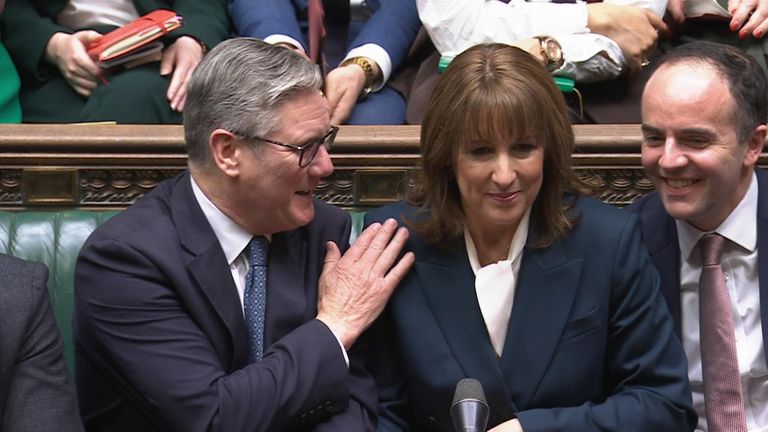
Rachel Reeves delivered her second budget in November, including a promise to end the two-child benefit cap and an extension to the tax threshold freeze
Following the budget in November, anti-poverty think tank the Joseph Rowntree Foundation projected that living standards would fall by £850 a year over the course of this parliament.
They also said that some actions at the budget, for example lifting the two-child benefit cap, would make the decline in living standards “less painful” for low-income households.
Frozen tax thresholds mean that many people will be paying thousands of pounds a year more tax in real terms by the end of this parliament than they do currently, however, including low earners.
Read more:
Budget tax threshold freeze: Use our calculator to see how much more you will pay
Sky News has also been tracking Labour’s performance against their key policy targets, like small boat Channel crossings, housebuilding and renewable energy.
Explore their performance towards those below:
Click here to read more information about why we picked these targets and how we’re measuring them.
The Data and Forensics team is a multi-skilled unit dedicated to providing transparent journalism from Sky News. We gather, analyse and visualise data to tell data-driven stories. We combine traditional reporting skills with advanced analysis of satellite images, social media and other open source information. Through multimedia storytelling we aim to better explain the world while also showing how our journalism is done.
-
 Sports2 years ago
Story injured on diving stop, exits Red Sox game
-
 Sports3 years ago
‘Storybook stuff’: Inside the night Bryce Harper sent the Phillies to the World Series
-
 Sports2 years ago
Game 1 of WS least-watched in recorded history
-
 Sports3 years ago
Button battles heat exhaustion in NASCAR debut
-
 Sports3 years ago
MLB Rank 2023: Ranking baseball’s top 100 players
-
Sports4 years ago
Team Europe easily wins 4th straight Laver Cup
-
 Environment3 years ago
Japan and South Korea have a lot at stake in a free and open South China Sea
-
 Environment1 year ago
Here are the best electric bikes you can buy at every price level in October 2024