

Quick Charge Podcast: April 17, 2023

Listen to a recap of the top stories of the day from Electrek. Quick Charge is available now on Apple Podcasts, Spotify, TuneIn and our RSS feed for Overcast and other podcast players.
New episodes of Quick Charge are recorded Monday through Thursday and again on Saturday. Subscribe to our podcast in Apple Podcast or your favorite podcast player to guarantee new episodes are delivered as soon as they’re available.
Stories we discuss in this episode (with links):
Subscribe to the Electrek Daily Channel on Youtube so you never miss a day of news
Follow Mikey:
Listen & Subscribe:
Share your thoughts!
Drop us a line at tips@electrek.co. You can also rate us in Apple Podcasts or recommend us in Overcast to help more people discover the show!
FTC: We use income earning auto affiliate links. More.

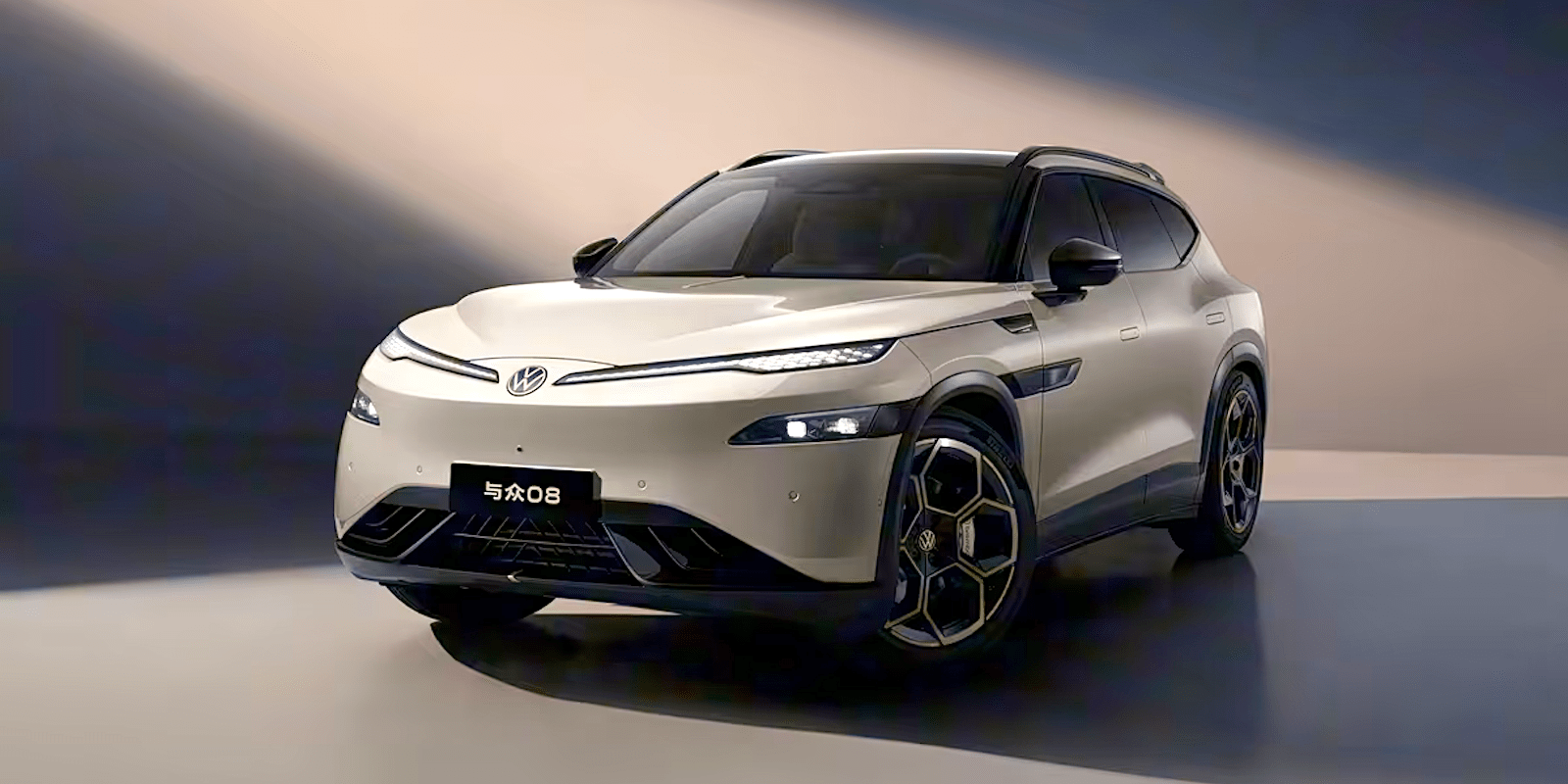
Volkswagen has released a new ID.UNYX 08 electric crossover for the Chinese market with a sharp look, an ultra-fast charging 800V system architecture, and a starting price that’s bound to steal even more sales from the struggling Tesla brand.
Co-developed by Volkswagen and XPeng over the last year, CarNewsChina is reporting that the new VW is being positioned as an upscale flagship for the ID.UNYX lineup that made its debut in 2024, and brings a series of new features to the German brand’s all-electric Chinese lineup.
The new ID.UNYX 08 is reportedly set to be offered with two battery options – in ~82 kWh and ~95 kWh capacities offering between 630 km and 730 km (~425 miles) of range, depending on drive and trim levels.
Those batteries will be sending power to a 230 kW (~310 hp) electric motor, and can be charged at lickedy-quick speeds, thanks to an 800V system architecture that supports 300+ kW charging for 10-80% top-off times in the ~20 minute range, depending on battery choice.
Big in China – and more?
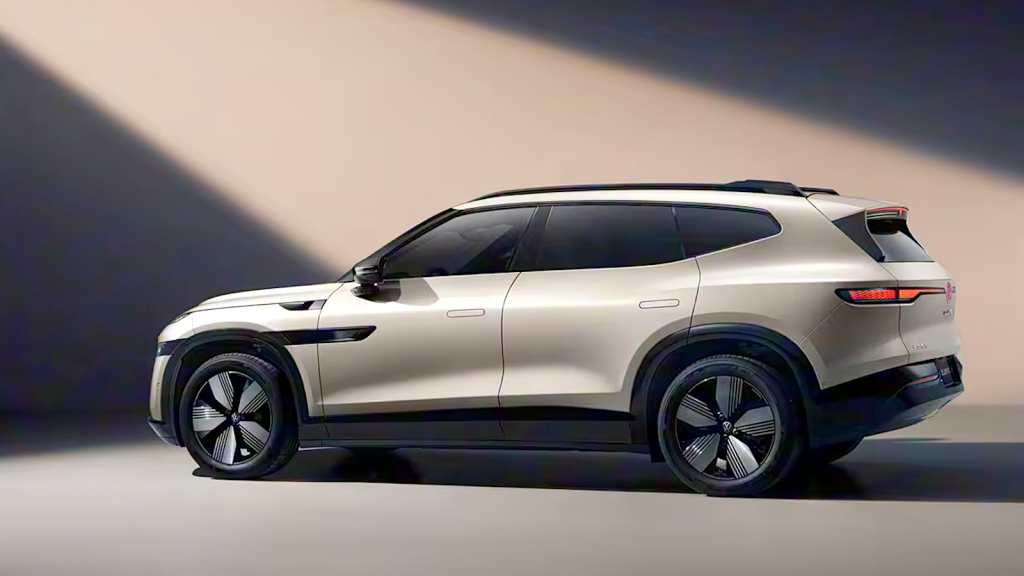
Dimensionally, the new ID. UNYX 08 is precisely 5,000 mm long, making it about as a Jeep Wagoneer S at just over 16 feet and riding on a ~119″ wheelbase. At nearly 6.4 feet wide and just under 5.5 feet tall, it’s firmly in the midsize-to-large SUV class by US standards – but that 5m length is crucial for the car if it ever intends to play on the global stage. That’s because a number of cities in the UK and EU have floated bans on non-commercial vehicles over 5 meters long, and the fact that this European-branded car being built and sold half a world away has “maxed out” those dimensional boxes sure feels significant to me.
That said, if I’m so smart why am I writing about Chinese Volkswagens at 5:30 in the morning on Christmas Eve, right?
Right – but you guys are smart. You know stuff. Take a look at some of the VW ID.UNYX 08 press photos, below, then let us know if you think this latest electric Volkswagen has global ambitions in the comments section at the bottom of the page.
VW ID.UNYX 08

SOURCE | IMAGES: VW, via CarNewsChina.

If you’re considering going solar, it’s always a good idea to get quotes from a few installers. To make sure you find a trusted, reliable solar installer near you that offers competitive pricing, check out EnergySage, a free service that makes it easy for you to go solar. It has hundreds of pre-vetted solar installers competing for your business, ensuring you get high-quality solutions and save 20-30% compared to going it alone. Plus, it’s free to use, and you won’t get sales calls until you select an installer and share your phone number with them.
Your personalized solar quotes are easy to compare online and you’ll get access to unbiased Energy Advisors to help you every step of the way. Get started here.


FTC: We use income earning auto affiliate links. More.


Annealed neodymium iron boron magnets sit in a barrel at a Neo Material Technologies Inc. factory in Tianjin, China on June 11, 2010.
Bloomberg | Bloomberg | Getty Images
Rare earth magnet makers are having a moment as Western nations scramble to build domestic “mine-to-magnet” supply chains and reduce their dependence on China.
A turbulent year of supply restrictions and tariff threats has thrust the strategic importance of magnet manufacturers firmly into the spotlight, with rare earths surging toward the top of the agenda amid the U.S. and China’s ongoing geopolitical rivalry.
Magnets made from rare earths are vital components for everything from electric vehicles, wind turbines, and smartphones to medical equipment, artificial intelligence applications, and precision weaponry.
It’s in this context that the U.S., European Union and Australia, among others, have sought to break China’s mineral dominance by taking a series of strategic measures to support magnet makers, including heavily investing in factories, supporting the buildout of new plants, and boosting processing capacity.
The U.S. and Europe, in particular, are expected to emerge as key growth markets for rare earth magnet production over the next decade. Analysts, however, remain skeptical that Western nations will be able to escape China’s mineral orbit anytime soon.
“Frankly, we were the solution to the problem that the world didn’t know it had,” Rahim Suleman, CEO of Canadian group Neo Performance Materials, told CNBC by video call.
Photo taken on Sept. 19, 2025 shows rare-earth magnetic bars at NEO magnetic plant in Narva, a city in northeastern Estonia.
Xinhua News Agency | Xinhua News Agency | Getty Images
“The end-market is growing from the point of physics, not software, so therefore it has to grow in this way,” he continued. “And it’s not dependent on any single end market, so it’s not dependent on automotive or battery electric vehicles or drones or wind farms. It’s any energy-efficient motor across the spectrum,” Suleman said, referring to the demand for magnets from fast-growing industries such as robotics.
His comments came around three months after Neo launched the grand opening of its rare earth magnet factory in Narva, Estonia.
Situated directly on Russia’s doorstep, the facility is widely expected to play an integral role in Europe’s plan to reduce its dependence on China. European Union industry chief Stéphane Séjourné, for example, lauded the plant’s strategic importance, saying at an event in early December that the project marked “a high point of Europe’s sovereignty.”
Neo’s Suleman said the Estonian facility is on track to produce 2,000 metric tons of rare earth magnets this year, before scaling up to 5,000 tons and beyond.
“Globally, the market is 250,000 tons and going to 600,000 tons, so more than doubling in ten years,” Suleman said. “And more importantly, our concentration is 93% in a single jurisdiction, so when you put those two factors together, I think you’ll find an enormously quick growing market.”
‘Skyrocketing demand’
To be sure, the global supply of rare earths has long been dominated by Beijing. China is responsible for nearly 60% of the world’s rare earths mining and more than 90% of magnet manufacturing, according to the International Energy Agency.
A recent report from consultancy IDTechEx estimated that rare earth magnet capacity in the U.S. is on track to grow nearly six times by 2036, with the expansion driven by strategic support and funding from the Department of Defense, as well as increasing midstream activity.
Magnet production in Europe, meanwhile, was forecast to grow 3.1 times over the same time period, bolstered by the EU’s Critical Raw Materials Act, which aims for domestic production to satisfy 40% of the region’s demand by 2030.
Regional composition of rare earths and permanent magnet production in 2024, according to data compiled by the International Energy Agency.
IEA
John Maslin, CEO of Vulcan Elements, a North Carolina-based rare earth magnet producer, told CNBC that the company is seeking to scale up as fast as possible “so that this fundamental supply chain doesn’t hold America back.”
Vulcan Elements is one of the companies to have received direct funding from the Trump administration. The magnet maker received a $620 million direct federal loan last month from the Department of Defense to support domestic magnet production.
“Rare earth magnets convert electricity into motion, which means that virtually all advanced machines and technologies—the innovations that shape our daily lives and keep us safe—require them in order to be operational,” Maslin told CNBC by email.
“The need for high-performance magnets is accelerating exponentially amid a surge in demand and production of advanced technologies, including hard disk drives, semiconductor fabrication equipment, hybrid/electric motors, satellites, aircraft, drones, and almost every military capability,” he added.
Separately, Wade Senti, president of Florida-based magnet maker Advanced Magnet Lab, said the only way to deliver on alternative supply chains is to be innovative.
“The demand for non-China sourced rare earth permanent magnets is skyrocketing,” Senti told CNBC by email.
“The challenge is can United States magnet producers create a fully domestic (non-China) supply chain for these magnets. This requires the magnet manufacturer to take the lead and bring the supply chain together – from mine to magnet to customers,” he added.
-
 Sports2 years ago
Story injured on diving stop, exits Red Sox game
-
 Sports3 years ago
‘Storybook stuff’: Inside the night Bryce Harper sent the Phillies to the World Series
-
 Sports2 years ago
Game 1 of WS least-watched in recorded history
-
 Sports3 years ago
Button battles heat exhaustion in NASCAR debut
-
 Sports3 years ago
MLB Rank 2023: Ranking baseball’s top 100 players
-
Sports4 years ago
Team Europe easily wins 4th straight Laver Cup
-
 Environment3 years ago
Japan and South Korea have a lot at stake in a free and open South China Sea
-
 Environment1 year ago
Here are the best electric bikes you can buy at every price level in October 2024